The history of baptism from ancient rituals to today
The history of baptism from ancient rituals to today
The history of baptism begins with ancient Jewish washing practices and the ministry of John the Baptist, then develops through the first Christian communities. Baptism became a central Christian rite, but its meaning, timing, wording, and method have differed across churches and periods.
In the earliest Christian sources, baptism represented repentance, forgiveness, and entry into a new community. Over time, Christians connected it with union with Jesus, the gift of the Holy Spirit, cleansing from sin, and incorporation into the church. The practice moved from local rivers and homes into formal church buildings, while debates about infant baptism, immersion, and the proper formula continued.
Jewish purification practices shaped the setting for baptism
Baptism did not appear in a religious vacuum. Judaism already included several kinds of ritual washing, especially immersion in naturally gathered water. These practices were associated with ritual purity after particular bodily conditions, contact with impurity, or preparation for worship.
A Jewish ritual bath, commonly called a mikveh, was not identical to later Christian baptism. A mikveh could be used repeatedly, while Christian baptism generally came to be understood as a once-for-life initiation. Still, the existence of Jewish immersion practices helps explain why water could carry meanings of purification, readiness, and renewed religious identity in the first century.
Jewish communities also practiced forms of washing connected with conversion. Scholars debate the precise relationship between these practices and Christian baptism, because surviving evidence comes from different periods and regions. The safest conclusion is that early Christians inherited a world in which water rituals already had religious significance, then gave immersion and washing a distinct meaning centered on Jesus.
Water had broader symbolic associations in Jewish scripture and worship as well. It could represent creation, deliverance, cleansing, danger, and new life. Accounts such as the flood, Israel’s passage through the sea, and ritual washings provided images that later Christian writers used when interpreting baptism. These biblical themes helped baptism become more than an external washing: it signified a passage from one condition of life to another.
Important distinction: Jewish ritual immersion and Christian baptism influenced the religious environment in which baptism developed, but they were not simply the same ceremony under different names.
John the Baptist and the beginnings of Christian baptism
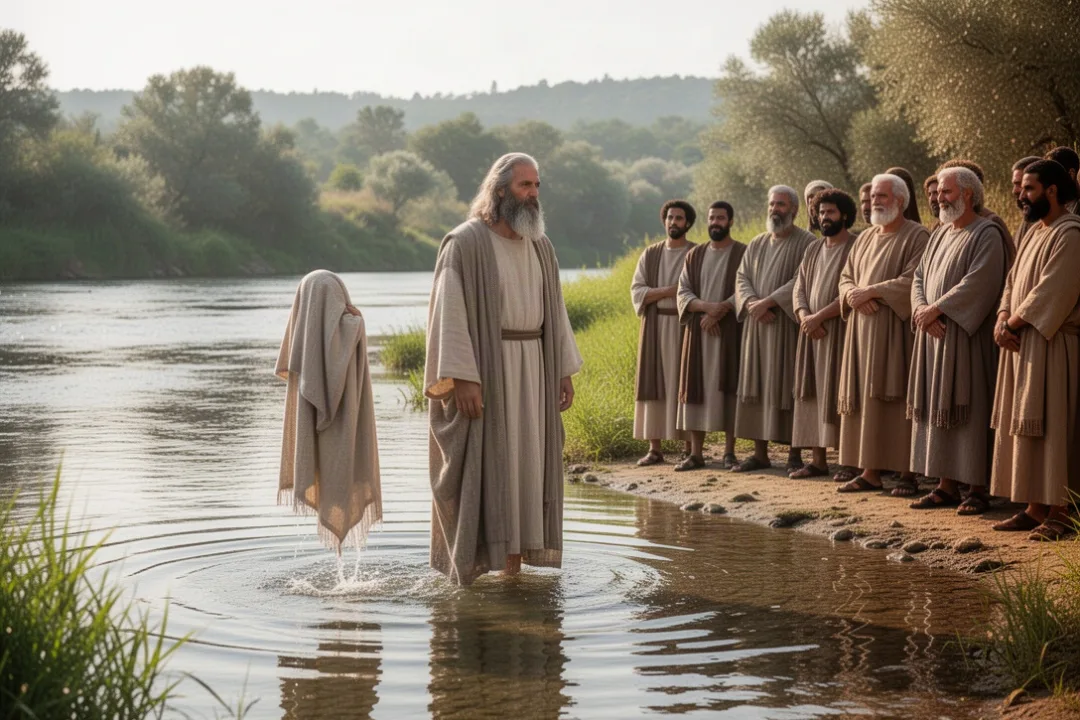
The earliest widely recognized figure associated with Christian baptism is John the Baptist, who preached in the region around the Jordan River in the early first century. Ancient Christian accounts describe John calling people to repentance and baptizing them in water as a public response to his message.
John’s baptism differed from ordinary Jewish washing because it was closely tied to moral change and preparation. Those who received it were publicly acknowledging the need to turn away from wrongdoing and prepare for God’s coming action. It was not presented merely as routine purification after temporary impurity.
The New Testament accounts place Jesus among those connected with John’s baptism, although Christian writers interpret that event in different theological ways. After John’s ministry, Jesus’ followers continued baptizing. The earliest Christian preaching linked baptism with faith in Jesus, repentance, forgiveness, and the arrival of the Holy Spirit.
The first Christians also used baptism to mark a person’s entry into a new, identifiable community. In the ancient Mediterranean world, religious allegiance was often expressed through shared meals, rituals, and group practices. Baptism provided a visible boundary between those who accepted the Christian message and those who had not.
References to baptism in the New Testament come from several authors and settings, so they do not provide a single detailed ceremony that every later church followed. Some passages emphasize the name of Jesus, while others use a threefold formula involving the Father, Son, and Holy Spirit. Accounts also differ in how much preparation, teaching, or personal testimony they describe.
The practice expanded as Christian missionaries preached beyond Judea and Galilee. Converts were baptized in households, outdoor water sources, and other available locations. At this stage, baptism was usually connected with conversion and adult commitment, because the movement was spreading among people who were newly accepting the Christian faith.
Early Christian communities developed baptismal teaching and ceremony
By the late first and second centuries, Christian communities were giving baptism a more structured place in worship and instruction. The Didache, an early Christian writing, gives practical guidance about baptism and prefers running water when available. It also allows other water and, when necessary, pouring water over the head.
This evidence is significant because it shows that early Christians valued immersion but did not always treat full immersion as the only valid method. Local conditions mattered. A church without access to a suitable river, pool, or large vessel could adapt the rite while preserving its central purpose.
Other early Christian writers describe baptism as a serious rite preceded by moral instruction and fasting. Justin Martyr, writing in the second century, portrays converts as learning Christian teaching, praying, fasting, and then being washed in water. His account connects baptism with forgiveness, spiritual renewal, and participation in the Christian community.
The language used for baptism also became more developed. Christians associated the rite with death and resurrection, drawing on New Testament teaching about leaving an old life behind and beginning a new one. They also connected it with the Holy Spirit, illumination, adoption, and entrance into the church.
Early baptismal ceremonies often included several actions rather than water alone. A candidate might renounce Satan or former loyalties, affirm Christian belief, turn toward the west and east, receive anointing, and join the community at the Eucharist. These details varied by location, but they show that baptism was understood as a complete process of preparation, renunciation, confession, washing, and welcome.
When did infant baptism become part of Christian practice?
Evidence for infant baptism appears in early Christian history, although the practice did not develop identically everywhere or at one universally agreed date. Some second-century writers refer to children receiving baptism, while other early sources focus mainly on adult converts. The existence of infant baptism did not eliminate adult baptism, because Christianity continued to gain adult followers through mission and conversion.
Arguments for infant baptism often centered on the idea that baptism is a gift of grace and incorporation into the church, not only a public statement made by a person capable of explaining personal faith. Arguments against it emphasized conscious repentance and individual confession. Those different assumptions later became a major dividing line among Christian traditions.
In many early communities, baptism took place around the annual celebration of Easter. Candidates underwent a period of instruction, sometimes lasting weeks or longer. The final rites could include fasting, an all-night vigil, anointing, immersion, white clothing, and reception of Communion.
How the ceremony changed: Early baptism could involve immersion, pouring, or another form of applying water. The historical record shows both a strong preference for immersion in some settings and practical flexibility in others.
Christian baptism became more formal after the Roman Empire adopted Christianity
During the first three centuries, Christians often baptized in private homes, rivers, courtyards, and other suitable places. Some communities built dedicated facilities, but baptism was not yet tied to a standardized public system across the Roman world. That changed as Christianity gained legal recognition and imperial support in the fourth century.
The conversion of Emperor Constantine and the legalization of Christianity transformed the church’s public position. After Christianity became increasingly established within the empire, congregations could build large worship spaces and special baptisteries. These structures sometimes contained large pools where candidates descended into the water and emerged as part of the rite.
Fourth-century Christian leaders wrote extensive baptismal instructions. In cities such as Jerusalem, Antioch, Milan, and Constantinople, candidates received formal teaching before being baptized, often during the Easter season. Bishops preached sermons explaining the symbolism of the rite, while newly baptized Christians wore white clothing and joined the Eucharistic assembly.
The growth of infant baptism became more visible during late antiquity. Several factors contributed to its spread, including the increasing Christian identity of whole households, concern about the consequences of dying without baptism, and theological debates about original sin. Augustine of Hippo argued strongly that infant baptism was an apostolic practice and connected it with the church’s teaching about humanity’s need for grace.
Not all Christians agreed about baptismal timing or its effects. Some delayed baptism until adulthood because they feared committing serious sins afterward. Others, including some members of Christian households, were baptized as infants. The practice of delaying baptism shows that early Christians could regard the rite as powerful and binding while still disagreeing about the best time to receive it.
By the late Roman and medieval periods, baptism was increasingly administered to infants. The ceremony often included sponsors, anointing, exorcism prayers, a confession of faith made on the child’s behalf, and the application of water. In the Western church, pouring water over the head became common, while immersion remained more prominent in some Eastern settings and in particular local traditions.
Medieval churches defined baptism as a central sacrament
In medieval Western Christianity, baptism became one of the church’s central sacraments. The church taught that baptism marked a person permanently as a Christian and removed the stain of original sin. It was normally performed on infants, although adults who converted to Christianity still underwent a period of instruction before receiving it.
The setting of baptism changed as well. Instead of large outdoor pools or separate baptisteries, many churches placed a baptismal font near the entrance. This location symbolized the idea that baptism was the doorway into the Christian community. Fonts could be made of stone or metal and were often decorated with crosses, biblical scenes, or other Christian symbols.
Medieval baptismal rites included more than water. A priest might bless the water, anoint the candidate with oil, place salt in the mouth, mark the forehead with a cross, and use a candle or white garment. The exact details varied across regions and centuries, but the ceremony emphasized protection, cleansing, belief, and belonging.
Church law also increasingly regulated who could baptize and what made a baptism valid. In ordinary circumstances, an authorized minister performed the rite. In an emergency, however, many Western churches allowed a layperson to baptize, especially if an infant seemed likely to die. The person was expected to use water and the accepted baptismal wording with the intention of performing Christian baptism.
Eastern Orthodox churches preserved a stronger pattern of triple immersion in many places, commonly connected with the Father, Son, and Holy Spirit. Infants were usually baptized, chrismated, and admitted to Communion. This differed from the later Western pattern in which confirmation or its equivalent was often separated from infant baptism by several years.
The medieval church’s approach also linked baptism with social identity. In Christian societies, baptism was not only a personal religious decision; it was often the event that entered a child into the community recognized by family, parish, and government. Parish records of baptisms became important documents for tracking births, family relationships, and local membership.
The Reformation reopened debates about baptism
The Protestant Reformation of the sixteenth century challenged church authority and revised several teachings about the sacraments, but the major reformers did not reach one view on baptism. Martin Luther retained infant baptism and taught that baptism was God’s promise and gift, received through faith rather than earned by human achievement.
John Calvin and other Reformed leaders also defended infant baptism. They connected it with the covenant between God and the church and compared it, in theological terms, with circumcision as a sign applied to the children of believers. For these traditions, baptism did not depend on the child’s ability to make a mature personal decision.
The Church of England and other Protestant churches developed their own baptismal forms while generally continuing infant baptism. Some Lutheran and Anglican communities kept elaborate ceremonies, including sponsors, renunciation of evil, anointing, and the use of a font. Other reformers simplified the rite and focused more directly on preaching, confession, and water.
The most radical challenge came from groups often called Anabaptists. They rejected infant baptism because they believed baptism should follow a person’s conscious faith and commitment. Since they considered infant baptism invalid, many adults who joined their communities were baptized again from the perspective of established churches, which is why opponents used the name “Anabaptist,” meaning re-baptizer.
Anabaptist communities usually practiced baptism upon confession of faith. Their position influenced later Baptist, Mennonite, Brethren, and other traditions, although these groups developed distinct beliefs and practices. The debate made two questions especially prominent: Who should be baptized? and What does baptism accomplish?
Some churches treated baptism primarily as a sacrament through which God gives grace and incorporates a person into the church. Others described it mainly as an ordinance or act of obedience that publicly expresses faith already present. Many Christians combine these ideas, viewing baptism as both divine gift and human response.
Modern Christian traditions practice baptism in several ways
Today, baptism remains nearly universal among Christian traditions, but its form differs considerably. Roman Catholic, Eastern Orthodox, Anglican, Lutheran, Reformed, Methodist, Baptist, Pentecostal, independent evangelical, and other churches do not all use the same age, wording, preparation, or method.
Churches that baptize infants usually ask parents and sponsors to promise that the child will be raised within the Christian faith. The congregation may also affirm its responsibility to support the child. Later rites, such as confirmation, first Communion, or a profession of faith, may provide an opportunity for the baptized person to affirm the faith personally.
Churches that practice believer’s baptism normally require a profession of faith before baptism. Candidates may attend classes, meet with church leaders, give a testimony, or answer questions about their beliefs. Baptism often follows conversion but can also occur after a longer period of Christian participation.
The method of applying water also varies:
Immersion places the person under the water and raises them again, often symbolizing death and resurrection with Christ.
Affusion pours water over the head, a method used in many Western churches and in some emergency situations.
Aspersion sprinkles water, although it is less common in some traditions than pouring or immersion.
Most churches use either a Trinitarian formula naming the Father, Son, and Holy Spirit or wording centered on the name of Jesus. Some groups accept only one of these forms, while others recognize baptisms performed in different traditions if the water, intention, and essential wording meet their standards.
Modern churches also differ over whether baptism is required for salvation, how baptism relates to the Holy Spirit, and whether a person should be baptized again after a change of faith. Many historic churches reject repeated baptism because they regard it as an unrepeatable initiation. Some churches that practice believer’s baptism encourage a person baptized as an infant to undergo believer’s baptism, because they do not consider the earlier rite to match their understanding of biblical baptism.
Beyond church disagreements, baptism has remained a public marker of identity. It may be held in a sanctuary, a home, a swimming pool, a lake, a river, or the sea. The surroundings change, but the central elements remain recognizable: water, Christian faith, a gathered community, and a welcome into the church.
Understanding the history of baptism requires holding together both continuity and change. The practice grew from a world shaped by Jewish purification and John’s call to repentance, became an initiation rite among early Christians, gained formal structures in late antiquity, took a central place in medieval sacramental life, and became a major point of debate during the Reformation. Its many modern forms reflect different answers to the same enduring questions about faith, cleansing, commitment, grace, and belonging.
Frequently asked questions
Was baptism practiced before Christianity?
Yes. Jewish communities practiced ritual immersion and washing before the rise of Christianity, including immersion in a mikveh for certain forms of ritual purification. These practices provided part of the religious background for John the Baptist and the first Christians. Christian baptism developed its own meaning, however, especially as an initiation connected with Jesus, repentance, the Holy Spirit, and membership in the church.
Did the early church baptize only adults?
Early Christian communities certainly baptized adult converts, because Christianity was spreading among people who had not previously belonged to the movement. Evidence for infant baptism also appears in early Christian sources, although it was not practiced in exactly the same way everywhere. Over subsequent centuries, infant baptism became dominant in many historic churches, while other traditions continued to emphasize baptism after a personal profession of faith.
Why do some Christians baptize by immersion?
Immersion reflects the physical imagery of going down into water and rising again, which many Christians associate with dying and rising with Christ. It also resembles the practice described or preferred in several early Christian sources. Other churches use pouring or sprinkling because they regard the application of water, rather than one specific method, as the essential element of baptism.
Can a person be baptized more than once?
Historic Catholic, Orthodox, Anglican, Lutheran, and Reformed churches generally teach that baptism is performed once and should not be repeated. Some Baptist and evangelical churches may baptize people who were baptized as infants because they do not recognize infant baptism as a personal profession of faith. The answer therefore depends on the church’s theology and its understanding of what makes baptism valid.








Leave a Reply