If you have encountered the word Areopagus while reading Acts 17, you may wonder whether it means a hill, a court, or a meeting of philosophers. The answer is that it can refer to both a physical place in Athens and the governing council associated with that place.
The Greek name Areios Pagos means “Hill of Ares”. The rocky hill stood northwest of the Acropolis, and the Areopagus council was one of Athens’s oldest public bodies. In the New Testament, the apostle Paul was brought to the Areopagus after speaking with people in Athens. The setting placed his message within one of the city’s most recognizable centers of public discussion and judgment.
The Areopagus was first a rocky outcrop in Athens, located between the Acropolis and the ancient marketplace. It rises above the surrounding area and provides a clear view toward important parts of the city. Because of its position near the Acropolis, the hill was closely connected with Athens’s religious, civic, and political life.
The name comes from Greek mythology. Ares was the Greek god associated with war, while pagos means a rocky hill or outcrop. According to an ancient myth, Ares was tried on the hill by the gods after killing the son of Poseidon. The story helped explain the place-name, although the historical council’s development belongs to the political history of Athens rather than to mythology alone.
“Areopagus” also names the Council of the Areopagus. This council consisted traditionally of former archons, or senior Athenian magistrates, who joined the body after completing their term of office. Its membership connected the council with the city’s established political leadership and gave it considerable prestige.
The council’s authority changed over time. In earlier periods, it exercised broad influence over public affairs, but democratic reforms in Athens reduced many of its political powers. Even after those changes, the Areopagus continued to have important responsibilities, especially in matters involving homicide and religious offenses.
The hill: the physical location northwest of the Acropolis.
The council: an influential Athenian body linked with former archons.
The court: a judicial institution with particular authority in homicide cases.
The biblical setting: the place or council connected with Paul’s public address in Acts 17.
These meanings overlap, but they should not be treated as identical. A person might say “the Areopagus” to mean the hill, the council, or the judicial institution. The surrounding context determines which meaning is most likely.
Plain definition: The Areopagus was a prominent hill in Athens and the name of the ancient council associated with it. In Acts 17, the word may point to the council, its meeting place, or the wider setting where Paul spoke.
How the Areopagus council developed and functioned
The Areopagus council belonged to the old constitutional structure of Athens. Before the city’s democracy developed into its later form, aristocratic institutions held much of the authority. The council’s members were connected to the archons, and this gave the Areopagus a strong association with experienced civic leaders.
Its early responsibilities appear to have been broad. The council could oversee conduct, consider serious legal matters, and play a role in protecting the city’s religious order. Ancient sources describe it as an institution whose authority was significant before democratic reforms transferred many decisions to other bodies.
A major change came during the reforms associated with Ephialtes in the fifth century B.C. The exact process and extent of the changes are debated in the surviving evidence, but the general picture is clear: the Areopagus lost much of its wider political authority. Powers moved toward democratic institutions such as the Assembly, the Council of Five Hundred, and popular courts.
The reduction of political power did not make the Areopagus irrelevant. It retained a respected role in homicide trials and in cases involving certain religious concerns. Its continuing authority reflected the Athenian tendency to preserve old institutions even while changing how they operated.
Ancient Athens used several courts and public bodies, so the Areopagus was not simply the city’s general-purpose court. It should not be pictured as a modern courthouse handling every kind of legal dispute. Its jurisdiction was more specialized, and its reputation rested partly on its age and connection to the city’s sacred traditions.
Why the council mattered to Athenian identity
The Areopagus represented continuity. Athens could be politically innovative and still honor an institution associated with its earliest traditions. That combination of democratic debate and inherited authority shaped the city’s civic culture.
The council also reflected the close relationship between law and religion in the ancient world. Homicide was not only a private injury or a violation of civil law. It could raise questions about pollution, ritual responsibility, and the well-being of the community. A court connected with religious tradition was therefore well suited to handle such cases.
Its prestige also helps explain why references to the Areopagus carried weight. The name suggested public judgment, educated authority, and the seriousness of civic discussion. A speaker brought before the Areopagus was not necessarily facing a criminal prosecution, but the setting could still involve a respected audience with the power to evaluate what was being said.
Why Paul was brought to the Areopagus in Acts 17
Acts 17 places Paul in Athens during a missionary journey through the Greek world. Before reaching the Areopagus, Paul had been reasoning in the synagogue and speaking in the marketplace. He encountered Epicurean and Stoic philosophers, who heard his message about Jesus and the resurrection and wanted to understand more.
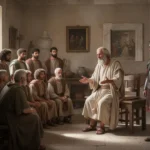
Some listeners treated Paul as a person promoting unfamiliar deities. Others were curious and asked for a fuller explanation. Acts then says that they took him to the Areopagus and invited him to explain the new teaching he was presenting. The passage does not portray the event as a simple private conversation. It presents Paul speaking before an audience interested in assessing his ideas.
The wording creates an interpretive question. Did Paul stand on the physical hill? Was he brought before the formal council? Or does “Areopagus” identify a public venue associated with intellectual discussion? Scholars have offered different answers because the Greek expression can be understood in more than one way.
The safest reading is that Paul was brought into a setting connected with the Areopagus and its authority. Luke may have intended the council itself, the place where it met, or both. The narrative’s central point does not depend on identifying the exact stone where Paul stood. It highlights the encounter between the Christian message and the religious and philosophical culture of Athens.
Acts 17:18–34 records Paul’s speech and its results. Luke names Dionysius, a member of the Areopagus, among those who responded, along with a woman named Damaris and others. The passage does not say that the whole council converted, nor does it describe a formal trial of Paul. It reports a public exchange in which some mocked, some postponed judgment, and some believed.
The audience Paul addressed
The Epicureans and Stoics were not interchangeable groups. Epicurean philosophy generally sought happiness through freedom from fear and unnecessary disturbance, while Stoicism emphasized living according to reason and the order of nature. Both schools had complex beliefs, and neither can be reduced to a single slogan.
Paul’s speech recognizes that his audience is religiously serious. He begins from what he has observed in Athens and refers to an altar dedicated to an unknown god. Rather than starting with a detailed argument from Hebrew Scripture, he uses a point of contact within Athenian religious life.
He then presents the God he proclaims as the creator and Lord of heaven and earth. Paul argues that this God does not depend on temples built by human hands or require service as though he lacked anything. He also challenges the idea that the divine can be represented adequately by gold, silver, stone, or human artistic skill.
Paul’s reasoning moves from creation to humanity’s dependence on God. He presents human beings as living within God’s sustaining care and calls them to turn away from ignorance and idolatry. The speech reaches its most controversial point when Paul connects God’s future judgment with the resurrection of Jesus.
Paul begins with an Athenian religious reference and leads the discussion toward the identity of the God who made the world.
That approach explains why the Areopagus scene remains significant. Paul does not simply repeat a message without regard for his listeners. He speaks in language they can engage, refers to ideas familiar in their culture, and then makes claims that press beyond their existing categories.
What Paul’s Areopagus speech teaches about communication
The speech in Acts 17 is often studied as an example of communicating across religious and cultural boundaries. Paul does not assume that his audience already accepts Israel’s Scriptures, Israel’s covenant history, or the claims about Jesus. He begins with observations available in their own city and uses those observations as a bridge.
That does not mean Paul avoids disagreement. His message challenges idolatry, self-sufficiency, and incomplete ideas about the divine. A respectful starting point is not the same as accepting every belief held by the audience. Paul’s method combines careful attention with a clear theological claim.
Several features of the speech stand out:
He observes before he argues. Paul pays attention to Athens’s religious practices and uses a local reference as a starting point.
He establishes common ground. His audience can understand ideas about the creator, humanity, and divine presence even before they accept his conclusions.
He corrects mistaken assumptions. The God Paul proclaims is not confined to a temple or dependent on human offerings.
He moves toward the resurrection. The message is not merely a general statement about spirituality or the existence of God.
He accepts mixed responses. Some listeners reject the message, while others continue listening and believe.
The speech also shows why context matters when interpreting biblical passages. Paul’s words occur in a city known for public debate, competing religious practices, and philosophical schools. The Areopagus setting helps readers understand why Luke emphasizes discussion, examination, and varied reactions.
At the same time, the passage should not be used to claim that every detail of Paul’s speech was designed as a universal communication formula. Acts gives a particular account of one encounter. It offers principles that readers may apply, but it does not remove the need to understand the audience, the subject, and the circumstances of each conversation.
Reading tip: Acts 17 should be read as a complete scene. Notice Paul’s location, audience, starting point, central claim, and the different responses rather than treating one phrase about the Areopagus as the whole message.
Where the Areopagus fits among Athens’s famous sites
The Areopagus is close to several landmarks that shaped ancient Athens, but it was not the same place as the Acropolis, the Parthenon, or the Agora. The Acropolis is the fortified high area crowned by major temples. The Agora was the marketplace and a major center of public, commercial, and political activity. The Areopagus is the rocky hill near these sites.
Paul’s activity in Acts 17 reflects this connected urban environment. He reasons in the synagogue and marketplace before being taken to the Areopagus. These locations were not isolated from one another; they belonged to a city where religious practice, commerce, politics, education, and philosophy existed within walking distance.
The physical hill itself is relatively stark compared with the monumental buildings of the Acropolis. Visitors encounter exposed rock, steps, and a broad view of Athens. The surface can be uneven and slippery, especially when worn smooth by many feet, so anyone visiting should use care rather than treating the climb as an ordinary paved walkway.
From the hill, you can look toward the Acropolis and imagine how the area functioned as a dense civic landscape. The view does not recreate the first-century city, since modern Athens surrounds the ancient sites, but the location still gives useful perspective on the relationship between the Areopagus, the Agora, and the Acropolis.
Are “Mars Hill” and “Areopagus” the same name?
Mars Hill is the traditional English name for the Areopagus. Mars was the Roman god associated with war, corresponding broadly to the Greek Ares. English Bible translations and Christian writing have therefore used “Mars Hill” as an alternative to “Areopagus.”
The two names refer to the same ancient hill, but “Areopagus” preserves the Greek form and can also refer to the council. “Mars Hill” is a translation or cultural equivalent of the place-name, not a separate location. In English discussions of Acts 17, the names are often used interchangeably.
Modern readers should also avoid assuming that every organization or institution called “Mars Hill” is directly connected with the ancient Athenian council. The name has been adopted in many later contexts because of its biblical and historical associations. The original Areopagus remains the hill and council in Athens.
How to understand the Areopagus today
The Areopagus matters for at least three related reasons. Historically, it illustrates how Athens combined ancient institutions with changing democratic structures. Biblically, it provides the setting for one of the New Testament’s most discussed public speeches. Geographically, it gives visitors a direct connection to the cityscape Paul and his audience knew.
When studying the word, begin by identifying which sense is intended. A history book may be discussing the Athenian council. A travel guide may be describing the rocky hill. A sermon or Bible study may focus on Paul’s address in Acts 17. These uses are related, but they emphasize different questions.
A careful reading can also avoid two common mistakes. First, the Areopagus was not simply a synonym for all Athenian philosophy. Paul met philosophers in Athens, but the Areopagus itself was a civic institution with a legal and historical identity. Second, Acts 17 does not describe Paul delivering a generic speech about being tolerant of all religions. The speech makes a definite claim about the creator, human responsibility, judgment, and Jesus’s resurrection.
If you want to study the passage closely, read Acts 17:16–34 alongside background on Athens’s religious life, philosophical schools, and political institutions. Pay attention to the verbs describing Paul’s actions: he observes, reasons, speaks, explains, and responds. Then compare the audience’s reactions rather than assuming they all reached the same conclusion.
The name Areopagus therefore carries several layers of meaning. It identifies a landmark shaped by Greek tradition, a council that survived major political changes, and the setting of a conversation between Christian proclamation and Athenian intellectual culture. Understanding those layers makes both the ancient site and Acts 17 easier to read accurately.
Frequently asked questions
How do you pronounce Areopagus?
In American English, Areopagus is commonly pronounced “air-ee-OP-uh-gus,” with the strongest emphasis on the third syllable. Pronunciations may vary slightly between English speakers, and a pronunciation closer to the original Greek will sound different. The Greek form is often transliterated as Areios Pagos, meaning “Hill of Ares.”
Was Paul put on trial at the Areopagus?
Acts 17 does not describe a formal criminal trial. Paul was brought to a setting associated with the Areopagus so listeners could examine his teaching. The account presents a public discussion rather than a conviction, sentence, or legal charge. Some people mocked, some wanted to hear more, and some believed, including Dionysius and Damaris.
Did the Areopagus meet on the hill?
Ancient evidence does not allow complete certainty about every meeting location or period. The council was named for the hill and strongly associated with it, but “Areopagus” could refer to the institution as well as the physical site. In Acts 17, the wording may indicate the council, its location, or a broader public setting connected with the council.
What is the main message of Paul’s speech in Acts 17?
Paul presents God as the creator and sustainer of all people, not a deity dependent on temples or human-made images. He calls his audience away from ignorance and idolatry and announces that God has appointed a judge, confirmed through the resurrection of Jesus. The speech connects Athenian religious questions with a specific Christian claim.











Leave a Reply