NT canon: How the 27 New Testament books were recognized
NT canon: How the 27 New Testament books were recognized
If you have ever wondered why the New Testament contains exactly 27 books, you are asking a historical and theological question with a careful answer. The NT canon is the collection of writings Christians recognize as authoritative Scripture: the four Gospels, Acts, 21 letters, and Revelation.
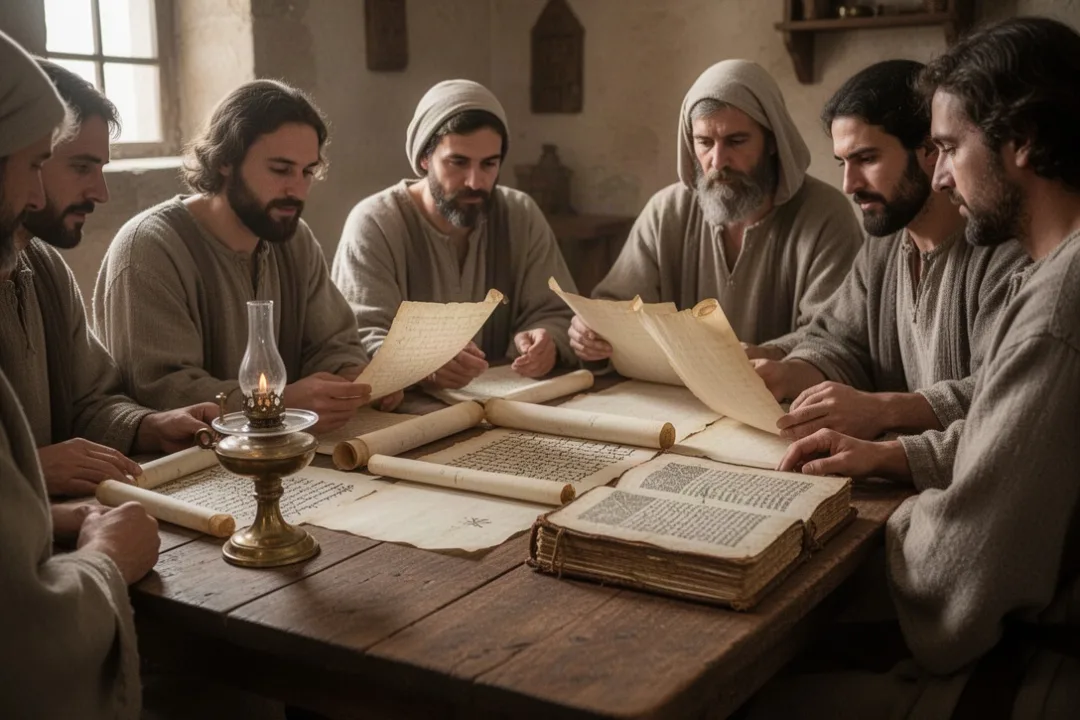
Those books did not appear as a bound New Testament immediately after Jesus’ resurrection. They were written, copied, read aloud in churches, shared between Christian communities, and gradually recognized as a consistent body of authoritative writings. The process took time because the early church had to distinguish apostolic teaching from other religious texts and from writings that were useful but not considered Scripture.
Short answer: The NT canon is the 27-book collection recognized by the historic Christian church. Its recognition developed through the books’ apostolic connection, agreement with received Christian teaching, widespread use in worship, and enduring acceptance across churches.
The word canon comes from a term associated with a measuring rod or standard. In Christian usage, it refers to the recognized list of books that function as the normative rule of faith. A canonical book is not merely old, popular, or spiritually encouraging; it is regarded as having a unique authority for the church.
The phrase NT canon therefore means the authoritative collection of New Testament writings. It does not mean the physical Bible, a particular translation, the order of the books, or every early Christian document. A manuscript is a copy of a text, a translation renders that text into another language, and the canon identifies which writings belong in Scripture.
Early Christians did not usually describe the process by saying that a committee “created” Scripture. Their language and practice more often reflected recognition: churches received certain writings as authoritative because they were connected to the apostles and agreed with the faith taught in Christian communities.
Why the church needed a recognized New Testament collection
The first Christians inherited the Hebrew Scriptures, which they read in light of Jesus’ life, death, and resurrection. At the same time, the church was receiving new apostolic teaching through preaching, letters, and accounts of Jesus’ ministry. As congregations spread through the Roman world, they needed reliable writings that could be read publicly and used to teach believers.
Several pressures made a recognized collection increasingly necessary. Churches had to preserve the apostles’ message after the first generation of witnesses began to die. They also needed to respond to alternative teachings that used Christian language but presented different beliefs about Jesus, creation, salvation, or the resurrection.
Letters circulated beyond their original destinations. Paul’s letter to the Romans was not only relevant to Christians in Rome, and a letter addressed to one congregation could be copied and shared elsewhere. The Gospels likewise became treasured across many communities because they preserved the central story of Jesus’ ministry and resurrection.
How the NT canon developed step by step
The canon emerged through overlapping stages rather than through one single event. Some books were accepted very early, while a small group remained debated for generations. The following sequence provides a useful way to understand the development.
Jesus and the apostles established the message. Jesus’ teaching and the apostolic witness formed the foundation of Christian faith. The earliest communities preserved this teaching through oral instruction, worship, preaching, and eventually written texts.
New Testament writings were composed. The Gospels, Acts, letters, and Revelation were written during the first century, although scholars continue to discuss the precise dates and authorship of some books.
Churches copied and circulated the writings. Paul’s letters and other important texts moved from congregation to congregation. The four Gospels came to be read together as a unified witness to Jesus.
Christian leaders appealed to recognized books. Writers from the second century onward quoted or referred to many New Testament writings as reliable authorities in teaching and debate.
Churches compared disputed writings with received teaching. Books whose apostolic origins or doctrinal consistency were questioned received more cautious treatment in some regions.
Regional lists became clearer. Church leaders in different areas produced lists that increasingly matched the 27-book collection now familiar to most Christians.
Broad church recognition stabilized the list. By the late fourth century, influential lists included all 27 books, although different Christian traditions later described the authority of the canon in somewhat different ways.
This sequence should not be treated as a perfectly uniform timeline. Acceptance was gradual and regional, and a book could be widely respected before every church formally placed it on a list. The New Testament canon developed through repeated use and recognition across Christian communities.
Which books belong to the NT canon
The historic New Testament contains 27 books arranged in five broad groups. The order can vary slightly among traditions, but the standard Protestant, Roman Catholic, and Eastern Orthodox New Testament collections contain the same 27 writings.
Gospels: Matthew, Mark, Luke, and John.
History: Acts of the Apostles.
Pauline letters: Romans; 1 and 2 Corinthians; Galatians; Ephesians; Philippians; Colossians; 1 and 2 Thessalonians; 1 and 2 Timothy; Titus; Philemon.
General or catholic letters: Hebrews; James; 1 and 2 Peter; 1, 2, and 3 John; Jude.
Apocalyptic writing: Revelation.
These categories describe how the books are commonly grouped; they do not imply that every book fits only one literary type. For example, Acts is historical narrative with theological purpose, while Revelation combines letters, visions, symbolism, and prophetic exhortation.
What criteria helped identify canonical books
No early Christian source presents a universally agreed checklist applied mechanically to every book. Still, several recurring considerations can be seen in the way churches evaluated writings. These criteria worked together rather than operating as separate tests.
Apostolic connection
The strongest consideration was a book’s connection to an apostle or to the apostolic witness. Matthew and John were traditionally associated with apostles. Mark was connected with Peter in early Christian testimony, and Luke was associated with Paul. Paul’s letters claimed apostolic authority directly, while other letters were linked to figures such as James, Peter, John, or Jude.
Apostolic connection did not always mean that an apostle personally held the pen. In the ancient world, a trusted associate could preserve and communicate an apostle’s teaching. The key question was whether a writing credibly carried the authority of the first witnesses commissioned to proclaim Christ.
Agreement with the rule of faith
Churches compared writings with the rule of faith, meaning the central teaching received in Christian communities. This included belief in one God, Jesus Christ as truly human and truly divine, his death and resurrection, the work of the Holy Spirit, and the hope of resurrection and final judgment.
A text could be ancient or impressive and still fail to qualify if its teaching contradicted the faith publicly proclaimed in churches. Doctrinal consistency did not mean every New Testament author used identical vocabulary or emphasized the same themes. It meant that the books were understood to offer complementary testimony rather than a fundamentally different gospel.
Widespread use in churches
Regular use in worship was another significant factor. A writing read across many congregations had a stronger claim to represent the church’s shared faith than a text known only in one small circle. Public reading mattered because it placed a book within the ordinary life of Christian communities rather than leaving it as a private or speculative document.
This criterion helps explain why some writings were valued but not included in the canon. Books such as the Shepherd of Hermas were respected by some Christians and could be read for instruction, yet they did not achieve the same broad canonical status as the four Gospels or Paul’s letters.
Spiritual and theological reception
Christians also considered whether a writing consistently nourished the church’s faith and worship. This does not mean that personal feelings alone determined the canon. Rather, generations of believers recognized certain books as authoritative because those writings shaped preaching, prayer, baptismal instruction, ethical teaching, and understanding of Christ.
The church’s reception was especially significant where a book’s authorship was uncertain. Hebrews, for example, was widely valued but does not identify its author. Its place in the canon was supported by its theological depth, early use, and eventual acceptance across major Christian communities.
Why the four Gospels became central
The church recognized four Gospels, not one combined account and not an unlimited number of competing narratives. Matthew, Mark, Luke, and John present Jesus from distinct perspectives while sharing the central proclamation of his ministry, crucifixion, and resurrection.
By the second century, Christian writers were already treating these four writings as a distinctive collection. The fourfold Gospel gave churches a stable account of Jesus while preserving different emphases: Matthew highlights fulfillment and discipleship, Mark presents urgent action and suffering, Luke emphasizes salvation and the work of the Spirit, and John uses distinctive language to explore Jesus’ identity and mission.
Other writings about Jesus circulated in antiquity. Some are now called noncanonical gospels, including texts associated with names such as Thomas, Peter, or Judas. Their existence does not mean the church simply ignored them. Many were evaluated and rejected, often because they appeared later, lacked credible apostolic roots, or expressed teachings that did not match the received faith.
How Paul’s letters became a collection
Paul’s letters were first written to particular congregations and individuals, but their value quickly extended beyond those original settings. A church facing questions about worship, unity, suffering, leadership, or Christian conduct could learn from correspondence sent to another church dealing with related concerns.
Paul himself expected some letters to be shared. In Colossians 4:16, he refers to the exchange and public reading of letters between congregations. That reference offers an early glimpse of a process in which apostolic writings moved through the wider Christian network.
By the second century, collections of Pauline letters were circulating. The exact contents and arrangement may have varied, but the letters were increasingly treated as a coherent body of apostolic instruction. The inclusion of Hebrews was debated in some Western churches because its author is unnamed, while many Eastern churches accepted it earlier as connected with Paul’s apostolic circle or teaching.
Why some New Testament books were disputed
Most of the New Testament books achieved broad recognition relatively early, but several faced questions about authorship, destination, language, or theological interpretation. The disputed group is sometimes called the Antilegomena, a term used for writings spoken against or debated in parts of the church.
The books most often associated with this discussion include Hebrews, James, 2 Peter, 2 and 3 John, Jude, and Revelation. This does not mean that all churches rejected them or that their eventual inclusion was arbitrary. It means that their status was not equally settled everywhere at the same time.
Hebrews: Its author is not named, which led some communities to question its apostolic connection. Its powerful presentation of Christ’s priesthood helped support its acceptance.
James: Some readers questioned how its emphasis on works related to Paul’s teaching about faith. Many churches came to recognize that the writings address different errors and are not necessarily contradictory.
2 Peter: Questions about style, vocabulary, and authorship contributed to a slower and more cautious reception in some regions.
2 and 3 John: These short letters identify their author as “the elder,” and their limited length may have affected how widely they circulated.
Jude: Its use of material known from Jewish tradition prompted questions for some readers, though the letter’s central Christian teaching remained significant.
Revelation: Its vivid symbolism led to different interpretations, and some churches were cautious about its use. Other communities regarded it as an important prophetic witness.
The history of these books shows why the canon should not be described as a simple vote. Recognition involved careful examination, local practice, correspondence between churches, and long-term reception.
Important milestones in the history of the NT canon
Several surviving sources help historians trace the development of the New Testament collection. They do not all have the same authority or provide a complete picture, but together they show an increasingly clear pattern.
Second-century Christian witnesses
Writers such as Ignatius of Antioch, Polycarp, Justin Martyr, and Irenaeus show that many New Testament writings were already being read and used authoritatively during the second century. Irenaeus, writing in the late second century, strongly defended the fourfold Gospel.
These writers do not always quote books in the same way modern scholars cite Scripture, and they do not all provide complete lists. Their evidence is still valuable because it demonstrates that the New Testament writings were not first treated as authoritative in the fourth century.
The Muratorian Fragment
The document commonly called the Muratorian Fragment contains an early list or discussion of Christian books. Its date, original form, and damaged beginning remain subjects of scholarly discussion, but it reflects a period when churches were distinguishing recognized writings from other works.
Because the fragment is incomplete and its wording is sometimes difficult to interpret, it should not be treated as a perfect snapshot of every church’s canon. It is better understood as one piece of evidence for ongoing discussion about authoritative books.
Eusebius and categories of reception
In the early fourth century, Eusebius described Christian writings using categories that included recognized books, disputed books, rejected works, and texts that were not genuine. His discussion illustrates the seriousness with which Christian communities evaluated apostolic claims and doctrinal reliability.
His categories also show that the boundary was not equally clear in every location. Some books later included in the New Testament were still debated, while some writings eventually excluded from the canon had meaningful devotional or historical value.
Athanasius’ Festal Letter
In a letter dated to AD 367, Athanasius of Alexandria listed the 27 books that now make up the New Testament. This is the earliest surviving document known to present that exact list. It is a major milestone, but it should not be mistaken for the moment the canon suddenly came into existence.
Athanasius was expressing a settled position within his church tradition after generations of use and debate. Other regions reached similar conclusions through their own discussions, and the wider process continued through ecclesiastical decisions and shared practice.
Regional church councils
Church gatherings at Hippo in 393 and Carthage in 397 and 419 listed the same 27 New Testament books. These were regional councils, not a single universal council that created the Bible for all Christians. Their decisions reflected a growing consensus in the Latin-speaking church.
Eastern Christian traditions also developed their own patterns of recognition. The details of authority and liturgical use differed, but the 27-book New Testament became the common inheritance of the major historic Christian traditions.
What the NT canon does not mean
Understanding the canon requires separating several ideas that are often combined. The canon is related to inspiration, authority, preservation, and translation, but it is not identical to any one of them.
Canon is not the same as inspiration. Christians who believe the books are inspired are making a theological claim about their source and authority. Canon refers to which books are recognized as belonging to that category.
Canon is not the same as authorship. A book can be canonical even when its human author is not identified with certainty, as with Hebrews.
Canon is not the same as manuscript wording. Textual critics compare ancient copies to identify the earliest recoverable wording. That work concerns the text of a canonical book, not the list of canonical books.
Canon is not the same as translation. English versions differ in wording and style, but translation differences do not normally change the 27-book New Testament.
Canon is not the same as usefulness. A noncanonical Christian writing may be historically interesting or spiritually helpful without having the authority of Scripture.
This distinction is especially useful when someone says that a later church “added” a book to the Bible. A church council could formally state which books it recognized, but the writings had already been circulating and functioning as authoritative in many Christian communities for centuries.
How different Christian traditions view the NT canon
Most major Christian traditions agree on the contents of the New Testament. The more visible differences between Protestant, Roman Catholic, and Eastern Orthodox Bibles concern the Old Testament collection, not the New Testament.
Roman Catholic, Eastern Orthodox, and Protestant traditions all receive the same 27 New Testament books. They may differ in how they explain the church’s role in recognizing Scripture, how they describe tradition and authority, and how they interpret particular passages, but they do not generally maintain different New Testament lists.
Some ancient Christian communities have distinctive biblical traditions or liturgical practices. When studying a historical claim about the canon, it helps to ask whether the disagreement concerns the New Testament itself, the Old Testament, the order of books, or the authority given to church tradition alongside Scripture.
How to evaluate claims about “missing” New Testament books
Claims about a hidden or suppressed Gospel often rely on confusion between ancient existence and canonical status. A document can be old without being written by an apostle, and a text can mention Jesus without preserving the earliest Christian witness.
Use a few practical questions when assessing such a claim:
When was the document written? A text from the second or third century may preserve earlier traditions, but it is not automatically as early as the first-century New Testament writings.
Who wrote it? A title linking a work with an apostle may reflect later attribution rather than known authorship.
How widely was it used? Evidence from multiple regions matters more than evidence from one isolated group.
What does the text teach? Compare its view of God, Jesus, creation, salvation, and resurrection with the faith represented in the recognized books.
How did early Christian leaders treat it? A text’s reception can reveal whether it was read as Scripture, valued for instruction, or rejected as unreliable.
This method does not require assuming that every canonical decision was simple or that every rejected writing was worthless. It allows you to consider date, authorship, use, teaching, and reception together.
Why the canon still matters for reading the New Testament
The canon gives readers a defined collection rather than an unlimited archive of early Christian literature. It places the Gospels, Acts, letters, and Revelation in a shared framework so that individual passages can be read alongside the wider apostolic witness.
It also encourages careful reading. Paul should not be isolated from the Gospels, James should not be read as a replacement for Paul, and Revelation should not be treated as a detached collection of symbols. The canon invites readers to consider unity and diversity together.
For Christian communities, the canon also shapes public worship, preaching, doctrine, prayer, and moral formation. For historians, it provides a central body of early Christian evidence while leaving room to study other ancient texts for context and comparison.
A useful distinction: The question “Which books belong in Scripture?” is a canon question. The question “What did the earliest manuscripts say?” is a textual question. The question “How should this passage be interpreted?” is an interpretive question. Keeping these questions separate prevents many common misunderstandings.
How to study the NT canon responsibly
Begin with the 27-book collection itself, then read selected early Christian witnesses that show how these books were used. Avoid treating one quotation, one manuscript, or one council as the entire history. The evidence is cumulative and develops across regions and generations.
It also helps to distinguish historical description from theological conviction. Historians can examine dates, manuscripts, quotations, lists, and patterns of use. Christians may then draw theological conclusions about inspiration and divine providence according to their tradition.
When a difficult question arises, check the exact claim being made. Is someone arguing that a book was unknown, disputed, excluded, or merely absent from one early list? Those are different claims and require different evidence. A careful answer usually becomes clearer once the terms are defined.
The NT canon is best understood as the result of a long process of recognition centered on apostolic witness, faithful teaching, and widespread church use. The 27 books were not selected because they formed a convenient number; they became the church’s New Testament through sustained reception across the Christian world.
Frequently asked questions
Did the Council of Nicaea choose the books of the New Testament?
No. The Council of Nicaea in AD 325 is not known for establishing the New Testament’s book list. Discussion about the canon had already been taking place for generations. Later writers and regional church councils helped express the growing consensus around the 27 books, while Nicaea is chiefly associated with major questions about Christian doctrine.
Are the books of the New Testament in chronological order?
No. The books are arranged mainly by literary grouping: Gospels, Acts, letters, and Revelation. The Pauline letters are generally ordered by length and category rather than composition date. A chronological reading plan may place some letters before the Gospels or arrange Paul’s letters according to proposed historical settings, but those arrangements remain partly dependent on scholarly judgments.
Why are there four Gospels instead of one?
The early church preserved four distinct accounts because each was associated with apostolic witness and was widely received by Christian communities. Matthew, Mark, Luke, and John overlap in their presentation of Jesus but differ in structure, emphasis, and wording. Together they provide a fourfold witness rather than a single edited narrative.
Can a noncanonical Christian writing still be useful?
Yes. A noncanonical text may provide historical information about later Christian movements, devotional ideas, or debates in the ancient world. Its usefulness does not give it the same authority as Scripture. Readers should consider its date, authorship, manuscript history, and theological setting before treating its claims as evidence about earliest Christianity.








Leave a Reply