Gideon was an Israelite judge whom God used to rescue Israel from Midian with an army of only 300 men. His story appears mainly in Judges 6–8, where he moves from hiding in fear to leading a remarkable military victory. Gideon’s life also shows that faith can coexist with uncertainty, while warning that an impressive victory does not automatically guarantee faithful leadership afterward.
Gideon lived during the period of the judges, before Israel had a permanent king. During this era, Israel repeatedly turned away from God, suffered oppression from surrounding peoples, cried out for help, and received deliverance through a leader raised up by God. After that judge died, the cycle often began again.
Gideon’s story begins after Israel had again abandoned the worship of the Lord. For seven years, the Midianites and their allies invaded the land, destroying crops and taking livestock. The Israelites hid in caves and strongholds, and the country became impoverished because the people could not safely harvest what they planted.
Midian was not simply a distant political threat. Its raids reached into the daily life of ordinary families. The invaders came when crops were ready, leaving Israel without food and forcing the people to depend on hiding places. This pressure helps explain why Gideon was threshing wheat in a winepress when the Lord’s messenger came to him.
The central tension in Gideon’s story: God called him a courageous deliverer before Gideon felt courageous. His identity was shaped by God’s calling, not merely by his present circumstances.
Who Gideon was before he became a judge
Gideon belonged to the tribe of Manasseh, one of the tribes descended from Joseph. His family lived in Ophrah, and his father was Joash. Gideon described his clan as the weakest in Manasseh and himself as the least important member of his father’s household, a statement that reveals how small and vulnerable he believed he was.
When the angel of the Lord appeared, Gideon was threshing wheat in a winepress. Wheat was normally threshed in an open, elevated place where the wind could help separate grain from chaff. A winepress was a poor location for the work, but it offered concealment from Midianite raiders.
The messenger addressed Gideon as a mighty warrior, even though Gideon was acting cautiously and privately. The greeting was not a simple description of Gideon’s current behavior. It pointed toward what God intended to make him and what God would accomplish through him.
Gideon immediately questioned why Israel was suffering if the Lord was truly with them. He also asked where the wonders of the past had gone, referring to the stories of God bringing Israel out of Egypt. His questions show that Gideon knew Israel’s religious history, but he struggled to connect those earlier acts of deliverance with his own crisis.
How God called Gideon to deliver Israel
The calling unfolds through a series of commands and signs. Gideon did not receive the assignment all at once in a way that removed every concern. Instead, the narrative shows him asking questions, requesting confirmation, obeying specific instructions, and gradually moving toward public leadership.
God sent a messenger to Gideon. The messenger told him that he would save Israel from Midian, not through personal strength but through God’s presence.
Gideon prepared an offering. The sign involving fire confirmed that the visitor was not an ordinary human messenger.
Gideon destroyed his father’s altar to Baal. He was told to tear down the altar and cut down the associated Asherah pole.
Gideon built an altar to the Lord. He began reform at home before leading a national campaign.
Gideon gathered an army. Men from several northern tribes responded when the Spirit of the Lord came upon him.
God reduced the army to 300. The smaller force made it clear that the victory could not be credited to Israel’s military numbers.
One of the most significant details is that Gideon obeyed even though he was afraid. When ordered to destroy his father’s altar, he did it at night rather than in broad daylight. That choice was fearful, but it was still obedience. The story does not portray courage as the absence of fear; it portrays courage as acting faithfully while fear remains.
Why Gideon destroyed Baal’s altar first
Before Israel could be delivered from Midian, Gideon had to confront idolatry within his own community. God told him to tear down his father’s altar to Baal and remove the Asherah pole beside it. He was then to build an altar to the Lord and offer a sacrifice using the wood from the pole.
This was a dangerous assignment because the altar belonged to Gideon’s family and was used by the local community. Gideon’s father, Joash, was evidently influential enough that the townsmen demanded Gideon’s death when they discovered what he had done.
Joash defended his son by arguing that if Baal were truly a god, Baal could defend himself. From that point, Gideon received the name Jerubbaal, commonly understood in the context as a challenge to Baal. The name remembered the public confrontation between Israel’s God and the local idol.
The order of events matters. Gideon’s first assignment was not to defeat Midian. It was to remove false worship from his own household. The narrative presents spiritual loyalty as the foundation for public deliverance, rather than treating military success as the primary issue.
What Gideon’s fleece signs meant
After the Spirit of the Lord came upon Gideon, he summoned men from Manasseh, Asher, Zebulun, and Naphtali. Yet Gideon still asked God for confirmation. He placed a fleece of wool on the ground and requested that dew appear on the fleece while the surrounding ground remained dry. When that happened, he asked for the reverse sign the next time.
These requests are often remembered as an example of “putting out a fleece.” Gideon was asking for a specific sign to confirm God’s promise. The passage presents God’s patience with Gideon, but it does not necessarily command believers to make fleece tests their normal method for making decisions.
Gideon had already received a clear calling, and the signs served to reassure him before a frightening battle. The episode therefore carries two lessons. God can be patient with a fearful servant, but persistent demands for signs can also reveal reluctance to trust what God has already made clear.
Practical distinction: Asking for wisdom and seeking confirmation are different from treating a random event as an infallible message. Gideon’s fleece belonged to a unique biblical calling and should not replace prayer, Scripture, wise counsel, and careful judgment.
How Gideon’s army was reduced to 300 men
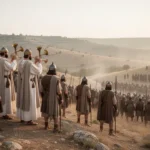
Gideon’s forces initially numbered more than 30,000, while the Midianite camp was described as being spread across the valley. God told Gideon that Israel had too many soldiers because the people might claim the victory for themselves. The army was reduced in two stages.
Fearful soldiers were allowed to leave. More than 20,000 men went home, leaving 10,000.
The soldiers were tested at the water. God separated the remaining men according to how they drank, and only 300 were retained for the battle.
The text emphasizes that the reduction was designed to prevent Israel from boasting. Gideon’s force was not merely smaller than expected; it was deliberately made too small to appear capable of defeating the Midianite coalition by ordinary military strength.
Readers sometimes focus on the exact meaning of the soldiers’ drinking positions, but the larger point is clearer than the tactical detail. God selected a tiny group so that the source of victory would be unmistakable. The account does not praise the 300 as naturally superior warriors. Their number highlights divine action.
God also knew that Gideon was afraid. He told Gideon that if he was still afraid, he could go down near the enemy camp with his servant Purah and listen. Gideon heard a Midianite soldier recount a dream and its interpretation as a sign that Gideon’s army would prevail.
That moment strengthened Gideon enough to worship before the battle began. It is a revealing detail: God did not shame Gideon for fear. He provided reassurance, then Gideon responded by worshiping and returning to organize the attack.
How Gideon defeated Midian with trumpets, jars, and torches
Gideon divided the 300 men into three companies. Each soldier carried a trumpet, an empty jar, and a torch hidden inside the jar. The plan depended on surprise, darkness, noise, and the appearance of a much larger force surrounding the camp.
At Gideon’s signal, the men blew their trumpets, broke the jars, exposed the torches, and shouted. The sudden display created confusion among the Midianites. The Lord caused panic in the enemy camp, and the Midianites turned against one another before fleeing.
Gideon’s strategy was not a conventional assault based on overwhelming weapons. The men’s actions announced an army without showing its actual size. The broken jars also allowed the hidden torches to become visible at the same moment, producing a coordinated shock.
Other Israelite tribes were then called to pursue the fleeing Midianites. Gideon sent messengers to Ephraim, whose men captured two Midianite leaders at the Jordan River. The victory extended beyond the initial surprise attack and became a broader pursuit of the defeated army.
How Gideon handled conflict with the Ephraimites
After the battle, the men of Ephraim complained that Gideon had not called them earlier. Their anger could have caused a new division among the tribes. Gideon answered with humility, saying that Ephraim’s later contribution had been greater than what his own clan had accomplished.
His response calmed their anger. Gideon did not insist on receiving all the credit for the victory or challenge the offended tribe to prove its worth. He used a diplomatic answer that recognized Ephraim’s role and prevented the internal dispute from overshadowing the defeat of Midian.
This episode offers a different picture of leadership from the battlefield scene. Gideon’s strength here was not daring or intimidation but the ability to reduce wounded pride. Leaders often need to manage disagreements among allies after success, when questions about recognition and participation can become as dangerous as the original conflict.
What happened when Gideon asked for food
During the pursuit, Gideon and his men were exhausted. Gideon asked the people of Succoth and Penuel for food for his soldiers, but both communities refused. They feared that Gideon might fail to capture the Midianite kings, Zebah and Zalmunna, and did not want to support a campaign that could end badly.
Gideon responded with a threat of punishment after the kings were captured. He eventually returned and carried out that threat against the leaders of Succoth and destroyed the tower at Penuel, killing the men of the city. These events make the later part of the story more troubling than the opening chapters.
The narrative does not present every action Gideon took as an unquestioned model. His leadership became harsher as the pursuit continued, and his response to local opposition contrasted with his earlier willingness to answer Ephraim diplomatically. Deliverance did not make Gideon morally immune to anger, retaliation, or the temptations of power.
Why Gideon refused to become king
After Israel’s victory, the people asked Gideon to rule over them, and they extended the offer to his son and grandson. Gideon refused, explaining that the Lord should rule over Israel. On the surface, this was a faithful rejection of dynastic power and a recognition that Israel’s true king was God.
Gideon’s answer is one of the strongest statements in his story. He did not claim that his family should establish a permanent royal line. He pointed the people away from human rulers and toward divine authority.
Yet his later actions complicated that message. Gideon requested gold earrings taken from the enemy, and the people gave him a large amount. He used the gold to make an ephod, a priestly garment or sacred object. The text says that Israel treated it as a religious snare, and it became a source of unfaithfulness in Gideon’s household and in the wider community.
The precise form and purpose of this ephod are not fully explained in the passage. It may have been connected with priestly or divinatory use, but the important point is its effect: an object associated with Gideon’s victory became an occasion for false worship. His refusal of political kingship did not prevent him from creating a religious symbol that drew people away from God.
What Gideon’s family life reveals about his legacy
Gideon had many wives and was the father of 70 sons. He also had a son named Abimelech through a concubine in Shechem. After Gideon died, Abimelech sought power in Shechem and eventually killed most of his brothers, becoming a violent and destructive ruler.
Abimelech’s story is told in Judges 9, after Gideon’s death, but it is connected to Gideon’s family legacy. Gideon had refused the title of king, yet the size and structure of his household created a complicated inheritance. His son’s later attempt to rule shows how political ambition could emerge even without a formal royal dynasty.
Gideon’s influence therefore had two sides. During his lifetime, Israel experienced 40 years of peace after Midian’s defeat. At the same time, his religious compromise and family arrangements contributed to instability after his death. The Bible preserves both realities rather than simplifying him into either a perfect hero or a complete failure.
What the Bible says about Gideon’s faith
Gideon is named in Hebrews 11 among figures associated with faith. The passage remembers him alongside other leaders who acted courageously and experienced victory. This confirms that the New Testament recognizes genuine faith in Gideon’s response to God’s call.
That recognition does not erase the weaknesses recorded in Judges. Gideon believed God enough to destroy Baal’s altar, gather an army, confront Midian, and pursue the enemy. He also repeatedly sought reassurance, made troubling decisions, and allowed a religious object to become a snare.
His story presents faith as trust expressed through obedience, not as constant emotional confidence. Gideon often felt inadequate, but he continued taking the next step God gave him. At the same time, faith in one season does not guarantee wise choices in every later season.
What Gideon teaches about fear and courage
Gideon’s fear appears openly in the biblical account. He hid while threshing wheat, questioned God’s presence, asked for signs, obeyed at night, and needed encouragement before the battle. The text does not require readers to pretend that biblical leaders felt no anxiety.
His courage developed through specific acts of obedience. He did not begin by commanding an army of 300. He began by responding to a message, offering a sacrifice, destroying a local altar, gathering troops, and moving toward the enemy camp. Each step prepared him for the next.
This pattern can help explain why Gideon remains relatable. Fear did not disqualify him, but fear also did not become an excuse to remain passive forever. His story holds both truths together: God was patient with his uncertainty, and God still called him to act.
What Gideon teaches about leadership and success
Gideon’s leadership included several strengths that are easy to overlook. He obeyed a difficult private command, accepted an army reduction that made him vulnerable, used encouragement wisely, cooperated with other tribes, and answered Ephraim’s complaint without escalating it.
His weaknesses are equally instructive. He threatened towns that would not support him, pursued retaliation, accumulated wealth, and created an object that encouraged idolatry. His story warns that public success can conceal private or later failure.
Success should not be confused with lasting faithfulness. A victory can be real while the leader’s later choices are still harmful.
Recognition can become a spiritual danger. Gideon rejected a crown but accepted wealth that contributed to a religious snare.
Leadership requires restraint after victory. Anger and authority can become destructive when opponents are treated as enemies who must be punished.
Private obedience matters. Gideon’s first act of reform happened at home, before the public battle.
God can work through limited resources. The 300 soldiers made divine help more visible, not human ability more impressive.
How Gideon compares with other judges
Gideon is one of the longer and more developed narratives in the book of Judges. Like other judges, he was raised up during oppression and brought military deliverance to Israel. His story follows the recurring pattern of Israel’s unfaithfulness, suffering, crying out, rescue, and renewed decline.
What makes Gideon distinctive is the extended attention given to his inner hesitation. The narrative records his questions, signs, fears, and need for reassurance in unusual detail. It also gives substantial space to the consequences of his leadership after the central victory.
Gideon is therefore neither presented as a flawless champion nor dismissed as a faithless man. His life demonstrates how God can use an uncertain person while still holding that person responsible for the choices made with authority. The result is a nuanced portrait of calling, courage, achievement, and compromise.
Gideon’s place in the wider biblical message
Gideon’s story reinforces a repeated biblical theme: God often works through people and circumstances that do not appear powerful by ordinary standards. A hidden farmer, a small clan, and a tiny army become instruments of deliverance. The emphasis is not that weakness is automatically virtuous, but that human strength is not the foundation of God’s saving work.
The story also points to the limits of deliverance through human judges. Gideon could defeat Midian, but he could not permanently transform Israel’s worship or secure lasting faithfulness for the nation. Peace lasted for a time, yet the old pattern returned. The book of Judges ultimately creates a longing for a better and more faithful kind of ruler.
For Christian readers, Gideon is also mentioned in Hebrews 11 as an example of faith. His inclusion encourages people who feel inadequate, but it should be read with the full account in Judges. Gideon shows that God can use a fearful servant, while his later failures remind readers that dependence on God must continue after the crisis has passed.
What to remember about Gideon
Gideon was a judge, military leader, and deliverer of Israel during a period of oppression by Midian. God called him while he was hiding, reassured him through signs, reduced his army to 300 men, and gave Israel victory through a surprising nighttime attack.
His life cannot be reduced to the phrase “mighty warrior.” Gideon was also a questioning man, a cautious man, a capable diplomat, a severe ruler, a wealthy leader, and a flawed religious influence. Those tensions are part of why his story remains valuable.
The clearest lesson is that God’s calling can meet people in fear and weakness, but the responsibility of faithfulness continues after the breakthrough. Gideon trusted God enough to win a great victory; his later choices show why humility, obedience, and spiritual vigilance must continue when the battle is over.
Frequently asked questions
Was Gideon a prophet in the Bible?
Gideon is primarily identified as a judge and military deliverer, not as one of Israel’s writing prophets. God’s messenger spoke to him, and Gideon received divine instructions for his mission. However, the Bible does not give him the same prophetic role associated with figures such as Samuel, Isaiah, or Jeremiah.
Why did God choose only 300 soldiers with Gideon?
God reduced Gideon’s army so Israel could not claim that its own military strength had defeated Midian. The unusually small force made the victory a clear demonstration of God’s power. The text focuses on preventing human boasting rather than presenting the 300 soldiers as a specially elite unit.
Did Gideon do everything God asked?
Gideon obeyed several difficult commands, including destroying Baal’s altar and attacking Midian with the reduced army. Yet his record was mixed. He used threats against Succoth and Penuel, accumulated gold, and made an ephod that became a religious snare. His story includes genuine faith alongside serious failures.
What does Gideon’s fleece teach Christians today?
The fleece shows that God was patient with Gideon’s uncertainty as he faced an overwhelming assignment. It does not necessarily establish a general rule that believers should demand miraculous signs for ordinary decisions. Prayer, Scripture, wise counsel, and responsible judgment remain better foundations than treating random events as guaranteed messages from God.










Leave a Reply