Timbrels in the Bible: meaning, history, and symbolism
Timbrels in the Bible: meaning, history, and symbolism
Timbrels were ancient hand-played frame drums used for music, dancing, celebration, and worship, especially in biblical accounts of communal joy.
The word may sound unfamiliar because many modern Bible translations use tambourine or frame drum instead. In older English translations, including the King James Version, “timbrel” commonly represents the Hebrew word tof or a related form. Although the exact design of every ancient instrument cannot be reconstructed, the basic picture is clear: a shallow, circular drum that a player held in one hand and struck with the other.
Timbrels appear in scenes involving women, singers, dancers, armies, kings, and worshipers. They could mark a victory, accompany a procession, provide rhythm for dancing, or help a congregation express praise. Their biblical significance comes not only from their sound but also from the moments in which they were played.
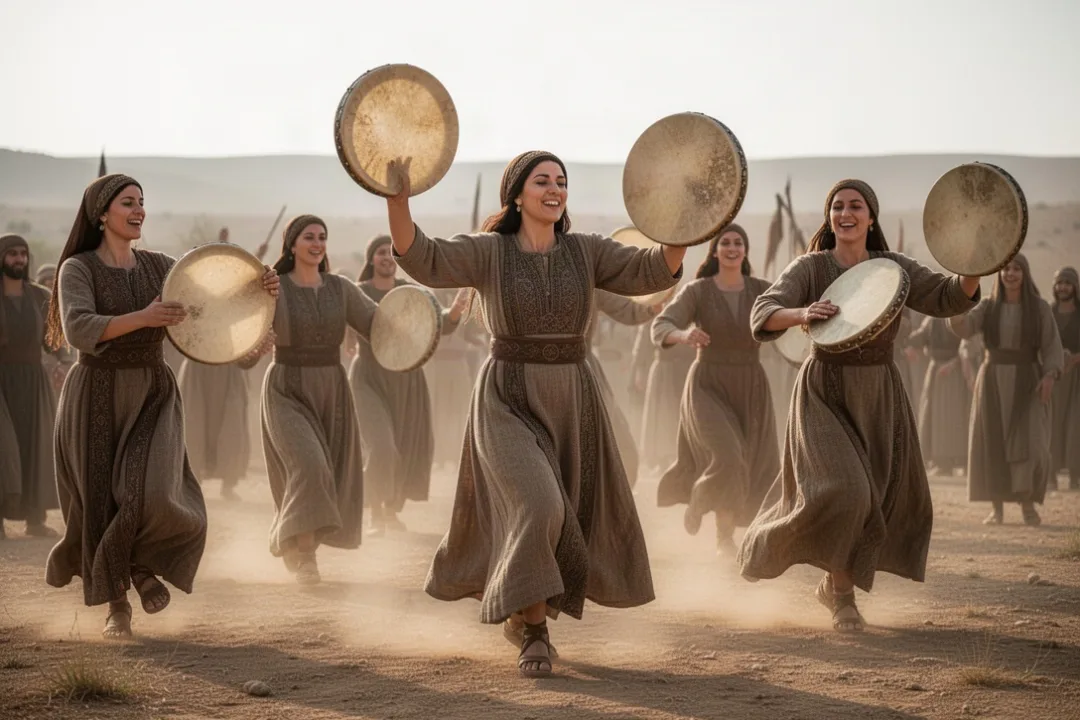
A timbrel was most likely a single-headed frame drum. It consisted of a round wooden frame with an animal skin stretched across one side. The frame was shallow enough to hold comfortably, making the instrument suitable for processions, dancing, and music performed while standing or moving.
The player could strike the stretched skin with the fingers or palm, tap the rim, or shake the instrument to create changes in tone. Depending on its construction, a timbrel may have produced a dry, sharp beat or a deeper resonance. Ancient instruments varied, so one timbrel may not have sounded exactly like another.
Some frame drums from the ancient Near East included small metal pieces that rattled when the instrument was shaken. Modern readers often picture a tambourine with jingles for this reason. However, the biblical term does not prove that every timbrel had jingles. The safest description is a hand-held frame drum, with additional features varying by time and place.
A useful distinction: “Timbrel” is an English translation term, not the name of a modern standardized instrument. Biblical references point to a family of hand-held frame drums rather than one precisely documented design.
Why translations use timbrel, tambourine, and tabret
Readers may find several English words for what appears to be the same biblical instrument. Timbrel, tambourine, tabret, and timbrel drum reflect different translation traditions and decisions about how to communicate an ancient Hebrew term to modern readers.
The Hebrew word most often connected with timbrel is tof. Translators have rendered it in several ways because English musical vocabulary has changed over time. “Timbrel” was familiar in older English, while “tambourine” is more recognizable to many modern readers.
These terms should not be treated as perfectly interchangeable in every passage. Translation choices can depend on the surrounding context, the translator’s preferred wording, and whether the instrument is mentioned alongside dancing, singing, or other instruments. Still, they generally direct the reader toward a small or medium frame drum played by hand.
The word “tabret” also appears in some older translations. It may refer to a related percussion instrument, and in certain passages the exact distinction between instruments is uncertain. Readers comparing translations should focus first on the scene: who is playing, what has happened, and how the music functions.
Where timbrels appear in the Old Testament
Timbrels occur in several kinds of biblical scenes. They are especially associated with celebration after deliverance, public dancing, and music offered in praise. The instrument is not presented as an isolated object; it belongs to a social setting in which people respond physically and musically to important events.
Miriam leads women with timbrels after the Red Sea
One of the best-known references occurs in Exodus 15:20–21. After Israel’s escape from Egypt and the crossing of the Red Sea, Miriam is described as a prophet and as Aaron’s sister. She takes a timbrel, and the women follow her with timbrels and dancing.
The scene connects the instrument with deliverance, shared memory, and women’s leadership in worship. Miriam’s music is not private entertainment. It is a public response to what the community understands as God’s saving action. The dancing and percussion give the celebration a visible and audible form.
This passage also shows that timbrels could accompany singing. The women answer Miriam’s lead with a musical response that praises God for the defeat of the Egyptian army. The drum supplies a strong pulse for movement, repetition, and communal participation.
Women greet victorious soldiers with music
In 1 Samuel 18:6–7, women come out from Israel’s towns with singing, dancing, joy, and musical instruments after David and the army return from battle. Older translations may call one of these instruments timbrels, while newer translations often say tambourines.
The passage illustrates a common ancient pattern: women welcome returning warriors with organized public celebration. Their performance acknowledges military victory and expresses the community’s excitement. It also becomes politically significant because the women’s song compares David’s achievements with Saul’s, contributing to Saul’s growing jealousy.
That detail matters because it shows that music in the Bible could shape public opinion. A timbrel was not merely background sound. Percussion, singing, and dance could communicate honor, create a shared emotional response, and make a message memorable.
Jephthah’s daughter meets him with dancing
Judges 11:34 describes Jephthah’s daughter coming out to meet him after his victory, accompanied by timbrels and dancing. The passage is emotionally difficult because of Jephthah’s vow and the consequences that follow. The musical setting heightens the tragedy: what begins as a joyful reception quickly becomes a scene of grief.
This reference confirms that timbrels were suitable for welcoming someone home after battle. It also warns against reducing biblical instruments to simple symbols of happiness. The same instrument can appear at the edge of celebration and sorrow, depending on the events surrounding it.
Timbrels in psalms and worship
The Psalms associate timbrels with praise, singing, and dancing. Psalm 81:2 calls for instruments including the timbrel in a festival setting, while Psalm 149:3 links praise of God with dancing and the timbrel. Psalm 150 includes the timbrel among instruments used to praise God.
These passages place percussion inside formal and communal worship. Praise is not limited to silent reflection or spoken words. The psalm writers imagine worship involving voices, movement, rhythm, and a range of instruments. The timbrel contributes energy and structure to that public praise.
The references do not establish that every worship service used a timbrel or that the instrument had one fixed liturgical role. They do show that percussion was considered appropriate for honoring God in the poetic and worshiping life of Israel.
What timbrels meant symbolically
The meaning of a timbrel depends on its setting, but several themes recur. The instrument is associated with joy, victory, movement, and collective praise. Its sound is easy to carry outdoors and its rhythm is easy for a group to follow, which helps explain its place in public celebrations.
A timbrel could represent the turning point between danger and safety. Miriam’s timbrel follows the escape from Egypt. The women in Samuel greet soldiers after battle. In these scenes, the beat marks a community’s response to survival or success.
It could also express the bodily nature of worship. Biblical praise often involves more than inward feeling. People sing, dance, raise their voices, process, and play instruments. A frame drum fits that pattern because it joins sound and physical movement.
At the same time, the timbrel does not automatically mean carefree celebration. Judges 11 places it beside a deeply painful story. The instrument identifies the daughter’s expectations and the community’s normal response to victory, while the narrative reveals the devastating consequences of Jephthah’s vow.
Victory: Timbrels could accompany celebrations after military success or deliverance.
Public praise: The instrument helped a group express worship together.
Dance and procession: Its steady beat supported coordinated movement.
Women’s musical leadership: Several important scenes specifically mention women playing timbrels.
Emotional contrast: A joyful instrument can appear in a story that turns toward sorrow.
Who played timbrels?
Biblical passages mention women playing timbrels particularly often. Miriam leads the women after the Red Sea crossing, and women use them when welcoming victorious soldiers. These accounts provide valuable evidence of women’s visible and influential role in communal music.
That pattern should not be turned into an absolute rule that only women played the instrument. Other biblical passages place the timbrel among instruments used for praise without restricting its use to one gender. Psalm 150, for example, presents musical praise in broad, communal terms.
The emphasis on women may reflect the social customs of particular celebrations. Women commonly performed welcome songs and victory dances in ancient Near Eastern settings. Their music could honor warriors, celebrate national deliverance, and preserve a community’s memory of important events.
Miriam’s role is especially significant. She is not described as merely participating at the edge of the event. She takes leadership, and the women respond to her. The timbrel therefore appears alongside prophetic authority and organized communal expression.
How timbrels were probably played
A frame drum can be played in several ways, and the biblical texts do not provide a technical manual. The instrument was likely held upright or at an angle, with one hand supporting the frame and the other hand striking the head. Players could create different accents by using the fingertips, palm, or rim.
When several people played together, the timbrel would produce a strong, repeating pulse. That made it useful for dancing and processions, where the music needed to coordinate many people rather than showcase a complicated solo performance.
The instrument’s portability also mattered. Unlike a large stationary drum, a timbrel could be carried while walking or dancing. It required no complicated setup, which suited outdoor festivals, victory welcomes, and religious processions.
Its sound would have depended on the size of the frame, the tension of the hide, the materials available, and the playing technique. Dry weather, moisture, and wear could also affect a skin drum. Ancient musicians would have understood these practical differences even though the biblical writers do not describe them in detail.
How timbrels compare with modern tambourines
A modern tambourine is the closest familiar comparison, but the comparison has limits. Modern tambourines often have pairs of metal jingles set into the frame and may be made with or without a drumhead. A biblical timbrel was probably a frame drum with a skin head, while the presence of jingles remains uncertain in many references.
The safest approach is to picture a hand-held circular drum, not necessarily the polished classroom or orchestra tambourine familiar today. Some reconstructions may include jingles because related frame drums used them, but a reconstruction should not be treated as a proven image of every biblical timbrel.
The difference matters when interpreting the biblical text. If you imagine only a light shaker, you may miss the instrument’s rhythmic power. A skin-headed frame drum can produce a clear beat capable of supporting a large outdoor gathering.
At the same time, the Bible’s purpose is usually theological or narrative rather than technical. The writers want readers to understand the joy of a victory, the shape of a worship service, or the emotional shock of a tragic story. They do not attempt to preserve exact measurements or performance instructions.
Common mistakes when interpreting timbrel references
Several misunderstandings arise when readers treat the word as if it referred to a fully documented modern instrument. Careful reading keeps the historical evidence and the biblical message together.
Assuming every timbrel had metal jingles: Some related instruments may have included rattling pieces, but the biblical word alone does not establish that feature.
Assuming the term always means exactly the same instrument: Translation vocabulary can cover related frame drums and percussion instruments.
Ignoring the passage’s setting: A timbrel in a victory welcome carries a different narrative force from one mentioned in a psalm or a tragic story.
Reducing the instrument to entertainment: Biblical timbrels often support worship, communal memory, or public recognition.
Claiming that only women played them: Women are prominent in several scenes, but the broader worship references do not create an exclusive rule.
Treating modern reconstructions as certain: Reconstructed instruments can illustrate possibilities, but they cannot answer every historical question.
Reading tip: Compare at least two Bible translations when you see “timbrel.” If one says “tambourine” and another says “timbrel,” the difference usually reflects translation style rather than two completely unrelated objects.
How to study a timbrel passage carefully
Begin by identifying the action around the instrument. Ask whether people are celebrating a victory, welcoming a person, worshiping at a festival, dancing, or responding to a crisis. The surrounding verbs often reveal more than the noun itself.
Next, compare the passage with related references. Miriam’s leadership in Exodus, the victory welcome in Samuel, the difficult homecoming in Judges, and the praise language of the Psalms create a broader picture. No single verse explains every use of the instrument.
Then check the translation. A modern Bible may use “tambourine,” while an older version uses “timbrel” or “tabret.” A study Bible or Hebrew lexicon can help you see when the same underlying term appears in different English forms.
Read the whole scene: Identify who plays, who listens, and what event prompts the music.
Observe the accompanying actions: Look for singing, dancing, procession, praise, or mourning.
Compare translations: Note whether the English wording changes from timbrel to tambourine or another term.
Separate certainty from possibility: Treat the frame-drum identification as strong, but details such as jingles as less certain.
Apply the passage’s main message: Focus on deliverance, worship, communal joy, or the story’s emotional contrast rather than on speculation about construction.
Why timbrels still matter for readers today
Timbrels help modern readers imagine the physical and communal character of biblical worship. The people in these passages did not experience music as a private recording or a background track. They gathered, moved, sang, played, and responded to one another.
The instrument also broadens the way readers understand leadership. Miriam’s timbrel is connected with her role as a prophet and leader among the women. The women who greet the returning army shape the public celebration through music. These scenes show that musical participation could carry social and spiritual authority.
Timbrels also remind readers that biblical stories hold joy and grief close together. The same kind of music that welcomes a victorious person can become part of a painful narrative. Understanding the instrument helps preserve that contrast instead of flattening every reference into a simple picture of happiness.
For churches, schools, museums, and Bible study groups, a frame drum can provide a useful visual and sonic aid. A demonstration should be presented as an informed reconstruction, not as an exact duplicate of a particular biblical instrument. The goal is to make the text more vivid while keeping historical claims modest.
What a historically careful picture of timbrels looks like
The most responsible picture combines several observations. A timbrel was probably a portable frame drum with a stretched skin. It was played by hand and suited to rhythm, dancing, processions, celebrations, and worship. Women are prominent players in several narratives, but the instrument was not necessarily restricted to them.
The word’s translation history explains why modern Bibles differ. “Timbrel” is traditional English wording, while “tambourine” gives many readers a more familiar reference point. Neither word should encourage unnecessary certainty about the exact size, shape, or presence of jingles in every ancient example.
Most importantly, the biblical writers use timbrels in scenes of communal response. The beat gathers people, marks a moment, and turns feeling into action. Whether the mood is triumphant, worshipful, or painfully complicated, the timbrel makes the community’s response audible.
Frequently asked questions
Is a timbrel the same as a tambourine?
A timbrel is generally understood as an ancient hand-held frame drum, so a modern tambourine is a useful comparison. The terms are not perfectly identical, however. Modern tambourines often have metal jingles, while the biblical evidence does not establish that every timbrel had them. Translation traditions commonly use “timbrel” and “tambourine” for the same Hebrew instrument term.
Where is the most famous timbrel passage in the Bible?
The best-known reference is Exodus 15:20–21, where Miriam takes a timbrel after Israel’s escape from Egypt and the women follow with timbrels and dancing. Other notable passages include Judges 11:34, 1 Samuel 18:6–7, and Psalm 150. These references connect the instrument with victory, worship, dance, and public celebration.
Did only women play timbrels in the Bible?
No. Women are especially prominent in the narratives that describe victory celebrations, including Miriam’s song and the welcome for returning soldiers. However, the Psalms mention the timbrel as part of broader praise without limiting its use to women. The passages support women’s important musical leadership but do not establish an exclusive rule about who could play.
Do we know exactly what ancient timbrels looked like?
We can describe the general type with reasonable confidence: a portable, circular frame drum with a stretched skin, played by hand. More specific details are less certain. The size, depth, decoration, and use of metal jingles may have varied across periods and regions. Modern reproductions should therefore be viewed as plausible reconstructions rather than exact biblical originals.










Leave a Reply