Rachel's Tomb: History, Meaning, and Visiting the Site
Rachel's Tomb: History, Meaning, and Visiting the Site
If you are searching for Rachel’s Tomb, you may first want to know whether the site near Bethlehem is the actual place described in the Bible. The short answer is that it is the traditional location of Rachel’s burial, and it has been honored for centuries as a place of prayer and mourning. Its precise historical identification remains debated because the biblical accounts and later traditions point to more than one possible area.
Today, the best-known shrine stands just north of Bethlehem, near the modern boundary between Jerusalem and Bethlehem. Jewish pilgrims commonly call it Kever Rachel, meaning Rachel’s Tomb. Christians recognize Rachel as one of the matriarchs in Genesis, while the site also forms part of the shared religious history of the region.
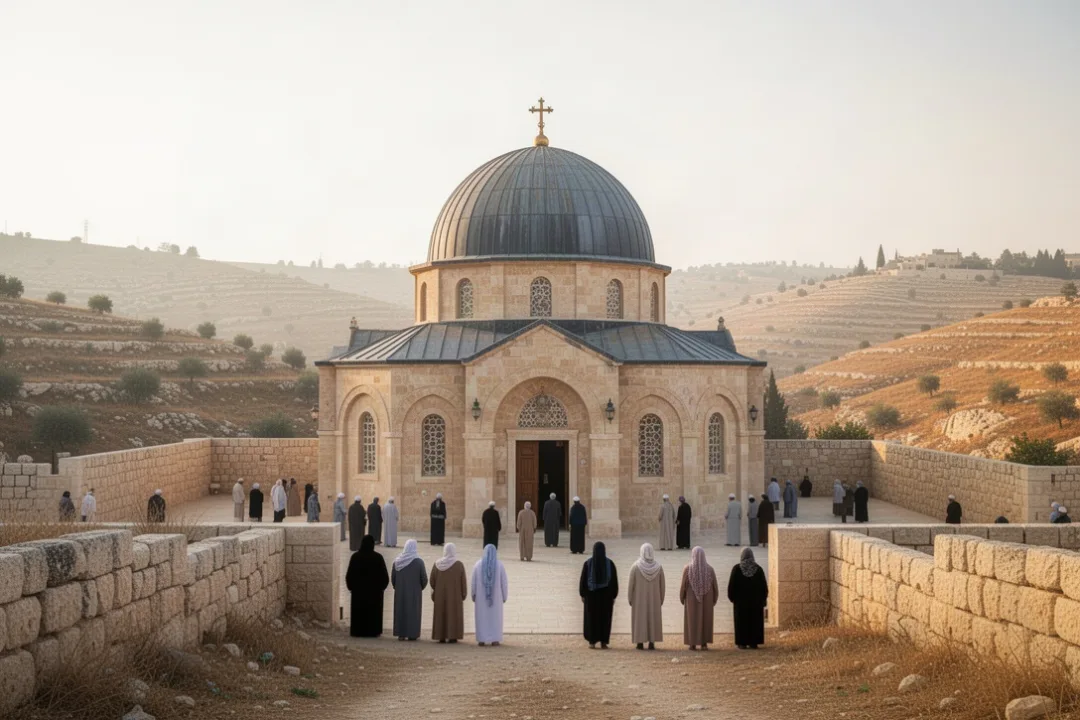
The shrine identified as Rachel’s Tomb is located on the road between Jerusalem and Bethlehem, close to Bethlehem’s northern entrance. In biblical terms, this setting fits the association between Rachel and Bethlehem, the town connected with her death and burial. The modern building, however, is not the same structure that would have existed in the biblical period.
Rachel was the beloved wife of Jacob and the mother of Joseph and Benjamin. According to Genesis 35, she died while giving birth to Benjamin as Jacob’s family traveled toward Ephrath, which the passage identifies with Bethlehem. Jacob marked her grave with a monument, creating the foundation for a tradition that continued long after the biblical period.
The site’s location has practical significance as well as religious importance. It lies in an area shaped by changing borders, roads, and security arrangements. Access conditions can vary, so anyone planning a visit should check current travel guidance, local transportation information, and opening arrangements rather than relying only on older descriptions.
Location note: Rachel’s Tomb is traditionally identified with the shrine near Bethlehem, but the exact historical location of Rachel’s grave cannot be proven with complete certainty.
Some visitors expect a quiet rural burial monument because the biblical setting describes a journey and a roadside memorial. The present site is different: it is an enclosed religious compound with a substantial protective structure. Its appearance reflects centuries of devotion, rebuilding, and the security concerns surrounding a major pilgrimage destination.
What the Bible says about Rachel’s death and burial
Rachel first appears in Genesis as the younger daughter of Laban and the woman Jacob loves. Jacob works for Laban in order to marry her, and their family story becomes part of the larger account of the twelve tribes of Israel. Rachel’s sons, Joseph and Benjamin, hold a particularly important place in that story.
Genesis 35 describes Rachel giving birth during the family’s journey southward. The birth is difficult, and she dies after naming her son Ben-Oni, a name associated with her suffering. Jacob gives the child the name Benjamin, and the text records Rachel’s burial on the road to Ephrath, identified as Bethlehem.
The passage also says that Jacob set up a pillar over her grave. That detail helps explain why Rachel’s burial place became associated with a visible memorial rather than an anonymous grave. The biblical account does not provide the kind of precise geographic coordinates that would settle every later question about the site.
Rachel’s death is presented as a deeply personal loss, but it also carries wider meaning. She is one of the four matriarchs traditionally honored in Judaism, alongside Sarah, Rebekah, and Leah. Her story combines love, motherhood, grief, and endurance, which helps explain why people have continued to pray at a place associated with her memory.
Rachel is also connected with the story of Joseph, whose life moves from family conflict to slavery, imprisonment, and political power in Egypt. Benjamin becomes the ancestor associated with the tribe of Benjamin. Through these children, Rachel’s family line remains part of the biblical account of Israel’s formation.
Rachel’s connection with Bethlehem and Ephrath
The names Ephrath and Bethlehem are important when considering the traditional location. Genesis places Rachel’s death near Ephrath and then identifies Ephrath with Bethlehem. Micah later describes Bethlehem Ephrathah as a significant place connected with the ruler who will come from it, giving Bethlehem an important role in Jewish and Christian interpretation.
Rachel’s Tomb is therefore not an isolated memorial. Its meaning is linked to the surrounding biblical landscape: Jacob’s travels, Bethlehem, the family of Israel, and the later history of Judah and Benjamin. A visitor who knows these connections may find that the site functions as a meeting point between personal remembrance and national religious memory.
Why Jeremiah’s lament is connected with Rachel’s Tomb
One of the most powerful biblical associations with Rachel’s Tomb comes from Jeremiah 31:15. The prophet describes Rachel weeping for her children and refusing consolation because they are gone. The image is not simply a reference to a woman mourning one death; it portrays Rachel as a symbolic mother grieving for her descendants.
Jeremiah’s passage refers to Ramah, a place associated with the deportation of people from Judah. Because Ramah is not identical to the modern shrine’s traditional location, the passage adds complexity to the question of Rachel’s geographical setting. It also shows that biblical writers could use Rachel’s grave and memory in a broad theological and poetic way.
In Jeremiah, Rachel becomes a voice for a nation experiencing exile and loss. Her personal sorrow represents the pain of families separated from their homes and children. The text then turns toward hope, describing a future in which the people return. The movement from grief to restoration is one reason Rachel remains such a compelling figure in Jewish tradition.
The association appears again in the Gospel of Matthew. Matthew 2:18 applies Jeremiah’s image of Rachel mourning to the deaths of children in and around Bethlehem during the story of Jesus’ infancy. Matthew is interpreting the earlier passage rather than offering a modern geographic statement about the tomb. The connection places Rachel’s grief within a Christian reading of Bethlehem’s history.
Jeremiah 31:15 presents Rachel’s mourning as a symbol of communal loss, while the surrounding passage points toward the return and restoration of her children.
These passages explain why people may visit Rachel’s Tomb for reasons that extend beyond the historical question of where Rachel was buried. Some come to remember children, family members, or communities affected by violence and displacement. Others pray for fertility, safe childbirth, family welfare, or comfort during bereavement.
How Rachel’s Tomb developed as a pilgrimage site
The shrine’s history is difficult to separate from the broader history of Bethlehem and Jerusalem. The location has been described, marked, repaired, and altered by different communities over many centuries. Accounts from travelers and religious writers helped strengthen its identity as Rachel’s burial place, even as scholars continued to discuss whether the tradition preserves the original location.
The earliest biblical monument would not have looked like the present compound. Over time, a modest structure became associated with a domed building and a surrounding enclosure. Architectural details changed through repairs and expansions, and the site’s appearance was affected by the political authorities who governed the region at different periods.
Jewish travelers and pilgrims have long visited the tomb to recite prayers and express grief. Rachel’s reputation as a compassionate mother made the site especially meaningful to people asking for help with childbirth and family concerns. In some Jewish communities, women have traditionally visited or prayed toward the tomb during moments connected with motherhood.
The shrine has also held significance in Christian memory because it is near Bethlehem and connected with the Gospel’s account of the children killed by Herod’s order. Christian visitors may approach it as part of a broader pilgrimage that includes Bethlehem’s churches and sites associated with the life of Jesus. The tone of devotion differs among visitors, but Rachel’s identity as a grieving mother remains central.
Muslim communities have also known and used the site, and the building has been referred to by names connected with Islamic tradition. The shrine’s history reflects the region’s overlapping religious landscapes rather than belonging to only one period or one community. Its present use and administration, however, should not be assumed from older travel accounts because those arrangements have changed over time.
Several features have contributed to Rachel’s Tomb’s enduring importance:
Biblical memory: Genesis connects Rachel’s death and burial with the road to Bethlehem.
Maternal symbolism: Rachel represents a mother grieving for her children and descendants.
Prayer traditions: Visitors have sought comfort, healing, family blessings, and help during childbirth.
Location: The shrine lies near Bethlehem, a city central to Jewish and Christian religious history.
Continuing pilgrimage: Generations of visitors have reinforced the site’s sacred identity.
What visitors may see and do at Rachel’s Tomb
The modern shrine is a protected religious site rather than an open archaeological ruin. Visitors generally encounter an enclosed building, controlled entrances, prayer areas, and interior spaces shaped by current religious use. The exact arrangement can change, so photographs or descriptions from previous years may not accurately represent conditions when you arrive.
Inside, the focal point is the tomb traditionally identified with Rachel. Visitors may pray, read religious texts, or spend a quiet moment remembering someone. Customs differ, and respectful behavior matters more than trying to imitate a practice you do not understand.
A visit can be meaningful even if you are not certain that the modern shrine marks the original biblical grave. Sacred sites often carry several kinds of significance at once: historical, textual, architectural, communal, and personal. Rachel’s Tomb has meaning because of the biblical tradition and because generations of people have come there with hopes and grief.
If you plan to visit, these practical steps can help:
Check access first. Confirm opening hours, entry requirements, transportation, and current security conditions before setting out.
Dress modestly. Clothing that covers the shoulders and knees is a considerate choice at a religious shrine.
Allow time for security procedures. Bags and visitors may be screened, and restrictions can change without much notice.
Follow instructions inside. Observe signs, separate prayer areas where applicable, and any photography rules.
Plan transportation carefully. Routes and permitted vehicles may differ depending on your starting point and current conditions.
Keep the visit reflective. Speak quietly and avoid treating active worship as a photo opportunity.
Travel caution: The area around Bethlehem is affected by political and security conditions that can change quickly. Check official government advisories and local information shortly before travel.
Photography is often a sensitive issue at active religious sites. Even if cameras or phones are allowed in some areas, ask before photographing worshippers, prayer books, guards, or private rituals. A respectful visitor treats the shrine as a place of devotion first and a tourist destination second.
How scholars understand the location debate
The tradition identifying the shrine near Bethlehem is old and deeply established, but tradition is not the same as archaeological proof. The biblical text places Rachel’s burial near Ephrath and Bethlehem, yet other passages introduce the name Ramah. Scholars have therefore examined whether the location moved over time, whether different places carried related names, or whether the texts reflect distinct traditions.
One challenge is that biblical place names do not always correspond neatly to modern maps. Towns could change size, names could be reused, and boundaries could be understood differently in different periods. A modern visitor may want a single definitive answer, but the surviving evidence does not permit complete certainty.
The reference to Ramah in Jeremiah has received particular attention. Some interpreters understand the prophet’s language as poetic rather than as a strict statement about the tomb’s location. Others consider how the Rachel tradition may have become connected with a place where exiles or captives passed through. These interpretations address both geography and symbolism.
There are also differing scholarly proposals about another possible location north of Jerusalem. That possibility has made the history of Rachel’s Tomb more complicated, but it does not erase the religious importance of the Bethlehem shrine. A sacred tradition can remain significant even when historians distinguish between devotional certainty and archaeological certainty.
It helps to keep three questions separate:
What does Genesis say? Rachel died during childbirth and was buried near Ephrath, identified with Bethlehem.
What does later biblical poetry do? Jeremiah uses Rachel as a mother who mourns her exiled children and then receives a promise of hope.
What does tradition identify? A shrine near Bethlehem has been honored for centuries as Rachel’s Tomb.
These answers overlap, but they are not identical. Genesis gives the foundational story, Jeremiah expands Rachel’s symbolic role, and pilgrimage tradition gives that memory a physical place. Understanding the distinctions allows you to appreciate the shrine without overstating what can be proven.
Rachel’s Tomb in Jewish and Christian religious memory
In Jewish tradition, Rachel is remembered as one of the matriarchs and as a mother whose suffering connects her with later generations. Her intercession is a recurring theme in religious storytelling and prayer. The tomb near Bethlehem is therefore associated not only with the death of a biblical woman but also with maternal compassion and protection.
Many visitors come with private concerns rather than academic questions. They may pray for a child, for a safe pregnancy, for family members in danger, or for comfort after loss. These practices should not be presented as a single universal ritual; Jewish customs vary by community, background, and personal belief.
Christian readers often encounter Rachel through Genesis, Jeremiah, and Matthew. In the Christian interpretation of Matthew, Rachel’s mourning becomes connected with the suffering of families in Bethlehem and with the larger story of Jesus. Christian pilgrims may include the shrine in a visit to Bethlehem, although the site is not generally treated as one of the central places associated with Jesus’ ministry.
The shared use of biblical figures can create both connection and tension. Rachel belongs to the foundational narratives of the Hebrew Bible, which Christianity also receives as scripture. At the same time, the shrine exists in a politically sensitive area where religious identity, historical memory, and present-day access are closely linked.
A thoughtful visit recognizes all of these layers. You can honor the religious meaning of Rachel’s Tomb while acknowledging that the location is traditional, the historical record is complex, and local realities may affect how the site is experienced. That balance is more accurate than describing it either as a proven archaeological fact or as a place with no historical value.
Frequently asked questions
Is Rachel’s Tomb in Jerusalem or Bethlehem?
Rachel’s Tomb is traditionally identified with a shrine just north of Bethlehem, on the road toward Jerusalem. Because the site is close to modern Jerusalem and the boundary around Bethlehem, descriptions can be confusing. It is generally associated with Bethlehem in the biblical and religious tradition, although the exact location of Rachel’s original grave remains a matter of historical discussion.
Why do people pray at Rachel’s Tomb?
Visitors pray there because Rachel is remembered as a beloved matriarch, a grieving mother, and a symbol of compassion for families. Some people ask for help with fertility, pregnancy, childbirth, family safety, or mourning. Others come simply to connect with biblical history. Practices differ among visitors, and the shrine’s active religious character calls for quiet and respectful conduct.
Can tourists visit Rachel’s Tomb?
Visits may be possible, but access is governed by current security conditions, religious hours, transportation arrangements, and local regulations. These details can change, sometimes with little notice. Check official travel guidance and current site information before traveling, and expect security screening and rules about clothing, photography, and movement within the compound.
Is Rachel’s Tomb proven to be Rachel’s actual grave?
No archaeological evidence establishes the modern shrine as Rachel’s original burial place beyond reasonable doubt. Genesis connects Rachel’s grave with Ephrath, identified with Bethlehem, supporting the traditional association. References to Ramah in Jeremiah and differences in ancient geography have led scholars to debate the location. The shrine remains historically and religiously significant even though absolute proof is unavailable.





Leave a Reply