2 Chronicles 7:14: Meaning, context, and application
2 Chronicles 7:14: Meaning, context, and application
2 Chronicles 7:14 is God’s call to his covenant people to respond to trouble with humility, prayer, repentance, and renewed dependence on him. The verse is often applied to national crises, but its original setting is more specific: God is speaking to Solomon after the dedication of the temple in Jerusalem.
What 2 Chronicles 7:14 says in its biblical setting
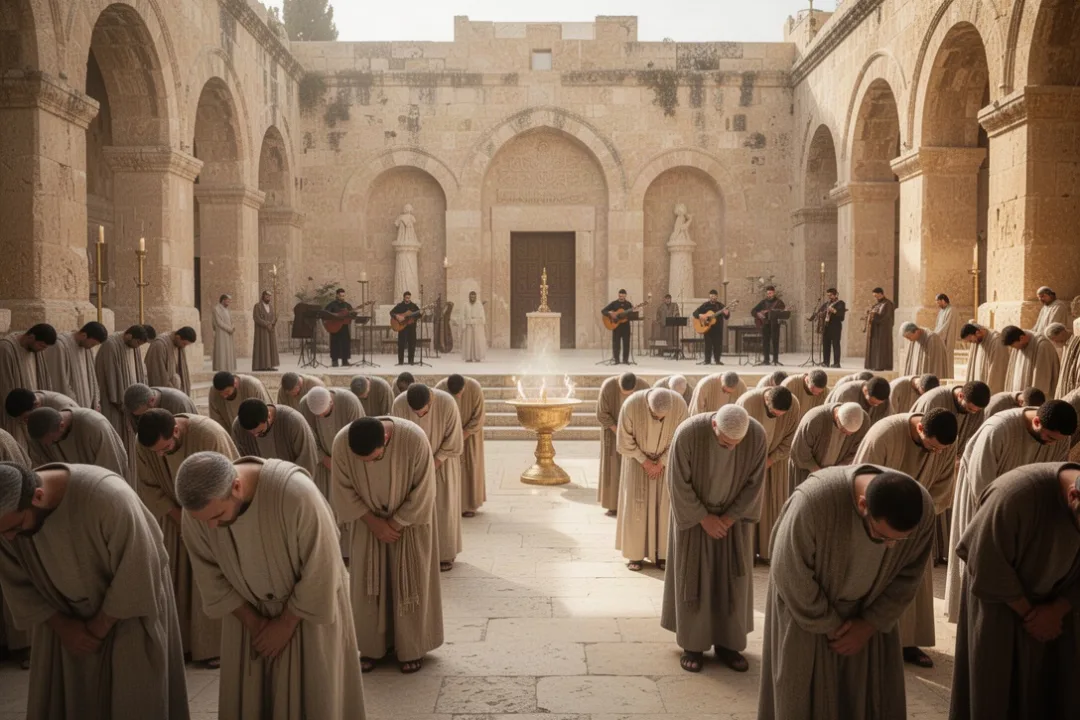
King Solomon had completed the temple, and the people gathered to worship. The dedication included sacrifices, music, prayer, and public praise. Solomon asked God to hear his people when they turned toward the temple in repentance, and God answered him after the celebration.
In 2 Chronicles 7:12-22, God explains how he will respond when Israel becomes unfaithful. He describes circumstances such as drought, locusts, or disease among the people. These hardships are connected to Israel’s covenant relationship with him, not presented as a general explanation for every disaster experienced by every person.
Verse 14 addresses “my people who are called by my name”—a phrase referring first to Israel. God identifies the people as belonging to him, then describes four responses: they must humble themselves, pray, seek him, and turn away from their wicked ways. The promised result is that God will hear from heaven, forgive their sin, and heal their land.
The verse therefore has both a promise and a condition. The promise is God’s willingness to hear, forgive, and restore. The condition is not a vague expression of regret but a sincere return to God expressed through humility, prayer, and changed conduct.
Context matters: 2 Chronicles 7:14 was originally spoken to Israel as God’s covenant people after the temple dedication. Applying it today should preserve its call to repentance without treating it as a guaranteed political formula or a promise that every national crisis has one simple cause.
The surrounding verses also make clear that the warning is serious. If Israel abandoned God and worshiped other gods, the people and the temple would face judgment. The land could become an object of astonishment, and the temple would not protect the nation from the consequences of persistent disobedience.
That context keeps the verse from becoming a stand-alone slogan. It belongs within the larger biblical pattern of covenant faithfulness: God is gracious and ready to forgive, but his people are called to worship him alone and live according to his commands.
What “humble themselves” means in 2 Chronicles 7:14
Humility in this verse is more than adopting a modest attitude or admitting that a problem exists. It means recognizing dependence on God and surrendering the assumption that human strength, status, wealth, or political power can solve spiritual failure.
For Israel, humility meant returning to the proper relationship with God. The people were not merely being asked to feel bad about national suffering. They were being called to acknowledge that their disobedience had placed them outside the path of covenant blessing and that restoration required submission to God.
Humility begins with honest recognition. A person cannot turn from sin while insisting that nothing is wrong. In the same way, a church or community cannot pursue renewal while protecting pride, excusing injustice, or blaming every problem on someone else.
This humility does not require accepting false guilt for actions you did not commit. Scripture distinguishes between personal responsibility and collective responsibility. The verse can lead people to examine their own lives and communities, but it should not be used to accuse victims of suffering or to claim certainty about why a particular disaster occurred.
Humility also affects how repentance is practiced. A humble person listens, receives correction, confesses honestly, and accepts the need for change. A proud person may use religious language while remaining committed to control, resentment, prejudice, or self-protection.
Humility admits dependence on God rather than treating faith as a tool for personal success.
Humility accepts correction from Scripture and from trustworthy, wise people.
Humility takes responsibility for actual sin without claiming responsibility for everything.
Humility makes room for repair when other people have been harmed.
In practical terms, humbling yourself may involve confessing a pattern of dishonesty, asking forgiveness, ending a destructive relationship, seeking help for an addiction, or admitting that religious activity has replaced genuine love for God and neighbor.
The verse does not present humility as humiliation for its own sake. Biblical humility is a truthful posture before God. It recognizes both human failure and God’s mercy, allowing repentance to become more than shame.
How prayer and seeking God differ from religious routine
The next response in the verse is prayer. In its original setting, prayer means turning toward God for mercy, guidance, and restoration. It is not a method for pressuring God into granting a preferred outcome, and it is not a substitute for obedience.
Prayer includes confession, intercession, praise, lament, and requests for help. When people pray in response to 2 Chronicles 7:14, they can ask God to expose sin, strengthen those who are suffering, give wisdom to leaders, protect the vulnerable, and create opportunities for reconciliation.
The command to seek God’s face adds a personal and relational dimension. Seeking God is not simply seeking an answer, a blessing, or relief from consequences. It means desiring God himself—his presence, character, will, and approval.
A person may pray frequently while still avoiding God’s will. Religious routine can coexist with bitterness, exploitation, dishonesty, or indifference to suffering. The verse joins prayer to humility and repentance because prayer is meant to draw people into faithful relationship, not merely produce religious words.
Seeking God can shape ordinary decisions:
Before speaking, you consider whether your words are truthful and constructive.
Before making a financial choice, you consider honesty, generosity, and its effect on others.
Before supporting a public cause, you examine whether your actions reflect justice and compassion.
Before confronting someone, you ask whether your goal is restoration or retaliation.
Before judging another person, you examine your own need for mercy.
Prayer and seeking God also belong in community. The setting of 2 Chronicles 7:14 is public and national, but public prayer does not remove personal responsibility. A congregation can pray for renewal while its members pursue forgiveness, accountability, and service in daily life.
Jesus’ teaching in the New Testament likewise connects prayer with sincere relationship rather than performance. The broader biblical witness calls worshipers to pray privately and together, to care for people in need, and to practice faithfulness beyond public religious display.
A useful test: If prayer leads you to greater honesty, compassion, obedience, and willingness to repair harm, it is moving toward the kind of response this verse describes. If it only asks God to change other people, it has missed part of the message.
What it means to turn from wicked ways
Turning from wicked ways is the verse’s clearest description of repentance. Repentance is not merely feeling sorrow or making a public statement. It means changing direction—turning away from conduct that opposes God and moving toward faithful obedience.
In the Bible, repentance can include abandoning idolatry, injustice, violence, dishonesty, sexual immorality, oppression, pride, and neglect of the poor. The exact application depends on the person and community, but the basic movement remains the same: sin is acknowledged, rejected, and replaced with a different way of living.
Repentance has visible fruit. Someone who has lied may need to tell the truth and correct the damage. Someone who has taken advantage of others may need to return what was taken and accept consequences. Someone who has caused division may need to stop spreading accusations and pursue peace with appropriate boundaries.
That does not mean every situation can be repaired immediately or that forgiveness eliminates civil, relational, or professional consequences. God’s forgiveness does not give a person permission to avoid accountability. In many cases, genuine repentance includes accepting limits and allowing harmed people to decide whether renewed trust is possible.
Repentance should also be specific. General statements such as “everyone has made mistakes” can be true while avoiding the actual issue. A more honest confession identifies the behavior, recognizes who was affected, and names the change required.
Personal repentance and community repentance
The verse speaks to God’s people as a group, so it can address both individual and communal sin. Personal repentance asks, “What do I need to confess and change?” Communal repentance asks, “What has our church, organization, or community tolerated, encouraged, or ignored?”
Community repentance must be more than a ceremony. A church that confesses indifference to poverty may need to change its budget and service practices. A Christian organization that acknowledges abuse must protect people, report wrongdoing where required, cooperate with investigations, and establish safeguards. Words matter, but structures and behavior reveal whether repentance is genuine.
At the same time, communal repentance should not become a way to avoid personal obedience. It is possible to criticize a nation, denomination, or political group while refusing to confront pride, cruelty, dishonesty, or prejudice in your own life.
Name the wrong clearly. Avoid minimizing, shifting blame, or using vague language.
Confess it to God and to the people affected when appropriate and safe.
Stop the harmful behavior. Repentance requires a practical break with the old pattern.
Make restitution where possible. Repair may involve returning property, correcting false claims, or rebuilding trust over time.
Accept accountability. Trusted spiritual leaders, counselors, or qualified professionals may help establish lasting change.
These steps do not purchase forgiveness. They express the seriousness of repentance and help prevent an emotional response from fading without transformation.
How “heal their land” should be understood today
The phrase “heal their land” refers first to Israel’s covenant land. In the immediate context, God promises restoration after judgment when his people return to him. The language is national and geographical, tied to Israel’s unique identity, temple, land, and covenant responsibilities.
Many Christians use the phrase to pray for healing in the United States or another country. That can be a meaningful expression of concern for social peace, justice, public health, and moral renewal. However, the verse should not be presented as a guarantee that a nation will prosper if enough citizens repeat it or as proof that one political program represents God’s will.
National repentance is not the same as political branding. The passage calls God’s people to humble themselves, not to congratulate themselves. It confronts the sins of the worshiping community before it gives them permission to diagnose everyone outside it.
“Healing” can include several dimensions:
Restored relationships between individuals and groups.
Protection and dignity for people who are vulnerable or oppressed.
Truthful leadership and accountable institutions.
Peace after violence, conflict, or deep division.
Spiritual renewal among people who identify as God’s followers.
Those applications should remain humble. Christians cannot claim that every hurricane, recession, epidemic, or political crisis is a direct punishment for a particular national sin. The Bible contains examples of divine judgment, but it also warns against assuming that sufferers are always more guilty than those who escape suffering.
The New Testament also changes the way Christians describe their primary identity. Followers of Jesus are part of a worldwide people from many nations. They should seek the good of their communities, pray for rulers, and work for justice, while remembering that God’s kingdom is not identical with any modern nation.
As a result, a responsible application of 2 Chronicles 7:14 asks how believers can practice humility and repentance where they actually have influence. That may mean confessing prejudice, resisting corruption, protecting children, welcoming the stranger, caring for neighbors, or refusing to use faith as cover for hatred.
How to apply 2 Chronicles 7:14 without misusing it
The verse can guide personal prayer and communal self-examination when it is read with its context intact. It is most helpful when it produces humility, courage, and concrete obedience rather than fear, manipulation, or partisan certainty.
Begin with the identity in the passage. Ask what it means for you to belong to God, and whether your conduct reflects that identity. Then examine the four responses in order: humility opens you to correction, prayer turns you toward God, seeking his face reorders your desires, and repentance changes your behavior.
Use the verse to pray for your own life before applying it to other people. This guards against a common misuse: treating the passage as an accusation directed only at opponents, strangers, or public officials. Leaders may need particular accountability, but every believer stands in need of mercy and correction.
Apply the verse alongside other biblical teachings. Repentance should be joined with love of neighbor, concern for the poor, truthfulness, justice, forgiveness, and care for those who suffer. A person who prays for national healing while ignoring a neighbor’s need has separated the verse from the larger ethical pattern of Scripture.
Keep expectations realistic. Forgiveness can be immediate when God receives sincere repentance, but restored trust, repaired institutions, and social healing often require time. The verse gives reason to hope in God’s mercy; it does not promise that every consequence will disappear overnight.
A thoughtful practice might look like this:
Read the surrounding passage, especially 2 Chronicles 7:11-22, rather than isolating verse 14.
Ask God to reveal personal sin before diagnosing the failures of a wider group.
Confess specifically, using clear language instead of general religious phrases.
Choose one obedient action that demonstrates a real change in direction.
Pray for leaders and neighbors without reducing spiritual concerns to party loyalty.
Continue in faithful practice after the public moment of prayer has ended.
Read this way, 2 Chronicles 7:14 remains a serious invitation to return to God. Its central message is not that people can control national outcomes through a formula. It is that God calls his people to honest humility, hears repentant prayer, forgives sin, and works toward restoration according to his mercy and purposes.
Frequently asked questions
Is 2 Chronicles 7:14 a promise to the United States?
Not directly. God originally spoke these words to Israel, a specific covenant nation connected to the temple and the land God had given it. Christians may apply its principles by praying for national repentance and public good, but the verse does not guarantee that the United States, or any modern country, will receive a particular political or economic outcome.
Who are “my people” in 2 Chronicles 7:14?
In the immediate passage, “my people” means the Israelites who belonged to God under the covenant established with them. Christians may understand themselves as God’s people through faith in Christ, but that broader application should not erase the verse’s original meaning or turn it into a claim that one nation has a unique biblical status.
Does this verse mean disasters are always caused by sin?
No. The passage describes a specific covenant warning to Israel and should not be used to explain every disaster. Scripture includes many reasons people suffer, and Jesus warned against assuming that victims are automatically more sinful than others. The verse calls for self-examination and repentance, not confident accusations against people experiencing hardship.
How can I practice this verse personally?
Read the surrounding chapter, ask God to expose your own sin, confess specific wrongdoing, and make practical changes. Seek reconciliation where it is wise and safe, accept accountability, and pray for your community without blaming others for every problem. Genuine application includes changed behavior, not only public prayer or emotional regret.











Leave a Reply