Are you searching for “Maccabees 1 1” because you want the meaning of the first chapter, or are you looking for verse 1 specifically? The phrase usually refers to 1 Maccabees, chapter 1. Its opening verse begins the story of Alexander the Great, but the chapter soon turns to the rise of Antiochus IV Epiphanes and the severe persecution of Jewish people in Jerusalem and Judea.
1 Maccabees 1 explains how political conquest became religious oppression. It describes the spread of Greek influence, conflict among Jewish leaders, the plundering of the Jerusalem Temple, and laws designed to eliminate Jewish worship and identity. These events set the stage for the Maccabean revolt described in the chapters that follow.
The chapter covers a period when the Jewish people lived under the control of large empires. Alexander’s victories created a vast kingdom, but that kingdom did not remain united after his death. His generals divided the territory, and Judea eventually came under the rule of the Seleucid Empire, a Greek-speaking kingdom based in the eastern Mediterranean and Near East.
The main crisis begins with Antiochus IV Epiphanes. He attempted to impose policies that went far beyond ordinary political administration. Jewish practices, laws, and worship were attacked, while pagan religious customs were promoted. The chapter presents this as a direct assault on the covenantal life of Israel.
That conflict was not simply between Jews and foreigners. Some Jewish leaders cooperated with the new policies because they admired Greek culture, wanted political influence, or believed traditional practices should be changed. The chapter therefore shows both external persecution and internal division within the Jewish community.
Central idea: 1 Maccabees 1 portrays religious persecution as a struggle over worship, identity, and loyalty—not merely a dispute about cultural style or government policy.
How Alexander’s conquest frames the chapter
First Maccabees opens by recounting Alexander’s expansion from Macedonia. He defeated the Persian ruler described in the chapter as Darius and established an enormous empire. The account emphasizes the speed and reach of his victories, presenting him as a ruler who conquered lands across the known world of the story.
Alexander’s success did not create lasting political unity. According to the chapter, he died after ruling for twelve years, and his generals took control. They fought among themselves, claimed royal authority, and divided the empire into separate kingdoms. This transition matters because it explains how Judea came under competing Hellenistic powers.
The chapter is not giving a complete biography of Alexander. Instead, it uses his rise and death to provide historical background for the events affecting Jerusalem. The political order that followed his conquests created the setting for Antiochus IV’s rule and for the later revolt led by the Maccabees.
The reference to Alexander also introduces a warning about imperial power. He gained extraordinary authority, yet his kingdom was divided after his death. The narrative suggests that military success and worldly glory are temporary, while the consequences of political decisions can continue for generations.
Who Antiochus IV Epiphanes was in 1 Maccabees 1
Antiochus IV Epiphanes was a Seleucid king who ruled over territories that included Judea. First Maccabees presents him as a ruler who sought to strengthen control by imposing a common political and religious culture. His policies favored Greek customs and challenged the distinct practices that shaped Jewish communal life.
The chapter refers to him as a sinful root that arose from the ruling powers. That image does not mean that every Greek person or every aspect of Greek culture was treated as evil. Rather, it identifies Antiochus’s use of power to suppress Jewish worship as the source of the crisis described in the chapter.
Antiochus’s actions included interference with the Temple, attacks on the Jewish law, and punishment of people who refused to abandon their religious practices. He did not merely ask Judeans to participate in an additional public ceremony. The laws described in the chapter attempted to make traditional Jewish observance illegal.
His title, “Epiphanes,” is often understood as meaning “manifest” or “revealed,” with the sense of divine appearance or manifestation. First Maccabees presents a sharp contrast between that royal claim and the king’s destructive conduct. His official image of power is weighed against the suffering caused by his rule.
How Jewish leaders became divided over Greek influence
First Maccabees says that some people from Israel came forward and urged the community to adopt the customs of surrounding nations. Their goal was to become more like the peoples around them. This desire was connected to the broader Hellenistic world, where Greek language, education, athletics, civic institutions, and religious practices shaped public life.
The chapter describes these people as renegades or lawless individuals because they rejected the covenantal obligations central to Jewish identity. The text is making a theological judgment, not offering a neutral cultural survey. For the writer, changing customs becomes dangerous when it requires abandoning the law and the worship of Israel’s God.
A major symbol of this change was the construction of a gymnasium in Jerusalem. In the Hellenistic world, gymnasiums were associated with athletic training, education, and civic culture. They could also be connected with pagan religious life. Some Jewish men concealed or reversed the physical sign of circumcision so they could avoid standing out in Greek settings.
These details show that assimilation was not presented as an abstract idea. It affected bodies, education, public status, and communal loyalties. People who embraced the new customs could gain access to institutions and influence, while those who maintained Jewish practices increasingly faced pressure and danger.
The chapter does not claim that every contact with another culture is automatically wrong. Its concern is coerced assimilation and the abandonment of practices understood to be commanded by God. That distinction helps modern readers avoid reducing the passage to a simple rejection of all foreign learning or cultural exchange.
Why the high priesthood became part of the political crisis
The high priesthood was both a religious office and a position of major public influence. First Maccabees describes a high priest named Jason, who obtained the office by promising the king money. He also asked permission to establish institutions associated with Greek civic life in Jerusalem.
This episode shows how the Seleucid government could use local leaders to advance its goals. Control did not depend only on soldiers stationed in the region. It also depended on alliances with influential people who were willing to reshape Jewish institutions in exchange for authority.
Jason’s actions created a crisis of legitimacy. The high priest was expected to protect the Temple and serve the religious community, yet the chapter portrays him as using his position to promote policies that weakened traditional observance. His behavior made the conflict especially painful because the pressure came through a Jewish leader as well as through a foreign king.
The chapter also mentions people who were eager to identify themselves with Greek culture. Their choices reflected a desire for social acceptance and political opportunity. First Maccabees treats those motives as a form of unfaithfulness because advancement came at the cost of the law.
What happened when Antiochus attacked Jerusalem
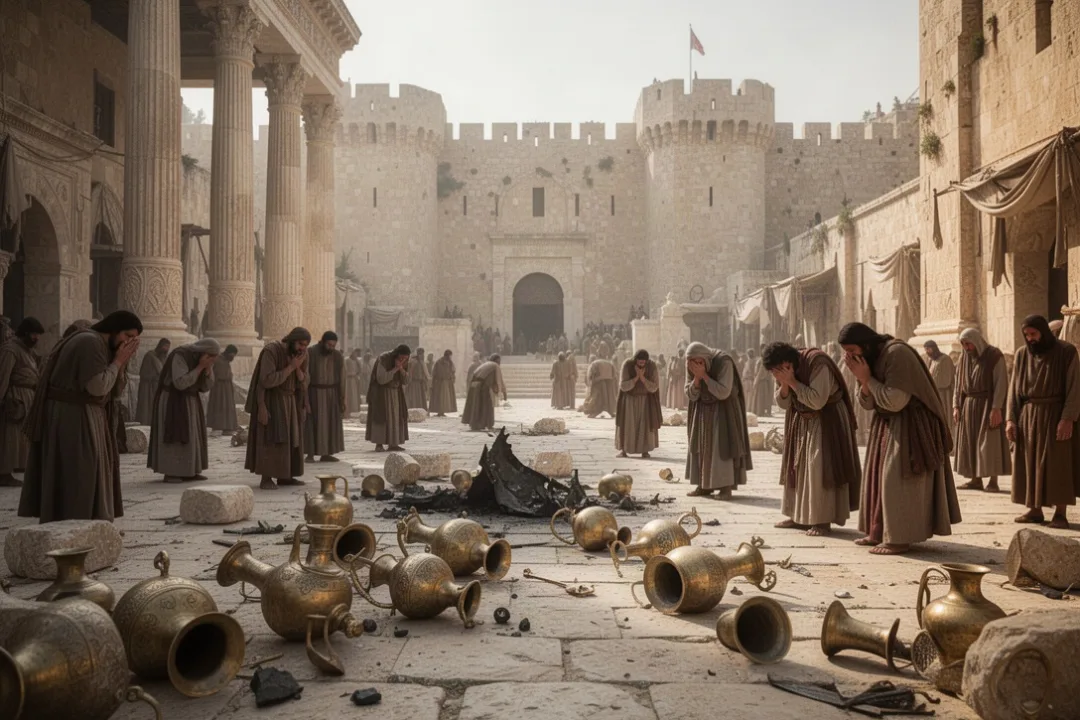
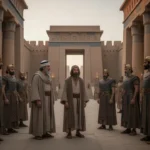
After a campaign in Egypt, Antiochus turned toward Jerusalem. First Maccabees describes his entry into the city and the violence that followed. The account emphasizes that Jerusalem was not treated as a protected religious center. It was invaded, plundered, and subjected to severe destruction.
The king or his forces took valuable objects from the Temple, including sacred vessels and other treasures. The Temple’s wealth was not merely financial. Its objects represented the worship of God and the continuity of the Jewish community. Removing them was therefore both economic theft and religious desecration.
The chapter describes widespread killing and mourning. Residents fled, and Jerusalem was left in a deeply damaged condition. The text uses images of grief and desolation to show how the city’s public and religious life had been shattered.
Antiochus’s forces also built a fortified structure near the city, allowing them to control Jerusalem and monitor the population. This fortress represented more than military occupation. It made the presence of foreign power visible beside the Temple and helped enforce policies against Jewish observance.
The result was a community living under both military surveillance and legal pressure. Worship could no longer be practiced freely, and ordinary religious decisions could carry life-threatening consequences.
What the “abomination of desolation” means here
First Maccabees records the dedication of the Jerusalem altar to a pagan deity and the introduction of pagan sacrifices. The chapter identifies this event with language commonly translated as “the abomination of desolation.” The phrase refers to a profaning presence or practice placed where sacred worship should occur, producing desecration and devastation.
Readers may encounter slightly different wording depending on the Bible translation. The central meaning remains the same: the Temple was forced to serve a religious purpose contrary to the worship prescribed in the Jewish law.
The chapter also mentions an altar built on the site of the Temple’s altar. Sacrifices forbidden by Jewish law were offered there, and pagan religious practices were introduced throughout the region. For the writer, this was the defining religious offense of the crisis.
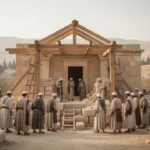
The event matters because the Temple was not simply one building among many. It stood at the center of Jewish worship and communal memory. Its defilement represented an attempt to replace the community’s relationship with God rather than merely tax or govern the population.
Which Jewish practices were banned
The laws described in 1 Maccabees 1 targeted practices that marked Jewish identity. People were forbidden to offer traditional sacrifices, observe festivals, keep the Sabbath, or follow the law of Moses. Copies of the law were destroyed when they were found, and those who preserved them faced punishment.
The chapter gives special attention to circumcision. Mothers who had their sons circumcised were killed, and the infants were killed as well. The perpetrators are described as hanging the children from their mothers’ necks. This horrifying detail communicates the deliberate attempt to stop the transmission of Jewish identity from one generation to the next.
The policy therefore attacked both public worship and family life. It was designed to make Jewish observance impossible in the home, the synagogue or community, and the Temple. A person could not simply keep faith private without risking consequences for ordinary family customs.
First Maccabees also describes the destruction of law scrolls by fire. The written law represented instruction, memory, and covenant. Burning it was an attempt to sever the community from the texts that shaped its worship and ethics.
Those who obeyed the royal commands could sometimes preserve their lives, at least temporarily. Those who refused faced arrest or execution. The chapter presents the issue as a test of faithfulness under coercion, not as a minor disagreement over ritual preferences.
Sabbath observance was prohibited.
Traditional sacrifices and festivals were suppressed.
Circumcision was banned and brutally punished.
Copies of the Jewish law were destroyed.
Jewish religious identity was targeted in public and private life.
How to read 1 Maccabees 1 responsibly
Readers can misunderstand the chapter if they treat it as a broad condemnation of every form of Greek culture. The immediate issue is not the existence of another language, style of education, or artistic tradition. The conflict concerns a government’s attempt to replace Jewish worship and compel people to violate practices they regarded as commanded by God.
It is also useful to distinguish between historical description and theological interpretation. First Maccabees reports political events, battles, appointments, and acts of persecution, but it interprets those events through the categories of covenant faithfulness, law, sin, and judgment.
The chapter should not be separated from its setting. Judea was caught between imperial rulers, local elites, competing claims to the high priesthood, and powerful cultural pressures. Understanding those forces makes the narrative more precise and prevents the conflict from being reduced to a simple ethnic opposition.
At the same time, the text clearly centers the experience of people whose religious practices were criminalized. Its emotional force comes from the suffering of families, the desecration of sacred space, and the courage of those who refused to comply.
Common mistakes when studying 1 Maccabees 1
A careful reading benefits from a few safeguards. These points help separate what the chapter says from assumptions that readers sometimes bring to it.
Do not confuse 1 Maccabees 1 with 1 Maccabees 1:1. The first refers to the whole chapter; the second refers only to its opening verse about Alexander’s conquest.
Do not assume “Maccabees” means only one person. The name refers to a family and revolutionary movement, especially associated with Judas Maccabeus and his brothers in the chapters that follow.
Do not treat the chapter as a complete history of Alexander. Alexander’s career appears briefly as background for the political divisions that follow.
Do not overlook internal Jewish conflict. Some local leaders supported Hellenizing policies, so the crisis involved both imperial pressure and choices within the community.
Do not reduce the issue to cultural preference. The chapter focuses on laws that suppressed worship, destroyed sacred texts, and punished family religious practices.
Do not assume every Bible tradition places the book in the same category. First Maccabees is included in Catholic and Orthodox Old Testament collections, while many Protestant traditions place it among the Apocrypha.
Do not read the persecution without the following chapters. Chapter 1 establishes the crisis; the later narrative explains how resistance develops.
What 1 Maccabees 1 teaches about faith under pressure
The chapter presents faithfulness as something practiced through ordinary actions: keeping the Sabbath, circumcising children, preserving sacred writings, and refusing prohibited sacrifices. These acts might appear small compared with armies and kings, yet they become politically significant when a government tries to eliminate them.
One lesson is that religious identity can be contested through institutions. The gymnasium, the high priesthood, the Temple, military fortifications, and royal decrees all became places where power was exercised. The conflict did not occur only in private beliefs; it reached education, public office, family customs, and sacred space.
Another lesson concerns the danger of exchanging religious responsibility for social advancement. The chapter portrays some leaders as willing to compromise in order to gain influence. Their decisions affected the whole community, showing that public leadership carries consequences beyond personal conviction.
The chapter also honors resistance without pretending that resistance is easy. People who refused the king’s commands risked imprisonment, exile, and death. Their faithfulness was costly because the surrounding political system was designed to make obedience to the law dangerous.
For contemporary readers, the passage can prompt questions about conscience and coercion: What happens when authorities criminalize core religious practices? How should communities respond when leaders trade principle for status? What forms of identity survive when institutions are pressured to conform?
How chapter 1 leads into the Maccabean revolt
First Maccabees 1 ends with Judea under severe religious and political oppression. The Temple has been desecrated, Jewish practices have been banned, and those who remain faithful face deadly consequences. This ending creates the conditions for the action that follows.
In the next chapter, the priest Mattathias and his sons become central figures in the resistance. The revolt does not appear out of nowhere. It grows from the combination of imperial force, local collaboration, Temple desecration, and laws that attacked the foundations of Jewish life.
The chapter’s final mood is one of grief and desolation, but it also prepares the reader for a decision. The question is no longer whether the community can avoid conflict. It is whether people will obey the royal commands or remain loyal to the law as they understand it.
That tension gives 1 Maccabees its narrative force. The chapter begins with the rise of a world-conquering king and ends with ordinary Jewish practices placed under threat. Between those points, it shows how political ambition can become religious persecution—and why resistance emerges when a community’s worship and identity are attacked.
Questions to ask while reading the chapter
Several questions can help you read 1 Maccabees 1 with greater clarity. First, ask who is exercising power at each stage: Alexander, his generals, Antiochus, local Jewish leaders, or military officials. The answer changes as the chapter moves from imperial expansion to direct persecution.
Next, ask which actions are described as political and which are described as religious. In this chapter, the two categories overlap. A high-priestly appointment can affect worship, a gymnasium can symbolize cultural realignment, and a royal decree can regulate family practice.
Finally, pay attention to the people who are missing from positions of power. The chapter gives particular weight to families, teachers of the law, worshipers, and those who suffer because they refuse to comply. Their experiences explain why the story is remembered not simply as a change of rulers but as a crisis of faith and community survival.
Read in that way, 1 Maccabees 1 is more than a list of ancient events. It is a carefully shaped account of how empire, local ambition, cultural pressure, and religious persecution combined to produce one of the most significant Jewish revolts of the Hellenistic period.
Frequently asked questions
Is 1 Maccabees 1 the same as 1 Maccabees 1:1?
No. “1 Maccabees 1” normally means the entire first chapter, while “1 Maccabees 1:1” means its opening verse. Verse 1 introduces Alexander the Great and his conquest of Persia. The rest of the chapter moves through the division of Alexander’s empire, the rise of Antiochus IV, and the persecution of Jewish religious practice.
Who is the main enemy in 1 Maccabees 1?
Antiochus IV Epiphanes is the main ruler responsible for the persecution described in the chapter. However, the narrative also identifies Jewish leaders who supported Hellenizing policies and helped advance them locally. The conflict therefore involves both the Seleucid government and internal divisions among the people of Judea.
Why is 1 Maccabees important for understanding Hanukkah?
The chapter describes the desecration of the Jerusalem Temple, while later chapters recount its recovery and rededication under the Maccabean leadership. Hanukkah commemorates that rededication. Chapter 1 provides the background for why restoring the Temple became such a central goal of the revolt.
Is 1 Maccabees part of the Bible?
Its status depends on the Christian tradition. It is included in Catholic and Orthodox Old Testament collections, while many Protestant Bibles place it among the Apocrypha or do not include it in the main canon. It is also an important historical and religious text for understanding the Second Temple period.




Leave a Reply