Daniel in the Bible: His story, visions, and meaning
Daniel in the Bible: His story, visions, and meaning
Daniel is the biblical model of faithful wisdom under pressure. Taken from Jerusalem to Babylon, he served powerful kings without abandoning his loyalty to God.
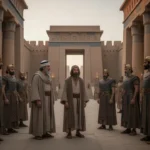
Daniel appears primarily in the Book of Daniel, which is part of the Old Testament. The book presents him as a young Judean exile who becomes a trusted adviser in the courts of Babylon and Persia. His story begins after Jerusalem is conquered and some members of Judah’s royal and noble families are brought to Babylon.
The opening chapter describes Daniel and three companions—Hananiah, Mishael, and Azariah—being selected for education and royal service. Their Babylonian names are more familiar to many readers: Shadrach, Meshach, and Abednego. Although Daniel is given the Babylonian name Belteshazzar, he continues to practice his faith and identify with the God of Israel.
The name Daniel is commonly understood to mean “God is my judge.” That meaning fits the book’s central concern: human rulers may judge, promote, threaten, or condemn, but God remains the highest authority. Daniel’s life shows how a person can participate in public life while refusing to treat political power as ultimate.
Daniel is also mentioned outside his own book. In Ezekiel, the name Daniel appears among examples of exceptional righteousness and wisdom. Some readers understand that reference to the same Daniel who appears in the later book; others discuss whether it refers to an earlier renowned figure. The Book of Daniel itself clearly presents Daniel as a wise Judean living among the exiles.
The book has two noticeably different parts:
Daniel 1–6 contains court stories about Daniel and his companions, including dreams, political pressure, and miraculous deliverance.
Daniel 7–12 records Daniel’s visions concerning kingdoms, suffering, judgment, and God’s future rule.
The book also changes language. Much of Daniel 2:4 through 7:28 is written in Aramaic, while the surrounding material is in Hebrew. Aramaic was widely used across the ancient Near East, so the language shift may fit the book’s movement between Jewish concerns and the wider international world of empires.
Central idea: Daniel’s faithfulness does not remove him from difficult institutions or dangerous circumstances. It gives him a way to live truthfully within them without surrendering his convictions.
How Daniel remained faithful in Babylon
Daniel’s first test involves food and identity. The Babylonian court assigns him and his companions a portion of the king’s food and wine. Daniel decides not to defile himself, then asks for a limited trial involving vegetables and water. After the trial, the four young men appear healthy, and the narrative presents God as giving them knowledge and skill.
This episode is about more than diet. The court is attempting to reshape the young exiles through education, names, language, and royal privileges. Daniel does not reject learning or public service; instead, he draws a boundary around worship and personal faithfulness. He can gain knowledge from Babylon without allowing Babylon to define his deepest allegiance.
Daniel’s first major court challenge comes when King Nebuchadnezzar demands that his wise men tell him both his troubling dream and its interpretation. The king threatens execution when they cannot do so. Daniel responds by asking for time, gathering his companions, and seeking mercy from God.
God reveals the mystery to Daniel in a night vision. Daniel then praises God as the one who reveals mysteries and changes times and rulers. He explains that the king’s dream concerns a great statue representing a sequence of kingdoms. A stone not cut by human hands strikes the statue and becomes a mountain, symbolizing a kingdom established by God that will ultimately outlast human empires.
Daniel does not claim that his wisdom comes from himself. Before interpreting the dream, he makes clear that no human ability can uncover the mystery on its own. This pattern continues throughout the book: Daniel is gifted, intelligent, and courageous, but he directs credit toward God rather than turning spiritual insight into personal glory.
Daniel’s companions face a different test in chapter 3. Nebuchadnezzar sets up a large image and commands officials to bow before it. Shadrach, Meshach, and Abednego refuse, even when threatened with a fiery furnace. Their answer expresses one of the book’s strongest examples of trust: God can deliver them, but even if he does not, they will not worship the image.
Daniel himself is not present in that particular scene. That detail matters because the story is not simply a collection of Daniel’s personal exploits. It also shows how a community can practice shared courage. The three companions stand together, refuse idolatry, and leave the outcome to God.
Later, Daniel interprets another dream in which Nebuchadnezzar is warned about pride. The king’s greatness has grown, but the dream portrays his downfall and humiliation. Daniel urges him to renounce sin and practice justice, especially toward the oppressed. The warning is not merely about private arrogance; it links spiritual pride with the misuse of royal power.
Chapter 5 shifts to Belshazzar, who holds a feast using vessels taken from the Jerusalem temple. A mysterious hand writes on the wall, and the king’s advisers cannot explain it. Daniel is brought in because of his reputation for wisdom. He reminds Belshazzar that Nebuchadnezzar had been humbled when he became proud, then announces that Belshazzar has failed to learn from that example.
The message on the wall declares that the king’s rule has been weighed and found deficient, and that his kingdom will be divided. The account presents Babylon’s fall as an act of divine judgment against arrogance and desecration. Daniel does not soften the message to protect his position, even though honest speech places him near danger.
The best-known story comes in chapter 6, when Daniel serves under a new administration. Officials who resent his success search for grounds to accuse him, but they find no corruption in his work. They therefore target his religious practice and persuade the king to issue a temporary law restricting petitions to anyone except the king.
Daniel responds by continuing to pray toward Jerusalem, as he has done before. He does not stage a protest or hide his practice, but he also does not treat the king’s command as binding on matters of worship. He is thrown into a den of lions, and God protects him. The king then recognizes Daniel’s God as a living and enduring ruler.
Several details connect these stories. Daniel works competently, speaks truthfully, prays consistently, and refuses worship that belongs to God. His faithfulness is steady rather than theatrical; it appears in ordinary habits before it is tested in public crises.
What Daniel’s visions mean in the Bible
Daniel’s second half moves from court narrative to apocalyptic vision. Apocalyptic writing uses symbolic animals, heavenly messengers, strange numbers, and dramatic scenes to reveal the spiritual meaning of historical events. Its symbols are not always intended as simple one-to-one codes. They invite readers to see earthly empires from God’s perspective.
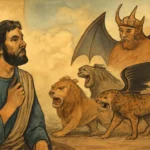
In chapter 7, Daniel sees four great beasts rising from the sea. The beasts represent kingdoms, but their animal-like forms portray political power as violent and less civilized than it appears. The vision then shifts to a heavenly courtroom, where the “Ancient of Days” judges the powers of the earth.
A figure described as “one like a son of man” approaches the Ancient of Days and receives authority and an everlasting kingdom. Rather than acting like the predatory beasts, this figure appears human. The vision contrasts kingdoms that dominate through violence with a kingdom associated with true humanity, justice, and permanence.
In the New Testament, Jesus frequently uses the expression “Son of Man” for himself. Christian readers therefore connect Daniel 7 with Jesus’ identity, suffering, vindication, and future reign. Daniel’s original vision, however, also includes an explanation in which the holy people receive the kingdom. Interpretations commonly discuss both the representative figure and the people he represents.
Chapter 8 presents a ram and a goat, followed by a smaller horn that becomes associated with opposition to God and the persecution of faithful people. The vision is interpreted in relation to kingdoms and rulers connected with the ancient Greek period. It emphasizes that oppressive power can expand rapidly, but it remains subject to a limit set by God.
Chapter 9 contains Daniel’s prayer of confession and the vision of the seventy weeks, sometimes translated as seventy “sevens.” Daniel reads Jeremiah’s prophecy about Jerusalem’s desolation and responds not by calculating privately but by confessing the sins of his people. His prayer takes responsibility for national failure while appealing to God’s mercy.
The seventy-weeks passage has received several major interpretations. Some readers understand the periods as a symbolic framework for the restoration of Jerusalem and the coming of an anointed ruler. Others connect the passage with events during the second-century-B.C. persecution under Antiochus IV Epiphanes. Christian interpreters have also related parts of it to Jesus and to future events.
Because the passage contains complex numbers and difficult references, confident claims that assign every detail to a modern event go beyond what the text clearly establishes. A careful reading keeps the main emphasis in view: history is not outside God’s knowledge, and suffering does not mean that evil has won permanently.
Chapters 10 through 12 record Daniel’s final vision. He mourns and fasts before receiving an appearance of a heavenly messenger. The vision describes conflict among kingdoms, pressure on God’s people, and a ruler who exalts himself. It ends with a promise that those who sleep in the dust will awaken, some to everlasting life and others to disgrace.
Daniel 12 is especially significant because it is one of the clearest Old Testament passages concerning resurrection and final judgment. The faithful are promised not merely survival in memory but participation in a future restoration. The wise are portrayed as shining, and those who lead others toward righteousness are honored.
The book’s visions therefore address more than curiosity about end-times schedules. They ask who truly rules, how believers should respond to persecution, and whether justice will ultimately prevail. Daniel’s answer is firm: kingdoms rise and fall, proud rulers are judged, and God’s kingdom endures.
What historical setting shapes Daniel’s message
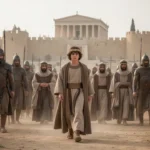
Daniel’s story begins with the Babylonian conquest of Jerusalem and continues through changes in imperial rule. The book mentions Nebuchadnezzar, Belshazzar, Darius, and Cyrus. These names place the narrative in the period when Babylon dominated Judah and when the Persian Empire later controlled the region.
The opening setting reflects the trauma of exile. Jerusalem has been defeated, temple vessels have been taken, and young Judeans are being trained for service in a foreign court. For the people of Judah, the crisis raises painful questions: Has God abandoned them? Can they remain God’s people away from their land and temple? Does the success of Babylon prove that Babylon’s gods are stronger?
Daniel answers these questions through both story and vision. God allows judgment and exile, but he has not lost control. The Babylonian king can carry off sacred vessels, yet he cannot control the meaning of dreams or the destiny of kingdoms. The empire can threaten bodies, but it cannot command genuine worship.
Readers should also recognize that the book’s historical details and composition have been discussed extensively by Jewish and Christian interpreters. Many traditional readers understand Daniel as a sixth-century-B.C. work connected directly with the historical Daniel. Many modern scholars emphasize features that appear to reflect the persecution of Jews under Antiochus IV in the second century B.C. and therefore date the final form of the book later.
That debate should not be reduced to a quick slogan. It involves the relationship between prophecy, historical setting, literary form, language, and the book’s presentation of Daniel as an ancient wise man. Whichever position a reader takes, the book’s message about faithfulness under imperial pressure remains central.
The visions make particularly strong sense for communities facing oppression. Symbolic beasts and arrogant horns allow the book to describe political violence in theological terms. A ruler may present himself as invincible, but Daniel reveals him as temporary, accountable, and bounded by divine authority.
Exile becomes a setting for faithful identity rather than proof of abandonment.
Empire is exposed as temporary, even when it appears invincible.
Wisdom means understanding God’s rule, not merely predicting events.
Deliverance may come through rescue, endurance, or final resurrection.
Why Daniel matters for readers today
Daniel offers a practical picture of integrity in public life. He does not isolate himself from government, education, or administration. He learns the language and literature of Babylon, serves under several rulers, and performs demanding work. Yet he refuses to let professional success erase his worship or moral judgment.
That balance is difficult because compromise often begins gradually. Daniel’s first decision concerns food and personal practice, while later decisions concern idolatry and prayer. His example suggests that small acts of conviction prepare a person for larger tests. Faithfulness is formed before the crisis arrives.
Daniel also shows how to speak truth to power. He interprets frightening dreams, warns kings about pride, and announces judgment to a ruler who has desecrated the temple. He is respectful without being flattering. His loyalty to God makes him more honest, not less responsible, in his public role.
His prayer in chapter 9 provides another model. Daniel does not treat national suffering as an opportunity to condemn everyone else while excusing himself. He identifies with his people, confesses wrongdoing, and asks God for mercy. The prayer combines moral clarity with humility.
The book can also help readers resist sensational approaches to prophecy. Daniel contains genuine mystery, and its symbols have inspired many interpretations. But the visions do not encourage endless speculation detached from obedience. They call readers to remain faithful, reject arrogance, endure suffering, and trust God’s judgment.
A responsible way to read Daniel’s visions includes these habits:
Read each vision in its literary setting. Notice the surrounding prayer, explanation, or historical narrative before assigning a modern meaning.
Compare the symbol with the interpretation provided in the book. Daniel sometimes explains the beasts, horns, or kingdoms directly.
Distinguish clear themes from disputed details. God’s rule and the judgment of evil are clearer than the identification of every prophetic timeline.
Consider the original audience. Exiles and persecuted communities needed courage to remain loyal when empires demanded conformity.
Let hope produce faithfulness. The purpose of the visions is not fear-driven prediction but endurance grounded in God’s final justice.
Daniel is also valuable for understanding how the Bible presents wisdom. Biblical wisdom is not simply intelligence or education. Daniel has both, but his wisdom is shown through dependence on God, disciplined prayer, ethical courage, and truthful speech. Knowledge becomes wise only when it is directed toward what is good.
At the heart of Daniel is a conflict between temporary power and lasting authority. Babylon’s kings build statues, issue decrees, and claim control over life and death. God’s kingdom appears less visible in the short term, yet it is the only rule described as everlasting. That contrast gives the book its enduring force.
For Christians, Daniel contributes to the biblical understanding of Jesus as the Son of Man and to the expectation of resurrection and final judgment. For Jewish readers, it remains a powerful book of covenant loyalty, prayer, wisdom, and hope amid foreign domination. For any reader considering faith under pressure, Daniel asks a direct question: What will you continue to honor when obedience becomes costly?
The answer modeled by Daniel is neither reckless defiance nor passive surrender. It is careful work, persistent prayer, courage before rulers, solidarity with faithful companions, and confidence that no empire has the final word.
Frequently asked questions
Was Daniel a real person in the Bible?
The Book of Daniel presents him as a historical Judean exile who served in the courts of Babylon and Persia. The identity, date, and composition of the book have been debated by scholars, especially because its visions closely address later persecution. Traditional readers identify the book’s author with the Daniel described in its stories, while many modern scholars distinguish the historical figure from the book’s final form.
What is Daniel best known for?
Daniel is best known for surviving the lions’ den after continuing to pray despite a royal ban. He is also remembered for interpreting Nebuchadnezzar’s dreams, explaining the writing on the wall, and receiving visions of future kingdoms and God’s everlasting rule. His defining quality is steady faithfulness rather than a single miracle.
What does the Book of Daniel teach about prophecy?
Daniel presents prophecy as a revelation of God’s authority over kingdoms, suffering, and history. Its visions use symbols that can be difficult to interpret, so readers should avoid treating every number as a precise modern timetable. The clearest message is that arrogant rulers are temporary, faithful people should endure, and God’s justice will ultimately prevail.
Why is Daniel important to Christians?
Christians read Daniel as an important background for Jesus’ use of the title “Son of Man,” especially in relation to Daniel 7. The book also supports Christian teaching about resurrection, judgment, persecution, and God’s everlasting kingdom. Its stories provide practical examples of prayer, integrity, and courage when political or social pressure conflicts with faith.








Leave a Reply