When you read about Daniel serving in a foreign government, you may wonder how someone can remain faithful when the surrounding culture expects compromise. The Book of Daniel answers through stories of courage and visions about kingdoms, judgment, suffering, and God’s lasting rule. It presents Daniel and his friends as people who live responsibly in an empire without allowing the empire to define their worship.
The book combines court narratives with apocalyptic visions. Its first half follows Daniel and his companions through dangerous tests, while its second half records symbolic revelations received by Daniel. Together, these sections encourage faithfulness when political power appears permanent and when the future seems uncertain.
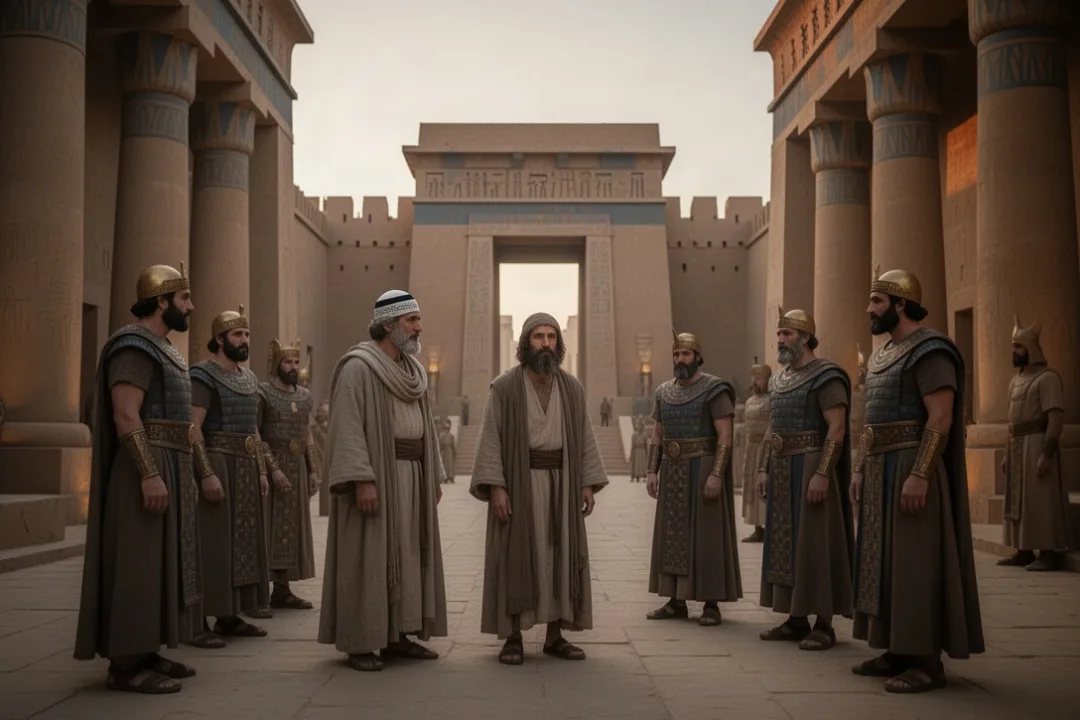
Daniel belongs to the Old Testament and is traditionally associated with Daniel, a Jewish exile in Babylon. The opening chapters place him among young Judeans taken from Jerusalem after Babylon conquered the city. Daniel receives training for royal service, learns the language and literature of the court, and eventually serves under more than one regime.
The book is set during the period when Judah lived under foreign rule. Babylon destroyed Jerusalem and its temple in the sixth century BCE, and many Judeans were deported. The story begins in that world of displacement, but later chapters refer to the rule of the Medes and Persians, showing Daniel’s long career across political transitions.
Daniel is unusual because it uses both Hebrew and Aramaic. Most of the book is written in Aramaic in the central section, while the opening and closing portions are in Hebrew. That bilingual shape reflects the book’s concern with both Israel’s covenant life and the wider international world of empires.
A helpful starting point: Daniel is not only a collection of predictions. Its central question is how God’s people should live faithfully when they are surrounded by powerful institutions, conflicting loyalties, and pressure to conform.
How the book is organized
The easiest way to understand Daniel is to separate its two main forms. Chapters 1 through 6 tell stories about Daniel and his friends, usually involving a royal command, a test of loyalty, and a surprising act of divine help. Chapters 7 through 12 describe visions that Daniel receives and struggles to understand.
Chapter 1: Daniel and his friends enter Babylonian training and refuse the royal food and wine.
Chapters 2–4: Daniel interprets dreams and visions for King Nebuchadnezzar.
Chapter 5: Belshazzar sees mysterious writing during a royal feast, and Daniel explains its judgment.
Chapter 6: Daniel is placed in a lions’ den after continuing his regular prayers.
Chapters 7–8: Daniel sees symbolic beasts, horns, and a ram and goat representing violent political powers.
Chapters 9–12: Daniel prays over Jerusalem, receives further revelations, and hears about suffering, resurrection, and the end of the vision.
This arrangement also creates a movement from public stories to private visions. In the stories, other people often observe Daniel’s faithfulness. In the visions, Daniel himself becomes frightened, confused, and dependent on heavenly interpreters. The book therefore shows both visible courage and inner uncertainty.
What happens in Daniel’s main stories
Daniel and his friends refuse the royal provisions
Daniel, Hananiah, Mishael, and Azariah are taken from Judah and assigned new names connected with Babylonian culture. They are also given food and wine from the king’s table. Daniel decides not to defile himself with those provisions and asks for a limited test involving vegetables and water.
The story emphasizes that Daniel does not begin with a dramatic public confrontation. He makes a careful request to the official responsible for him and accepts a practical trial. After the test, Daniel and his friends appear healthy, and they continue their training. Their faithfulness involves both clear boundaries and wise conduct.
The issue is not simply that every item on a royal menu is inherently evil. The food may represent dependence on the king, participation in practices that conflicted with Jewish identity, or resistance to the process of assimilation. The narrative’s larger point is that Daniel can learn the empire’s language and serve its administration without surrendering his deepest allegiance.
Daniel explains Nebuchadnezzar’s statue dream
King Nebuchadnezzar dreams of a large statue made from several materials. He demands not only an interpretation but also a description of the dream itself, placing his wise men in an impossible position. Daniel asks his friends to pray for mercy, and God reveals both the dream and its meaning to Daniel.
The statue represents a sequence of kingdoms, while a stone that is not made by human hands strikes the statue and becomes a great mountain. The dream communicates that human empires are temporary, even when they seem solid and magnificent. God’s kingdom, by contrast, is portrayed as enduring and not dependent on military force or royal self-promotion.
Daniel responds by giving credit to God rather than claiming unusual wisdom for himself. This detail matters throughout the book: Daniel can possess administrative ability and interpretive skill, but he does not treat those gifts as personal reasons for glory. His wisdom remains received wisdom.
The three friends and the fiery furnace
Hananiah, Mishael, and Azariah—called Shadrach, Meshach, and Abednego in the Babylonian setting—refuse to worship the king’s golden image. Nebuchadnezzar threatens them with a blazing furnace, but they decline to compromise. Their response includes confidence that God can rescue them and a willingness to remain faithful even if rescue does not happen.
The narrative does not present faith as a guarantee of avoiding danger. Instead, it highlights loyalty before outcome. The three men do not bargain with God or claim that suffering would prove God had failed. They worship God because God is worthy of worship, not merely because obedience produces immediate safety.
When the king looks into the furnace, he sees an additional figure with the three men, and they emerge unharmed. Readers have interpreted that figure in different ways, including as an angelic presence or a divine messenger. The text stresses the reality of God’s presence and protection without requiring every reader to settle the figure’s precise identity.
Another royal dream concerns a great tree that provides shelter and food before being cut down. Daniel interprets the tree as Nebuchadnezzar and warns that the king’s pride will lead to humiliation. The king later boasts about his power and accomplishments, and the judgment described in the dream overtakes him.
After a period of abasement, Nebuchadnezzar’s understanding returns, and he acknowledges that God rules over human kingdoms. The chapter does not merely criticize personal arrogance. It exposes the political temptation to treat wealth, territory, and public achievement as proof that a ruler is self-sufficient.
The story gives the powerful a direct warning: authority is accountable. A king may build cities and command armies, but he remains a creature under divine judgment. Daniel’s message is especially sharp because he serves inside the royal system while refusing to flatter its ruler.
The writing on the wall at Belshazzar’s feast
Belshazzar holds a lavish feast and uses vessels taken from the Jerusalem temple. During the celebration, a hand writes mysterious words on the wall. Daniel is called to read and interpret them after other experts fail.
Daniel reminds Belshazzar of Nebuchadnezzar’s earlier humiliation and explains that Belshazzar has not learned humility from it. The writing announces that the king’s rule has been evaluated and found lacking, and that his kingdom will be divided. That same night, the chapter records the end of his reign.
The story links reverence, memory, and accountability. Belshazzar is not judged merely for holding a feast. He is judged for treating sacred things with contempt and refusing to learn from history. Daniel’s interpretation shows that judgment can arrive after a long period of apparent stability.
Daniel in the lions’ den
Officials who resent Daniel’s success persuade King Darius to approve a decree restricting prayer. Daniel learns about the decree but continues praying toward Jerusalem three times a day, as he had done before. His opponents report him, and the king is forced to place him in a den of lions.
Daniel’s practice is both public and ordinary. He does not stage a protest or seek danger, but he will not abandon a settled rhythm of prayer. His opponents understand that his integrity is consistent enough to become predictable. They cannot find corruption in his administration, so they target his worship.
God protects Daniel, and the king discovers him alive the next morning. The chapter portrays prayer as an expression of steady allegiance, not a technique for controlling events. Daniel prays before the crisis, remains faithful during it, and does not use the outcome to claim personal invulnerability.
What the visions of Daniel communicate
The visions use symbols because they address political realities that ordinary description cannot fully capture. Beasts, horns, heavenly courts, violent conflicts, and mysterious numbers portray kingdoms as more than neutral administrative structures. They reveal the brutality, arrogance, and instability that can hide behind official power.
The four beasts and the heavenly court
In chapter 7, Daniel sees four beasts rising from the sea. They represent kingdoms or rulers, but their animal-like forms also suggest that political authority has become predatory. The fourth beast is especially terrifying and has horns connected with rulers who speak arrogantly and persecute the holy people.
Then the scene shifts to a heavenly court. The Ancient of Days takes his seat, books are opened, and judgment is rendered. A figure described as “one like a son of man” approaches and receives an everlasting kingdom. Rather than quoting the vision, it is enough to observe that this figure represents human dignity and rightful rule in contrast to the beasts’ violence.
Many Christian readers connect this “son of man” figure with Jesus’ use of the same expression in the Gospels. In Daniel itself, the figure is part of a vision about God’s judgment on oppressive kingdoms and the vindication of the holy people. Interpretations differ on how the individual figure and the community are related.
The ram, the goat, and the arrogant horn
Chapter 8 presents a ram with two horns and a goat with a prominent horn. The angel Gabriel explains that the animals symbolize kingdoms, and the imagery describes a rapid conquest followed by fragmentation. A later ruler emerges from that fractured setting and becomes especially aggressive toward the holy people and the sanctuary.
The vision’s political symbolism is more specific than the earlier dream of the statue. Many scholars connect the ram with the Medo-Persian empire and the goat with Greece, while the prominent later horn is commonly associated with Antiochus IV Epiphanes. He ruled in the second century BCE and interfered severely with Jewish worship in Jerusalem.
Daniel’s vision speaks to communities facing religious persecution by showing that oppression has a limit. The persecuting ruler may appear to grow powerful, but the vision sets boundaries around his authority. History is not uncontrolled, even when faithful people cannot yet see how justice will come.
The seventy weeks and Daniel’s prayer for Jerusalem
Chapter 9 begins with Daniel reading Jeremiah’s prophecy about Jerusalem’s desolation. He responds not by calculating dates immediately but by confessing the nation’s sin and asking God for mercy. His prayer recognizes both the justice of exile and the faithfulness of God’s covenant promises.
Gabriel then gives Daniel a revelation involving seventy “weeks,” a term that can refer to groups of seven. The passage is difficult and has generated several major interpretive approaches. Some readers understand the periods symbolically, while others connect them to sequences of historical events, the rebuilding of Jerusalem, persecution, or future fulfillment.
The safest central emphasis is that prayer and prophecy belong together. Daniel does not treat revelation as a replacement for repentance. He reads Scripture, identifies with his people’s failure, and asks God to restore Jerusalem and the sanctuary.
The final vision and the hope of resurrection
Chapters 10 through 12 describe an extended vision involving spiritual conflict, earthly rulers, and a period of severe distress. Daniel receives information about political struggles, but the vision does not turn history into a simple list of dates. It portrays events from the perspective of heavenly conflict and divine purpose.
Near the end, the book expresses one of the clearest Old Testament hopes for resurrection and final judgment. The dead are described as awakening, with different outcomes for the righteous and the wicked. Those who have lived wisely and helped others toward righteousness are honored with lasting radiance.
The message is not that believers will understand every detail of the future. Daniel himself is told that some matters remain sealed until the appointed time. The vision offers confidence that faithfulness is not wasted, evil will not have the last word, and God’s justice reaches beyond the limits of one lifetime.
Major themes that connect the whole book
Faithfulness in a foreign culture
Daniel and his friends live in Babylon, learn its language, accept government assignments, and interact with rulers. They are not portrayed as withdrawing from public life. At the same time, they refuse practices that would make the empire their ultimate authority.
This balance is one of the book’s most useful features. Faithfulness does not require ignorance of the surrounding culture, and public service does not require surrendering religious conviction. Daniel models competent participation with moral limits.
God’s sovereignty over political power
Nearly every major ruler in Daniel must learn that authority is temporary. Nebuchadnezzar receives kingdoms and loses his stability through pride. Belshazzar’s feast ends in judgment. The visions portray successive empires as beasts that rise and fall under the scrutiny of heaven.
That claim is not a promise that every political event will be easy to explain. It is a declaration that no government is ultimate. The book gives readers a way to respect legitimate authority without treating any ruler, nation, or political program as sacred.
Wisdom under pressure
Daniel’s wisdom includes interpretation, administration, restraint, and timing. He asks for help, seeks prayer from his friends, speaks truth to rulers, and avoids unnecessary provocation. His courage is not reckless; it is joined to discernment and self-control.
The book also recognizes that wisdom can be emotionally costly. Daniel is troubled by his visions, loses strength, and needs heavenly messengers to help him understand. A faithful person may be confused or afraid without becoming faithless.
Prayer as a response to crisis
Prayer appears when Daniel needs the interpretation of Nebuchadnezzar’s dream, when he confesses Israel’s sin, and when he faces the royal decree. These prayers are not decorative details. They show that Daniel responds to political danger by turning toward God rather than relying only on strategy.
His prayer in chapter 9 is especially instructive because Daniel includes himself in the confession. Although the narrative presents him as personally faithful, he does not place himself above his community. He prays as a member of a people who need forgiveness and restoration.
Perseverance when deliverance is uncertain
The fiery furnace and lions’ den are often remembered because Daniel and his friends survive. Yet the strongest statements of faith occur before the outcome is known. The three men are willing to remain faithful even if the furnace takes their lives, and Daniel continues his prayers despite knowing the penalty.
Daniel therefore avoids a shallow promise that obedience always produces immediate protection. Sometimes God rescues people from danger; sometimes faithful people suffer or die. The book insists that God’s worth does not depend on an easy outcome.
How to read Daniel’s prophecy responsibly
Prophetic passages invite strong opinions, especially when readers try to connect them with current events. Daniel does speak about kingdoms, persecution, judgment, and the future, but its symbols should not be treated as a code that automatically identifies every modern leader or headline.
Begin with the vision’s own explanation. Chapter 7 interprets the beasts as kingdoms, and chapter 8 identifies the ram and goat in relation to major empires. Historical context helps prevent interpretations that ignore the book’s original audience and the political pressures they faced.
It also helps to distinguish between clear theological claims and disputed chronological details. The book clearly teaches that arrogant power is judged, God’s kingdom endures, and the faithful are ultimately vindicated. Christians and Jewish interpreters have differed over the precise timing and referents of many symbols.
Read the surrounding narrative. A symbol in Daniel belongs to a vision with a setting, audience, and emotional response.
Look for the interpretation inside the book. The explanations given by angels or narrators should guide any later application.
Compare related biblical passages carefully. Connections with Ezekiel, Jeremiah, Zechariah, Revelation, and the Gospels can be valuable, but they should not erase Daniel’s own context.
Separate application from identification. A vision may warn against arrogant rulers without naming a particular modern ruler.
Keep the ethical purpose in view. Prophecy calls readers to endurance, worship, repentance, and hope—not merely speculation.
Be cautious with date-setting: Daniel’s visions have inspired many predictions about exact end-time schedules. The book itself emphasizes perseverance and God’s authority more clearly than it supplies a timetable for modern readers.
What Daniel can mean for life today
Daniel speaks to anyone who must work, study, or serve within institutions that do not share their faith. Its characters do not control the empire, but they can control the integrity of their decisions. They refuse false worship, perform their duties well, and speak honestly when rulers are wrong.
For a student, employee, public servant, or business leader, this may mean identifying practices that cross a genuine moral boundary rather than treating every inconvenience as persecution. It may also mean developing excellence in ordinary responsibilities. Daniel’s influence comes partly from the fact that hostile officials cannot find corruption in his work.
The book also challenges despair. Political systems can appear permanent, and injustice can seem too strong to resist. Daniel’s visions place those systems inside a larger horizon where judgment is real, evil is limited, and faithful endurance matters even when success is not immediate.
Prayer remains one of the book’s most practical patterns. Daniel does not wait until a crisis to develop a spiritual life. His established habits make his priorities visible when pressure arrives. A regular practice of prayer, Scripture reading, confession, and community support can similarly prepare you to respond with clarity rather than panic.
Finally, Daniel teaches humility about the future. The visions reveal enough to sustain hope but not enough to satisfy every curiosity. A mature reading allows mystery to remain while holding firmly to the book’s central convictions: God rules over the kingdoms of the world, human pride is accountable, and those who remain faithful are not forgotten.
A practical reading plan for the Book of Daniel
You can read Daniel in one sitting, but a slower approach makes its changes in genre easier to notice. Read the stories first, then return to the visions with the earlier examples of faithfulness in mind. The same questions recur across both sections: Who has authority? What does faithfulness cost? How does God respond to arrogant power?
First reading: Read chapters 1–6 as connected stories about life in imperial service.
Second reading: Read chapters 7–12 slowly, marking every symbol that receives an explanation.
Context check: Notice references to Jerusalem, the temple, exile, kings, and foreign kingdoms.
Personal reflection: Identify where the book addresses compromise, pride, prayer, courage, and hope.
Community discussion: Compare interpretations of difficult visions without treating disagreement as a failure of faith.
Questions can help you read each chapter carefully. Ask what the ruler demands, what the faithful person does, what danger follows, and what the narrative says about God’s authority. For the visions, ask what the symbols represent within the passage, who explains them, and how the vision is meant to shape the reader’s conduct.
Daniel is ultimately a book about living faithfully under pressure while trusting that earthly power is not the final reality. Its stories make that trust concrete, and its visions widen the horizon from one royal court to the judgment of all kingdoms. Read together, they call for courage without arrogance, service without compromise, and hope without speculation.
Frequently asked questions
Was Daniel a historical person?
Daniel is presented as a Jewish exile who served in Babylonian and later Persian royal courts. The book’s historical details and date of composition are discussed differently by scholars, especially because its visions closely address conflicts associated with the second century BCE. Readers may affirm the book’s theological message while recognizing that questions about its formation and historical setting remain debated.
Why does Daniel use different languages?
The book contains sections in Hebrew and Aramaic, the latter being widely used across the ancient Near East. The language change may reflect different sources, audiences, or literary purposes. It also fits Daniel’s setting as a Jewish figure working within international imperial culture while remaining connected to Israel’s Scriptures and worship.
Is the Book of Daniel part of the Bible’s wisdom literature?
Daniel shares features with wisdom literature, especially its stories about court sages, dreams, interpretation, and wise conduct. In the Hebrew Bible, however, Daniel is commonly placed among the Writings rather than the Prophets. Christian traditions generally place it among the Major Prophets because of its visions and prophetic message.
How is Daniel connected to the Book of Revelation?
Revelation draws on Daniel’s imagery of beasts, horns, heavenly judgment, and God’s everlasting kingdom. These connections help readers see how early Christian authors interpreted Daniel’s hope. Revelation does not simply provide a one-to-one decoding of every Daniel symbol; each book has its own setting, purpose, and symbolic development.






Leave a Reply