Uzziah of Judah: reign, achievements, and downfall
Uzziah of Judah: reign, achievements, and downfall
When you read that a king ruled Judah for more than half a century, you may wonder what made his reign so long and what eventually went wrong. Uzziah of Judah was one of the kingdom’s most successful rulers in its early years, but his story also shows how achievement can become dangerous when a leader rejects proper limits.
Uzziah became king as a teenager and ruled Jerusalem for approximately 52 years. The biblical accounts describe military victories, building projects, agricultural development, and a well-organized army. They also describe a decisive act of disobedience: Uzziah entered the temple sanctuary to burn incense, a duty assigned to priests, and was struck with a serious skin disease.
His reign appears in 2 Kings 15 and 2 Chronicles 26. The books use two names for him: Uzziah and Azariah. These names refer to the same king of Judah. His life is remembered both for the strength he brought to the nation and for the pride that damaged the final years of his rule.
Uzziah was the son of Amaziah, king of Judah, and his mother was Jecoliah of Jerusalem. He belonged to the Davidic royal line and ruled from Jerusalem, the capital of the southern kingdom. The biblical account says that the people of Judah made him king after his father’s death.
Uzziah was only 16 years old when he began to reign. A young king would have needed experienced officials, military commanders, priests, and advisers to manage the kingdom. The record presents his early rule as a period in which he sought God and received help, rather than as a time when he acted entirely on his own.
Second Kings calls him Azariah, while Second Chronicles calls him Uzziah. The difference can confuse modern readers, but it is not evidence of two separate kings in this context. Biblical names sometimes appear in variant forms, and the details of the reign—his father, kingdom, long rule, and skin disease—identify the same person.
The prophet Isaiah also refers to the year King Uzziah died. Isaiah’s temple vision is dated to that turning point, which connects Uzziah’s death with a major moment in Judah’s prophetic history. The reference does not make Uzziah the subject of Isaiah’s vision, but it shows how memorable the end of his reign was.
How Uzziah strengthened Judah
Uzziah’s early success was not limited to one military victory. The biblical narrative describes a broad program of strengthening Judah’s borders, defenses, agriculture, and army. His achievements help explain why later readers regarded his reign as unusually prosperous and powerful.
He fought against the Philistines and captured or damaged several of their fortified places, including Gath, Jabneh, and Ashdod. These cities represented important centers of Philistine influence west of Judah. The account also mentions battles against Arab groups and the Meunites, suggesting that Uzziah’s military activity extended beyond the immediate border with Philistia.
The Ammonites also paid tribute to Uzziah. The biblical writer presents this as evidence that his reputation and power reached beyond Judah itself. At the same time, the account does not portray every neighboring population in exactly the same way; some were defeated, while others appear to have acknowledged Judah’s authority through payments.
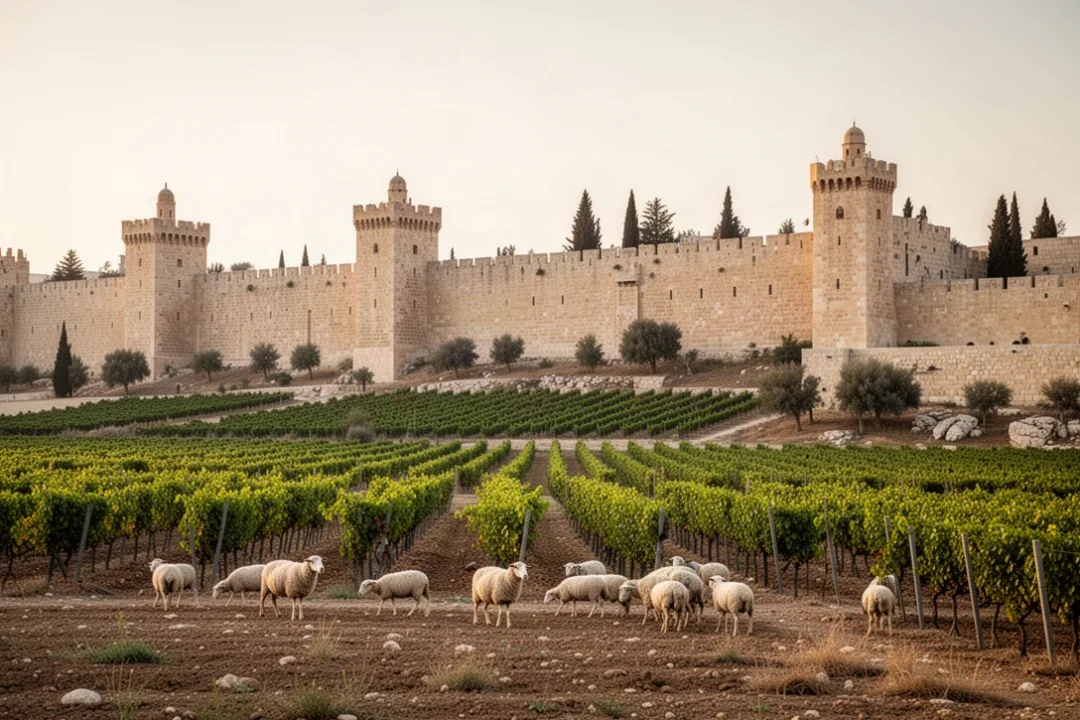
Uzziah also strengthened Jerusalem and other parts of Judah by building towers and fortifying strategic locations. Defensive towers could serve as observation posts, protected positions, and bases for soldiers. Such construction mattered in a period when cities were vulnerable to raids and armies often targeted walls, gates, and supply routes.
His building program included work in the wilderness, where he constructed and improved facilities for livestock. This detail shows that his administration was concerned not only with royal monuments or military walls but also with the practical economy of the kingdom.
Uzziah’s agricultural and economic policies
Second Chronicles describes Uzziah as having people who worked the land and raised livestock. He had wells dug and supported farming in the foothills and plains. These projects were especially useful in a largely agricultural society, where reliable water, grazing land, and crop production affected both household survival and national strength.
The king’s interest in agriculture reveals a broader understanding of security. A kingdom could not depend on soldiers alone. It needed food supplies, healthy animals, water access, and productive land. A stable agricultural base could support the army, provide revenue, and help cities endure periods of conflict.
The biblical description also connects Uzziah’s success with organization. He had people responsible for fields, vineyards, herds, and other resources. This suggests an administrative system capable of coordinating large projects across the kingdom, even though the text does not provide a complete description of how that system operated.
His reign therefore combined several forms of power:
Military power through trained troops and successful campaigns.
Defensive power through fortified towers, walls, and strategic positions.
Economic power through farming, vineyards, livestock, and water development.
Political power through influence over neighboring peoples and tribute.
These achievements should not be reduced to personal ambition. The account presents them as benefits to Judah during the years when Uzziah followed God and accepted guidance. His success was substantial, but the biblical writer does not treat success as proof that a king could ignore divine instruction.
Uzziah’s army and military technology
Uzziah organized a large fighting force under capable officials. The soldiers were grouped according to families and military divisions, and the army included trained warriors. The account also mentions shields, spears, helmets, armor, bows, and slings, showing that Judah’s forces were equipped for different types of combat.
One of the most distinctive details is the reference to devices designed by skilled craftsmen. These machines were placed on Jerusalem’s towers and corners of the wall to shoot arrows and large stones. The text does not explain their exact mechanical design, so it is best to avoid assigning them a specific modern label. Their purpose, however, was clearly defensive: they allowed defenders to attack forces approaching the city.
Uzziah’s army was not simply a crowd assembled in an emergency. It had officers, divisions, weapons, and a system for recording and organizing soldiers. This structure would have made Judah more prepared for invasion and better able to project force into neighboring territories.
His military reforms also help explain why the kingdom could withstand threats while expanding its influence. Strong fortifications protected population centers, while a trained army could respond beyond the capital. The combination of defense and offense gave Uzziah a reputation that extended across the region.
A useful distinction: The biblical account credits Uzziah with real administrative and military achievement, but it does not present those achievements as a license for unrestricted authority. His later downfall came when he crossed a boundary that the priesthood and temple regulations reserved to others.
Why Uzziah was considered successful at first
The central explanation in Second Chronicles is that Uzziah sought God during the days of the priest and adviser named Zechariah. Zechariah is described as someone who understood or instructed him in the fear of God. While that relationship continued, the account says, God gave Uzziah success.
This wording places Uzziah’s achievements inside a theological framework. His victories, building work, and prosperity were not described as merely the result of intelligence, technology, or favorable circumstances. The biblical writer regarded his dependence on God and willingness to receive instruction as essential to the health of his reign.
The account does not give many details about Zechariah’s background or later life. It also does not say that Uzziah was flawless during this period. Instead, it emphasizes a general pattern: humility and responsiveness preceded success, while self-exaltation later brought judgment.
That pattern matters because Uzziah’s story is not a simple contrast between a good king and a bad king. He was the same ruler who built defenses, improved agriculture, organized soldiers, and later entered the temple unlawfully. The biblical narrative holds both realities together.
What Uzziah did in the temple
Uzziah’s downfall began when he entered the temple to burn incense on the altar of incense. Burning incense was a sacred act associated with the priests. The priests confronted him and told him that the task was not his to perform, even though he was king.
More than 80 priests opposed him, led by Azariah the chief priest. They urged Uzziah to leave the sanctuary and warned that his action would not bring him honor before God. The confrontation shows that the priesthood regarded the temple’s boundaries as binding even on the monarch.
Uzziah became angry. According to the account, while he was holding the incense burner and the priests were confronting him, a skin disease appeared on his forehead. The biblical text uses a term often translated as leprosy, but the ancient condition described by that word should not automatically be identified with modern Hansen’s disease.
The priests quickly forced him out, and Uzziah himself hurried to leave because he recognized that God had struck him. His anger did not overcome the temple’s authority. Instead, the incident ended his direct participation in royal public life.
Why the temple incident mattered
The problem was not that Uzziah prayed or entered a place of worship. The issue was that he claimed a priestly function that had been assigned to another group. In the biblical order of worship, kings and priests had different responsibilities. Royal power did not erase those distinctions.
Uzziah’s action may have appeared small—a single act of burning incense—but it represented a much larger claim. He attempted to treat his political authority as if it also gave him unrestricted religious authority. The priests’ resistance made clear that the king remained accountable to God’s commands.
The narrative also links the act to pride. Uzziah had become strong, and the account says that his heart became proud to his destruction. His strength was not condemned in itself. His error was allowing success to reshape his understanding of his own position.
This is one of the most significant lessons in the story: achievement can produce a false sense of entitlement. A person may begin by receiving help, instruction, and responsibility, then gradually assume that success proves every desire is justified. Uzziah’s strength became the setting for his presumption.
What happened to Uzziah after his punishment
After the skin disease appeared, Uzziah could no longer live in the palace or carry out normal royal duties. He lived in a separate house, while his son Jotham supervised the palace and governed the people. The wording shows that Uzziah remained king in name, but his practical authority was transferred to his son.
Uzziah’s isolation was connected to his diseased condition. In the biblical law concerning skin diseases, a person in such a state was separated from the community, especially from sacred spaces. The king’s royal status did not exempt him from that rule.
Jotham’s role provided continuity for Judah. The kingdom did not collapse simply because Uzziah could no longer appear publicly. Administration continued under the next generation, allowing Jotham to gain experience before Uzziah’s death.
Uzziah eventually died and was buried near the kings in the burial field belonging to the kings. Second Kings and Second Chronicles describe the burial with care because his condition affected how he was remembered. He received an honored royal burial, but the account also preserved the fact that he had suffered from the skin disease as a consequence of entering the temple.
The tension is deliberate. Uzziah was a powerful Davidic king, yet his final years were marked by exclusion and limitation. His burial recognized his office, while the account of his disease remembered his transgression.
Uzziah and the beginning of Isaiah’s prophetic ministry
The death of Uzziah appears at the beginning of Isaiah 6. Isaiah says that he saw the Lord in the year King Uzziah died. This date creates a historical setting for Isaiah’s temple vision and calling, rather than suggesting that Uzziah appears in the vision itself.
Uzziah’s death may have carried symbolic weight for Judah. A long-reigning monarch had provided continuity and stability, but the nation now faced a change of leadership and an uncertain future. Isaiah’s vision emphasizes God’s holiness and sovereignty at a moment when human political security was changing.
The connection also encourages readers to see the limits of earthly kingship. Uzziah had built towers, commanded armies, and strengthened Jerusalem, but he was still subject to death and judgment. The prophetic vision shifts attention from the throne of Judah to the heavenly King.
Isaiah’s reference does not mean that his entire prophetic ministry began only after Uzziah’s death; the biblical material does not require that narrow assumption. It does show that Uzziah’s death was a recognizable marker in Judah’s history and a significant date for the prophet.
Common mistakes when reading Uzziah’s story
Several details about Uzziah can be misunderstood when the accounts in Kings and Chronicles are read quickly. Keeping the following distinctions in mind makes the story clearer.
Do not treat Uzziah and Azariah as two kings. In these accounts, the two names refer to the same ruler of Judah.
Do not assume every success was condemned. His army, fortifications, farming projects, and victories are presented as genuine achievements.
Do not reduce the punishment to a random illness. The narrative directly connects the skin disease with his unlawful attempt to burn incense.
Do not confuse a king’s authority with priestly authority. Uzziah’s royal office did not permit him to perform every sacred duty.
Do not claim that modern medicine has identified the exact disease. “Leprosy” is a traditional translation, but the ancient term and modern diagnosis are not automatically identical.
Do not forget Jotham’s role. Uzziah’s son governed while Uzziah lived in isolation, which explains how royal administration continued.
Do not portray Uzziah as either entirely virtuous or entirely wicked. The biblical account presents a successful ruler whose pride brought a serious reversal.
Practical ways to study Uzziah of Judah
If you want to understand Uzziah accurately, read the biblical references in more than one setting. Second Kings gives a concise royal evaluation, while Second Chronicles supplies the fuller account of his military, agricultural, and temple-related activities.
Start with 2 Kings 15:1–7. Notice Uzziah’s age, length of reign, family background, and the brief statement about his condition.
Read 2 Chronicles 26. Follow the sequence from early success to military organization, prosperity, pride, temple confrontation, isolation, and death.
Compare the names. Mark where the text says Azariah and where it says Uzziah so the difference does not create a false second character.
Track the turning point. Observe how the narrative moves from seeking God and receiving help to becoming strong and then proud.
Read Isaiah 6:1 in context. Consider why the death of Uzziah provides the historical setting for Isaiah’s temple vision.
Separate description from speculation. Keep clear what the text states about the disease, military equipment, and chronology from later assumptions about them.
A useful study question is, “What changed in Uzziah?” The answer is not simply that he gained power. He had power early in his reign as well. The decisive change was in his posture: he moved from receiving instruction and seeking God to acting as though his success entitled him to cross a sacred boundary.
What Uzziah’s life teaches about leadership
Uzziah’s life shows that a leader’s strengths can become weaknesses when they are no longer governed by humility. Organization, courage, technical skill, and ambition helped Judah prosper. Yet the same confidence that supported large projects may have encouraged him to dismiss the warnings of the priests.
His example also illustrates the value of defined responsibilities. A healthy kingdom required soldiers, farmers, officials, priests, and a king. Each role mattered, but no role automatically absorbed the others. Uzziah’s failure came when he treated royal power as permission to take over a function assigned to priests.
The story offers a warning for anyone with influence. Success can create access, recognition, and confidence, but it does not remove accountability. A person may be highly capable and still need correction. Uzziah’s long reign makes the warning sharper because his accomplishments were real.
His life also shows why biblical narratives preserve uncomfortable details about respected leaders. The writer does not hide Uzziah’s achievements, but neither does he excuse the king’s pride. This balanced presentation allows readers to see that public success and personal faithfulness are related but not identical.
How Uzziah fits into Judah’s royal history
Uzziah ruled during a period when Judah and Israel could still exercise considerable regional power. His reign overlapped with the rule of Jeroboam II in the northern kingdom of Israel, although the biblical accounts focus on different aspects of the two kingdoms. The political circumstances of the wider region helped make military strength and fortified cities especially important.
Uzziah’s long reign also connected two generations of Judah’s leadership. He followed Amaziah and was followed by Jotham. Because he became king so young and ruled for many years, his reign shaped Judah’s political culture over an extended period.
Yet length alone does not define his significance. Uzziah is remembered because his rule brought together national growth and personal failure. Judah became stronger under his administration, but the king’s own authority was limited by divine law. His story therefore belongs both to the history of Judah’s expansion and to the biblical reflection on pride.
For readers studying the kings of Judah, Uzziah provides a particularly clear example of a ruler whose reign cannot be summarized with a single label. He was a builder, commander, organizer, and agricultural patron. He was also a king who crossed a sacred boundary and spent his final years separated from public life.
Why Uzziah still matters to readers
Uzziah of Judah matters because his story addresses a question that reaches beyond ancient monarchy: How should people handle success? The biblical answer is not to reject strength or responsibility, but to use them within the limits established by God and to remain willing to receive correction.
His reign demonstrates that practical competence can benefit an entire community. Water systems, productive land, defensive walls, trained soldiers, and responsible administration all mattered to Judah’s welfare. But the temple incident demonstrates that competence cannot justify every action.
Uzziah’s life is therefore both historical and moral. It preserves the memory of a king who strengthened Judah while warning that power without humility leads to isolation. His achievements explain why he was respected; his downfall explains why respect alone is not the same as faithfulness.
Read together, the accounts in Kings, Chronicles, and Isaiah present a ruler whose life moved from promise to prosperity, from prosperity to pride, and from pride to limitation. That pattern makes Uzziah one of the most instructive kings in the history of Judah.
Frequently asked questions
Why is Uzziah also called Azariah?
Uzziah and Azariah are variant names for the same king of Judah in the biblical accounts. Second Kings commonly uses Azariah, while Second Chronicles uses Uzziah. His family background, long reign, military achievements, temple incident, and son Jotham identify the same ruler rather than two different kings.
How long did Uzziah rule Judah?
Uzziah ruled Judah for approximately 52 years, beginning when he was 16. His long reign gave him time to strengthen the army, improve defenses, develop agriculture, and expand Judah’s influence. Because he was isolated after his temple offense, his son Jotham handled practical government during the later part of his rule.
What was Uzziah’s main sin?
Uzziah’s main recorded offense was entering the temple to burn incense on the altar. That responsibility belonged to the priests, not the king. When the priests confronted him, he became angry, and a serious skin disease appeared. The narrative presents this act as an expression of pride and disregard for God’s established boundaries.
What can Uzziah’s story teach about success?
Uzziah’s story shows that success requires humility and accountability. His military, agricultural, and building achievements were real benefits to Judah, but they did not give him unlimited authority. The account warns that strength can become pride when a person stops accepting correction or assumes that past accomplishments justify crossing important boundaries.







Leave a Reply