Sennacherib in the Bible: his campaign against Jerusalem
Sennacherib in the Bible: his campaign against Jerusalem
If you have read about Sennacherib in the Bible, you may wonder why this Assyrian king appears in several books and how his invasion of Judah ended. The central event is his campaign against Jerusalem during the reign of King Hezekiah. Sennacherib’s army captured many fortified cities in Judah, but Jerusalem did not fall.
The biblical account appears in 2 Kings 18–19, 2 Chronicles 32, and Isaiah 36–37. These passages describe a crisis in which Assyria demanded surrender, mocked Judah’s trust in God, and surrounded the capital. According to the biblical narrative, God intervened, the Assyrian army withdrew, and Sennacherib later died in his own land.
Sennacherib was an Assyrian king who ruled in the late eighth and early seventh centuries BCE. He succeeded his father, Sargon II, and inherited one of the ancient Near East’s strongest empires. Assyria controlled a vast area through military conquest, tribute demands, deportations, and the installation of loyal rulers.
Judah was a smaller kingdom in the hill country west of the Dead Sea. Its capital, Jerusalem, was politically and religiously important, but it was not a match for Assyria in military strength. Hezekiah became king of Judah after a period in which Assyria had already pressured neighboring kingdoms and reduced Israel’s independence.
Hezekiah resisted Assyrian influence. According to 2 Kings 18, he stopped paying tribute to the king of Assyria and also opposed the Philistines who had accepted Assyrian control. From Judah’s perspective, this was an attempt to regain independence. From Assyria’s perspective, it was rebellion that required punishment.
The basic answer: Sennacherib invaded Judah to reassert Assyrian authority. The Bible presents his attack as a military and spiritual confrontation: Assyria trusted in imperial power, while Hezekiah was called to trust God.
Where the Bible tells Sennacherib’s story
The account is repeated in three biblical books, with each version emphasizing related details. Reading the passages together helps you see both the historical crisis and the Bible’s interpretation of it.
2 Kings 18–19: gives the main narrative, including the Assyrian campaign, the speech of the Rabshakeh, Hezekiah’s prayer, Isaiah’s message, and the army’s destruction.
2 Chronicles 32: highlights Hezekiah’s preparations for defense, his efforts to strengthen Jerusalem, and his encouragement to the people.
Isaiah 36–37: presents the crisis within the larger message of Isaiah, focusing strongly on God’s holiness, Jerusalem’s deliverance, and the limits of Assyrian power.
The same episode also appears indirectly in Isaiah 10, where Assyria is described as an instrument used for judgment but also held accountable for its arrogance. These passages do not treat Sennacherib as a neutral historical figure. They portray him as a proud ruler whose power is real but ultimately limited.
What happened during Sennacherib’s invasion of Judah
The biblical account can be followed in a series of stages. The order matters because the story moves from Assyria’s apparent victory to Jerusalem’s unexpected preservation.
Assyria invaded Judah. Sennacherib came against the fortified cities of Judah and captured them. The text does not describe the campaign as a minor raid; it presents the invasion as a serious national emergency.
Hezekiah acknowledged the pressure. He sent a message to Sennacherib at Lachish, admitted that he had acted wrongly, and offered to pay whatever the Assyrian king demanded.
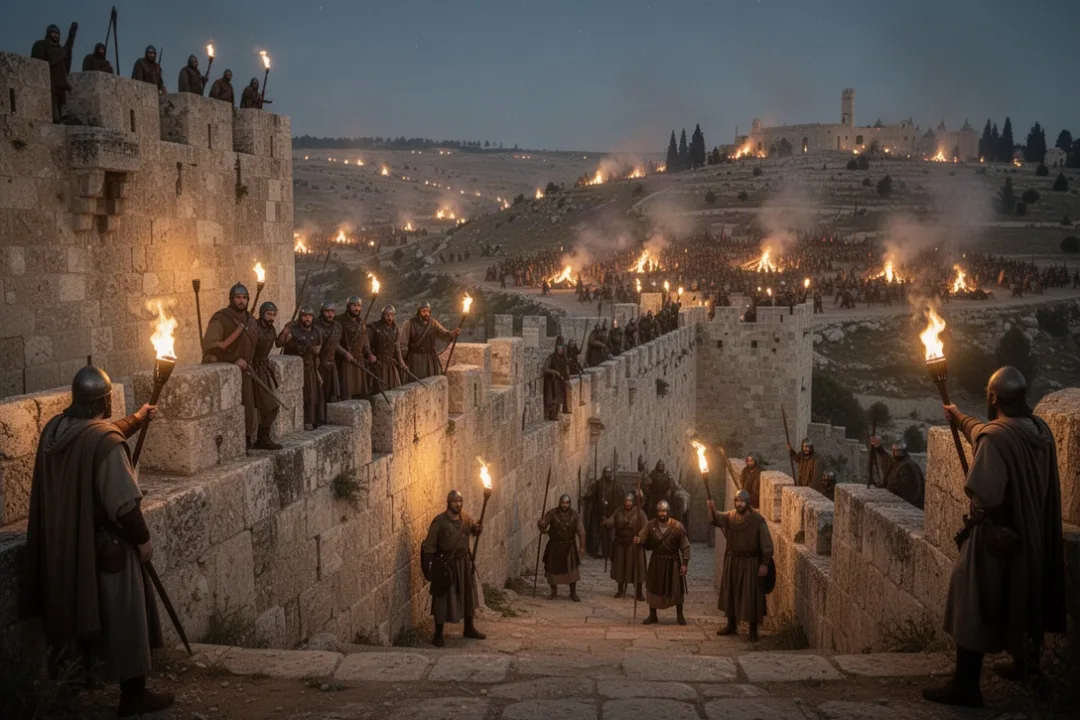
Assyria demanded Jerusalem’s surrender. Sennacherib sent senior officials, including the Rabshakeh, to speak to Jerusalem’s representatives and the people on the city wall.
The Rabshakeh attacked Judah’s confidence. He mocked Hezekiah, questioned Egypt’s ability to help, and argued that the Lord could not rescue Jerusalem from Assyria.
Hezekiah sought God’s direction. He tore his clothes, went to the temple, and sent messengers to the prophet Isaiah.
Isaiah announced deliverance. The prophet said that Sennacherib would not enter Jerusalem, shoot an arrow there, or build a siege ramp against it.
The Assyrian army was struck. The biblical narrative says that an angel of the Lord killed 185,000 in the Assyrian camp.
Sennacherib withdrew. He returned to Nineveh, the Assyrian capital, and did not capture Jerusalem.
This progression is the heart of the story. Assyria had already taken Judah’s cities, so the Bible does not present Jerusalem’s survival as evidence that Judah was militarily superior. Instead, the city’s preservation is attributed to divine intervention in response to Hezekiah’s prayer.
Why Lachish matters in the biblical account
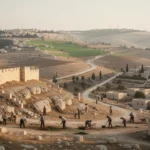
Lachish was one of Judah’s strongest fortified cities and held a strategic position in the foothills west of Jerusalem. During the invasion, Sennacherib operated from Lachish, and the biblical narrative places the Assyrian delegation there before it went to confront Jerusalem.
The city’s importance is also supported by Assyrian royal records and artwork. Reliefs from Sennacherib’s palace at Nineveh depict the siege and capture of Lachish. The scene shows the city under attack and prisoners being taken away, giving modern readers an external picture of the military campaign described in the Bible.
Lachish helps explain why Hezekiah faced such a severe crisis. The Assyrians were not merely making threats from a distant border. They had already conquered important Judean defenses and were close enough to place Jerusalem under direct pressure.
Second Chronicles 32 says that Hezekiah prepared Jerusalem by strengthening walls, organizing military leadership, and securing the city’s water supply. The account also describes his effort to encourage the people not to fear the Assyrian king. These preparations show that biblical faith did not mean ignoring practical defense.
What the Rabshakeh said to Jerusalem
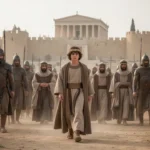
The Assyrian spokesman is called the Rabshakeh, which is generally understood as a title rather than a personal name. He stood near Jerusalem’s wall and spoke in a language the city’s ordinary residents could understand. The Judean officials asked him to use Aramaic instead, but he continued speaking publicly in a way designed to frighten the population.
His speech used several persuasive tactics. First, he challenged Judah’s political alliances. Hezekiah had looked to Egypt for help, but the Rabshakeh compared Egypt to a broken reed that would injure anyone leaning on it. The point was that foreign assistance could not save Judah from Assyria.
Second, he challenged Hezekiah’s religious reforms. He claimed that Hezekiah had offended the Lord by removing local high places and altars. This was misleading from the perspective of the biblical writers, who present Hezekiah’s centralization of worship as a reform rather than an insult to God.
Third, he claimed that the Lord Himself had commanded Assyria to attack Judah. The statement reflects a recurring biblical theme: God may use an empire as an instrument of judgment, but that does not excuse the empire’s pride or violence.
Finally, the Rabshakeh offered the people a tempting alternative to destruction. He promised that surrender would bring them to a land with grain, vineyards, and abundant water until they could be moved to another place like their own. The offer was part of Assyrian propaganda, because conquest normally involved deportation and loss of political independence.
The Rabshakeh’s speech was designed to make Jerusalem believe that resistance was both foolish and religiously hopeless.
His message was effective enough to distress the Judean officials. Yet the people on the wall remained silent because Hezekiah had instructed them not to answer. Their silence prevented a public debate from turning into panic or division.
How Hezekiah responded to Sennacherib’s threat
Hezekiah’s response combines grief, humility, action, and prayer. When he heard the Assyrian message, he tore his clothes and covered himself with sackcloth, traditional signs of mourning and repentance. He then went to the temple and sent representatives to Isaiah.
Hezekiah did not pretend that Assyria was harmless. His prayer acknowledged the reality of the military danger while focusing on the uniqueness of the Lord. In 2 Kings 19, he asks God to hear the Assyrian words and to act so that the kingdoms of the earth would know that the Lord alone is God.
The prayer is significant because Hezekiah does not ask only for personal safety. He asks for deliverance in a way that will reveal the difference between Assyrian claims and God’s authority. The crisis is therefore presented as more than a dispute between two rulers.
Isaiah’s response assures Hezekiah that Sennacherib will not conquer Jerusalem. The prophecy also says that the Assyrian king will hear a report, return home, and die there. The biblical narrative later connects these predictions with Sennacherib’s withdrawal and death.
Practical reading tip: Read 2 Kings 18–19 alongside Isaiah 36–37, then consult 2 Chronicles 32 for additional details about Hezekiah’s defensive preparations and encouragement to Jerusalem’s people.
What happened to the Assyrian army
According to 2 Kings 19, Isaiah delivered a message in which God condemned Sennacherib’s arrogance and promised that the Assyrian army would not enter Jerusalem. That night, the angel of the Lord struck down 185,000 in the Assyrian camp. When the survivors awoke, they found the dead around them.
The text does not explain the event using modern medical or military terminology. It gives a theological explanation: the Lord acted decisively against the army that had mocked Him. The account then says that Sennacherib broke camp and returned to Nineveh.
Some readers ask whether the number 185,000 should be read as a precise military census, a conventional ancient figure, or part of the narrative’s dramatic presentation. The biblical text states the number, but it does not provide a separate explanation of how it was calculated. A careful reading should distinguish what the passage says from later speculation about the mechanism.
The parallel passage in 2 Chronicles 32 says that the Lord sent an angel who destroyed the mighty warriors, commanders, and officers in the camp of the king of Assyria. The emphasis remains the same: Jerusalem was rescued without a successful Assyrian assault on the city.
What happened to Sennacherib after he returned home
After returning to Nineveh, Sennacherib went into the temple of his god Nisroch. While he was worshiping there, two of his sons, Adrammelech and Sharezer, killed him and escaped to the land of Ararat. His son Esarhaddon then became king.
The account appears in 2 Kings 19:37, Isaiah 37:38, and 2 Chronicles 32:21. The biblical writers use Sennacherib’s death to reinforce the point that a ruler who seemed invincible could not escape judgment or control his own destiny.
Assyrian sources also preserve evidence that Sennacherib was succeeded by Esarhaddon. The biblical account and ancient Near Eastern records therefore intersect on the broad succession, even though they present different details and purposes.
The murder of Sennacherib is not described as a random family event in the biblical narrative. It comes after the king’s failure to take Jerusalem and functions as a reversal of his earlier threats. He had presented himself as a ruler who could defeat every kingdom, yet he died in a setting where he expected protection from his god.
What Sennacherib’s own records say
Sennacherib’s royal inscriptions provide valuable historical context. In the account commonly known as the Taylor Prism, he describes his campaign in the region and says that he captured many fortified cities of Judah. He also reports that he shut up Hezekiah in Jerusalem “like a bird in a cage,” in the sense that the Judean king was confined within his capital.
The inscription says that Hezekiah sent tribute to Sennacherib. This agrees with the biblical report in 2 Kings 18 that Hezekiah paid a heavy amount after the Assyrian king captured Judah’s fortified cities. Assyrian records also describe tribute, including precious materials and other goods.
What the inscription does not claim is equally important. It does not say that Sennacherib captured Jerusalem. Royal inscriptions commonly emphasized victories and did not necessarily record setbacks in the language a modern historian might expect. The fact that Jerusalem remained outside Assyrian control fits the biblical account, although the inscription itself does not explain why the city was not taken.
The biblical and Assyrian accounts have different goals. Sennacherib’s record presents the campaign as imperial success and highlights tribute. The Bible presents the same crisis as proof that Assyria’s power had limits and that Jerusalem’s preservation depended on God.
How Assyria is portrayed in the wider Bible
Sennacherib’s story is part of a larger biblical view of Assyria. Assyria is shown as a real political power used to discipline sinful nations, including Israel and Judah. At the same time, Assyria is condemned for cruelty, pride, exploitation, and its belief that military strength made it independent of God.
Isaiah 10 develops this idea through the image of an instrument that boasts against the one who uses it. The message is that Assyria may serve a role in judgment, but it cannot claim ultimate authority. Its king is accountable for the arrogance and violence that accompany conquest.
Nahum, writing about Nineveh in a different historical setting, also presents Assyria as a violent empire facing divine judgment. The book does not focus on Sennacherib’s Jerusalem campaign in the same direct way, but it helps explain why biblical readers viewed the eventual fall of Assyria as morally and theologically significant.
Assyria’s role also differs from Babylon’s later role in Judah’s history. Sennacherib failed to capture Jerusalem, while Babylon eventually destroyed Jerusalem and its temple. The Bible therefore does not suggest that Jerusalem could never fall. Instead, it treats each crisis according to the prophetic message given at that time.
What the story teaches about power, fear, and faith
The narrative speaks to readers who feel overwhelmed by an opponent with greater resources. Jerusalem faced a professional army, damaged defenses, political isolation, and a deliberate campaign of psychological intimidation. The people were not asked to deny those facts; they were asked not to treat Assyria as more powerful than God.
The story also distinguishes between wise preparation and ultimate trust. Hezekiah strengthened Jerusalem’s defenses, managed the city’s water, organized soldiers, and encouraged the population. Then he prayed. The sequence suggests that responsible action and dependence on God are not opposites.
The Rabshakeh’s speech shows how fear can be produced through words as well as weapons. He mixed accurate observations with distorted religious claims and promises designed to weaken resistance. His example remains useful when evaluating confident statements from powerful people: a claim can sound informed while still being manipulative.
Finally, the narrative warns against confusing temporary success with absolute authority. Sennacherib had conquered cities and demanded tribute, but those accomplishments did not guarantee victory at Jerusalem. In the Bible’s presentation, pride turns military strength into a reason for judgment rather than proof of permanent security.
How to read the three biblical accounts together
A focused reading plan can help you compare the passages without losing the main storyline. Begin with the longer narrative in 2 Kings, then read the parallel material in Isaiah and Chronicles.
Read 2 Kings 18 first for the political background, Hezekiah’s reforms, the fall of Judah’s fortified cities, and the Rabshakeh’s speech.
Read 2 Kings 19 next for Hezekiah’s prayer, Isaiah’s response, the promised deliverance, and Sennacherib’s withdrawal.
Read Isaiah 36–37 to see how the same event fits Isaiah’s teaching about God’s holiness and the arrogance of imperial power.
Read 2 Chronicles 32 for Hezekiah’s preparations, his speech to the people, and the Chronicler’s emphasis on divine rescue.
Compare the historical setting with the Assyrian evidence from Lachish and Sennacherib’s inscriptions, remembering that each source has a different purpose.
As you read, separate three kinds of information: what Sennacherib did, what his representatives claimed, and what the biblical writers say those events meant. That distinction keeps the account clear and prevents the Rabshakeh’s propaganda from being mistaken for the narrator’s judgment.
Why Sennacherib remains important in biblical studies
Sennacherib is one of the clearest examples of a biblical figure whose story can be studied through Scripture, archaeology, royal inscriptions, geography, and ancient political history. Lachish reliefs confirm the scale of the Assyrian campaign, while the biblical texts preserve details about Hezekiah, Isaiah, Jerusalem, and the city’s survival.
His story also raises a question that appears throughout the Bible: how should people understand powerful empires? The biblical answer is neither that empires are imaginary nor that their success proves divine approval. Assyria is powerful, organized, and dangerous, yet still subject to God’s judgment.
For Christians and Jews who read these passages as Scripture, the account centers on God’s faithfulness and the importance of prayer under pressure. For readers approaching it historically, the account remains a valuable record of Judah’s encounter with Assyria and of how that crisis was remembered and interpreted by later generations.
Sennacherib in the Bible is therefore more than the name of an ancient king. He represents the threat of imperial power at its most confident: an army that has already conquered cities, a spokesman who mocks religious faith, and a ruler who assumes Jerusalem must surrender. The story’s decisive claim is that this confidence had a limit, and Jerusalem’s fate was not determined by Assyria alone.
Frequently asked questions
Was Sennacherib the king who destroyed Jerusalem?
No. Sennacherib attacked Judah and captured many fortified cities, but the Bible says he did not capture Jerusalem. Jerusalem was destroyed later by the Babylonian army under Nebuchadnezzar. Sennacherib’s campaign occurred during Hezekiah’s reign, while Babylon’s destruction came generations afterward, during the reign of Judah’s final kings.
How did Sennacherib die according to the Bible?
The Bible says that Sennacherib was worshiping in the temple of Nisroch when two of his sons, Adrammelech and Sharezer, killed him. They escaped to the land of Ararat, and another son, Esarhaddon, became king. This account appears in 2 Kings 19:37, Isaiah 37:38, and 2 Chronicles 32:21.
Is the Sennacherib mentioned in the Bible the same king known from history?
Yes. The biblical Sennacherib is the Assyrian king known from ancient inscriptions and archaeological evidence. His records describe a campaign against Judah, the capture of Lachish, and tribute from Hezekiah. The records do not claim that he captured Jerusalem, which is consistent with the biblical account that the city survived.
What does the Bible say happened to Sennacherib’s army?
According to 2 Kings 19 and the parallel passages, an angel of the Lord struck down 185,000 in the Assyrian camp. Sennacherib then withdrew to Nineveh. The text presents this as a direct act of divine intervention. It does not describe the event using modern medical or military explanations, so later theories should be kept separate from the biblical wording.






Leave a Reply