If you searched for who Simeon is from the Bible, you may have noticed that the name refers to more than one person. The most familiar Simeon is the elderly man in Luke 2 who met the infant Jesus at the temple and praised God. However, the Bible also mentions Simeon as a son of Jacob, as the ancestor of one of Israel’s tribes, and possibly as a leader in the early Christian church.
The meaning depends on the passage you are reading. Simeon in Luke is a faithful worshiper waiting for God’s promised salvation. Simeon, Jacob’s son, is one of the twelve sons who became the founders of Israel’s tribes. These figures share a name but belong to different periods and stories.
The Simeon most people mean is the man described in Luke 2:25–35. He lived in Jerusalem and is portrayed as righteous, devout, and attentive to God. He was waiting for the “consolation of Israel,” meaning the promised comfort and restoration God had pledged to his people.
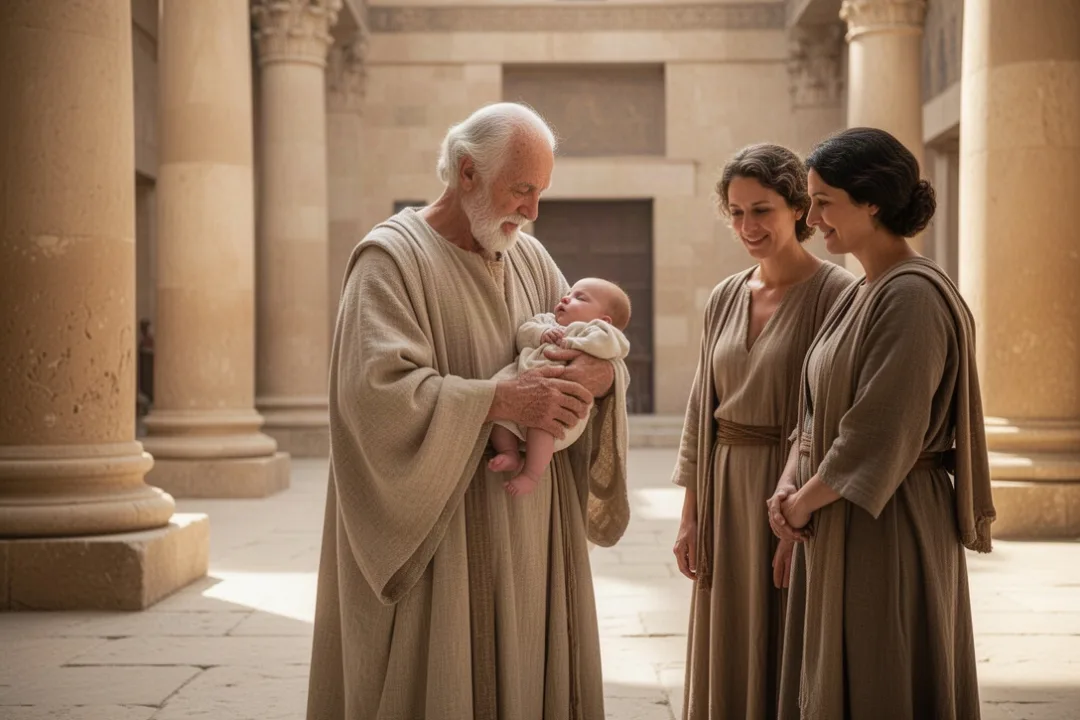
Luke says that the Holy Spirit had revealed to Simeon that he would not die before seeing the Lord’s Christ, or Messiah. When Mary and Joseph brought the infant Jesus to the temple according to Jewish law, Simeon was led there by the Spirit. He took Jesus in his arms and recognized him as the fulfillment of God’s promise.
The text does not give Simeon’s age, occupation, family background, or social position. He may have been an older man, since he speaks about being ready to depart in peace, but the Bible does not provide a precise age. Traditions sometimes add details, yet those details should not be treated as biblical facts.
Simeon’s significance comes from his spiritual discernment. Other people saw a baby being presented at the temple. Simeon saw God’s salvation. His response shows that faith can recognize God’s work even when it appears in an ordinary, vulnerable, and unexpected form.
Simeon’s encounter with Jesus shows a person receiving God’s promise with gratitude, trust, and honest awareness of its cost.
What Simeon said about Jesus and God’s salvation
Luke records a prayer often called the Nunc Dimittis, from the Latin words meaning “now you dismiss.” Simeon tells God that he can now depart in peace because he has seen the salvation God prepared. The prayer is not merely personal; it describes Jesus’ importance for Israel and the nations.
Simeon says that Jesus will be a light for revelation to the Gentiles and a source of glory for Israel. In other words, Jesus’ mission will reach beyond the Jewish people while also fulfilling Israel’s hope. Simeon presents salvation as something God has prepared openly and purposefully, not as a private blessing reserved for a small group.
This moment is significant because it appears early in Luke’s Gospel, before Jesus begins his public ministry. Simeon identifies the child’s future importance before the child performs miracles, teaches crowds, or gathers disciples. His recognition rests on God’s revelation rather than visible accomplishments.
Simeon’s words also connect Jesus with revelation and judgment. He says that the child will cause many in Israel to fall and rise, and that he will be a sign opposed by many. This means Jesus will reveal what is in people’s hearts. His presence will require a response; people will not all receive him in the same way.
The passage does not present discipleship as an easy path with no grief. Simeon tells Mary that a sword will pierce her soul. This points to deep sorrow connected with Jesus’ life and mission, traditionally understood especially in relation to his rejection and death. The joy of recognizing salvation exists alongside the pain of what that salvation will involve.
Key idea: Simeon’s joy is grounded in God’s faithfulness, but his prophecy also acknowledges suffering. The passage holds hope and grief together rather than separating them.
Why Simeon matters in the story of Jesus’ early life
Simeon appears during the presentation of Jesus at the temple, a scene that also includes Mary, Joseph, and Anna. According to Luke 2, Jesus’ parents brought him to Jerusalem in keeping with the requirements associated with the birth of a firstborn son. The setting connects Jesus with Israel’s worship, Scripture, and covenant life.
Simeon serves as one of the first public witnesses to Jesus’ identity. At this point, Jesus is known only as a child. Simeon’s testimony confirms that the child is connected with God’s promised redemption. His words help readers understand that Jesus’ life cannot be separated from Israel’s long expectation of the Messiah.
His presence also reinforces a pattern in Luke’s opening chapters: God gives important testimony through people who might otherwise be overlooked. Simeon is not introduced as a ruler, priest, scholar, or military leader. He is a faithful person who waits, listens, and responds when the moment arrives.
Luke places Simeon beside Anna, a prophetess who also speaks about the child to those waiting for Jerusalem’s redemption. Together, they provide an older generation’s response to Jesus. Their faithfulness contrasts with the power and fear associated with Herod, the king who later seeks to destroy the child in Matthew’s account.
What Simeon teaches about waiting for God
Simeon had to wait for something he had not yet seen. Scripture does not say how long he waited or describe every difficulty he faced. It does show that his waiting was active rather than passive. He remained devoted to God, stayed attentive to the Spirit, and continued participating in the life of worship.
That pattern gives Simeon’s story a practical meaning. Biblical waiting is not simply doing nothing until circumstances change. It can involve prayer, obedience, service, and a willingness to recognize an answer that looks different from what you expected.
Simeon also demonstrates the difference between recognizing a promise and controlling its outcome. He did not arrange the timing, appearance, or circumstances of Jesus’ arrival. He received what God gave him and responded with praise.
Wait with faith: Simeon trusted that God’s promise would be fulfilled, even before he could see how.
Stay attentive: He was responsive to the Holy Spirit rather than absorbed only in his own expectations.
Recognize ordinary settings: The moment occurred in the temple during a familiar religious practice.
Respond with gratitude: Simeon’s first recorded response was praise, not self-congratulation.
Accept the whole truth: He welcomed salvation while acknowledging that Jesus’ mission would bring opposition and sorrow.
For readers today, Simeon can represent a mature faith that has learned to hold confidence and uncertainty together. He does not receive every explanation about the future. He receives enough light to recognize God’s work and to respond faithfully.
Simeon was also Jacob’s second son
Another important Simeon appears in Genesis. He was the second son of Jacob and Leah, after Reuben and before Levi. His birth is described in Genesis 29, where Leah names him Simeon because she says the Lord had heard that she was unloved.
This Simeon became one of the twelve sons of Jacob, whose descendants formed the twelve tribes of Israel. He was therefore an ancestor of the tribe of Simeon. His story belongs to the patriarchal period, many generations before the Simeon who met Jesus in Luke.
Simeon and his full brother Levi are especially remembered for their violent response to the violation of their sister Dinah. In Genesis 34, they deceive and attack the men of Shechem. Their actions become a major issue when Jacob later reflects on his sons’ character.
In Genesis 49, Jacob’s words about Simeon and Levi criticize their anger and violence. He says their weapons are instruments of wrongdoing and declares that they will be scattered in Jacob and dispersed in Israel. This statement functions as a sober evaluation of their conduct, not as praise for decisive action.
The account of Jacob’s sons shows how the Bible can present a person with both family importance and serious moral failure. Simeon’s place in the family line does not excuse his actions. His story warns against allowing anger, group loyalty, or a desire for revenge to govern judgment.
How the tribe of Simeon developed in Israel
The descendants of Simeon became one of Israel’s tribes. Their tribal records appear in places such as Numbers 1, Numbers 26, and 1 Chronicles 4. The tribe participated in Israel’s life during the wilderness period and later received territory in the promised land.
Joshua 19 describes Simeon’s inheritance as towns located within the territory assigned to Judah. This arrangement is one reason the tribe of Simeon can become less visible in later biblical narratives. Rather than possessing a large, distinct region surrounded by other tribes, Simeonite towns were situated inside Judah’s area.
The tribe’s history does not follow a simple rise-and-fall pattern. Census lists show its population at different points, while later genealogical and military records mention Simeonite families and leaders. First Chronicles 4 describes Simeonite descendants who expanded their settlements and defeated inhabitants in certain areas.
By the time of the divided monarchy, Simeon’s identity appears closely connected with Judah. Some members may have been absorbed into Judah’s political and territorial life, while others retained a distinct family identity. The Bible does not provide one complete narrative explaining every stage of this process.
When you read a reference to “Simeon” in a passage about land, tribal counts, or Israel’s military organization, the name may refer to the tribe rather than one individual. Context is essential.
Other biblical references to the name Simeon
The name Simeon appears in several additional passages. In Luke 3:30, Simeon is listed in Jesus’ genealogy as an ancestor in the line leading back to David and beyond. This Simeon is not described in detail and should not automatically be identified with another person who has the same name.
Acts 13:1 mentions “Simeon called Niger” among the prophets and teachers in the church at Antioch. The passage identifies him as a Christian leader, but it does not provide enough information to build a full biography. The word “Niger” is a distinguishing title or descriptor in the text; it should not be confused with the name of the elderly Simeon in Luke 2.
Some readers also connect Simeon called Niger with Simon of Cyrene, the man mentioned in the accounts of Jesus’ crucifixion. The Bible does not explicitly establish that they were the same person, so the connection remains speculative. Similar names are not proof of personal identity.
There is also Simon Peter, whose name is sometimes rendered as Simeon in certain translations or transliterations of Greek and Hebrew forms. Acts 15:14 refers to Peter by a form of the name Simeon. This does not mean Peter is the same person as Simeon in Luke 2 or Jacob’s son.
Spelling differences arise because biblical names passed through Hebrew, Aramaic, Greek, Latin, and English. Simon and Simeon can be related forms, but a reader still needs to examine the passage and its context before deciding whom it describes.
How to identify which Simeon a passage means
Start with the book and chapter. A Simeon in Luke 2 is almost certainly the devout man at the temple. A Simeon in Genesis belongs to Jacob’s family. A Simeon in Joshua may refer to a tribe or its territory. The surrounding subject usually resolves the question quickly.
Next, look for clues about the person’s relationships and setting. Names of Jacob, Leah, Dinah, Levi, or Joseph point toward the patriarch’s son. References to Jerusalem, the temple, Mary, Joseph, or the Holy Spirit point toward Luke’s Simeon. Mentions of Antioch, prophets, or teachers may indicate Simeon called Niger.
Luke 2: the righteous man who sees the infant Jesus at the temple.
Genesis 29 and 34: Simeon, Jacob’s son and Leah’s child.
Genesis 49: Jacob’s assessment of Simeon and Levi.
Joshua 19: the tribal territory assigned to Simeon.
1 Chronicles 4: genealogical and settlement records connected with Simeon’s descendants.
Acts 13: Simeon called Niger, a leader in the church at Antioch.
Acts 15: a form of Simeon used in reference to Peter.
Pay attention to whether the name is singular or collective. “Simeon” may designate one man, while “the sons of Simeon” or “the tribe of Simeon” describes a larger community. Biblical genealogies can also use an ancestor’s name to identify later descendants.
Common mistakes when studying Simeon in the Bible
The name is easy to confuse because several people and groups share it. Careful reading prevents most errors, especially when you avoid filling gaps in the text with later traditions or assumptions.
Assuming every Simeon is the man in Luke 2: The Simeon who held Jesus is only one of several biblical figures with that name.
Confusing Simeon with Simon Peter: Some forms of the names overlap, but Peter’s identity must be determined by the passage.
Inventing details about Luke’s Simeon: Scripture does not give his exact age, occupation, marital status, or priestly rank.
Calling Simeon a priest without evidence: He was at the temple, but Luke does not say that he served as a priest.
Ignoring the tribe: References in Joshua, Numbers, and Chronicles may concern Simeon’s descendants rather than an individual man.
Turning Jacob’s son into a simple hero or villain: His story includes family significance, serious violence, and a later rebuke from Jacob.
Treating tradition as Scripture: Later Christian stories may offer imaginative details, but they should be labeled as tradition rather than biblical teaching.
Reading tip: When a name appears more than once, write down the person’s location, relatives, time period, and actions. Those four clues usually distinguish one Simeon from another.
What Simeon’s story means for Christian faith
Luke’s Simeon is often remembered as a model of patient hope. He waited for God’s promise without knowing exactly when or how it would arrive. His example speaks to people who are praying for change, longing for justice, or trying to remain faithful during a long season of uncertainty.
His response also emphasizes that salvation is centered on a person, not merely an idea. Simeon does not praise an abstract improvement in society. He sees Jesus and recognizes God’s saving purpose in him. The passage therefore connects Christian hope with the identity and mission of Christ.
Simeon’s statement about the Gentiles is also significant. It presents God’s salvation as reaching across ethnic and national boundaries. Jesus is connected with Israel’s promises, yet his light is intended for the nations. This theme becomes increasingly important throughout Luke and Acts.
The story encourages humility in spiritual discernment. Simeon recognizes what others may overlook, but he does not take credit for creating the moment. He receives insight as a gift from God and responds publicly with praise. His example places discernment alongside dependence rather than personal status.
The Simeon who was Jacob’s son offers a different kind of lesson. His actions in Genesis warn that religious identity, family position, or a legitimate grievance does not justify uncontrolled violence. The Bible preserves his failure as part of the family story, showing that ancestry and moral character are related but not identical.
Taken together, the different Simeon passages encourage readers to examine both faithful waiting and misdirected anger. One Simeon shows how to receive God’s promise with trust; another shows how destructive passion can damage a family and shape a legacy.
How to read Simeon’s temple encounter personally
A useful way to read Luke 2 is to ask what Simeon sees, what he says, and what he understands. He sees an infant brought by ordinary parents. He says that God has fulfilled a promise. He understands that Jesus will bring salvation, reveal hearts, and face opposition.
You can also notice what Simeon does not do. He does not demand control over Jesus’ future, claim ownership of the child, or treat the encounter as a reason for personal fame. He blesses God and speaks truthfully about both glory and pain.
That balance can shape personal faith. Hope does not require pretending that every part of the future will be comfortable. Simeon’s example allows you to celebrate God’s faithfulness while acknowledging that obedience may involve sacrifice, grief, or resistance from others.
Finally, Simeon’s story points readers toward faithful attention. He was present, spiritually alert, and ready to recognize God’s work. The passage does not explain every detail of his life, but it gives a clear picture of a person whose long wait ended in worship.
The clearest answer to who Simeon is from the Bible
If the question comes from Luke 2, Simeon is a righteous and devout man in Jerusalem who was guided by the Holy Spirit to meet the infant Jesus at the temple. He recognized Jesus as God’s promised salvation, praised God, and told Mary that Jesus would bring revelation to the nations while also facing opposition and sorrow.
If the question comes from Genesis, Simeon is Jacob’s second son and Leah’s child, the ancestor of the tribe of Simeon. His story includes the violent episode at Shechem and Jacob’s later condemnation of his anger.
If the name appears in a passage about Israel’s land or genealogies, it may refer to the tribe or its descendants. If it appears in Acts, it may refer to Simeon called Niger or to a form of the name used for Peter. The surrounding passage—not the name alone—provides the answer.
Frequently asked questions
Was Simeon in Luke 2 a priest?
The Bible does not identify him as a priest. He was a righteous and devout man in Jerusalem who was guided by the Holy Spirit to the temple. His presence there does not prove that he held an official priestly role. Claims about his occupation, age, or family background go beyond what Luke records.
How is Simeon related to Jacob?
Simeon was Jacob’s second son and the child of Leah. He was one of the twelve sons whose descendants became the tribes of Israel. Simeon and his brother Levi were involved in the violent response to the events at Shechem, and Jacob later rebuked both brothers for their anger and cruelty.
Are Simeon and Simon the same name?
They are related forms that can overlap in biblical languages and translations, but the answer depends on context. Simon Peter is sometimes represented by a form of Simeon, while other passages refer to distinct people named Simeon. Shared spelling or pronunciation does not establish that two biblical figures were the same person.
What is the main lesson from Simeon’s meeting with Jesus?
Simeon demonstrates patient faith, spiritual attentiveness, and gratitude. He trusted God’s promise, recognized salvation in a child who appeared ordinary, and praised God when the promise was fulfilled. He also understood that Jesus’ mission would involve opposition and sorrow, showing that hope and suffering can exist together.










Leave a Reply