If you have read about the Good Samaritan or the Samaritan woman who spoke with Jesus, you may wonder who these people were and why they appear so often in the New Testament. Samaritans were not simply generic outsiders or foreigners. They belonged to a distinct religious and ethnic community connected to the ancient northern kingdom of Israel.
In biblical times, Samaritans lived mainly in and around Samaria, the central region of the land between Galilee and Judea. They shared important beliefs and ancestral traditions with the Jews, including reverence for the God of Israel and the first five books of the Bible, but they worshiped at Mount Gerizim rather than at Jerusalem. Centuries of political, religious, and social conflict created deep suspicion between the two communities.
That background explains why several Gospel stories carry such force. When Jesus made a Samaritan the example of compassionate behavior, spoke publicly with a Samaritan woman, or praised a Samaritan leper for returning to give thanks, he challenged assumptions about who could be faithful, neighborly, or accepted by God.
Where the Samaritans came from in biblical history
The name Samaritan comes from Samaria, the capital of the northern kingdom of Israel. After the united kingdom associated with David and Solomon divided, the northern kingdom continued as Israel, while the southern kingdom was known as Judah. Samaria became the northern kingdom’s political center.
The northern kingdom fell to the Assyrian Empire in the late eighth century BCE. The biblical account in 2 Kings 17 describes the Assyrians carrying away many Israelites and settling people from other conquered regions in the cities of Samaria. Those settlers are portrayed as bringing their own religious practices while also learning to honor the God of the land.
This account became part of the later Jewish understanding of Samaritan origins. It presented Samaritans as a population with mixed ancestry and mixed religious practice, and that description contributed to their negative reputation in some Jewish writings. The biblical narrative, however, reflects a particular theological and political perspective rather than providing a complete modern-style history of the community.
Historians generally understand Samaritan identity as developing through a more complicated process. It likely involved people who remained in the northern land, groups connected with the ancient Israelites, and changes caused by Assyrian rule, later empires, migration, and religious separation. The claim that Samaritans were simply foreigners who replaced all the original Israelites is too simple to capture the evidence.
The name can also refer to the inhabitants of the region in a geographical sense. In some passages, “Samaritan” identifies a person from Samaria, while in others it points to the distinct community that had developed there. Reading the surrounding passage helps determine whether the emphasis is regional, ethnic, religious, or social.
A useful distinction: Samaritans were related to the people of Israel, but they were not the same as the Judeans who worshiped at Jerusalem. Their shared roots and serious differences existed at the same time.
What Samaritans believed and where they worshiped
Samaritan faith centered on the Torah, the first five books of the Bible: Genesis, Exodus, Leviticus, Numbers, and Deuteronomy. Samaritan communities preserved their own version of the Pentateuch and developed religious traditions that differed from those of the Jewish communities centered in Jerusalem.
The most visible disagreement concerned the proper sanctuary. Samaritans regarded Mount Gerizim, near Shechem in the central hill country, as the chosen place for worship. Jews regarded the temple in Jerusalem as the authorized center. This was not a minor difference in location; in the ancient world, a sanctuary represented identity, covenant, history, and legitimate access to God.
The Samaritan woman expressed this dispute when she spoke with Jesus in John 4. She referred to the mountain where her people worshiped and contrasted it with the Jewish claim that Jerusalem was the proper place. Her question reveals that the disagreement was widely known and remained a live religious issue.
Jesus’ reply did not simply endorse Mount Gerizim or Jerusalem as competing sacred sites. He said that a time was coming when worship would not be defined by either mountain alone, but by worship rooted in spirit and truth. The point was not that history and place had no meaning. Rather, Jesus redirected the question toward the nature of genuine worship and the work of God.
Samaritan beliefs also included expectation connected with Moses and a future figure sometimes called the Taheb, understood in Samaritan tradition as a restorer or teacher. The exact way this expectation relates to Jewish messianic ideas varies, so it should not be treated as identical to every Jewish or Christian understanding of the Messiah.
The Samaritan Pentateuch differs from the Jewish Masoretic text in some readings. One significant example concerns worship at Mount Gerizim, which Samaritan tradition understands as supported by its version of the text. These textual differences show that the religious separation involved scripture and interpretation as well as geography.
The major beliefs and practices associated with Samaritan identity included:
Devotion to the God of Israel and special authority given to the Pentateuch.
Worship connected with Mount Gerizim rather than the Jerusalem temple.
Distinct priestly and communal traditions preserved within Samaritan families.
Observance of biblical festivals, including Passover, according to Samaritan practice.
A strong connection to ancient Israelite ancestry, especially through traditions associated with the northern tribes.
These similarities and differences help explain why Jews and Samaritans could recognize one another as connected to Israel while still regarding one another as religiously divided. Shared scripture did not erase competing claims about the correct sanctuary, priesthood, history, or interpretation.
Why Jews and Samaritans were hostile toward each other
By the time of Jesus, relations between Jews and Samaritans were marked by mutual distrust. The hostility had religious, political, and social roots rather than coming from one single incident. Each community believed that the other had departed from the true worship of God in important ways.
The rebuilding of the Jerusalem temple after the Babylonian exile provides part of the background. In Ezra 4, people identified with the populations of the surrounding region offer to help with the temple project, but their offer is rejected. The passage then describes opposition to the rebuilding of Jerusalem and its temple. Later conflicts between the communities strengthened the idea that the other side was untrustworthy.
The separation became more visible as Samaritans maintained their own sanctuary on Mount Gerizim and Jews centered worship in Jerusalem. The Samaritan temple was later destroyed by a Judean ruler during the second century BCE. That event deepened the memory of injury and made reconciliation even harder.
Political loyalties also mattered. Judea and Samaria experienced changing control under empires and regional rulers, and local communities did not always support the same authorities. Historical grievances could be carried into everyday encounters, making travel, trade, marriage, and religious conversation tense.
The New Testament reflects this atmosphere in several ways. Some Jewish people avoided traveling through Samaria, although routes through the region were possible and were sometimes used. John 4:9 explicitly presents the tension between Jews and Samaritans as a known social reality, while Luke 9:51–56 shows that a Samaritan village refused to receive Jesus because he was traveling toward Jerusalem.
It would be misleading to say that every Jew hated every Samaritan or that every Samaritan felt exactly the same way. Ancient communities were not uniform, and ordinary contact continued despite conflict. Still, the boundary was strong enough that calling someone a Samaritan could function as a serious insult in certain settings, as seen in John 8:48.
The relationship can be understood through several overlapping conflicts:
Identity: both communities claimed a connection with the people and worship of ancient Israel.
Authority: they disagreed about which texts, priests, traditions, and sanctuary should be trusted.
History: conquest, exile, temple disputes, and political rivalry created long memories.
Daily life: inherited suspicion affected travel, hospitality, religious boundaries, and personal relationships.
Knowing this context makes Jesus’ use of Samaritan characters more striking. He was not choosing a neutral example from a neighboring population. He was placing a member of a distrusted community inside stories about faithfulness, mercy, gratitude, and love of neighbor.
How Jesus used Samaritans in his teaching and ministry
The Good Samaritan made mercy the measure of neighborly love
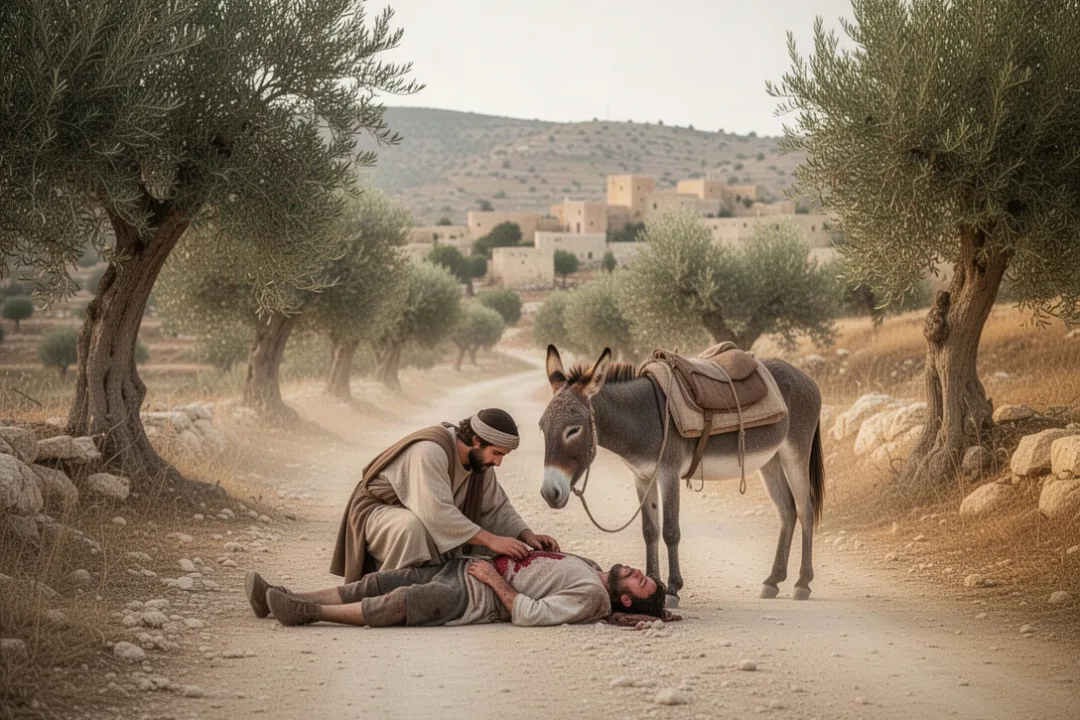
In Luke 10:25–37, a legal expert asks Jesus what must be done to inherit eternal life and then asks who qualifies as a neighbor. Jesus responds with the story of a man attacked by robbers. A priest and a Levite see the injured man but pass by, while a Samaritan stops, treats his wounds, arranges his care, and pays for what is needed.
The Samaritan is not presented as a religious authority or as someone from the listener’s own community. He is the person the audience might least expect to act rightly. His behavior shows practical compassion: he notices suffering, accepts personal inconvenience, spends his own resources, and follows through beyond the first moment of assistance.
Jesus does not leave the question at “Who is my neighbor?” He asks which person acted as a neighbor to the wounded man. That change matters. Instead of drawing a boundary around the people who deserve love, the story asks the listener to become a neighbor through merciful action.
The story’s force comes from the Samaritan becoming the model of mercy in a conflict where many listeners would have expected him to be the wrong example.
The parable does not mean that every member of one group is good and every member of another is bad. The priest and Levite are individual characters in a teaching story, not a blanket judgment against all priests or Levites. Its central challenge is that religious status and group identity do not automatically produce compassion.
The Samaritan woman shows Jesus crossing social and religious boundaries
In John 4, Jesus meets a Samaritan woman at a well near Sychar. The conversation crosses several boundaries at once: she is a Samaritan, she is a woman speaking with a male teacher in public, and her personal history is treated as part of the conversation rather than a reason to dismiss her.
Jesus speaks with her about living water, worship, and the coming Messiah. The scene does not erase the Jewish-Samaritan disagreement; the woman names it directly. Instead, the conversation shows Jesus treating her as a serious theological participant who can ask questions, understand his claims, and respond with faith.
After speaking with Jesus, she returns to her community and tells people about him. Many Samaritans believe because of her testimony and then listen to Jesus themselves. The passage gives her an important role as a witness, while also showing that faith can move from personal testimony to a community’s own response.
John 4 should not be reduced to a story about one woman’s private morality. The text emphasizes revelation, worship, identity, and witness as well as her personal circumstances. Her Samaritan identity is central to the story because it places the encounter within the wider dispute between the two communities.
The thankful Samaritan shows that outsiders can recognize God’s work
In Luke 17:11–19, Jesus heals ten people suffering from a serious skin disease. As they go to present themselves to the priests, they are cleansed. Only one returns to thank Jesus, and Luke identifies him as a Samaritan.
The passage highlights an unexpected contrast: all ten receive healing, but the one who returns is the person many listeners would have considered religiously or socially suspect. His gratitude becomes evidence of a responsive heart. Jesus does not use the story to deny the healing of the others; he draws attention to the one who recognizes what has happened and gives praise to God.
Jesus’ disciples had to rethink Samaria
Jesus’ approach to Samaritans also shaped the mission of his followers. In Acts 1:8, Samaria appears between Jerusalem and the ends of the earth in the expanding witness of the early church. The book of Acts later describes Philip preaching in Samaria, where people respond to the message and receive ministry.
This development is significant because it shows that Samaria was not merely a background setting for Jesus’ parables. Samaritan communities became part of the early Christian mission. The movement that began in a Jewish setting was being pushed across inherited boundaries of region, worship, and communal distrust.
The repeated pattern: Jesus does not praise Samaritans because group labels no longer matter. He uses Samaritan characters to show that faithfulness and compassion cannot be judged reliably by ancestry, reputation, or religious rivalry.
What “Samaritan” means in the Bible and today
In the Bible, “Samaritan” can carry more than one sense. It may identify a resident of Samaria, a person belonging to the Samaritan community, or a character whose identity matters because of the Jewish-Samaritan divide. The word’s meaning depends on the passage and on what the writer wants the reader to notice.
In the Old Testament, the term is most closely connected with the population and religious history of Samaria. In the Gospels, it often carries a strong social meaning because Jewish and Samaritan relations were tense. In Acts, Samaria becomes a major region where the Christian message spreads.
Modern Samaritans are a small surviving community with its own religious traditions and identity. They continue to maintain connections with Mount Gerizim and preserve Samaritan forms of worship and scripture. Their existence also demonstrates that the ancient community did not simply disappear after the period described in the Bible.
Modern Samaritan identity should not be confused with the modern English use of “good Samaritan.” That phrase comes from Jesus’ parable and generally means a person who helps someone in need, especially a stranger. It is a useful expression, but it can hide the original story’s sharper point: the helper was a Samaritan, a member of a community many listeners distrusted.
The biblical Samaritans therefore matter for at least three reasons:
They help explain the historical and religious setting of the New Testament.
They reveal how Jesus addressed prejudice, rivalry, and narrow definitions of neighbor.
They show that the Bible’s story includes a distinct community with shared roots and serious disagreements with Judean Judaism.
When you encounter Samaritans in the Bible, ask what the passage is doing with that identity. Is it explaining a geographic setting, revealing a religious dispute, surprising the audience with an example of faith, or showing a community receiving God’s message? Those questions prevent a shallow reading and make the stories’ social and theological force clearer.
Frequently asked questions
Were Samaritans Jews?
Samaritans were closely related to the ancient Israelites and shared belief in the God of Israel and the authority of the Pentateuch. However, they formed a distinct religious community with their own traditions, priesthood, scripture readings, and sanctuary at Mount Gerizim. Calling them simply “Jews” or simply “foreigners” misses the historical complexity of their identity.
Why did Samaritans worship on Mount Gerizim?
Samaritans believed Mount Gerizim was the sacred place chosen for worship in the Torah and associated it with the patriarchs and Israel’s early history. Jews centered worship in Jerusalem instead. This disagreement over the proper sanctuary represented a much larger conflict involving scripture, priesthood, ancestry, political history, and communal authority.
Did Jesus travel through Samaria?
Yes. John describes Jesus speaking with a Samaritan woman, and the Synoptic Gospels place him in situations involving Samaritans. The Gospel accounts do not present every journey as following the same route, but they clearly show Jesus engaging with Samaritans rather than treating the entire population as beyond contact. His actions challenged common social and religious boundaries.
What does the Good Samaritan teach Christians?
The parable teaches that loving your neighbor means responding mercifully to a person in need, not merely identifying people who belong to your own group. The Samaritan provides a concrete example through care, expense, and follow-through. The story also challenges prejudice by making a socially distrusted outsider the person who acts most faithfully.










Leave a Reply