When someone asks who sentenced Jesus to death, the short answer is Pontius Pilate, the Roman official who governed Judea during the early first century. The fuller answer is more complicated: Pilate was a prefect responsible for maintaining Roman control, a political administrator balancing local religious tensions, and the authority who authorized Jesus’ crucifixion according to the Gospels.
Pilate appears in several ancient sources, including the New Testament, the Jewish historians Josephus and Philo of Alexandria, and an archaeological inscription discovered at Caesarea Maritima. These sources do not tell every detail of his life, but together they provide a picture of a Roman governor known for firm, sometimes provocative methods.
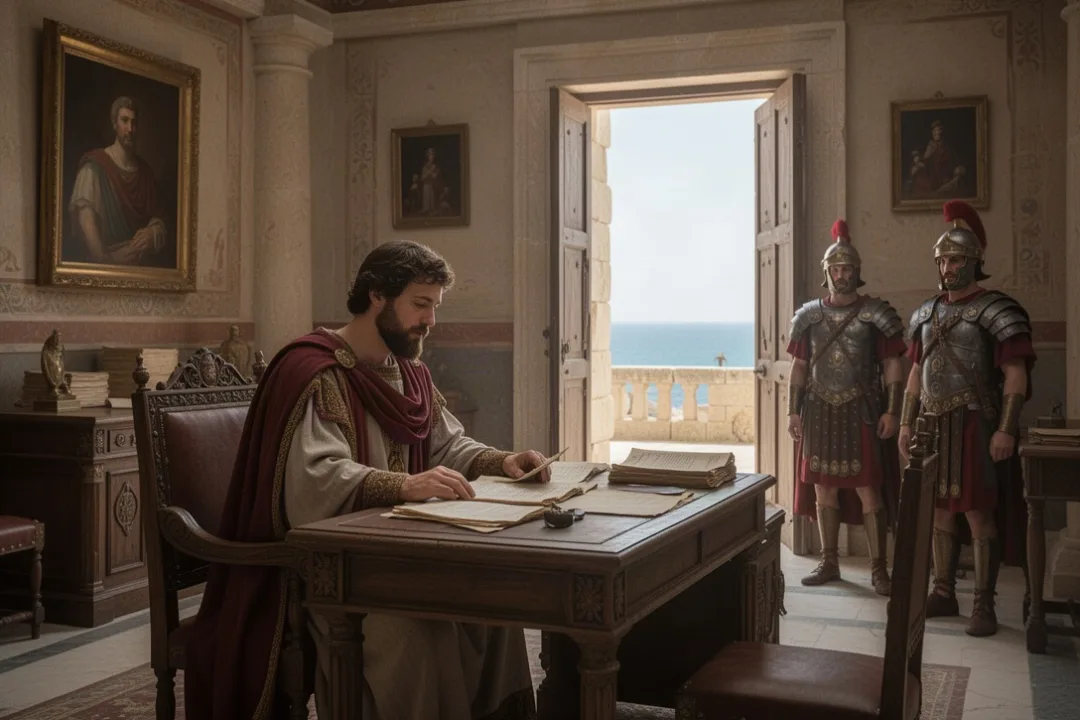
Pontius Pilate served as the Roman prefect of Judea, probably from approximately AD 26 to 36 or 37. Judea was a difficult province to govern. Its population included Jewish communities with strong religious traditions, while Roman authorities expected taxes, public order, and loyalty to the emperor.
Pilate’s official position was not that of an independent king. He represented the Roman emperor and answered to the larger imperial administration. His responsibilities likely included military security, legal authority in serious cases, financial oversight, and the enforcement of Roman policy.
The title most often associated with him in English is “governor,” but ancient evidence gives a more precise title. The Pilate Stone, an inscription found at Caesarea Maritima, identifies him as the “prefect” of Judea. The inscription was discovered in the 1960s and is one of the clearest archaeological references to Pilate.
Caesarea, on the Mediterranean coast, served as the Roman administrative center of Judea. Pilate probably spent much of his time there, although he could travel to Jerusalem when crowds, festivals, or security concerns required his presence. Jerusalem became especially sensitive during major Jewish festivals because large gatherings could also create opportunities for protest or unrest.
Little is known about Pilate’s background. His family name, Pontius, connects him with the Roman Pontii, but surviving sources do not establish his birthplace, family history, or early career with certainty. The name Pilate may be related to a Latin term associated with a spear, although the meaning and significance are not certain.
The basic historical picture: Pilate was a Roman prefect, not a Jewish religious leader or local king. His central task was preserving Roman authority in a province where politics and religion were closely connected.
What ancient Jewish and Roman sources say about Pilate
The surviving descriptions of Pilate are largely negative, although they come from writers with different purposes and perspectives. Two important sources are Josephus, a Jewish historian writing in the first century, and Philo of Alexandria, a Jewish philosopher who lived during Pilate’s administration.
Josephus describes several confrontations between Pilate and the Jewish population. In one incident, Pilate brought military standards or images associated with the emperor into Jerusalem. Many Jews objected because such images could be viewed as offensive to Jewish opposition to idolatry. According to Josephus, demonstrators showed remarkable willingness to face death rather than accept the standards in the city.
Pilate eventually removed the images. The episode suggests that he could recognize when a policy threatened to produce widespread resistance, even if he initially underestimated the depth of local opposition.
Josephus also describes a later project involving an aqueduct. Pilate used money from the temple treasury to help fund the construction, and protests followed. The account says that Pilate ordered soldiers to blend into the crowd with concealed weapons and attack demonstrators when violence began. Josephus presents the event as evidence of Pilate’s harsh response to opposition.
Another incident described by Josephus involved Samaritans gathering on Mount Gerizim. They believed a leader would reveal sacred vessels connected with Moses. Pilate interpreted the assembly as a possible uprising and sent troops to disperse it. After the violence, Samaritan leaders appealed to the Roman governor of Syria, who ordered Pilate to report to the emperor.
Philo gives a similar impression of Pilate’s administration. In a work describing a dispute over shields placed in Herod’s palace in Jerusalem, Philo portrays Pilate as stubborn and resistant to requests that the shields be removed. He also accuses Pilate of corruption, cruelty, and repeated executions without proper legal process. Philo’s account is shaped by the political conflict he was discussing, so historians assess its rhetoric carefully, but it still shows how some contemporaries remembered Pilate.
These accounts do not prove every detail beyond doubt. Ancient historians often arranged events to make moral and political points. They also wrote after the events they described and relied on information that cannot always be checked. Even so, their descriptions fit a recognizable pattern:
Pilate defended Roman authority and responded forcefully to perceived threats.
He could be inflexible when local leaders challenged his decisions.
He sometimes withdrew or changed course when a policy risked larger unrest.
His administration was associated with violence, public controversy, and political tension.
This background matters when reading the Gospel accounts. Pilate was not an inexperienced official encountering a crisis for the first time. He governed a volatile region and had experience dealing with crowds, religious objections, and accusations of rebellion.
How the Gospels portray Pilate’s role in Jesus’ trial
All four canonical Gospels place Pilate at the center of Jesus’ Roman trial. The accounts differ in emphasis and detail, but they agree on the essential point: Pilate authorized Jesus’ crucifixion, the Roman punishment typically associated with slaves, rebels, and people judged to threaten public order.
Jesus was brought to Pilate after Jewish authorities had questioned or condemned him. The precise legal and political process is difficult to reconstruct because the Gospels were written for theological as well as historical purposes. The accusations presented to Pilate are framed in terms that would concern a Roman governor, especially claims that Jesus challenged Caesar’s authority or claimed kingship.
In the Gospel of Mark, Pilate asks Jesus whether he is the king of the Jews. Jesus gives an answer that is presented as indirect or qualified. The religious leaders accuse him of many things, but Jesus remains largely silent. Pilate is portrayed as surprised by this silence and aware that jealousy may have contributed to the accusations.
The Gospels of Matthew and Mark describe a festival custom in which Pilate offers to release a prisoner. The crowd chooses Barabbas instead of Jesus. Matthew also includes a scene in which Pilate’s wife sends him a warning after a troubling dream. Pilate washes his hands before the crowd, symbolically distancing himself from responsibility, although he still hands Jesus over to be crucified.
The Gospel of Luke includes a distinctive episode in which Pilate sends Jesus to Herod Antipas, the ruler of Galilee. Herod is in Jerusalem and has authority over Galilee, where Jesus had been active. Herod questions Jesus and mocks him before returning him to Pilate. Luke also emphasizes Pilate’s repeated statement that he finds no sufficient basis for execution, while still describing the eventual decision to crucify Jesus.
The Gospel of John presents the longest and most developed dialogue between Jesus and Pilate. Their discussion centers on kingship, truth, authority, and the origin of Jesus’ kingdom. John also places strong emphasis on the contrast between Roman political power and Jesus’ distinctive understanding of kingship.
Across the accounts, several recurring elements shape Pilate’s portrayal:
The charge is political: Jesus is connected with the title “King of the Jews,” which could be interpreted as a challenge to Roman rule.
Pilate questions Jesus: The governor seeks to determine whether Jesus represents a real political threat.
The crowd and leaders exert pressure: The decision unfolds publicly rather than as a private judicial act.
Jesus is scourged and crucified: Pilate’s authority makes the Roman execution possible.
The inscription identifies Jesus as king: The notice placed on the cross connects the execution to the political accusation.
The Gospel writers do not all assign the same emphasis to Pilate. Some portray him as reluctant, while others focus more directly on the political calculation behind his decision. The differences reflect each Gospel’s literary and theological aims, but none removes Pilate’s formal responsibility for the execution.
Why Pilate’s hand-washing does not erase his role: The gesture in Matthew is symbolic rather than a legal transfer of power. Pilate remains the Roman authority who orders Jesus to be crucified, even while presenting himself as unwilling or not personally responsible.
Why Pilate sentenced Jesus despite apparent reservations
The question of Pilate’s motives has attracted attention for centuries. If the Gospel accounts show him as unconvinced that Jesus deserves death, why does he authorize the execution? The likely answer involves the governor’s responsibility to prevent disorder and protect Roman interests.
Roman officials did not need to believe that a defendant was morally guilty in order to execute him. A ruler could consider a person dangerous because of the potential response of followers, even when the person himself did not appear to be leading an armed revolt. In a tense province, the appearance of political instability could matter as much as the defendant’s intentions.
The title “King of the Jews” carried religious meaning for some people, but it could also sound like a rival claim to royal authority. Rome tolerated local customs and limited local leadership when they did not threaten imperial control. A public claimant to kingship, especially during a crowded festival in Jerusalem, could be treated as a security risk.
The Gospel of John presents Jewish leaders warning Pilate that releasing Jesus could make him appear disloyal to Caesar. Whether or not the conversation happened exactly as reported, the scene captures a realistic political concern. A Roman governor could be judged by how effectively he controlled unrest, not by how sympathetically he treated an accused religious teacher.
Pilate may also have wanted to avoid a disturbance among the crowd. Roman governors often had broad discretion in provincial cases, and crucifixion was a public warning as well as a punishment. Authorizing the execution could seem like the quickest way to remove a potential flashpoint.
His decision can therefore be understood through several pressures:
Political accusations: Jesus was connected with royal language that could be interpreted as opposition to Rome.
Public tension: Jerusalem was crowded during Passover, increasing the risk of unrest.
Local complaints: Religious leaders presented Jesus as a threat that required official action.
Career and accountability: Roman administrators had an interest in preventing disturbances that might reach their superiors.
Administrative expediency: Crucifixion allowed Pilate to resolve the case quickly and visibly.
These factors do not mean Pilate was powerless. He held the authority to release Jesus, and the Gospel accounts emphasize that he exercised a real choice. His apparent hesitation should not be confused with innocence. A governor can recognize that a case is politically motivated and still approve an unjust punishment.
Responsibility for Jesus’ death has sometimes been used to blame Jewish people as a whole. That interpretation is historically and morally wrong. The Gospel narratives involve particular leaders, a crowd in a specific setting, and a Roman execution ordered by Roman authority. They should not be turned into a charge against an entire people or religious community.
What happened to Pilate after Jesus’ crucifixion
The New Testament does not describe Pilate’s later career. Information about his end comes mainly from Josephus and later writers, and the details are limited. The most widely discussed event occurred after a confrontation with Samaritans at Mount Gerizim.
According to Josephus, a Samaritan gathering became associated with a leader who promised to reveal sacred objects connected with Moses. Pilate’s forces attacked the group, killing or capturing many participants. Samaritan leaders complained to Vitellius, the Roman governor of Syria, who ordered Pilate to go to Rome and explain his conduct to the emperor.
Josephus does not record the result of Pilate’s hearing. He does not say that Pilate was executed, banished, or formally convicted. Later Christian writers offer additional traditions, including accounts that connect Pilate with suicide or conversion, but these traditions are late, varied, and not secure historical evidence.
Pilate’s removal illustrates the limits of Roman provincial power. He could use force to maintain order, but violence that created broader complaints could damage his position. A governor was expected to keep control without producing a crisis that required intervention from higher authorities.
The archaeological record confirms that Pilate was a real Roman official, but it does not provide a complete biography. The inscription found at Caesarea mentions Pilate in connection with a building dedicated to the emperor Tiberius. Its significance lies in identifying his title and office, not in explaining his personal motives or final fate.
Modern historians therefore separate firm evidence from later tradition. The strongest conclusions are these:
Pilate governed Judea under the emperor Tiberius.
He held the title of prefect.
He faced repeated conflicts with local populations.
He responded to suspected threats with military force.
He left office after a Samaritan incident, according to Josephus.
The details of his life before and after Judea remain uncertain.
How Pilate is remembered in history and Christian worship
Pilate’s name remains familiar because it appears in the story of Jesus’ death and in Christian statements of faith. The Apostles’ Creed and the Nicene Creed both place Jesus’ suffering under Pontius Pilate, linking the event to a recognizable historical official rather than presenting it only as a timeless religious symbol.
That reference has a particular effect. Pilate represents the intersection of Roman political power, local religious conflict, and the Christian understanding of Jesus’ crucifixion. His name anchors the narrative in a period when Judea was governed by Rome.
In Christian interpretation, Pilate can represent the danger of surrendering justice to political pressure. He sees a case in which the accusations do not clearly justify execution, yet he chooses the decision most likely to preserve order and his position. His symbolic hand-washing becomes an image of attempted distance from a decision he still makes.
Historical interpretation is more cautious. Pilate should not be reduced to a single gesture or to a villain in a simplified morality tale. He was an imperial administrator operating within a system where coercion, military force, and public executions were accepted tools of government. At the same time, understanding that system does not excuse the decision to authorize Jesus’ death or the violence associated with Pilate’s administration.
Reading the sources together produces a balanced picture. The Gospels explain Pilate’s role in Jesus’ trial, Josephus and Philo provide external descriptions of his conduct, and the Caesarea inscription confirms his office. None of these sources supplies a complete account by itself, but together they show why Pilate remains a significant figure in both ancient history and Christian theology.
The most accurate answer to “Who was Pilate?” is therefore specific: Pontius Pilate was the Roman prefect of Judea who governed during the time of Jesus and authorized Jesus’ crucifixion after a politically charged trial. He was neither a passive bystander nor the sole figure involved. He was the official with final Roman authority, acting amid pressure, unrest, religious disagreement, and the demands of imperial rule.
Frequently asked questions
Was Pontius Pilate a Roman emperor?
No. Pilate was a Roman prefect, a provincial official who governed Judea under Emperor Tiberius. He had significant authority in the region, including power over courts, troops, taxes, and public order, but he was not an emperor, king, or member of the imperial family.
Did Pontius Pilate personally meet Jesus?
The Gospel accounts say that Pilate questioned Jesus during the trial before the crucifixion. The conversations differ among the Gospels, but they consistently present Pilate as the Roman official who examined the political accusations and authorized the execution.
Is there archaeological proof that Pilate existed?
Yes. The Pilate Stone, discovered at Caesarea Maritima, contains an inscription identifying Pontius Pilate as prefect of Judea. It is an important confirmation from outside the New Testament, although it does not describe the trial of Jesus or Pilate’s complete career.
How did Pontius Pilate die?
Reliable ancient sources do not establish how Pilate died. Josephus reports that he was ordered to report to the emperor after suppressing a Samaritan gathering, but he does not record the outcome. Later stories give different accounts, yet they are not considered secure historical evidence.









Leave a Reply