The crossing of the Red Sea: Story, meaning, and history
The crossing of the Red Sea: Story, meaning, and history
The crossing of the Red Sea is the central rescue event in the Exodus story, where the Israelites escape Pharaoh’s army and begin life as a free people.
The account appears mainly in Exodus 14, after Moses leads the Israelites out of Egypt. They reach the water while Pharaoh changes his mind and sends his army after them. With the sea in front and soldiers behind, the people believe they are trapped.
God then tells Moses to raise his staff over the water. A strong wind separates the waters, allowing the Israelites to cross on dry ground. When the Egyptian forces follow, the waters return, and the pursuing army is overwhelmed. The event ends with Israel recognizing God’s power and trusting Moses.
The story is not presented merely as an unusual escape. It marks a decisive change in Israel’s identity: the people move from slavery to freedom, from fear of Pharaoh to dependence on God, and from a loose group of fugitives to a community traveling toward a promised homeland.
The central idea: In Exodus, the crossing is a story of deliverance. The Israelites do not defeat Egypt through military strength; they survive because God makes a way where they see none.
Historical context behind the Exodus account
The crossing takes place after a series of disasters known as the plagues of Egypt. According to Exodus, Pharaoh finally permits the Israelites to leave after the death of the firstborn in Egypt. The people depart quickly, carrying provisions and taking valuables given to them by their Egyptian neighbors.
The narrative describes a large population traveling out of Egypt, including families, livestock, and people described as coming from different groups. Moses leads them under divine guidance, represented by a pillar of cloud by day and a pillar of fire by night. Their route does not take them directly toward the northern coastal road, which was likely more heavily controlled and could have exposed them to conflict.
Instead, the Israelites camp near the sea. The exact place names in the story, including Pi-hahiroth, Migdol, and Baal-zephon, have not produced a universally accepted modern location. This uncertainty affects how scholars reconstruct the geography, but it does not alter the narrative’s main focus on rescue and liberation.
Egypt in the second millennium BCE was a powerful regional state with organized administration, chariots, soldiers, and trade routes. The image of Pharaoh’s chariots pursuing escaped slaves presents the most feared force in the region as unable to prevent Israel’s escape. The story therefore has both a religious and political dimension: Pharaoh’s authority is challenged, and God is shown as greater than Egypt’s king.
The crossing of the Red Sea step by step
The Israelites leave Egypt. Moses leads the people away after Pharaoh releases them. They carry their belongings and travel as a community rather than as scattered individuals.
God guides their route. The people are led by visible signs of divine presence. Their route appears unusual, but the narrative says this protects them from facing war too soon.
Pharaoh changes his mind. After allowing the Israelites to depart, Pharaoh realizes that Egypt has lost its labor force. He sends chariots, horsemen, and troops to bring them back.
The Israelites see the Egyptian army. Fear spreads through the camp. Some complain to Moses that they would have been safer remaining in Egypt, revealing how quickly freedom can seem more dangerous than familiar oppression.
Moses tells the people to stand firm. He tells them that God will act on their behalf. The people are instructed to move forward rather than return to Egypt.
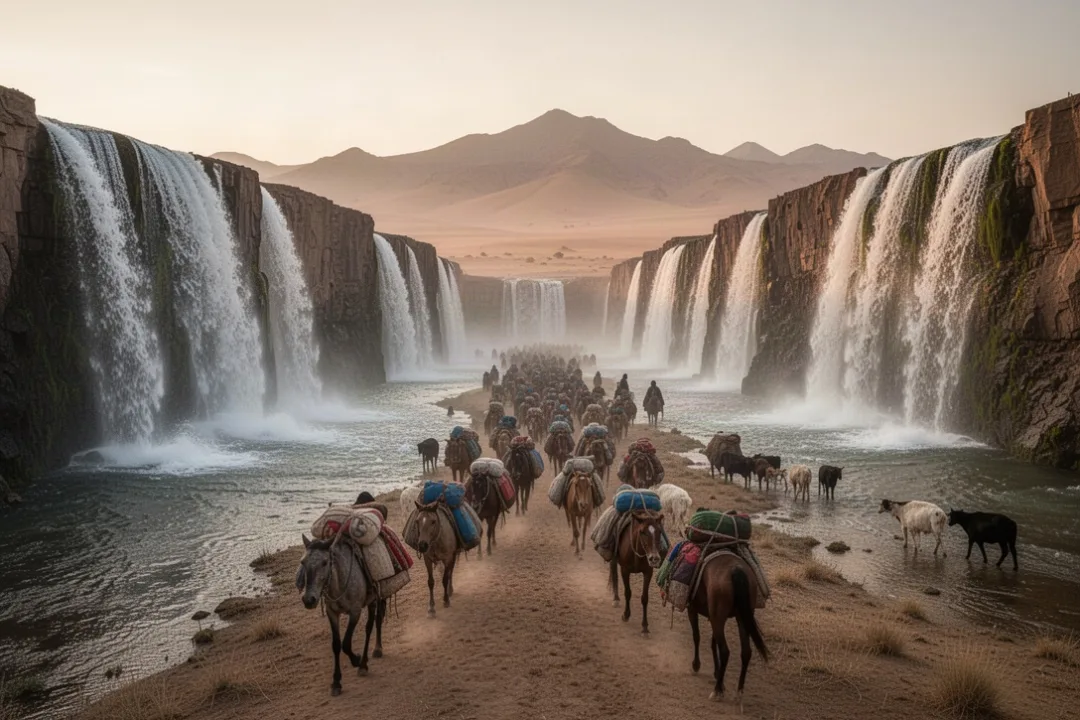
The waters are divided. Moses stretches out his hand over the sea. A powerful wind blows through the night, and the waters separate.
Israel crosses on dry ground. The people walk between walls of water, with the sea on either side. The text emphasizes that the ground beneath them is dry, allowing the entire community to pass.
The Egyptian army follows. Pharaoh’s chariots enter the passage. The pursuing troops become confused, and their movement is hindered.
The waters return. Moses again stretches out his hand, and the waters cover the Egyptian forces. Israel sees the army defeated along the shore.
The people respond with fear and faith. The episode closes by saying that Israel fears the Lord and trusts God and Moses. The next chapter gives a poetic response known as the Song of the Sea.
Why the Israelites were afraid at the shoreline
The emotional tension of the story comes from the Israelites’ apparent lack of options. Behind them is the Egyptian army; ahead is an obstacle they cannot cross by ordinary means. Their reaction is not presented as unusual. People who have just escaped oppression may still feel attached to the predictability of the old system, especially when freedom brings immediate danger.
Their complaints also reveal a recurring biblical theme: liberation is a process, not only a single moment. Leaving Egypt physically does not instantly remove fear, dependence, or the habits formed under slavery. The crossing begins Israel’s freedom, but the wilderness journey that follows will test how the people live as a free community.
Moses’ response directs attention away from panic and toward action. He does not tell the Israelites to solve the problem through their own strength. He tells them to move forward while God creates a path. The moment combines trust and obedience: the people must leave the shoreline and enter the passage that has opened before them.
What “Red Sea” means in the biblical text
Many English Bibles call the body of water the Red Sea, but the Hebrew expression is commonly written as Yam Suph. The phrase is often translated as “Sea of Reeds” or “Reed Sea.” The difference matters because it means the modern name may not identify the exact body of water understood by the original text.
In later biblical books, the same Hebrew expression can refer to bodies of water connected with the Gulf of Aqaba or the broader Red Sea region. Ancient geography did not always use boundaries and names in exactly the same way modern maps do. As a result, scholars have proposed several possible settings for the crossing.
Possible locations include areas near the northern lakes and wetlands of the eastern Nile Delta, the Bitter Lakes, and other waterways between Egypt and the Sinai Peninsula. Some proposed routes involve marshes or shallow lagoons, while others place the event farther south in a larger sea. No location has universal scholarly agreement.
Geography and faith are separate questions: Uncertainty about the precise location does not by itself settle whether the Exodus account is historically or theologically meaningful. It shows that the ancient place names and modern maps do not line up with complete certainty.
How wind and water may relate to the account
Exodus describes a strong wind blowing through the night and separating the water. Some readers understand this as a direct miracle in which natural forces become the means of divine deliverance. Others explore whether a rare but possible wind effect could have exposed a temporary land bridge or shallow crossing.
Researchers have discussed a phenomenon sometimes called wind setdown. Under certain conditions, sustained wind can push water away from a shallow area, temporarily exposing ground. If the wind stops or changes direction, water can rush back. Computer models and physical studies have examined whether similar effects could occur in parts of the eastern Nile Delta or nearby lakes.
These proposals may help explain how a natural process could produce the described conditions, but they do not prove where the biblical event occurred. They also do not remove the religious claim. Within the story, the timing, direction, and outcome of the wind are understood as God’s action through creation, not as an accidental weather event.
The text gives the wind a narrative role: it lasts through the night, opens a route for the people, and the water returns when Moses stretches out his hand. Readers may interpret the mechanism differently while still recognizing that the account presents deliverance as purposeful and extraordinary.
What Exodus says about Moses and Pharaoh
Moses stands between the frightened Israelites and the Egyptian army. He is not portrayed as a king or military commander. His authority comes from representing God, and the crossing reinforces that his leadership depends on obedience rather than personal power.
Pharaoh, by contrast, represents the system that has enslaved Israel. Earlier chapters show him resisting commands to release the people, even after repeated disasters. At the sea, his decision to pursue them exposes the instability of a ruler who has technically granted freedom but cannot accept the loss of control.
The confrontation is therefore larger than a chase. It places imperial power against divine authority. Egypt has horses, chariots, and trained soldiers; Israel has families, animals, and a leader carrying a staff. The unequal contest makes the outcome a declaration that oppression does not have the final word.
The Bible does not identify the Egyptian pharaoh by name in the Exodus narrative. Various historical theories have connected the story with different periods and rulers, but no identification has achieved universal acceptance. Claims that confidently name a specific pharaoh often depend on chronologies and assumptions that remain disputed.
The Song of the Sea and the meaning of victory
Exodus 15 records a poetic celebration commonly called the Song of the Sea. Moses and the Israelites praise God for defeating the pursuing forces, while Miriam leads the women with tambourines and dancing. The song gives the crossing a communal response: the people do not merely survive; they interpret their survival through worship.
The poem emphasizes God as a warrior who defeats the enemy, but it also looks ahead. It describes fear spreading among neighboring peoples and anticipates Israel’s movement toward the mountain and the land associated with God’s promise. In this way, the crossing is both an ending and a beginning: Egypt’s threat is broken, but Israel’s larger journey has only started.
The song also shows how biblical communities preserved major events. A dramatic rescue becomes part of public memory through poetry, music, and repeated worship. The event is meant to be retold, not kept as a private experience known only to Moses.
Major religious meanings of the crossing
Freedom from oppression
The most direct meaning is deliverance from slavery. Israel’s God hears the cries of an oppressed people and acts against a system built on forced labor. Later biblical laws repeatedly connect worship with ethical responsibility, especially the treatment of foreigners, servants, widows, orphans, and the poor.
Because the Exodus begins with liberation, the story has influenced Jewish reflection on justice and freedom for centuries. It remains central to Passover, when Jewish families retell the departure from Egypt and remember themselves as people who were once enslaved.
Trust when the path is unclear
The shoreline represents a crisis in which ordinary solutions fail. The Israelites cannot overpower the army, and the water blocks their route. The crossing therefore teaches that faith may involve moving forward before the entire route is visible.
This does not mean that fear disappears. The biblical account includes fear, complaint, confusion, and hesitation. Trust appears not as emotional calm but as a decision to follow Moses into the path God provides.
The formation of a people
Before the crossing, the Israelites are chiefly described as a population escaping forced labor. Afterward, they begin to understand themselves as a people with a shared memory, a shared God, and a shared destination. The sea becomes a boundary between the old identity under Pharaoh and the new identity formed in the wilderness.
God’s supremacy over political power
Pharaoh was treated as the supreme ruler of Egypt, but the story presents him as unable to control the people or the sea. The crossing therefore makes a theological claim about ultimate authority: no human ruler, however powerful, is beyond judgment or limitation.
How later biblical writers use the crossing
The crossing becomes a reference point throughout the Hebrew Bible. Psalms recall God’s division of the sea when praising divine power and remembering Israel’s history. Prophets use the Exodus to speak about restoration, warning, and the possibility of a new act of deliverance.
The event also appears in the New Testament. The apostle Paul refers to Israel being “baptized” into Moses in the cloud and the sea in 1 Corinthians 10; that passage uses the Exodus as a warning about disobedience and overconfidence. The Letter to the Hebrews refers to the crossing in Hebrews 11 as an example of faith.
These later references show that the crossing is not treated as an isolated story. It becomes a pattern for understanding rescue, covenant, judgment, memory, and the responsibilities that follow freedom.
What archaeology can and cannot establish
Archaeology has provided extensive information about ancient Egypt, Canaan, Sinai, trade routes, settlements, and the movement of people in the region. It has not produced a single inscription that directly confirms every detail of the Exodus narrative or identifies the exact crossing site.
That absence should be described carefully. Large groups of mobile laborers may leave limited archaeological traces, and the proposed route crosses regions where preservation and excavation are uneven. At the same time, the lack of direct evidence means that archaeological claims should not be overstated.
Some evidence is relevant to the background of the story. Egyptian records and monuments show that Semitic-speaking peoples lived and worked in Egypt, and Egyptian officials monitored movement through border regions. Such evidence demonstrates that the story’s setting is historically plausible in broad terms, but it does not independently verify the crossing itself.
Different readers weigh the biblical text, archaeology, oral tradition, and historical reconstruction in different ways. A responsible approach distinguishes between what Exodus explicitly says, what archaeology can support, and what remains uncertain.
Common explanations of how the waters parted
A direct miracle: God supernaturally divides the waters, and the wind described in the text is part of that miraculous action.
A natural event guided by providence: A strong wind exposes a passable area at exactly the needed time, and the returning water defeats the pursuers.
A shallow-water crossing: The “Sea of Reeds” may refer to marshes or lagoons in the eastern Delta rather than the deep open waters associated with the modern Red Sea.
A symbolic or liturgical reading: The story’s primary purpose may be to proclaim Israel’s deliverance and identity, even if the precise physical setting cannot be reconstructed.
These explanations do not all make the same claim, and they should not be presented as interchangeable. A reader can accept the story as a miracle, investigate natural mechanisms, or focus on its theological meaning. The wording of the biblical account allows the wind to be both a physical force and an instrument of divine purpose.
How to read the crossing responsibly
A careful reading keeps several layers together rather than forcing the story into only one category. Exodus is a narrative about a people, a theological confession about God, a memory of liberation, and a text shaped through poetry and worship. Asking only whether the water was physically deep enough misses much of its meaning, while ignoring the physical setting can flatten the story’s drama.
Read the surrounding chapters. Exodus 1–15 connects the crossing with slavery, the plagues, Passover, Pharaoh’s resistance, and the Song of the Sea.
Distinguish text from speculation. The biblical narrative gives place names and events, but modern proposals about the route remain uncertain.
Compare translations carefully. “Red Sea” and “Sea of Reeds” reflect different translation traditions and should not be treated as identical geographic labels without explanation.
Notice the human response. Fear, complaint, courage, worship, and memory all shape the story.
Consider what follows the rescue. The crossing does not end Israel’s difficulties; it begins the wilderness period and the work of forming a covenant community.
Why the crossing still matters
The crossing continues to matter because it joins freedom, faith, memory, and responsibility in one powerful story. It asks what people do after escaping oppression, how communities remember rescue, and whether those who have been freed will build a different kind of society.
For Jewish readers, the Exodus remains foundational to Passover and to the memory of liberation from Egypt. For Christians, the event is frequently read as a pattern of salvation and faith, especially in light of later references to it in the New Testament. For others, it offers a cultural and literary account of a vulnerable people confronting an empire.
The story’s lasting image is simple: a community stands before an impassable barrier, with danger closing in behind it, and a path opens through the obstacle. Its significance lies not only in the divided water but in what happens afterward. The people must walk through, remember who delivered them, and learn how to live as a free community.
Frequently asked questions
Is the Red Sea crossing a historical event?
The biblical text presents the crossing as a real event in Israel’s deliverance from Egypt. Modern historians and archaeologists have not reached agreement on the route, date, pharaoh, or exact body of water involved. Some proposed locations and natural mechanisms are plausible possibilities, but no single reconstruction has been conclusively established.
Where exactly did Moses cross the Red Sea?
No location is universally accepted. The Hebrew term often translated “Red Sea” is Yam Suph, which may mean “Sea of Reeds.” Proposed areas include northern Egyptian lakes and marshes, the Bitter Lakes, and other waterways near the Sinai Peninsula. Ancient place names and modern geography do not align with enough certainty to identify one site.
What is the main message of the crossing?
The main message is that God delivers Israel from slavery and defeats a power the people cannot overcome themselves. The crossing also marks the beginning of Israel’s life as a free covenant community. Its themes include trust during crisis, freedom from oppression, divine authority, communal memory, and the responsibilities that follow rescue.
Does the Bible say the water was parted by wind?
Yes. Exodus describes a strong wind blowing through the night while Moses stretches out his hand over the water. Readers interpret this in different ways: as a direct miracle, as a natural process guided by God, or as both. The text emphasizes the timing and purpose of the wind rather than providing a scientific explanation.






Leave a Reply