Paul’s journey to Rome: Route, shipwreck, and meaning
Paul’s journey to Rome: Route, shipwreck, and meaning
When you read about Paul’s journey to Rome, you may wonder how he traveled there, why he went as a prisoner, and what happened along the way. The answer appears mainly in Acts 27–28: Paul sailed from Caesarea under Roman guard, endured a devastating storm and shipwreck, spent several months on Malta, and eventually reached Rome.
Rome was not simply a destination on Paul’s travel itinerary. He was going there because he had appealed to Caesar, the highest legal authority available to a Roman citizen. Yet the voyage also became an important stage in his Christian witness. Even while chained and facing an uncertain future, Paul encouraged the crew, helped preserve lives, taught the people he met, and preached about Jesus in the imperial capital.
Paul’s trip to Rome followed a long legal conflict in Jerusalem and Caesarea. After his arrest in Jerusalem, he was held by Roman authorities while Jewish leaders brought accusations against him. The charges centered on his teaching, the temple, Jewish law, and his claim that Jesus had been raised from the dead.
Several Roman officials examined Paul’s case. The governor Felix kept him in custody and later left him imprisoned when he was succeeded by Festus. Festus wanted a practical resolution, but Paul maintained that he had not committed a crime deserving death. When Festus considered sending him to Jerusalem, where Paul feared an unfair ambush or trial, Paul used his legal right as a Roman citizen and appealed to Caesar.
That appeal changed the course of his life. Instead of receiving another local hearing, Paul was sent to Rome for judgment before the emperor. He was not traveling as a missionary with freedom to choose his route. He was part of a group of prisoners placed under the authority of a centurion named Julius, who belonged to the Augustan Cohort.
Paul’s status was unusual. He was a prisoner, but Roman officials treated him with a degree of trust. Acts identifies several companions or fellow travelers, including Aristarchus from Thessalonica. Luke, the author of Acts, also appears to have joined the voyage, since the narrative begins using “we” language in Acts 27 and continues through the arrival in Rome.
The central purpose of the trip: Paul went to Rome because he had appealed to Caesar, but the journey also fulfilled his desire to bear witness in Rome. His imprisonment restricted his movement without silencing his message.
Paul’s route from Caesarea toward Italy
The voyage began at Caesarea, the major Roman administrative center on the Mediterranean coast. Paul and the other prisoners boarded a ship from Adramyttium, a port in Asia Minor. This first vessel was apparently intended to sail along the coast rather than carry the travelers all the way to Italy.
The ship stopped at Sidon, where Julius allowed Paul to visit friends and receive care. This small detail reveals that Paul was not treated exactly like a dangerous criminal. The centurion still maintained responsibility for him, but he permitted a measure of personal contact and support.
From Sidon, the ship sailed under the shelter of Cyprus because the winds were unfavorable. The voyage continued along the coasts of Cilicia and Pamphylia until the travelers reached Myra in Lycia. There they transferred to a larger Alexandrian ship sailing for Italy.
Alexandria was a major Egyptian port, and ships from that region often transported grain to Rome. The vessel carrying Paul may have been a grain ship, although Acts does not give every technical detail about its construction. It was large enough to carry a substantial crew, passengers, prisoners, and cargo, but it was still vulnerable to the dangerous conditions of the open sea.
The journey then became difficult. The ship sailed slowly and struggled against the wind. After passing near Cnidus, the sailors moved south of Crete and reached a harbor called Fair Havens, near the city of Lasea.
By this point, the season had become dangerous for extended Mediterranean sailing. Acts says that the fast associated with the Day of Atonement had already passed, a reference that places the voyage late in the sailing season. Winter storms could make travel extremely hazardous, and safe harbors were limited.
Paul warns the crew before the storm
At Fair Havens, the ship faced a difficult decision. Remaining there through winter could be inconvenient and costly, while continuing toward a better harbor might allow the journey to reach its intended destination. The centurion listened to the ship’s pilot and owner, who favored moving on to Phoenix, a more suitable harbor on Crete.
Paul advised against the plan. His warning was not presented as a technical sailing calculation alone. He said that continuing would bring severe damage to the ship and its cargo, as well as danger to the people aboard. The centurion, however, trusted the experienced professionals more than Paul and chose to follow their recommendation.
For a short time, the decision seemed reasonable. A gentle south wind began to blow, creating the impression that the ship could make progress toward Phoenix. The crew raised the anchor and sailed close to Crete. But the apparent improvement did not last.
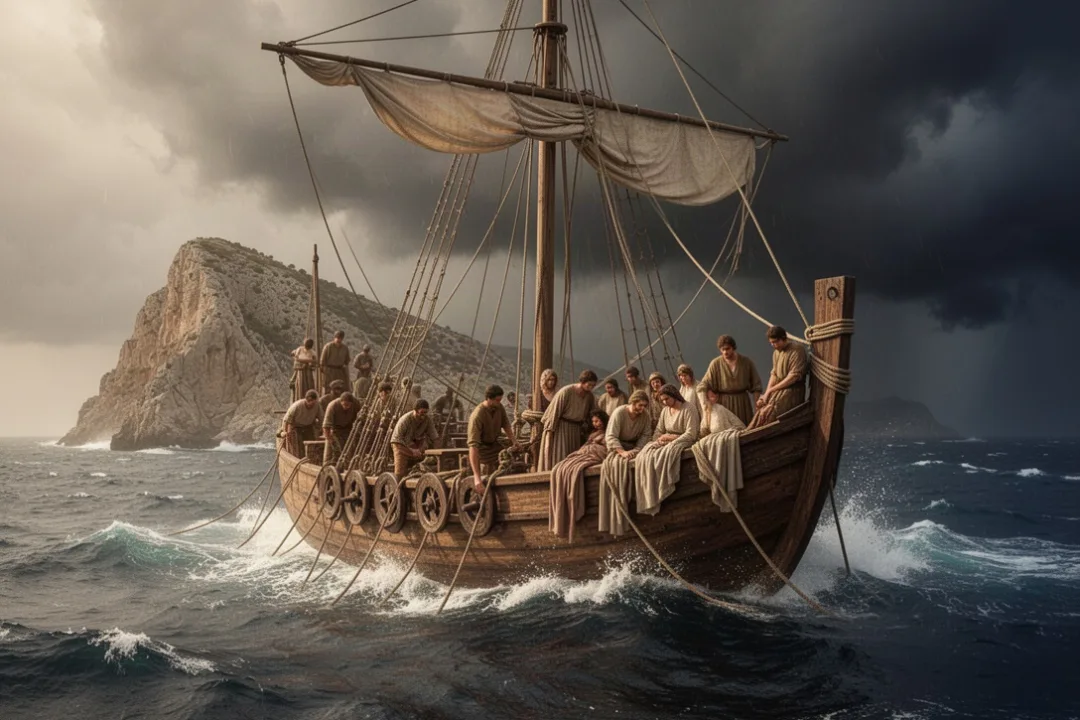
A violent wind called a northeaster, or Euroclydon in some translations, swept down from the island. The ship could not turn into the wind, so the sailors gave up trying to control its direction and allowed it to be driven along. The storm carried them away from their intended route and into open water.
The crew took emergency measures to keep the vessel from breaking apart. They pulled the ship’s boat aboard, secured the hull with ropes or cables, and lowered equipment. They also threw cargo overboard when necessary. As the storm continued, the sailors lost sight of the sun and stars, making it impossible to determine their position by normal means.
After many days without seeing daylight clearly, the passengers lost hope. Paul then stood among them and spoke with confidence. He said an angel of the God he served had assured him that he would stand before Caesar and that the people traveling with him would survive, although the ship itself would be lost.
Paul did not promise an easy escape. His message combined realistic danger with confidence in God’s purpose. He urged everyone to take courage, while also explaining that they would be stranded on an island.
Paul’s confidence did not deny the storm; it gave people a reason to endure it.
How the shipwreck unfolded near Malta
After fourteen nights of being driven across the Adriatic Sea, the sailors sensed that land was near. They measured the depth of the water and found it becoming shallower. Fearing that the ship might strike rocks, they dropped anchors from the stern and waited for daylight.
Some sailors then tried to escape by lowering the ship’s boat under the pretense of putting out anchors from the bow. Paul recognized the danger and told the centurion and soldiers that no one could be saved unless the sailors remained aboard. The soldiers cut away the boat, preventing the crew from abandoning the ship before the final attempt to reach shore.
Paul also encouraged everyone to eat. The passengers had gone without proper food for a long time, and their weakness would make survival more difficult. He took bread, gave thanks to God in the presence of all, broke it, and began to eat. The others followed his example and were strengthened.
Acts records that there were 276 people on the ship. After eating, they lightened the vessel further by throwing the remaining wheat into the sea. At daybreak, the crew did not recognize the land, but they saw a bay with a beach and decided to run the ship aground if possible.
They cut loose the anchors, released the rudders, and raised the forward sail. The ship struck a sandbar or channel between the waters, where the bow became stuck while the stern began to break apart under the force of the waves.
The soldiers considered killing the prisoners so that none could escape by swimming ashore. Under Roman military practice, a guard could face severe consequences if a prisoner escaped. Julius stopped the plan because he wanted to save Paul. He ordered those who could swim to reach land first and told the rest to use planks or pieces of the ship.
Every person reached shore safely. The promise Paul had delivered during the storm was fulfilled: the ship was destroyed, but the lives aboard it were preserved.
What happened to Paul on the island of Malta
The island was Malta, known in the ancient world as Melita. The local people showed unusual kindness by building a fire because rain and cold had made the survivors miserable. Paul gathered brushwood and placed it on the fire.
As the heat drove out a viper, it fastened onto Paul’s hand. The islanders saw the snake and assumed that Paul must be a murderer who had escaped the sea only to face justice. When Paul suffered no harm, they changed their opinion and began saying that he was a god.
Paul did not use the incident to claim divine status. Acts presents the snakebite as another example of his protection during the journey. The story also shows how quickly public opinion can change. The islanders moved from considering him a criminal to treating him as extraordinary based on what they saw happen.
The leading official on the island was Publius. His father was sick with fever and dysentery, and Paul visited him, prayed, and laid his hands on him. The man recovered. Afterward, other sick people on Malta came and were healed.
These events gave Paul and his companions a chance to serve the people who had welcomed them. When the three months on Malta ended, the islanders supplied them with provisions for the next stage of their journey. The shipwreck had interrupted Paul’s route, but it had not interrupted his ministry.
A useful distinction: Acts does not say that Paul controlled the storm or avoided suffering. He endured the same danger as everyone else, then used the opportunity to encourage, serve, and speak about his faith.
From Malta to Rome by way of Sicily and Italy
After wintering on Malta, Paul and the others boarded another Alexandrian ship that had spent the cold season on the island. Its figurehead was associated with the twin gods Castor and Pollux, a common type of maritime symbol in the ancient world.
The ship first reached Syracuse in Sicily and remained there for three days. It then traveled to Rhegium at the southern tip of the Italian peninsula. A favorable south wind helped the ship reach Puteoli, a major harbor west of modern Naples.
At Puteoli, Paul found believers and was invited to stay with them for seven days. This encounter shows that Christian communities already existed in parts of Italy before Paul reached Rome. The travelers then continued north by land or along the coastal route toward the capital.
Believers from Rome came out to meet Paul at the Forum of Appius and the Three Taverns, locations along the Appian Way. When Paul saw them, he thanked God and took courage. The welcome mattered because Paul had spent months in custody, survived a shipwreck, and still faced an uncertain legal hearing.
The final approach to Rome was not a triumphal procession. Paul entered the city under guard, likely still connected to the imperial legal system. Yet the meeting with local Christians reveals that he did not arrive alone in a spiritual sense. A network of believers was already present to receive and support him.
Paul’s ministry during house arrest in Rome
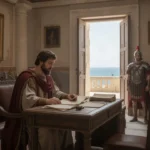
In Rome, Paul was allowed to live by himself with a soldier guarding him. This arrangement was a form of custody with limited freedom, not full release. He could receive visitors, communicate with others, and teach, but he remained under Roman authority while waiting for his case to proceed.
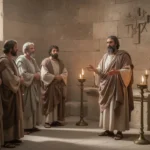
Paul first called together the Jewish leaders in Rome. He explained that he had done nothing against the Jewish people or ancestral customs, yet he had been handed over to the Romans as a prisoner from Jerusalem. He also explained that his chains were connected to Israel’s hope, especially the hope fulfilled in Jesus.
The Jewish leaders said they had not received a formal letter from Judea about him and had not heard direct accusations from visitors. They agreed to hear Paul explain his beliefs. On another appointed day, a larger group came to his lodging.
From morning until evening, Paul reasoned with them about the kingdom of God and tried to persuade them about Jesus from the Law of Moses and the Prophets. Some were convinced, while others did not accept his message. Acts describes disagreement among them as they departed.
The book ends by saying that Paul remained in Rome for two years, welcoming everyone who came to him. He proclaimed God’s kingdom and taught about the Lord Jesus Christ with openness and without being stopped.
That ending is deliberate. Acts does not narrate the outcome of Paul’s hearing before Caesar, nor does it describe his death. The final emphasis falls on the continuing spread of the gospel. Paul’s chains did not prevent visitors from hearing, and his restricted circumstances did not make the message inaccessible.
Major themes in Paul’s journey to Rome
God’s purpose continues through disruption
Paul’s route was repeatedly interrupted. He faced delays, contrary winds, a life-threatening storm, a shipwreck, a snakebite, and imprisonment. None of those events looked like a smooth path toward Rome. Yet each interruption created another setting in which people encountered Paul’s faith and received practical help.
The account does not suggest that every setback is easy or that suffering should be minimized. The passengers genuinely feared for their lives, and Paul himself experienced the danger. The broader point is that a difficult route can still serve a meaningful purpose.
Faith and practical action work together
Paul trusted God’s promise that the people aboard the ship would survive, but he did not become passive. He warned the crew, urged the sailors to remain aboard, encouraged people to eat, and accepted the need for disciplined action. His faith produced clear decisions rather than careless confidence.
The sailors also used their skills. They secured the ship, measured the water, dropped anchors, and searched for a way to reach land. Acts presents divine care and human responsibility together, not as competing explanations.
Paul’s witness included service
Paul preached, but he also helped. He encouraged frightened passengers, cared for the sick on Malta, and accepted hospitality from believers in Puteoli. His witness was expressed through words, courage, prayer, and practical service.
This balance matters when applying the story today. Speaking about faith and meeting urgent human needs are not separate activities. Paul’s actions made his message visible to people who had just survived a disaster.
The gospel reached the center of the Roman world
Rome represented political power, legal authority, and cultural influence. Paul arrived there under guard, not as a respected official. Nevertheless, he was able to speak to Jewish leaders, welcome visitors, and teach about Jesus for an extended period.
The journey therefore connects Paul’s personal legal appeal with the wider mission described throughout Acts. What began as a prisoner’s transfer ended with a public ministry in the empire’s capital.
Common mistakes when reading Paul’s journey
Calling it a voluntary missionary trip: Paul wanted to reach Rome, but the voyage described in Acts 27 began because he had appealed to Caesar and was being transported under guard.
Assuming Paul avoided the storm: Paul was exposed to the same danger as the other passengers. God’s protection did not mean the absence of fear, loss, or physical hardship.
Confusing Malta with another location: The island where the shipwreck occurred is Malta, not the modern island of Melita associated with other historical discussions.
Overstating the snake incident: Acts says Paul was unharmed after the snake attached to his hand. It does not present the event as a command for all believers to handle dangerous animals.
Claiming Acts gives the full outcome of Paul’s trial: The narrative ends during his Roman house arrest and does not report a final verdict, release, later travels, or death.
Reading the shipwreck as a failure of faith: Paul’s confidence remained intact, but the ship was still destroyed. The promised outcome concerned the survival of the people, not the preservation of the vessel.
Practical ways to study the account in Acts 27–28
You can understand the journey more clearly by reading it in stages rather than treating it as one uninterrupted travel story. Pay attention to who makes each decision, what danger is present, and how Paul responds.
Read Acts 27:1–12: Mark the route from Caesarea to Fair Havens and note Paul’s warning about continuing the voyage.
Read Acts 27:13–26: Follow the storm and identify the promise Paul gives about the survival of everyone aboard.
Read Acts 27:27–44: Observe the sailors’ escape attempt, Paul’s encouragement, the shipwreck, and the soldiers’ decision to spare the prisoners.
Read Acts 28:1–10: Notice how the people of Malta respond to Paul, Publius’s illness, and the healing of other islanders.
Read Acts 28:11–16: Trace the final sea route through Syracuse, Rhegium, and Puteoli before Paul reaches Rome.
Read Acts 28:17–31: Compare Paul’s message to the Jewish leaders with the open ministry that closes the book.
A map can help you visualize the journey, but do not let geography overshadow the narrative’s focus. Acts repeatedly draws attention to God’s faithfulness, Paul’s courage, the value of human cooperation, and the continuing opportunity to bear witness.
What Paul’s arrival in Rome means for the book of Acts
Paul’s arrival answers a promise made earlier in the story: he would bear witness in Rome. The journey shows that the promise did not require a comfortable route or a favorable legal situation. Paul reached Rome through confinement, danger, and delay.
The ending also leaves the mission open. The gospel has moved from Jerusalem through Judea and Samaria and outward toward the nations. By the time Paul is teaching in Rome, the message has crossed cultural, geographic, and political boundaries.
Paul’s journey to Rome is therefore more than an account of ancient travel. It is a story about purpose under pressure. A prisoner becomes an encourager during a storm. A shipwreck survivor serves sick islanders. A guarded visitor turns his lodging into a place of teaching.
The final image is not Paul walking freely through Rome. It is Paul living under guard while welcoming all who come to him. Acts closes by showing that physical restrictions do not necessarily end meaningful work. Paul reaches the city he had long hoped to see, and he continues to speak about God’s kingdom and Jesus with remarkable openness.
Frequently asked questions
How long did Paul’s journey to Rome take?
Acts does not give a complete number of days from Caesarea to Rome. The voyage included delays, difficult sailing, a fourteen-night storm, and three months on Malta before the travelers continued. The sea journey itself therefore took considerably longer than a direct trip, and the winter season was a major factor in the delay.
Who traveled with Paul to Rome?
Paul traveled with other prisoners, Roman soldiers, sailors, and passengers. Julius, a Roman centurion, supervised the prisoners. Aristarchus from Thessalonica was also present, and the “we” sections indicate that Luke accompanied Paul. Acts does not provide a complete passenger list, but it records 276 people aboard the ship during the storm.
Where did Paul’s shipwreck happen?
Paul’s shipwreck happened on Malta, called Melita in the Greek text of Acts. The survivors reached the island after the ship was driven across the sea during a severe storm. Malta’s people welcomed them, and Paul remained there for three months before sailing onward toward Sicily and Italy.
Did Paul ever leave Rome after his house arrest?
Acts ends while Paul is living under house arrest in Rome, so it does not tell readers what happened afterward. Later Christian writings discuss possible further travels, but those traditions are not described in Acts itself. The biblical account ends with Paul teaching visitors openly while waiting under Roman guard.




Leave a Reply