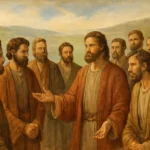
The apostles in Acts are the original witnesses of Jesus’ resurrection, Matthias, and Paul, whose ministry carries the gospel from Jerusalem toward the wider Roman world. Peter and John lead the earliest public witness, Matthias replaces Judas Iscariot among the Twelve, and Paul becomes the central missionary figure in the later chapters.
Acts also mentions the wider group of apostles and, in one passage, refers to Barnabas and Paul as apostles. The book presents them not as independent religious celebrities, but as witnesses sent by Jesus, empowered by the Holy Spirit, and accountable to the church’s shared mission.
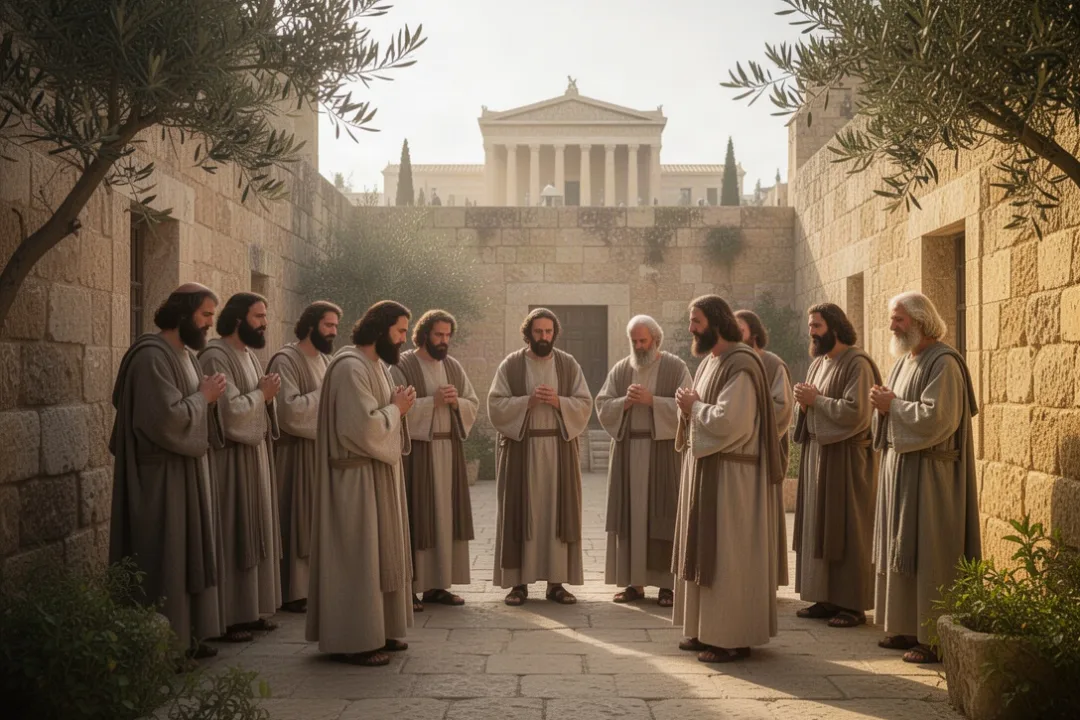
Acts begins with the apostles gathered in Jerusalem after Jesus’ resurrection and ascension. The book names the eleven remaining apostles and describes their need to restore the number of the Twelve after Judas Iscariot’s death.
The named group in Acts 1 includes Peter, John, James, Andrew, Philip, Thomas, Bartholomew, Matthew, James son of Alphaeus, Simon the Zealot, and Judas son of James. Judas Iscariot is remembered as the one who betrayed Jesus and died before the events that follow. Matthias is then selected to join the remaining apostles.
Acts does not give each member of the Twelve an individual ministry story. Instead, it focuses on a few central figures, especially Peter and Paul. John appears alongside Peter in the opening chapters, while James son of Zebedee is mentioned chiefly in connection with his execution. The other apostles remain part of the community’s foundation even when the narrative does not follow their movements.
A useful distinction: Acts uses “apostle” both for the core group connected with Jesus’ earthly ministry and for commissioned messengers involved in the church’s mission. The exact meaning depends on the passage.
Why Matthias was chosen to replace Judas
After Judas’ death, Peter explains that the group should appoint someone who had accompanied Jesus from the beginning of his public ministry through the resurrection appearances. The replacement needed to be a resurrection witness, not simply a respected believer or an effective speaker.
Two men are proposed: Joseph called Barsabbas, also known as Justus, and Matthias. The apostles pray for God to reveal the appropriate choice, and Matthias is selected by lot. Acts 1:26 then counts him with the eleven apostles.
Matthias is not mentioned again by name in Acts. That silence does not cancel his appointment; it shows that Luke’s narrative concentrates on the events needed to explain the church’s expansion. The important point is that the Twelve are restored before Pentecost, when the apostles publicly begin their witness in Jerusalem.
The selection also shows how the early believers understood apostolic responsibility. A candidate needed a long connection with Jesus and the capacity to testify to what God had done through him. Personal authority alone was not enough; the role was tied to faithful witness and divine commissioning.
How the apostles receive power at Pentecost
Acts 2 presents Pentecost as the moment when the Holy Spirit comes upon the gathered disciples. They speak in languages understood by people from many regions, and Peter explains the event to the crowd. The apostles’ mission is therefore presented as Spirit-empowered witness, not merely human organization.
Peter interprets Jesus’ death and resurrection through Israel’s Scriptures and calls the listeners to turn to God and receive baptism. Acts reports that many respond, and the community begins a shared pattern of teaching, fellowship, meals, prayer, and practical care.
The apostles continue to teach publicly and to associate the growth of the church with Jesus’ name. Their preaching is not centered on personal achievement. They repeatedly direct attention away from themselves and toward Jesus as the one whom God raised and exalted.
Pentecost also gives the apostles a public role among people from different linguistic and geographic backgrounds. The message begins in Jerusalem, but the presence of visitors from across the Jewish world hints at the wider movement that will develop throughout Acts.
What Peter and John do in the early chapters
Peter is the most prominent apostle in the first half of Acts, with John frequently beside him. In Acts 3, Peter and John encounter a man who has been unable to walk. Peter announces healing in Jesus’ name, and the event draws a crowd at the temple.
Peter uses the opportunity to explain that the healing points to Jesus’ authority. The apostles do not present themselves as possessing magical power. When questioned by authorities, Peter says that the man was restored through the name and power of Jesus Christ.
Peter and John are arrested, questioned, and ordered to stop teaching in Jesus’ name. They refuse to abandon their witness, while also remaining part of the praying church. Acts portrays them as bold but dependent on God, receiving courage through the Holy Spirit rather than relying on status.
The apostles also face internal and communal challenges. The story of Ananias and Sapphira in Acts 5 emphasizes the seriousness of deception within the Christian community. Later, the apostles respond to complaints that some widows are being overlooked in the daily distribution of food.
Rather than attempting to control every responsibility, the apostles support the appointment of seven trusted men to oversee this practical service. They remain devoted to prayer and the ministry of the word. This decision shows that spiritual leadership and practical administration both matter, but they need not be performed by the same people.
How the apostles face opposition and persecution
The religious authorities in Jerusalem repeatedly challenge the apostles. Their preaching about resurrection is especially controversial because it directly proclaims that Jesus, whom the authorities rejected, has been vindicated by God.
Acts describes arrests, interrogations, threats, beatings, and imprisonment. The apostles continue to teach despite these pressures. Their response is not presented as a desire for conflict; it is a conviction that obedience to God takes priority when human commands forbid their central testimony.
Gamaliel, a respected teacher, advises the council to avoid rash action and allow time to reveal whether the movement is genuinely from God. The apostles are nevertheless beaten before being released. They leave rejoicing that they have been counted worthy to suffer because of Jesus’ name.
Persecution also contributes to the spread of the message. After Stephen is killed, believers are scattered beyond Jerusalem, and many begin proclaiming Jesus in new places. The apostles remain in Jerusalem for a period, while the wider body of believers carries the message outward.
This pattern corrects a common assumption: the apostles are not the only people who evangelize in Acts. Ordinary disciples, appointed servants, and traveling missionaries all contribute to the expansion of the church.
How Peter leads the mission beyond Jerusalem
Peter’s ministry gradually crosses social and geographic boundaries. He visits believers in places such as Lydda and Joppa, where Acts reports healings and the restoration of Tabitha, also called Dorcas, to life. These signs lead many people to consider the message about Jesus.
The most significant turning point comes through Cornelius, a Roman centurion in Caesarea. Cornelius fears God, prays, and receives a message directing him to seek Peter. At the same time, Peter receives a vision that challenges his inherited assumptions about clean and unclean foods.
When Peter enters Cornelius’s home, he understands that God does not show favoritism among people who respond to him. While Peter is speaking, the Holy Spirit comes upon the Gentile listeners. They speak in tongues and are baptized.
Peter later explains this event to believers in Jerusalem who question his decision to enter a Gentile home. He describes God’s initiative and recognizes that the same gift given to Jewish believers has also been given to Gentiles. The episode establishes that Gentile inclusion is God’s work, not merely Peter’s personal policy.
Peter also plays a major role in the Jerusalem meeting described in Acts 15. Some believers argue that Gentile converts must adopt the full requirements of Jewish law, including circumcision. Peter reminds the gathering that God already gave the Holy Spirit to Gentiles and made no distinction in granting them faith.
His speech helps the leaders reach a decision that Gentile believers should not be burdened with the entire Mosaic law. The church sends a letter asking them to avoid practices associated with idolatry, blood, and sexual immorality. The decision combines theological conviction with pastoral care for fellowship among believers from different backgrounds.
What happens to James and the other original apostles
James son of Zebedee, the brother of John, appears among the leading apostles in the opening chapters. Acts 12 records that King Herod Agrippa I has James killed with the sword. James is the first of the Twelve whose death is explicitly narrated in Acts.
His death is followed by Peter’s imprisonment and miraculous release. The contrast is striking: James dies, while Peter is freed. Acts does not suggest that one apostle is more faithful because he survives. The book presents both martyrdom and deliverance within the unpredictable course of the mission.
The other original apostles remain associated with the Jerusalem church, especially in passages describing the apostles and elders together. Acts does not provide reliable individual biographies for Andrew, Philip, Thomas, Bartholomew, Matthew, James son of Alphaeus, Simon the Zealot, or Judas son of James.
Philip does receive a substantial narrative, but Acts identifies him as one of the seven appointed to serve the community, not as the apostle Philip from the list in Acts 1. He evangelizes in Samaria and explains Scripture to an Ethiopian official on the road from Jerusalem to Gaza. Keeping these two Philips distinct avoids a common reading error.
How Paul becomes an apostle in Acts
Paul first appears as Saul, a determined persecutor of Jesus’ followers. He approves of Stephen’s execution and seeks authority to arrest believers in Damascus. On the road there, the risen Jesus confronts him in a revelation that changes the direction of his life.
Acts 9, 22, and 26 each recount Paul’s encounter with Jesus, with different details suited to the setting of each speech. The consistent point is that Paul is called to become a witness to Jesus, including among Gentiles and rulers.
Ananias, a disciple in Damascus, is sent to Paul despite his reputation. He prays for Paul, and Paul is baptized. Soon afterward, Paul begins proclaiming that Jesus is God’s Son and the Messiah. His former opposition becomes part of his testimony to the power of divine mercy.
Paul’s commission is unusual because he did not follow Jesus during his earthly ministry in the same way as Matthias and the original Twelve. His apostolic authority in Acts is grounded in an encounter with the risen Jesus and a direct calling to proclaim the gospel to the nations.
Paul does not work alone. Barnabas brings him into contact with the Jerusalem believers and later seeks him for ministry in Antioch. The church in Antioch prays, fasts, and sends them out. Their work therefore combines personal calling with recognition and commissioning by a local church.
Why Barnabas and Paul are called apostles
Acts 14:14 refers to Barnabas and Paul as apostles when residents of Lystra attempt to honor them as gods after a healing. The two missionaries tear their clothes and urgently tell the crowd that they are human beings who proclaim the living God.
This passage shows that the word “apostle” can describe commissioned messengers beyond the Twelve. Barnabas is a respected leader who had already served the Jerusalem church and helped strengthen the growing movement in Antioch. Paul is the missionary commissioned especially toward Gentiles.
Their reaction in Lystra also clarifies what apostolic ministry is not. They reject worship, status, and divine honors. The miracle is not used to create a personality cult; instead, they urge the crowd to turn from idols to the Creator.
Paul and Barnabas later revisit the churches established during their journeys. They encourage believers to remain faithful despite suffering and appoint elders in the local congregations. Apostolic ministry includes preaching, teaching, strengthening, and organizing durable local leadership.
How the apostles and elders settle disputes
The Jerusalem council in Acts 15 is one of the clearest examples of shared leadership among the apostles and elders. The dispute concerns whether Gentile believers must be circumcised and required to keep the law of Moses in order to be saved.
Paul and Barnabas report what God has done among the Gentiles. Peter then describes Cornelius’s conversion, and James gives the concluding judgment. Although James is not explicitly called an apostle in the text, he functions as a leading figure in the Jerusalem church.
The decision is communicated in a letter from “the apostles and elders,” showing that the matter is not settled by one missionary acting alone. The leaders listen to testimony, discuss Scripture and God’s action, and send representatives with the written decision.
The meeting offers a practical pattern for resolving serious church disagreements:
Hear firsthand testimony about what God is doing.
Examine the question through Scripture and the church’s received faith.
Protect fellowship without placing unnecessary burdens on new believers.
Communicate the decision clearly through trusted representatives.
Acts does not portray unity as the absence of disagreement. The church reaches unity by addressing a real dispute openly and by recognizing that the gospel must be applied across cultural boundaries.
How the apostles’ mission expands through Acts
The movement in Acts follows a broad geographical pattern: Jerusalem, Judea, Samaria, and the wider Gentile world. This progression reflects Jesus’ commission at the beginning of the book and explains why the narrative moves from Peter’s ministry to Paul’s missionary journeys.
Peter’s encounter with Cornelius opens a decisive door to Gentile inclusion. The church at Antioch becomes a major center for missionary work, and Paul travels through cities in Asia Minor, Macedonia, Greece, and eventually toward Rome.
Paul’s preaching takes place in synagogues, public spaces, private homes, lecture halls, and places of prayer. He reasons from Scripture with Jewish audiences and speaks differently to Gentile audiences familiar with Greek religious ideas. The message remains centered on the true God, Jesus’ resurrection, repentance, and coming judgment.
Opposition appears in many forms: synagogue disagreement, public riots, legal accusations, economic hostility, and political pressure. Yet Acts repeatedly shows the message crossing boundaries of ethnicity, class, geography, and social standing.
The book ends with Paul in Rome under a form of house arrest, welcoming visitors and proclaiming God’s kingdom. Acts does not record Paul’s death or provide a complete account of every apostle’s later work. Its ending leaves the mission visibly active and open-ended.
Common mistakes when studying the apostles in Acts
Several reading habits can make the apostolic story harder to understand. The following distinctions help keep the names, roles, and events in their proper setting.
Do not treat every disciple as one of the Twelve. The larger group of believers includes many disciples, while the Twelve form a particular apostolic group.
Do not confuse Philip the apostle with Philip one of the Seven. Acts gives the evangelist Philip an extended narrative, but it identifies him with the group appointed in Acts 6.
Do not assume silence means inactivity. Several apostles are named but receive little narrative attention because Acts follows the main movement of the story.
Do not call Matthias a replacement for Paul. Matthias replaces Judas within the Twelve; Paul receives a separate commission as an apostle to the Gentiles.
Do not reduce apostolic work to miracles. The apostles preach, teach, endure opposition, resolve disputes, care for the church, and appoint local leaders.
Do not overlook the wider church. Believers who are not apostles also evangelize, host missionaries, provide material support, and carry the message into new regions.
Do not treat the council in Acts 15 as a private decision. The apostles, elders, missionaries, and gathered church participate in resolving the dispute.
For careful study: Read Acts 1–5 for the Twelve and Pentecost, Acts 9–12 for Paul’s calling and Peter’s Gentile mission, and Acts 13–28 for Paul’s missionary work and witness before authorities.
What the apostles in Acts teach about Christian leadership
The apostles’ authority is consistently connected to service and witness. They speak publicly, but they also pray, listen, accept correction, share responsibility, and recognize God’s work in people outside their original circle.
They do not present themselves as the source of the church’s power. Peter points to Jesus when a man is healed. Paul and Barnabas reject worship when a crowd mistakes them for gods. The leaders understand that signs and influence must direct attention to God rather than magnify the messenger.
Acts also shows that strong leadership can include disagreement and change. Peter must revise his assumptions about Gentiles. The Jerusalem leaders must address a major conflict about circumcision. Paul and Barnabas eventually separate after a sharp dispute over John Mark, yet the missionary work continues through multiple teams.
The apostles’ example therefore includes both conviction and accountability. They remain committed to the gospel while working within a community that tests claims, hears testimony, and seeks a faithful decision. Their story portrays the early church as a movement shaped by the Spirit, grounded in Jesus’ resurrection, and carried forward by many kinds of servants.
Frequently asked questions
Were all the apostles in Acts members of the original Twelve?
No. The Twelve are the original apostolic group restored by Matthias after Judas’ death. Acts also uses “apostles” for commissioned missionaries such as Paul and Barnabas. The book distinguishes the Twelve from the wider group of messengers without offering a complete list of every person who held an apostolic role.
Is Paul one of the apostles in Acts?
Yes. Acts presents Paul, first called Saul, as personally commissioned by the risen Jesus to serve as a witness, especially among Gentiles. His calling differs from that of the original Twelve because he did not follow Jesus throughout his earthly ministry, but his authority rests on a direct encounter with the risen Christ and the church’s recognition of his mission.
What happened to the apostles after Acts ends?
Acts does not provide a complete account of their later lives. It records James son of Zebedee’s execution and ends with Paul proclaiming God’s kingdom in Rome. Traditions about the later deaths and ministries of other apostles exist, but those details are not supplied by Acts itself and should be distinguished from the book’s account.
Why does Acts focus mainly on Peter and Paul?
Peter leads the early witness in Jerusalem and helps establish the inclusion of Gentiles. Paul then carries the message through extensive missionary travel and legal hearings. Luke’s narrative uses these two figures to show the gospel moving from its Jewish setting in Jerusalem into the wider Roman world, while acknowledging the work of the broader church.






Leave a Reply