The apostle Paul wrote the book of Romans, also called the Epistle to the Romans, while Tertius served as his secretary or scribe.
Romans is a letter from Paul to Christian believers in Rome. Paul identifies himself at the beginning as a servant and apostle of Jesus Christ, and the letter’s style, theology, and personal references consistently fit his ministry and other known writings. Near the end, Tertius adds a greeting and identifies himself as the person who wrote down the letter for Paul.
The clearest evidence comes from the letter itself. Romans opens with Paul introducing himself and describing his calling to proclaim the gospel among the nations. He addresses Christians in Rome as people whose faith is widely known, then develops a sustained explanation of the gospel and its implications for both Jewish and Gentile believers.
Paul also mentions personal circumstances that match the closing details of the letter. He says he is preparing to travel to Jerusalem with financial assistance collected from believers in Macedonia and Achaia. After that visit, he hopes to travel to Spain, stopping in Rome on the way. These details provide the voice and situation of a real missionary writing to a church he had not yet visited.
The final chapter contains numerous greetings to people Paul knows or knows about. He commends Phoebe, a servant of the church at Cenchreae, and asks the Roman Christians to receive and assist her. He also sends greetings to Priscilla and Aquila, fellow workers who had risked their lives for him, along with several other believers.
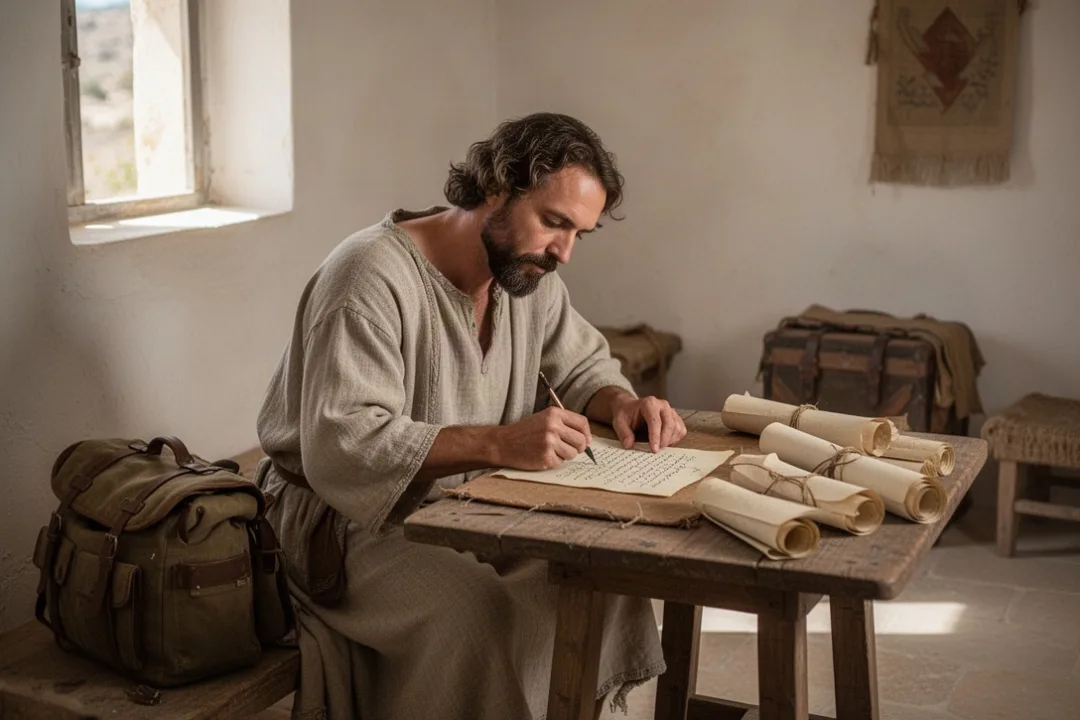
At the end, the letter includes a distinctive note: Tertius greets the readers and says he wrote the letter while working with Paul. This means there are two different senses in which someone might answer the question “Who wrote Romans?” Paul is the author, while Tertius was the person who physically wrote the text as Paul dictated or composed it.
The short answer: Paul wrote Romans, and Tertius acted as his writing assistant. Paul’s authority and message belong to the letter, while Tertius appears to have recorded the words in writing.
Who Tertius was and what a scribe did
Tertius is named only in Romans 16, so the Bible gives limited information about him. His name is Latin, which may suggest a connection with the Roman world, but the text does not tell us his background, social status, or later history. What it does show is that he worked alongside Paul closely enough to write a personal greeting within the letter.
In the ancient world, authors frequently used scribes, also called secretaries or amanuenses, to write correspondence. A scribe could take dictation, help prepare a polished document, or perform other writing tasks under the author’s direction. The exact process could differ from one letter to another, so it is safest to say that Tertius wrote the manuscript for Paul rather than treating him as an independent author.
Paul’s letters sometimes contain evidence of this practice. In one place, Paul mentions adding a greeting in his own handwriting, apparently to distinguish his personal contribution from the writing done by a secretary. That detail shows that using an assistant did not make the letter less genuinely Paul’s. It was a normal way for an ancient writer to produce correspondence.
The wording of Romans also helps explain why Tertius should not be confused with the letter’s principal author. The letter begins with Paul’s name, presents Paul’s apostolic teaching, and repeatedly refers to Paul’s plans and ministry. Tertius speaks briefly at the end rather than taking responsibility for the message.
Paul was the apostle responsible for the letter’s teaching, purpose, and authority.
Tertius was the scribe who wrote the letter and added a greeting.
Phoebe was the woman commended by Paul and associated with carrying the letter to Rome.
The Roman Christians were the original recipients who heard the letter read within their congregations.
This distinction between author and scribe matters because “written by” can describe either the person who composed the message or the person who put it onto the page. For Romans, the strongest answer is Paul as author and Tertius as secretary.
When and where Paul wrote Romans
Romans was probably written during the later part of Paul’s missionary work, when he was preparing to travel to Jerusalem with a collection for believers there. Paul describes himself as having completed his work in the regions where he had been preaching and as looking toward a future mission in Spain. These comments place the letter after substantial missionary activity but before his planned visit to Rome.
The letter is commonly associated with Corinth or its surrounding area, although the text itself does not give a simple location label. Several clues connect the closing chapter with people and places known from Paul’s ministry in that region. Phoebe is linked with Cenchreae, a port near Corinth, and Paul refers to Gaius, who sends greetings and is described as his host. Those details make the Corinthian setting plausible without requiring absolute certainty about the exact house or date.
The date is generally placed in the middle of the first century, before Paul’s journey to Jerusalem mentioned in the letter. The precise year is debated because ancient letters do not always provide modern-style dates, and the chronology of Paul’s travels must be reconstructed from several passages. A responsible answer therefore gives the broad setting rather than claiming a date the text does not state directly.
The historical setting helps explain the letter’s purpose. Paul was writing to a church he had not founded and had not yet visited. He wanted to establish a relationship with the Roman believers, explain his gospel clearly, ask for their support for future missionary work, and address practical tensions between Jewish and Gentile Christians.
Romans is therefore not simply an abstract theological essay. It is a real letter shaped by travel plans, financial responsibilities, personal relationships, congregational disagreements, and Paul’s calling to preach Christ among the nations.
Why Paul wrote to Christians in Rome
Paul’s central concern is the gospel of Jesus Christ and what it means for people from different backgrounds. He explains that the gospel reveals God’s righteousness and that faith is central to how people receive God’s saving grace. Romans develops these themes through a sustained argument rather than a short list of beliefs.
The letter addresses the universal problem of sin. Paul argues that Gentiles cannot claim moral superiority and that Jews cannot rely on possession of the law or ethnic identity as a basis for boasting before God. His point is not that Jewish Scripture is worthless. Instead, he presents the law and the prophets as bearing witness to God’s saving purpose, while emphasizing that reconciliation with God rests on faith rather than human achievement.
Paul then explains the significance of Jesus’ death and resurrection. He describes believers as receiving forgiveness, being set right with God, and entering a new way of life. His discussion of baptism, life in the Spirit, suffering, hope, and God’s purposes forms one of the letter’s most influential sections.
Romans also devotes substantial attention to the relationship between Jewish and Gentile believers. Paul wrestles with difficult questions about Israel, God’s promises, human unbelief, and the inclusion of the nations. His treatment is connected to the history of salvation and to the unity of the Christian community, not merely to an argument between rival groups.
After explaining major theological themes, Paul turns to daily conduct. He urges believers to offer themselves to God, use their gifts for the good of the community, practice sincere love, respond to hostility without revenge, respect legitimate authority, and welcome one another. The teaching is practical because Paul sees doctrine and behavior as inseparable.
Chapters 14 and 15 address disputes about food, special days, and the exercise of personal freedom. Paul does not tell every Christian to have identical preferences. He calls the strong and the weak to stop despising or judging one another and to pursue peace, mutual upbuilding, and the welfare of others.
Romans presents the gospel as God’s saving power for all who believe, not as a privilege reserved for one ethnic group.
Paul’s purpose can be seen in several connected aims:
To explain his gospel to a congregation he had not personally established.
To unite Jewish and Gentile believers around God’s grace in Christ.
To prepare for a visit to Rome and seek a partnership in future mission work.
To encourage holy living shaped by mercy, love, humility, and service.
To address real disagreements without allowing them to destroy fellowship.
How Paul’s authorship fits the rest of the New Testament
Romans belongs to the group of New Testament writings traditionally called the Pauline letters. Several of those letters name Paul at the opening and share themes, vocabulary, and concerns with Romans. These include the importance of faith, the significance of Jesus’ death and resurrection, the work of the Holy Spirit, the unity of the church, and the place of Gentiles within God’s people.
Romans has a more extended and carefully developed presentation than some of Paul’s shorter letters, but its length does not make its authorship unusual. Paul adapted his letters to the needs of each congregation. A church facing specific local problems might receive a focused response, while a church he had not visited might receive a broader explanation of his teaching and mission.
The letter’s personal material also connects it with Paul’s network of coworkers. Priscilla and Aquila appear elsewhere in the New Testament as ministry partners. Paul refers to many other people in Romans 16, showing that the letter arose from a living network of congregations and traveling workers rather than from an isolated author working alone.
Ancient Christian writers consistently treated Romans as a letter of Paul. The internal evidence and the early reception of the letter reinforce one another. While scholars may discuss how Paul and Tertius collaborated or how the letter was circulated, the basic authorship question is not difficult: Romans is Pauline in origin.
That does not mean every interpretive question has one universally accepted answer. Readers continue to discuss the structure of the letter, the meaning of particular passages, the role of the law, the relationship between chapters 9–11 and the rest of Romans, and the form of the original ending. Those debates concern interpretation and transmission, not the central identification of Paul as the author.
What Romans teaches about authorship, collaboration, and the church
Romans shows that biblical writing could involve collaboration without losing a clear authorial voice. Paul did not need to write every letter personally with his own hand for the message to be recognized as his. Tertius’s role illustrates how ministry often included practical cooperation: one person preached, another wrote, others carried the letter, and a congregation received and interpreted it together.
Phoebe’s role is especially significant for understanding how the letter traveled. Paul commends her and asks the Roman believers to welcome her in a manner worthy of the saints. The passage presents her as a trusted person connected with the church at Cenchreae and capable of representing Paul’s interests to the Roman congregation.
The closing greetings also make clear that Christian communities were interconnected. Paul names people in Rome whom he knows personally or whose work he recognizes. He is addressing a particular network of believers, not an anonymous audience. Their relationships, risks, service, and hospitality form part of the setting in which the letter was heard.
Readers can also learn from the way Paul combines conviction with pastoral care. He states his theological position strongly, yet he repeatedly applies it to humility, patience, mutual welcome, and concern for people whose consciences differ on secondary matters. For Paul, a correct understanding of grace should produce a community that refuses contempt and self-righteousness.
Read the closing chapter carefully: Romans 16 is more than a list of names. It identifies Paul’s coworkers, honors their service, shows how the letter was delivered, and confirms that the theology of Romans was communicated through real relationships.
The answer to “Who wrote the book of Romans in the Bible?” can therefore be stated simply but accurately: the apostle Paul composed Romans, likely dictating it to Tertius, who wrote the document. Phoebe appears to have carried it to Rome, where believers received a letter designed to explain the gospel, strengthen unity, and support Paul’s continuing mission.
Frequently asked questions
Did Paul write Romans himself by hand?
Not necessarily. Romans identifies Tertius as the person who wrote the letter while working with Paul, which strongly suggests that Tertius served as Paul’s scribe. Paul remains the letter’s author because the message, argument, personal plans, and apostolic authority come from him. Ancient writers commonly used assistants to record and prepare correspondence.
Who delivered the letter to the Christians in Rome?
Romans commends Phoebe, a servant of the church at Cenchreae, and asks the Roman believers to receive and assist her. This strongly suggests that she carried the letter or served as its trusted representative. The passage does not provide a detailed travel account, but Phoebe is the person most directly associated with bringing Romans to its audience.
Was Paul writing to a church he had founded?
No. Paul had not yet visited Rome when he wrote the letter, and Romans reads like an explanation of his gospel to a community he hoped to visit. The congregation included people Paul knew through wider Christian networks, but the letter was not sent to a church personally established by him.
Why is Romans considered one of Paul’s most important letters?
Romans gives an unusually sustained explanation of the gospel, including sin, grace, faith, Jesus’ death and resurrection, the Holy Spirit, Israel’s place in God’s purposes, and Christian conduct. It also applies those beliefs to unity between Jewish and Gentile believers, making the letter both theological and pastoral.









Leave a Reply