Nero in the Bible: who is the beast of Revelation?
Nero in the Bible: who is the beast of Revelation?
Nero is not named directly in the Bible. He was the Roman emperor who ruled from AD 54 to 68, and many interpreters connect him with the number 666 in Revelation 13. The connection comes from adding the numerical values of the letters in “Neron Caesar,” written in Hebrew letters.
That identification is influential, but it is not the only Christian interpretation of Revelation’s beast. The Bible uses symbolic language, and readers have understood the beast as referring to Nero, the Roman imperial system, a future ruler, or more than one of these at the same time.
The New Testament does not mention Nero by name. It also does not give a straightforward statement such as “the beast is Nero.” Instead, the possible connection comes from comparing biblical clues with the political and religious setting of the first-century Roman Empire.
Nero became emperor after the death of Claudius in AD 54. He ruled during the period when the Christian movement was spreading through the Roman world, including major cities such as Rome, Corinth, and Ephesus. His reign overlapped with the ministries and deaths of several early Christian leaders.
The New Testament writers usually referred to Roman officials by their titles or described events without identifying every ruler by name. For example, Acts refers to the emperor as Caesar when Paul appeals to the imperial court. That title does not by itself identify Nero, because several Roman emperors were called Caesar.
Paul’s appeal to Caesar appears in Acts 25. The text presents Paul as a prisoner who uses his legal right as a Roman citizen to have his case heard by the emperor’s court. The passage does not name the emperor, but the events are commonly placed during Nero’s reign.
Paul’s letter to the Romans also addresses life under Roman authority. Romans 13 tells believers to respect governing authorities and to pay taxes and customary obligations. The passage does not praise Nero personally, nor does it identify him as a righteous ruler. It presents a general teaching about civil authority, public order, and the Christian responsibility to live peacefully.
Keep the distinction clear: Nero appears in the historical background of the New Testament, but he is not a named biblical character. The strongest proposed identification comes from Revelation 13, not from a verse that explicitly mentions him.
How Revelation’s number 666 can point to Nero
Revelation 13 describes a beast that exercises authority, demands allegiance, and persecutes those who remain faithful to God. Near the end of the chapter, readers are told to calculate the beast’s number, identified as 666. The wording suggests a number puzzle or coded identification familiar to the original audience.
In the ancient world, letters could also represent numbers. This practice is often called gematria. A person’s name could therefore be converted into a numerical total by adding the values assigned to its letters.
One common calculation uses the name Neron Caesar, the Hebrew form of “Nero Caesar.” The letters are assigned numerical values as follows:
נ (nun) = 50
ר (resh) = 200
ו (waw) = 6
ן (final nun) = 50
ק (qof) = 100
ס (samekh) = 60
ר (resh) = 200
The total is 666. The calculation works because “Neron” includes the final “n” sound used in the Greek form of the name, while “Caesar” is represented through a Hebrew spelling. The method is not a modern numerological trick; it fits a known ancient way of associating names and numbers.
Several other details in Revelation support the proposal. The beast is connected with imperial power, blasphemous claims, violence, and persecution. Those features resemble the experience of Christians living under a Roman regime that could demand public loyalty and punish resistance.
Revelation 13 also says that the beast’s number is the number of a person, or is associated with a human name, depending on how the Greek is understood. That wording makes a specific ruler a plausible possibility, although it does not settle the matter by itself.
Why the spelling “Neron Caesar” matters
The calculation depends on a particular spelling. The Latin form is usually written Nero Caesar, while the Greek form commonly includes an additional “n” at the end of Nero: Neron Caesar. When the name is transliterated into Hebrew, that extra letter changes the numerical total.
This explains why the proposed identification is both persuasive and limited. It works with a historically reasonable spelling and a known ancient practice, but readers who did not use that spelling would not necessarily reach the same number.
The name also has an additional association with the Roman emperor. A Greek manuscript tradition records the beast’s number as 616 rather than 666. That variant can be explained by using the Latin form “Nero” instead of the Greek “Neron.” Removing the numerical value of the final “n” changes 666 to 616.
The existence of both numbers does not prove the Nero interpretation, but it is one reason many scholars take the connection seriously. A scribe or early reader familiar with the Latin spelling could have recognized 616 as the same name calculated in a different linguistic form.
What Revelation’s beast may have meant to first-century Christians
Revelation was written to Christian communities facing pressure from the surrounding culture and political world. The book uses visions of beasts, horns, crowns, dragons, and cities to portray the struggle between God’s kingdom and oppressive human power.
The beast in Revelation 13 is not merely a private individual with an unusual name. It represents authority that demands worship, controls economic participation, and attacks faithful people. The imagery therefore points beyond Nero’s personality to the broader Roman imperial system and its claims.
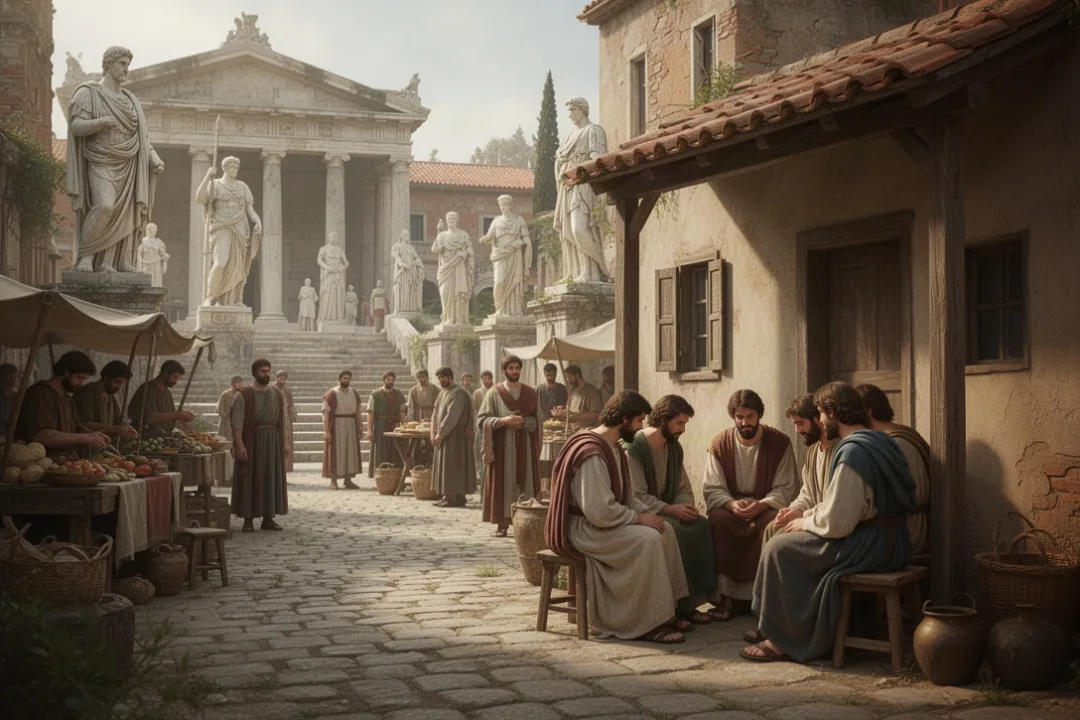
Roman emperors were honored through public ceremonies, statues, temples, coins, and official language. The exact form of imperial worship varied from place to place, and not every Roman subject faced the same level of pressure. Even so, Christians could experience a conflict between loyalty to Jesus as Lord and the public expectations attached to Roman rule.
Revelation’s reference to buying and selling under the beast has often been read as a picture of economic exclusion. The passage does not provide a simple description of an empire-wide modern identification system. It portrays the social and financial consequences of refusing allegiance to an idolatrous power.
For Christians in Asia Minor, where several churches received the messages in Revelation 2 and 3, the issue may have involved ordinary participation in civic, commercial, and religious life. A person’s willingness to honor local gods or imperial authority could affect relationships, business, and social standing.
Nero is a compelling historical candidate because his rule illustrates the kind of power Revelation condemns. He claimed supreme authority, was associated with extravagant imperial self-presentation, and became notorious for hostility toward Christians after the fire in Rome. Yet the beast’s description is larger than one emperor, which is why many interpreters understand Nero as a historical embodiment of the beast’s pattern rather than the only possible meaning.
Revelation’s symbolism can identify a real historical power while also describing the recurring behavior of rulers who demand worship and persecute the faithful.
What history says about Nero and the early Christians
Nero’s reign is relevant because of the persecution associated with him. The Roman historian Tacitus, writing outside the Bible, says that after a major fire in Rome, Nero blamed Christians and subjected some of them to cruel punishments. His account is one of the important historical sources for the connection between Nero and persecution in Rome.
The Bible itself does not describe that fire or provide a narrative of Nero’s persecution. First Peter refers to suffering among Christians and mentions Babylon as a symbolic location, but interpreters disagree about the date, setting, and relationship of that letter to Nero’s persecution. The passage should not be treated as an explicit reference to the emperor.
Later Christian writers connected the deaths of Peter and Paul with Rome during Nero’s reign. Those traditions are significant in early Christian history, but the New Testament does not narrate Paul’s execution, and it does not name Nero as the official who ordered it.
The book of Acts ends with Paul living in Rome under guarded conditions and continuing to teach. Because Acts does not describe the outcome of his case, readers should avoid claiming that the book records his death under Nero. The traditional association is historically possible, but it comes from later evidence rather than a direct biblical statement.
Nero’s reputation also developed after his death. Ancient accounts portray him as violent, self-indulgent, and hostile to political rivals, though those accounts were written by authors who had reasons to criticize him. Historical sources must therefore be read carefully rather than reduced to a simple portrait.
Some ancient people expected Nero to return after his death, or believed that another ruler could appear claiming to be Nero. This “Nero redivivus” expectation may help explain why later readers found Nero especially suitable as a symbol of recurring tyranny. It also shows how a historical emperor could become a model for future evil rulers in Christian interpretation.
Use historical sources carefully: Tacitus and later Christian traditions help explain the Nero background, but they are not substitutes for the biblical text. Revelation must still be interpreted from its own language, symbols, and first-century setting.
How major interpretations of Nero in Revelation differ
Christians and biblical scholars do not all interpret Nero’s relationship to Revelation in the same way. The differences usually concern the date of Revelation, the meaning of prophecy, and whether the beast refers primarily to a past ruler or also to a future one.
The Nero or preterist interpretation
The preterist interpretation reads much of Revelation as referring to events near the time when it was written. On this view, Nero is a strong candidate for the beast because the number 666 can encode his name and his reign fits the book’s themes of persecution and imperial arrogance.
Some preterist interpreters place Revelation before Nero’s death in AD 68. Others allow for a date later in the first century while still seeing Nero’s memory and the Roman imperial system as central to the book’s imagery.
This interpretation pays close attention to the original audience. Revelation was addressed to real churches in the Roman province of Asia, so its symbols likely communicated something meaningful to those communities rather than only describing events thousands of years later.
The imperial or symbolic interpretation
Another approach sees Nero as one expression of a wider reality. The beast represents political power that becomes idolatrous and oppressive, with Nero serving as a particularly recognizable example. The number 666 may identify him while also pointing to the destructive character of imperial rule.
This interpretation explains why Revelation uses several images rather than giving a biographical account of Nero. The book addresses the spiritual and moral nature of domination: rulers who demand ultimate loyalty, systems that reward compromise, and societies that punish people who refuse to participate in injustice.
The futurist interpretation
Many futurist interpreters believe the beast refers primarily to a future world ruler or political authority. They may acknowledge that Nero fits the number 666 or that the Roman Empire forms part of Revelation’s background, while maintaining that the prophecy has a later and more comprehensive fulfillment.
From this perspective, Nero can be a foreshadowing or prototype of the final antichrist-like ruler rather than the complete fulfillment of the prophecy. The historical Nero illustrates the pattern, but a future figure would display it on a larger scale.
The idealist or recurring-pattern interpretation
The idealist approach emphasizes the continuing conflict between faithful worship and corrupt power. It does not require the beast to identify only one person in one period. Nero may be an important first-century reference, while the symbol continues to challenge later generations to recognize persecution, propaganda, coercion, and false worship.
These interpretations do not always exclude one another. A passage can have a first-century referent and still express a pattern that reappears throughout history. The main disagreement is about which aspect should receive the greatest weight.
How to read the Nero connection responsibly
Start with the passages themselves rather than with a modern prediction. Revelation 13 and 17 contain the primary images associated with the beast, while Revelation 12–14 develops the conflict among the dragon, the beasts, and those who remain faithful to God.
Then consider the historical setting. Ask what Roman authority, emperor worship, economic pressure, and persecution would have meant to the original churches. This approach prevents the number 666 from becoming an isolated code detached from the book’s central message.
It also helps to distinguish what the text says from what later tradition supplies. The Bible says that the beast has a number and that wisdom is needed to calculate it. It does not say, in plain words, “Nero Caesar is the beast.” The identification remains an interpretation based on several converging clues.
When weighing the Nero proposal, consider these questions:
Does the proposed name fit the number using a historically plausible spelling?
Does the interpretation account for the beast’s political, religious, and economic power?
Does it make sense for the churches that first received Revelation?
Does it recognize the manuscript reading of both 666 and 616?
Does it avoid treating every detail as a one-to-one prediction about a single modern person?
The number 666 also has symbolic force within Revelation. Six falls short of seven, a number often associated with completeness in biblical symbolism. Repeated sixes may suggest intensified human power that still fails to reach divine perfection. This symbolic reading does not cancel the name calculation; both levels may operate together.
Some readers connect 666 with modern technology, identification systems, or specific political leaders. Such claims should be approached cautiously. A proposed interpretation should explain the ancient wording and audience before applying the symbol to current events.
The most balanced conclusion is that Nero is a serious historical candidate behind Revelation 13’s number 666, especially when “Neron Caesar” and the 616 manuscript reading are considered. At the same time, the beast represents more than a name. Revelation condemns every authority that takes the place of God, demands total allegiance, and uses power to crush faithful people.
Frequently asked questions
Does the Bible say that Nero was the Antichrist?
No. The Bible does not name Nero as the Antichrist, and the word “Antichrist” appears in the letters of John rather than in Revelation’s description of the beast. Some interpreters connect Nero with Revelation’s beast because of the 666 calculation and his reputation for persecution. Others view him as a historical example of anti-Christian power rather than the final Antichrist.
Why do some Bible manuscripts read 616 instead of 666?
The two numbers can reflect different spellings of Nero’s name. “Neron Caesar,” based on the Greek form, produces 666 when written in Hebrew letters. The Latin form “Nero Caesar” omits the final “n,” reducing the total to 616. This variation is one reason the Nero interpretation has attracted scholarly attention, although it does not prove that interpretation by itself.
Was Nero responsible for Paul’s death?
Early Christian tradition places Paul’s execution in Rome during Nero’s reign, and that historical setting is widely considered plausible. However, the New Testament does not describe Paul’s execution or say that Nero personally ordered it. Acts ends while Paul is still alive in Rome, so the connection comes from later tradition and historical reconstruction rather than a direct biblical account.
What does 666 mean if it does not refer to Nero?
Interpretations differ. Some readers understand 666 as a symbol of corrupt human power, especially authority that demands worship and persecutes believers. Others expect a future ruler to fulfill the image of the beast. Even when Nero is not identified as the main referent, the number remains connected with opposition to God, false allegiance, and oppressive political or religious power.










Leave a Reply