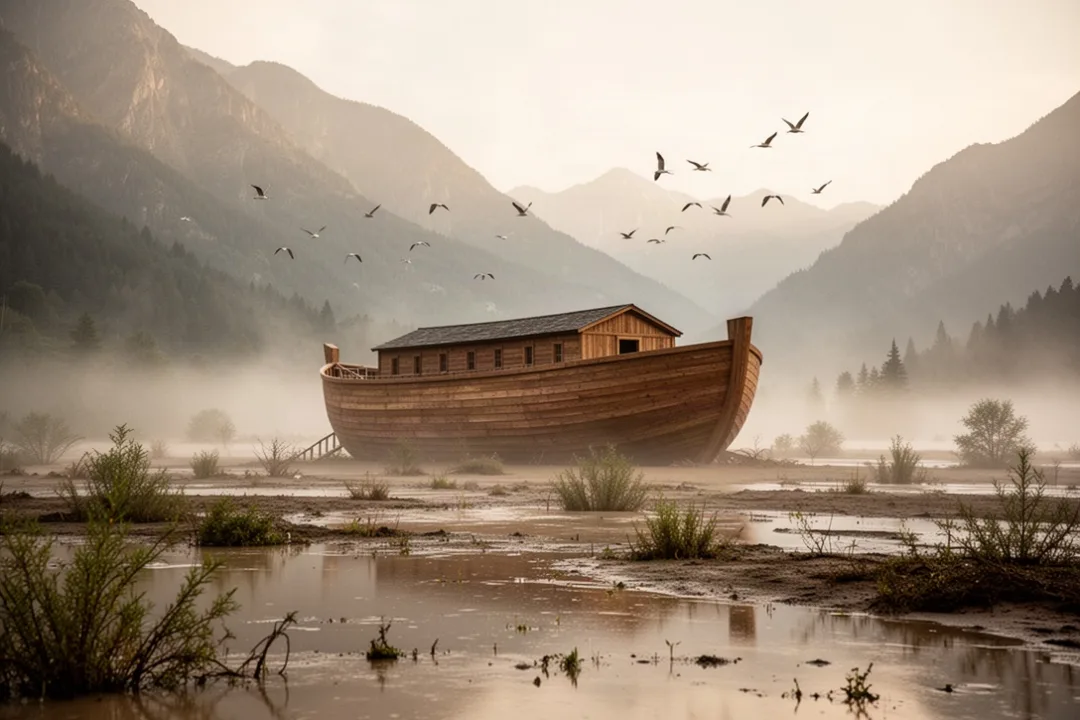
Noah was in the ark for about one year and ten days, according to the dates recorded in Genesis. The flood began when Noah was 600 years old, on the 17th day of the second month, and the family left the ark on the 27th day of the second month in the following year.
The rain lasted 40 days and 40 nights, but that was only the beginning of the time Noah spent aboard. The waters continued to rise, cover the earth, recede, and dry up long after the rainfall stopped.
The flood account in Genesis gives a sequence of dates and time periods rather than one sentence stating the total duration. When those details are placed together, they show that Noah remained in the ark for more than a year.
Genesis 7:11 says the flood began in Noah’s 600th year, on the 17th day of the second month. Genesis 8:14-16 records that the ground was dry by the 27th day of the second month of Noah’s 601st year, after which God told Noah to leave.
So the clearest answer is:
Time from entering until leaving: about one year and ten days.
Rainfall: 40 days and 40 nights.
Waters prevailing: 150 days.
Waiting after the ark came to rest: several additional months before Noah was told to exit.
Short answer: Noah was not in the ark for only 40 days. The rain lasted 40 days and nights, but Noah, his family, and the animals remained aboard for roughly one year and ten days.
How the flood timeline unfolds in Genesis
The following sequence brings together the major time markers in Genesis 7 and 8. The exact calendar system behind the ancient dates is debated, but the narrative clearly presents a stay lasting from the second month of one year to the second month of the next.
Noah enters the ark. God tells Noah, his family, and the animals to enter. Genesis 7:10 indicates that the floodwaters begin after seven days.
The flood begins. On the 17th day of the second month, rain falls, and the underground waters are described as breaking open.
Rain falls for 40 days and nights. The waters rise and lift the ark above the ground.
The waters continue to prevail. Genesis says the waters cover the mountains and remain powerful for 150 days.
The ark comes to rest. On the 17th day of the seventh month, the ark rests on the mountains of Ararat.
The mountain tops become visible. On the first day of the tenth month, Noah can see the tops of the mountains.
Noah sends out birds. He first sends a raven and later sends a dove more than once to test whether the waters have receded.
The earth becomes dry. By the 27th day of the second month in Noah’s 601st year, the ground is dry.
God tells Noah to leave. Noah, his family, and the animals finally exit the ark.
This timeline explains why a simple answer of “40 days” is incomplete. Forty days describes the principal period of rainfall, while the complete stay includes the long period during which the floodwaters remained over the land and then gradually withdrew.
Why people often answer 40 days
The number 40 days and 40 nights is one of the best-known details in the flood story. Genesis 7:12 says the rain fell for that length of time, and Genesis 7:17 describes the flood lasting 40 days as the waters rose and lifted the ark.
Because this number is memorable, people sometimes use it as the answer to how long Noah was in the ark. That answer actually confuses the duration of the rain with the duration of the entire voyage.
Genesis 7:24 says the waters prevailed over the earth for 150 days, and Genesis 8:3 says that after those 150 days the waters began to subside. Even if the rainfall ended earlier, the ark could not be left safely while the surrounding land remained covered.
The difference is similar to the difference between a storm and its aftermath. A storm may last a limited number of hours, while flooding, blocked roads, damaged homes, and unsafe conditions continue for much longer. In Genesis, the rain is only one stage of the larger flood account.
How the dates show a year and ten days
The starting date is given in Genesis 7:11: the 17th day of the second month of Noah’s 600th year. The ending date is given in Genesis 8:13-14: the 27th day of the second month of Noah’s 601st year.
In ordinary language, that is one year and ten days. Some readers calculate the interval as approximately 371 days by using a 12-month calendar in which each month has 30 days. That numerical calculation can be useful for illustration, but it should not be treated as a universally established calendar conversion.
Ancient calendars did not always work like the modern Gregorian calendar. Months could be tied to lunar observation, calendars could be adjusted, and the text does not give enough information to determine every calendar detail with modern precision.
The safest wording is therefore “about one year and ten days”. The biblical dates establish the relative duration clearly even if readers differ about converting that period into an exact number of modern days.
What happened during the first seven days
Genesis indicates that Noah entered the ark before the flood began. After he, his family, and the animals were inside, seven days passed before the waters came. This waiting period is easy to miss because the narrative moves quickly from God’s command to the beginning of the flood.
The seven-day interval means the full time connected with Noah’s stay may be described in two slightly different ways. If someone asks how long Noah was physically inside the ark, the answer includes those days before the rain. If someone asks how long the flood itself lasted, the answer begins when the waters arrived.
Either way, the seven days do not change the main point. Noah was aboard for far longer than the 40 days of rainfall, and the complete period extended into the following year.
Why the ark remained after the rain stopped
When the rain ended, the world described in Genesis was not immediately dry. The water had risen over the land, and the narrative says the waters continued to prevail. Noah could not simply open the door and walk out as soon as the clouds cleared.
Genesis describes a gradual process:
The waters begin to recede after the period in which they prevailed.
The ark rests on the mountains of Ararat.
Mountain peaks become visible later.
Noah sends birds to learn whether the ground is usable.
The surface of the ground eventually dries.
God gives Noah the command to leave.
The ark resting on a mountain did not mean that the surrounding land was ready for habitation. A visible mountain peak was not the same as dry ground, and dry ground was not necessarily the same as an instruction to leave. The story presents Noah as waiting for God’s direction, not relying only on what he could observe through the window.
What the 150 days mean in the flood chronology
The reference to 150 days appears in the middle of the flood account. Genesis 7:24 says the waters prevailed for 150 days, and Genesis 8:3 repeats that the waters receded after 150 days.
Readers sometimes ask whether the 150 days include the 40 days of rain. The wording and chronology have led to different interpretations, especially because the account describes both rising waters and later recession. The central point remains clear: the floodwaters were present and dominant for a substantial period after the initial rainfall.
Genesis also places the ark’s resting on the 17th day of the seventh month. If the second through seventh months are counted as five 30-day months, the period from the 17th day of the second month to the 17th day of the seventh month equals 150 days. This appears to reflect a schematic 30-day calculation in the narrative, even though ancient calendar practices could be more complicated.
That detail helps show how the flood story uses dates to mark stages: beginning, rising, resting, revealing the mountains, drying, and departure.
What Noah did while waiting for the land to dry
The Genesis account gives only a limited description of daily life inside the ark. It does not provide a journal of Noah’s activities, a detailed schedule, or a complete inventory of the food and work required. It does say that the ark contained Noah’s family, the animals, and provisions for food.
From the practical demands of the story, the occupants would have needed to manage several responsibilities:
Feeding the animals with the stored food brought aboard.
Maintaining the animal spaces as well as possible in a confined vessel.
Living with limited space for an extended period.
Watching for changes in the water level and landscape.
Waiting for instructions before opening the ark and leaving.
These practical details are reasonable implications, but they should not be presented as information the text explicitly describes step by step. Genesis focuses more on the flood’s chronology, God’s commands, Noah’s obedience, and the covenant that follows than on the ark’s daily routine.
How Noah used the raven and dove
After the ark had come to rest and time had passed, Noah sent out a raven. Genesis 8:7 says the raven went back and forth until the waters had dried from the earth. The account then describes Noah sending a dove to find out whether the waters had receded from the surface.
The first dove returned because it found no place to land. Seven days later, Noah sent it again, and it returned with a freshly plucked olive leaf. After another seven days, Noah sent the dove a third time, and it did not return.
These birds function as signs within the narrative, but they did not replace the final command from God. Even after the dove failed to return, Noah remained in the ark until God told him to come out. The sequence emphasizes that the visible signs of drying land and the divine instruction to leave were separate parts of the process.
The olive leaf is often treated as a symbol of renewed life and peace, but in the immediate story it also has a practical meaning: vegetation was appearing again, showing that the waters had receded enough for plants to be found.
When the ark came to rest compared with when Noah left
The ark came to rest on the mountains of Ararat on the 17th day of the seventh month. Noah did not leave at that point. Several months passed while the waters continued to withdraw and the land became more suitable.
The chronology includes these later markers:
First day of the tenth month: the mountain tops become visible.
After another interval: Noah sends the raven and dove.
First day of the first month of Noah’s 601st year: the surface of the ground is described as drying.
27th day of the second month: the ground is dry, and God tells Noah to leave.
This distinction matters because “the ark landed” and “Noah left the ark” are not the same event. The vessel stopped moving months before the journey was complete.
Remember the two dates: the ark rested in the seventh month, but Noah did not leave until the second month of the next year. The waiting period after the landing was a major part of the story.
Does the flood account give an exact modern number of days?
The text gives exact dates within its own calendar framework, but translating them into an exact modern day count requires assumptions. Readers commonly describe the interval as 371 days when they use twelve 30-day months plus ten days. Others avoid a precise total because the calendar may not correspond directly to a fixed 360-day year.
The expression “one year and ten days” is more faithful to what the text directly supplies. It communicates the duration without pretending that the ancient calendar can be converted with complete certainty into the Gregorian calendar used in the United States.
There is also a difference between counting elapsed time and counting calendar dates inclusively. For example, counting both the first date and the last date as full calendar days produces a different total from measuring the time between them. This is another reason to use the biblical phrasing rather than insist on one modern numerical figure.
How different passages describe the same flood
The flood chronology is distributed across several passages, especially Genesis 7:6-24 and Genesis 8:1-19. Each passage contributes a different part of the timeline.
Genesis 7 supplies the age of Noah, the date the flood began, the seven-day waiting period, the 40 days of rain, the rising waters, and the 150 days during which the waters prevailed. Genesis 8 records the wind, the receding waters, the resting of the ark, the appearance of the mountain tops, the birds, the drying ground, and the command to leave.
Reading only one short portion can create an incomplete answer. For example, focusing on Genesis 7:12 gives the rainfall duration, while reading through Genesis 8 reveals that Noah stayed aboard until the following year.
The passages are best understood as a connected chronology rather than as competing answers. The 40 days, 150 days, and one year and ten days refer to different measurements within the same event.
What “one year and ten days” does not mean
The phrase does not necessarily mean that Noah was continuously sailing for the entire period. The ark was in motion while the waters rose and later came to rest on the mountains. Once it rested, Noah and the others remained inside while the land dried.
It also does not mean that rain fell continuously for the entire year. Genesis specifically associates the rain with 40 days and nights. The later months involve the recession and drying of the floodwaters.
Finally, the phrase does not tell us every detail about how time passed inside the ark. The text does not specify daily routines, the exact number of animals, or the precise dimensions of every living area in a way that would allow a complete reconstruction of life aboard. The duration can be answered confidently even when some practical questions remain open.
Why the timeline matters to the meaning of the story
The extended timeline gives the flood account a different shape from a brief disaster story. Noah’s obedience involved not only building the ark and entering it, but also remaining patient after the danger appeared to change.
The hardest part may not have been the first days of rain. Inside the ark, Noah had to wait through rising waters, the eventual stillness after the ark rested, the slow appearance of the mountains, and the repeated bird tests. Even after the ground looked dry, he waited for God’s command.
The chronology also highlights the difference between survival during judgment and the beginning of a new life afterward. The exit from the ark marks a transition: Noah’s family and the animals leave the confined vessel, worship follows, and God establishes a covenant signified by the rainbow in Genesis 9.
Does the Bible say Noah was inside the ark the entire time?
Genesis presents Noah, his family, and the animals as entering the ark before the flood and leaving only after God tells them to do so. On that straightforward reading, Noah remained inside for the full period between those events.
The text does not describe Noah leaving temporarily to inspect the land or to gather supplies. The birds were sent from the ark, and Noah himself waited until the command to exit. That is why the standard answer treats the full interval as his time in the ark.
Some discussions distinguish between the time Noah was “in” the ark and the time the ark was “afloat,” but this is a useful clarification rather than a separate biblical duration. The ark was part of Noah’s refuge throughout the waiting period, including the months after it came to rest.
How to answer the question in one sentence
If you need a concise answer, say: “Noah was in the ark for about one year and ten days; the rain lasted 40 days and nights, but the floodwaters took much longer to recede.”
That wording includes the essential distinction and avoids the most common misunderstanding. It also leaves room for calendar differences by saying “about” rather than claiming an exact modern total.
The dates in Genesis begin with the 17th day of the second month of Noah’s 600th year and end with the 27th day of the second month of his 601st year. Those markers are the foundation for the answer.
Related questions about the ark’s timeline
The flood account contains several durations, so readers may encounter different numbers in sermons, study notes, and conversations. The best way to evaluate them is to ask what each number measures.
Seven days: the waiting period after Noah entered before the flood began.
40 days and nights: the period of rain.
150 days: the period in which the waters prevailed, described around the midpoint of the chronology.
About one year and ten days: the period from Noah’s entry until he left the ark.
These figures do not need to compete with one another. They describe different stages of the same account and help explain why the total stay was much longer than the rainfall.
Frequently asked questions
Did Noah stay in the ark for 40 days or one year?
He stayed in the ark for about one year and ten days. The 40 days and nights refer specifically to the rain. After the rain stopped, the floodwaters still covered the land, gradually receded, and left the ground unsuitable for departure. Noah remained inside until God told him and the others to leave.
How long did it take for the floodwaters to go down?
Genesis describes a gradual recession rather than an immediate change. The waters prevailed for 150 days, the ark later rested on the mountains of Ararat, and the mountain tops became visible in the tenth month. The ground was not declared dry enough for Noah to leave until the 27th day of the second month of the following year.
When did Noah enter the ark?
Noah entered before the flood began, along with his family and the animals God directed him to take. Genesis indicates that seven days passed between his entry and the beginning of the flood. The flood itself began on the 17th day of the second month of Noah’s 600th year.
Is Noah’s time in the ark exactly 371 days?
Many Bible readers calculate approximately 371 days by assuming twelve 30-day months and adding ten days. However, the ancient calendar cannot be converted into a modern day count with complete certainty. “One year and ten days” is the clearest wording because it follows the dates Genesis directly provides.










Leave a Reply