Matthew 22 records several of Jesus’ most challenging teachings: the parable of the wedding banquet, the question about paying taxes, the resurrection debate, the greatest commandment, and the question of the Messiah’s identity. Together, these passages show that entering God’s kingdom requires more than religious association; it calls for a responsive heart, faithful love, and a right understanding of Jesus.
The chapter also shows increasing conflict between Jesus and several religious or political groups in Jerusalem. Their questions sound religious, but many are designed to trap him publicly. Jesus answers each challenge with wisdom, exposes shallow motives, and turns attention toward the deeper demands of God’s kingdom.
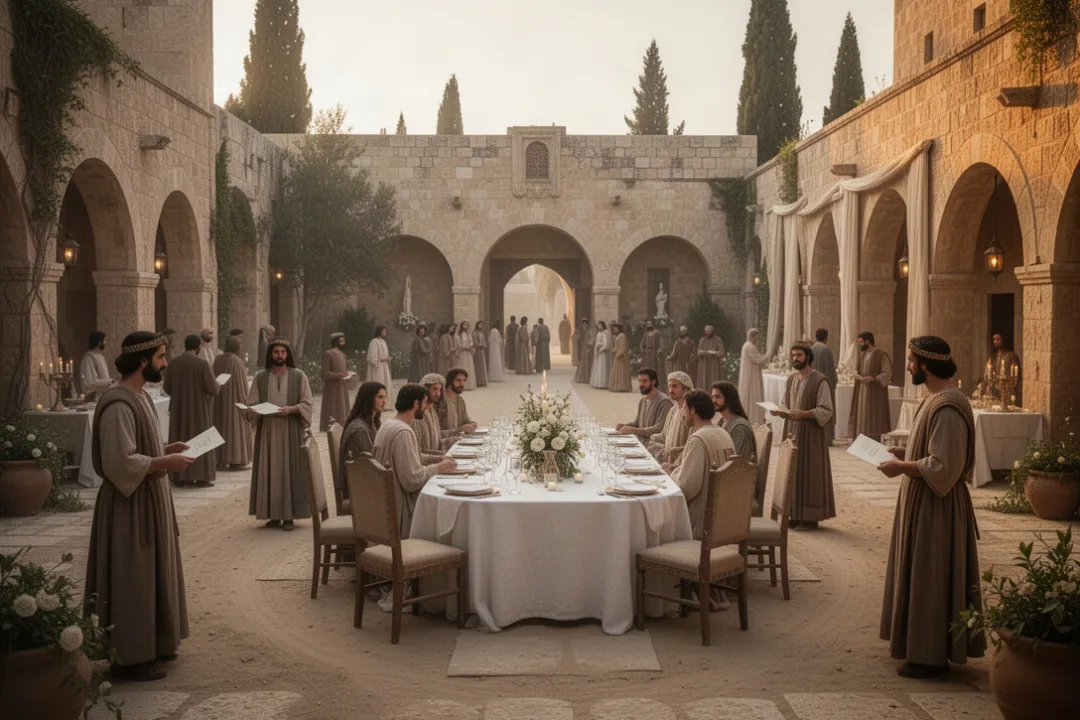
Matthew 22 begins with a parable comparing the kingdom of heaven to a king who prepares a wedding feast for his son. The king sends servants to summon the invited guests, but they refuse to come. When the invitation is repeated, some guests ignore it while others mistreat or kill the messengers.
The king responds by judging those who rejected the invitation and then sends servants to gather people from the roads. The banquet hall is filled with guests who were not part of the original group invited. The story ends with the king finding one guest who is not wearing appropriate wedding clothing. After questioning him, the king has him removed from the feast.
The parable presents several connected ideas about God’s invitation, human refusal, judgment, and the proper response to grace. The original guests represent people who receive a privileged invitation but reject it. The later guests illustrate the widening reach of the kingdom, including people who might not have been expected to belong.
Jesus’ audience would have recognized the banquet as an image of celebration, honor, and royal generosity. A king’s invitation was not a casual social request. Refusing it could communicate defiance, especially when the king sent additional servants to clarify the invitation and extend another opportunity to attend.
Central idea: The parable distinguishes between being invited and responding faithfully. Mere proximity to religious things does not replace genuine repentance, trust, and a life shaped by God’s kingdom.
Why the wedding garment matters
The guest without a wedding garment has often raised questions. The parable does not explain every detail of the clothing custom, and interpreters differ about whether the garment represents righteous conduct, a transformed life, or the fitting response to the king’s generosity. The main point is clear: accepting an invitation outwardly is not enough if the person refuses the character and allegiance the kingdom requires.
The man is speechless when questioned, suggesting that he has no adequate defense. His presence at the feast may represent someone who wants the benefits of the kingdom without accepting its authority. Jesus therefore warns against a merely external connection to faith.
The closing statement contrasts the many who are invited with the few who are chosen. It should not be treated as a mathematical formula or used to calculate how many people will be saved. Instead, it reinforces the seriousness of the invitation and the need for an authentic response.
The parable should also be handled carefully. It is directed into a specific conflict involving Jesus, Israel’s leaders, and the rejection of God’s messengers. It must not be used to condemn Jewish people as a whole. Matthew’s Gospel comes from a Jewish setting and repeatedly presents Jesus, his disciples, and the Scriptures he fulfills within Israel’s story.
How Matthew 22 answers the question about taxes
After the banquet parable, Pharisees and Herodians join together to question Jesus about paying taxes to Caesar. This partnership is significant because the two groups had different interests. The Herodians were associated with the ruling dynasty and could be more accommodating toward Roman power, while many Pharisees were deeply concerned with Jewish religious identity and law.
The question is designed as a trap: should Jews pay the imperial tax or not? If Jesus rejects the tax, his opponents can accuse him of opposing Roman authority. If he supports it without qualification, they can portray him as compromising loyalty to God and Israel.
Jesus recognizes their insincerity and asks them to show him the coin used for the tax. He then asks whose image and inscription appear on it. His response distinguishes between obligations owed to the emperor and obligations owed to God, but it does not reduce faith to private spirituality or give unlimited authority to the state.
The coin bears the ruler’s image, while human beings are made in the image of God. That background helps explain why the answer has greater depth than a simple statement about taxes. People may have civic responsibilities, but their entire lives ultimately belong to God.
Civic responsibility: The passage recognizes that governments can have legitimate claims, such as taxes and public duties.
Ultimate allegiance: God’s claim is greater because it concerns worship, conscience, character, and the whole person.
Limits of political power: Giving the government what is owed does not mean giving it the authority that belongs only to God.
Jesus does not offer a detailed theory of government in this exchange. He answers a hostile question by refusing its false choice. A person can acknowledge civic obligations while remembering that no earthly authority deserves worship or unquestioning obedience.
Practical reading: Matthew 22:15-22 calls you to take public responsibilities seriously without allowing politics, national identity, or government power to become a substitute for devotion to God.
What Jesus teaches about resurrection and marriage
Next, the Sadducees approach Jesus with a question about resurrection. The Sadducees were associated with the Jerusalem priestly leadership and did not accept the resurrection as taught by other Jewish groups. Their hypothetical case involves a woman who, under the levirate marriage practice described in the Law of Moses, is successively married to brothers who die without children.
They ask which husband she will have in the resurrection. The question assumes that life after resurrection simply continues the legal and social structures of the present age. Jesus says this misunderstands both the power of God and the nature of the resurrection.
Jesus explains that resurrected life is not merely an extension of ordinary earthly marriage. People who rise are compared to angels in heaven in the sense that they no longer marry or are given in marriage. This does not mean that human beings become angels. It means that resurrection life belongs to a different order of existence, no longer governed by death and the need to produce descendants.
Jesus then argues from the Torah, using the passage where God identifies himself as the God of Abraham, Isaac, and Jacob. His point is that God is not the God of the dead but of the living. The statement does not function as a complete description of every detail of the afterlife. It establishes that God’s covenant relationship with the patriarchs is not canceled by physical death.
The exchange teaches that resurrection is grounded in God’s faithfulness, not human speculation. The Sadducees’ story tries to make resurrection appear absurd by forcing the next age into the categories of this age. Jesus instead tells them to expect a reality transformed by God’s power.
Common misunderstandings about this passage
Matthew 22 does not say that marriage is unimportant or that family relationships have no value. It says that marriage, as an institution connected with this mortal life, will not operate in exactly the same way after resurrection. Jesus is answering a specific question about marital status, not rejecting love, companionship, or human dignity.
The passage also does not give permission to dismiss difficult questions. Jesus responds to the Sadducees’ scenario, but he does so by correcting the assumptions beneath it. When considering Christian beliefs about resurrection, it is useful to ask whether a question limits God’s future work to present experience.
Matthew’s account places this debate alongside the conflict in Jerusalem. Religious leaders are not simply seeking information; they are testing Jesus. His response therefore reveals both the truth of resurrection and the inadequacy of arguments built on disbelief or clever manipulation.
Why the greatest commandment is central to Matthew 22
After hearing that Jesus had silenced the Sadducees, a Pharisee who is described as an expert in the law asks which commandment is greatest. The question may be sincere, confrontational, or both. Jewish teachers discussed how the many commandments related to one another, and asking Jesus to identify the greatest created another opportunity to test his interpretation.
Jesus answers by joining two commands from the Hebrew Scriptures. The first calls for complete love of God—with the heart, soul, and mind. The second commands love of one’s neighbor as oneself. Matthew records that all the Law and the Prophets depend on these two commands.
The first command comes from Deuteronomy 6:4-5, the beginning of the central Jewish confession known as the Shema. It describes love of God as total loyalty rather than a passing emotion. The language of heart, soul, and mind points to the whole person: desires, will, identity, understanding, and daily choices.
The second command comes from Leviticus 19:18. Loving your neighbor does not mean approving every action or avoiding necessary correction. It means seeking another person’s good, refusing revenge, acting honestly, and treating others with the same moral seriousness you apply to yourself.
Jesus does not present love as a vague feeling that replaces obedience. In Matthew 22, love is the fulfillment and organizing principle of obedience. It gives the commandments their proper direction and exposes religious behavior that is technically precise but morally empty.
Love God with your whole self: Let worship shape your priorities, decisions, desires, and understanding.
Love your neighbor concretely: Practice honesty, mercy, fairness, patience, and care for people whose needs are easy to overlook.
Keep the two commands together: Claims to love God that produce contempt for people are inconsistent with Jesus’ teaching.
Let love guide interpretation: Read individual commands in a way that reflects God’s holiness, justice, mercy, and faithfulness.
This answer also helps connect the chapter’s earlier scenes. The wedding banquet concerns a response to God’s invitation. The tax question concerns ultimate allegiance. The resurrection debate concerns God’s power and covenant faithfulness. The greatest commandments show what a life oriented toward God should look like in practice.
What Jesus means by “the Son of David”
Jesus then asks the Pharisees a question about the Messiah. He asks whose son the Messiah is, and they answer, “the Son of David,” identifying the expected king as David’s descendant. This title carries royal and covenantal meaning because God’s promises to David shaped Jewish hopes for a future ruler.
Jesus refers to Psalm 110, where David speaks of someone whom he calls “Lord.” Since a father normally holds greater status than a son, Jesus asks how David can call his own descendant “Lord.” The question is not denying that the Messiah is David’s descendant. It challenges the assumption that the Messiah can be understood only as an ordinary human king.
Matthew uses this exchange to point toward the greater identity of Jesus. The Messiah is connected to David’s royal line, yet he also possesses a status that surpasses David. Jesus is not merely another political leader who will restore national power according to ordinary expectations.
The question remains unanswered by Jesus’ opponents, and Matthew says that no one is able to reply. From the Gospel’s perspective, the issue is not an abstract puzzle. It asks readers to recognize that Jesus fulfills Israel’s hopes in a way that exceeds familiar categories.
This final exchange also explains why the chapter’s earlier conflicts matter. The leaders question Jesus’ authority, but the deeper question is who he is. If he is only a teacher, his claims can be judged by ordinary standards. If he is the Messiah and Lord, then his words demand a response involving worship, obedience, and trust.
How to read Matthew 22 as one connected chapter
Matthew 22 contains different scenes, but they share a common concern: how people respond to Jesus and to God’s authority. The chapter moves from a rejected invitation to debates about politics, resurrection, Scripture, love, and the Messiah. Each episode exposes a different kind of misunderstanding.
Refusing the invitation: Some people reject God’s call even when it is clearly presented.
Attending without the proper garment: Others want the benefits of the kingdom without a transformed response.
Testing Jesus with politics: Some reduce faith to a contest between public loyalty and religious identity.
Limiting resurrection to present categories: Others underestimate God’s power by assuming the future must work exactly like the present.
Separating love from obedience: Religious people can focus on debates while missing the heart of God’s commands.
Misunderstanding the Messiah: People may expect a leader who fits their assumptions instead of recognizing Jesus’ true authority.
The chapter therefore challenges both open rejection and outward religiosity. A person may know Scripture, ask sophisticated questions, and belong to a respected religious group while still resisting the authority of God. Matthew 22 asks whether your response is merely verbal or whether it reaches your loyalties, relationships, and conduct.
For personal reading, begin by identifying the question or challenge in each scene. Then observe how Jesus exposes the assumptions behind it. Finally, consider what the passage reveals about God’s kingdom, human responsibility, and the identity of Jesus.
Matthew 22 is not simply a collection of memorable sayings. Its teachings fit together around the call to receive God’s invitation, honor God above every earthly power, trust the promise of resurrection, love God completely, love neighbors faithfully, and recognize Jesus as the Messiah whose authority surpasses ordinary human categories.
Frequently asked questions
What is the main message of Matthew 22?
Matthew 22 emphasizes that God’s kingdom calls for a genuine response, not superficial religious association. Jesus teaches that people must honor God above political powers, trust God’s promise of resurrection, love God wholeheartedly, love their neighbors, and recognize Jesus as the Messiah. The chapter also warns that religious knowledge or outward participation cannot replace faithful obedience.
What does “render unto Caesar” mean today?
Jesus’ answer about the tax recognizes legitimate civic obligations while placing them beneath God’s ultimate claim. It does not endorse every government action or suggest that political authority is unlimited. For modern readers, the principle supports responsible citizenship while reminding you that worship, conscience, and complete allegiance belong to God rather than to any ruler, nation, or political movement.
Does Matthew 22 teach that people will not be married in heaven?
Jesus says that resurrection life will not include marriage in the same form known in the present age. He is responding to a debate about legal marriage and resurrection, not dismissing earthly marriage or human love. The passage presents the future as transformed by God’s power, with relationships no longer organized around mortality, inheritance, or the need for descendants.
Why does Jesus connect love of God and love of neighbor?
The two commands summarize the direction of faithful obedience. Love of God involves complete loyalty and devotion, while love of neighbor expresses that devotion through mercy, fairness, honesty, and practical care. Keeping the commands together prevents a person from claiming deep spirituality while treating others cruelly, or from pursuing social good while ignoring the God whom Jesus places first.






Leave a Reply