When you read the Gospels separately, Jesus’ ministry can seem difficult to place on a calendar. You may wonder when he called the Twelve, how long he preached in Galilee, or where the Jerusalem visits belong. The broad timeline is clear: Jesus was baptized, proclaimed God’s kingdom, taught and healed, gathered disciples, traveled toward Jerusalem, and was crucified during Passover, followed by his resurrection appearances.
The exact years are less certain. Most historians place the public ministry of Jesus in the late 20s or early 30s AD, often estimating roughly two to three years. The Synoptic Gospels—Matthew, Mark, and Luke—emphasize a major movement from Galilee toward Jerusalem, while John records several visits to Jerusalem and mentions multiple Passovers. Those differences affect how long the ministry appears to have lasted.
How to use this timeline: Treat the sequence of major events as reliable while recognizing that the Gospels do not provide a modern day-by-day calendar. Some episodes cannot be assigned an exact date or location.
Jesus’ ministry begins with baptism and preparation
Before Jesus’ public work begins, the Gospels place him in the care of John the Baptist. John preached repentance and announced that God was acting decisively. People came to him at the Jordan River, where he baptized them as a sign of turning back to God.
Jesus’ baptism by John marks the recognized beginning of his public ministry. The event appears in Matthew 3, Mark 1, and Luke 3, while John’s Gospel refers to the Spirit descending on Jesus after John’s testimony. The accounts present Jesus as receiving the Spirit and being identified for his mission.
Immediately after the baptism, Jesus spends time in the wilderness. Matthew 4 and Luke 4 describe three temptations, while Mark gives a much shorter account of the same period. The setting emphasizes testing, obedience, and preparation before Jesus begins proclaiming the kingdom of God.
John’s Gospel presents some early activity among John the Baptist’s followers after Jesus’ baptism. Several disciples begin following Jesus, including Andrew, Simon Peter, Philip, and Nathanael in John 1. The Synoptic Gospels describe the calling of fishermen beside the Sea of Galilee later in the narrative, so the exact relationship between these accounts is debated.
Jesus then begins announcing that God’s kingdom has drawn near. His message calls people to repent and trust the good news. This proclamation provides the central theme for the rest of his ministry: God is acting through Jesus to restore, judge, heal, and gather a faithful people.
Jesus’ early ministry includes Galilee, Cana, and Jerusalem
The first phase of public activity includes teaching, signs, healings, and the gathering of disciples. Jesus’ hometown of Nazareth is in Galilee, and the region becomes the main setting for much of his ministry. He also travels beyond Galilee and appears in Jerusalem, especially in John’s account.
John 2 places the wedding at Cana among Jesus’ early signs. Jesus turns water into wine, and the event reveals his glory to his disciples. The story introduces a pattern that continues throughout John: a visible sign points beyond itself to Jesus’ identity and mission.
John also records a visit to Jerusalem during Passover early in Jesus’ ministry. There, Jesus disrupts commercial activity in the Temple courts. John places this action near the beginning of the narrative, while Matthew 21, Mark 11, and Luke 19 place a similar Temple action during the final week.
There are two main ways Christians and scholars understand this difference. Some propose that Jesus cleansed the Temple on two occasions, one early and one near the end. Others think the Gospel writers arranged the same event differently to highlight its theological meaning. The safest timeline acknowledges the shared importance of the Temple action without claiming more chronological precision than the sources provide.
During this period, Jesus also speaks with Nicodemus, a Pharisee and member of the Jewish leadership, according to John 3. Their conversation concerns spiritual rebirth, God’s saving purpose, and the identity of the Son. John 4 then describes Jesus traveling through Samaria and speaking with a Samaritan woman, an encounter that broadens the narrative beyond Jewish communities in Galilee and Judea.
John the Baptist continues his own ministry for a time, but his role begins to recede as Jesus’ public work expands. John 3–4 describes Jesus and his disciples baptizing in the Judean countryside, although John clarifies that Jesus himself was not personally performing the baptisms. Matthew 4 and Mark 1 later emphasize Jesus’ return to Galilee after John’s arrest.
Jesus’ Galilean ministry centers on teaching, healing, and discipleship
The central and most extensive phase of the Gospel story takes place in Galilee. Jesus teaches in synagogues, villages, and open country; heals the sick; confronts unclean spirits; forgives sins; and calls people to follow him. His reputation spreads across the region, drawing crowds as well as opposition.
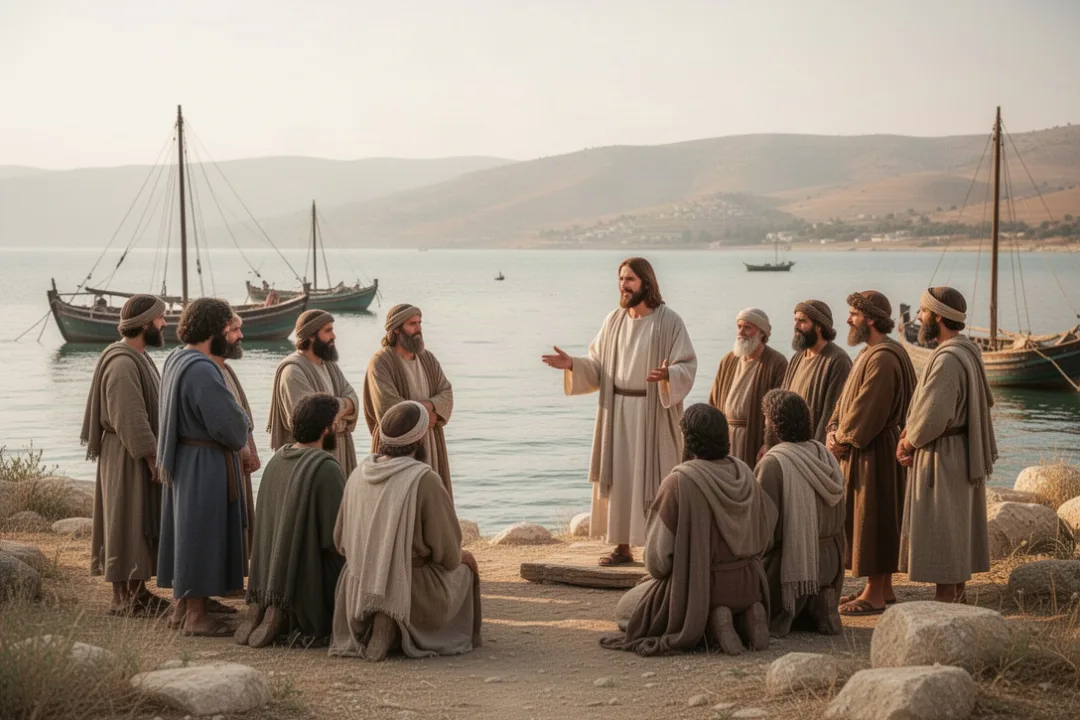
Mark 1, Matthew 4, and Luke 4 describe Jesus beginning his Galilean proclamation after John the Baptist is arrested. He calls Simon Peter and Andrew, then James and John, while they are working as fishermen. Other disciples join him as the ministry develops, and the Twelve are eventually appointed as a distinct group representing the renewed people of God.
The calling of the Twelve is a major development. Jesus does not simply gather admirers; he forms a community that will hear his teaching, witness his actions, and later carry the message beyond his immediate ministry. The lists of the Twelve appear in Matthew 10, Mark 3, and Luke 6, with slight differences in the names and order.
Jesus’ teaching includes the Sermon on the Mount in Matthew 5–7 and a shorter, related discourse in Luke 6, often called the Sermon on the Plain. These teachings address anger, reconciliation, love of enemies, prayer, generosity, anxiety, judging others, and faithful action. They show that life under God’s reign involves both inner transformation and practical conduct.
Parables become one of Jesus’ best-known teaching methods. He compares God’s kingdom to seeds, a hidden treasure, a pearl, yeast, a growing crop, and a net in Matthew 13 and related passages. Other parables focus on mercy, responsibility, prayer, wealth, and the danger of religious self-confidence.
Jesus’ healings include people with fever, paralysis, skin diseases, blindness, deafness, and other serious conditions. The Gospel accounts also describe exorcisms and the raising of Jairus’s daughter, the widow’s son at Nain, and Lazarus in John 11. These stories are presented not merely as displays of power but as signs of compassion, restoration, and the arrival of God’s kingdom.
Teaching: Jesus announces God’s kingdom and explains what faithful living looks like.
Healing: His actions restore people physically, socially, and religiously.
Forgiveness: Several controversies concern Jesus’ authority to forgive sins.
Table fellowship: He eats with people regarded as sinners or outsiders.
Discipleship: Followers are called to trust him, serve others, and accept the cost of commitment.
Conflict grows as Jesus’ ministry becomes more visible. Disputes concern Sabbath practice, fasting, ritual traditions, forgiveness, table fellowship, and his authority. Some religious leaders challenge him publicly, while others show interest or engage him in serious conversation. The opposition is not presented as a simple conflict with all Jewish people; Jesus, his disciples, and the crowds are themselves Jewish, and the disputes occur within the religious life of first-century Judaism.
Several major events belong to this Galilean period, although their exact order varies among the Gospels. Jesus calms a storm, feeds large crowds, walks on the sea in some accounts, and sends the Twelve to preach and heal. The feeding of the five thousand is the only miracle before the resurrection reported in all four Gospels, making it a particularly important marker in the public ministry.
After the feeding, Jesus’ teaching turns more directly toward his identity and coming suffering. At Caesarea Philippi, Peter identifies Jesus as the Messiah in Matthew 16, Mark 8, and Luke 9. Jesus then begins telling the disciples that he will suffer, be rejected, die, and rise again. The disciples struggle to understand this because they expect the Messiah’s mission to look like triumph rather than humiliation.
Jesus moves toward Jerusalem and prepares his disciples
At a significant turning point, Jesus sets his direction toward Jerusalem. Luke 9 describes this determination especially clearly, while Matthew and Mark also organize the latter portion of their narratives around the journey. The road is not presented as ordinary travel; it becomes a period of intensified teaching about discipleship, humility, service, judgment, and the cost of following Jesus.
The Transfiguration appears in Matthew 17, Mark 9, and Luke 9 shortly after Peter’s confession and the first predictions of suffering. Jesus is revealed in glory before Peter, James, and John, with Moses and Elijah appearing in the scene. The event strengthens the connection between Jesus, Israel’s Scriptures, and the coming passion.
During the journey, Jesus teaches through parables and direct instruction. Luke includes the Good Samaritan, the rich fool, the lost sheep, the lost coin, the prodigal son, the persistent widow, and the Pharisee and tax collector. These stories emphasize mercy, repentance, prayer, generosity, and God’s concern for the lost.
Jesus also teaches about marriage, children, wealth, leadership, and prayer. He repeatedly challenges his disciples’ desire for status. Greatness in the kingdom is defined by service, and the first may become last. The disciples are warned that attachment to possessions and public honor can prevent wholehearted devotion.
John’s Gospel includes additional activity in Jerusalem and Judea during this general period. Jesus teaches at Jewish festivals, faces increasingly direct opposition, and raises Lazarus at Bethany according to John 11. That sign becomes a catalyst for intensified plans among leading authorities to stop Jesus, while the Synoptic Gospels place the major public escalation later in the Jerusalem week.
The chronology between the Synoptic Gospels and John cannot be reduced to a perfectly synchronized itinerary. John mentions several Passovers and other festivals, which can support a ministry lasting more than two years. The Synoptics focus more tightly on the final journey to Jerusalem and do not provide enough festival markers to calculate an exact duration.
A useful distinction: The Gospels agree on the ministry’s major movement and climax, but they sometimes arrange events by theme rather than by a modern chronological schedule. Agreement on meaning does not require every episode to appear in the same sequence.
Jesus’ final week in Jerusalem leads to the crucifixion
Jesus enters Jerusalem shortly before Passover. In the Synoptic accounts, crowds greet him with messianic language, and the entry is associated with a colt or donkey. John also describes a public arrival, though the details and order differ. This event is commonly remembered as Palm Sunday, even though the Gospels themselves do not use that later liturgical name.
In Jerusalem, Jesus teaches publicly and is questioned by various groups. The controversies include taxation, resurrection, the greatest commandment, the identity of the Messiah, and the authority behind Jesus’ actions. Matthew 23 contains strong criticism of scribes and Pharisees, while Mark 12 and Luke 20 record several challenges and responses.
The Temple action becomes especially significant during this final visit. Jesus overturns tables or disrupts commerce in the Temple courts, condemning practices that conflict with the Temple’s purpose as a place of prayer. The action symbolizes judgment against corrupt worship and helps explain why the authorities view him as a serious threat.
Jesus teaches about coming judgment and the future of Jerusalem in the so-called Olivet discourse, recorded in Matthew 24–25, Mark 13, and Luke 21. He warns his disciples to remain alert and faithful. The discourse combines predictions concerning the Temple’s destruction with broader teaching about suffering, watchfulness, and the coming of the Son of Man.
During the week, Jesus shares a final meal with his disciples. Matthew 26, Mark 14, and Luke 22 describe the meal in connection with Passover, while John places the death of Jesus in relation to the preparation for Passover. At the meal, Jesus interprets the bread and cup in relation to his body and blood and announces that one of the Twelve will betray him.
John 13–17 gives an extended account of Jesus’ final teaching to his disciples. He washes their feet, commands them to love one another, speaks of remaining united with him, and promises the coming help of the Holy Spirit. These chapters provide a farewell setting that complements the Synoptic accounts of the meal and the coming crisis.
After the meal, Jesus goes to Gethsemane, or to a garden across the Kidron Valley in John’s account. He prays in anguish and submits himself to God’s will. Judas arrives with an armed group or detachment, identifies Jesus, and Jesus is arrested. The disciples scatter, although Peter follows at a distance in the Synoptic accounts.
Jesus faces questioning before Jewish leaders and is then taken to the Roman governor Pontius Pilate. The Gospels differ in the precise sequence and names of the individuals involved, but they agree that Roman authority carried out the crucifixion. The charge is connected to kingship, making Jesus a perceived political threat under Roman rule.
Jesus is crucified at Golgotha, outside Jerusalem. Mark 15, Matthew 27, Luke 23, and John 19 each describe the death with distinctive details. The crucifixion occurs during the Passover period and is followed by burial in a tomb associated with Joseph of Arimathea. The Gospel accounts present Jesus’ death as both a historical execution and the central saving event of his mission.
Resurrection appearances complete the Gospel timeline
On the first day of the week after the Sabbath, women go to the tomb and find it open and empty. The accounts differ in the number of women named, the messengers at the tomb, and the precise sequence of appearances, but they share the claim that Jesus was raised from the dead.
Mary Magdalene is prominently associated with the first resurrection discovery and, in John 20, with an appearance of the risen Jesus. The Synoptic Gospels also describe appearances to other women, to disciples traveling to Emmaus, and to the gathered disciples. Paul later summarizes several resurrection appearances in 1 Corinthians 15, including an appearance to Peter, the Twelve, James, and a larger group of believers.
The resurrection appearances are not presented as a continuation of ordinary Galilean ministry. They are a new phase in which Jesus commissions his followers and confirms the message they will proclaim. Matthew ends with a commission to make disciples among all nations; Luke and Acts describe the disciples’ witness beginning in Jerusalem; John emphasizes restoration, belief, and the role of Peter.
Luke 24 and Acts 1 connect the end of Jesus’ earthly appearances with his ascension. The Gospels do not give a single modern-style timetable for the interval between resurrection and ascension. Acts describes a period of appearances and instruction, while the closing section of Luke moves more rapidly from resurrection to departure.
The public ministry therefore reaches its climax through a connected sequence:
Baptism and wilderness testing: Jesus is publicly identified and prepared for his mission.
Early preaching: He announces God’s kingdom and begins gathering disciples.
Galilean ministry: He teaches, heals, casts out demons, tells parables, and forms the Twelve.
Journey to Jerusalem: He prepares the disciples for suffering and defines faithful discipleship.
Final week: He enters Jerusalem, teaches in the Temple, shares the final meal, and is arrested.
Crucifixion and resurrection: He dies, is buried, rises, and appears to his followers.
For study purposes, the most reliable approach is to track both the broad historical sequence and the purpose of each Gospel writer. Matthew often highlights fulfillment and Jesus’ teaching, Mark emphasizes urgency and suffering, Luke stresses mercy and the journey to Jerusalem, and John organizes signs and festival visits around Jesus’ identity. Reading the four accounts together gives a fuller picture than forcing every scene into an exact calendar.
Frequently asked questions
How long did Jesus’ public ministry last?
The exact length cannot be established with certainty. Many estimates place it at roughly two to three years, based especially on the Passover references in John’s Gospel. Some reconstructions allow a shorter period, while others support a ministry lasting more than two years. The Gospels provide a theological narrative rather than a complete calendar, so the precise starting and ending years remain uncertain.
What event began Jesus’ public ministry?
Jesus’ baptism by John the Baptist is generally treated as the beginning of his public ministry. It is followed by his wilderness testing and the announcement that God’s kingdom has drawn near. The baptism identifies Jesus publicly and marks the transition from the relatively hidden years before ministry to his preaching, healing, teaching, and gathering of disciples.
Did Jesus visit Jerusalem more than once?
Yes. John records several visits to Jerusalem connected with Jewish festivals, while Matthew, Mark, and Luke focus mainly on Jesus’ final journey there. This is one reason scholars discuss differences between the Gospel timelines. The accounts clearly place Jesus in Jerusalem at the end of his ministry, but they arrange and emphasize his earlier visits differently.
Which Gospel gives the most detailed timeline?
No single Gospel supplies a complete modern chronology. John offers more festival markers, including several Passovers, which can help estimate the ministry’s duration. Matthew, Mark, and Luke provide a closely related account of Jesus’ movement from Galilee toward Jerusalem. Comparing all four gives the best overall timeline, while still leaving some events’ exact order uncertain.









Leave a Reply