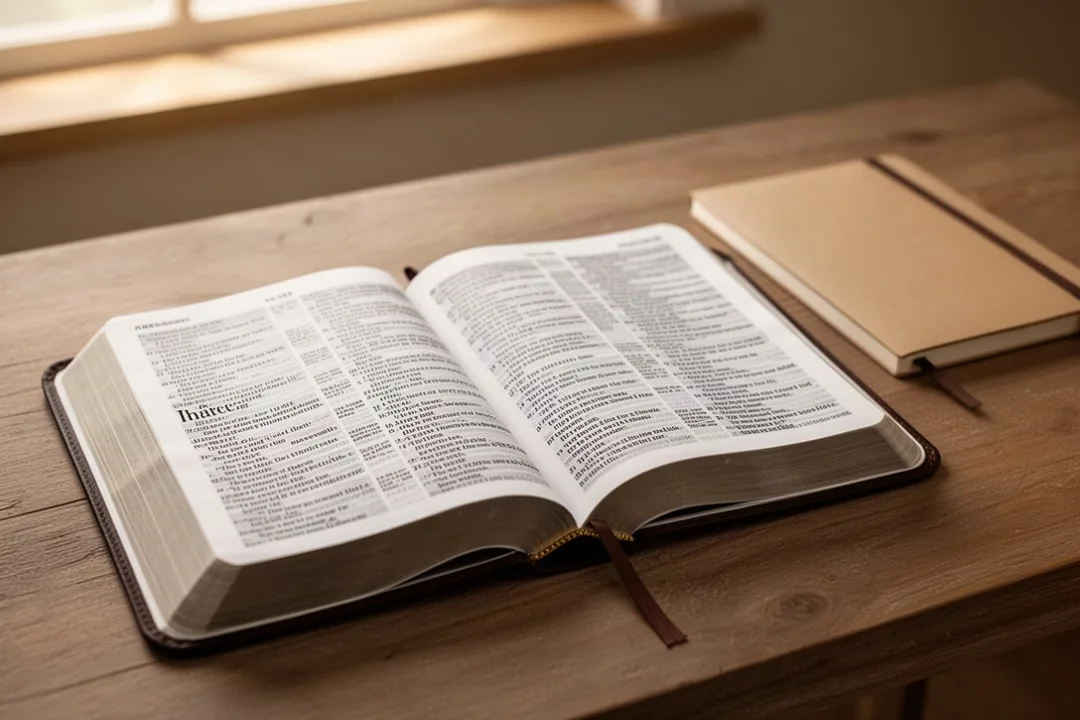
The first book of the New Testament is the Gospel according to Matthew, usually called Matthew. It tells the story of Jesus Christ, beginning with his genealogy and birth, continuing through his teaching and ministry, and ending with his resurrection and commission to his disciples.
Matthew stands at the meeting point between the Old and New Testaments. Its opening chapters connect Jesus with Israel’s history, while its later chapters present him as the Messiah, teacher, and risen Lord. The book contains some of Jesus’ best-known teachings, including the Sermon on the Mount, the Lord’s Prayer, the Beatitudes, and the Great Commission.
Matthew appears first because it provides a strong bridge from the Old Testament to the story of Jesus. The book repeatedly connects events in Jesus’ life with Israel’s Scriptures, showing how Christians understand those earlier promises and patterns as reaching fulfillment in him.
The placement also makes sense from a literary standpoint. The Old Testament ends with expectation: God’s people await restoration, the coming of God’s kingdom, and the fulfillment of his promises. Matthew begins by presenting Jesus within that story rather than as an isolated figure from the first century.
Matthew is not necessarily the earliest Gospel to have been written. The order of the New Testament books is based on theological and literary considerations, not simply on the date each book was composed. Its position gives readers a natural transition from the laws, prophets, poetry, and historical narratives of the Old Testament to the life and teaching of Jesus.
Direct answer: If you are looking for the first book of the New Testament, read Matthew. It is one of the four Gospels and contains 28 chapters.
What Matthew is about
Matthew presents Jesus as the promised Messiah and the authoritative teacher of God’s kingdom. The book does not merely list events from Jesus’ life. It arranges those events and teachings to show who Jesus is, what his kingdom means, and how his followers should live.
Several major movements shape the book. Jesus is introduced through his ancestry and birth, then tested and revealed through his ministry. He teaches crowds and disciples, heals the sick, confronts religious and political opposition, enters Jerusalem, is crucified, rises from the dead, and sends his followers to make disciples among all nations.
The central question is not simply what Jesus did. Matthew also asks readers to consider his identity and their response to him. People in the narrative worship him, follow him, misunderstand him, challenge him, betray him, or reject him. Those responses help explain the significance of his works and teachings.
Matthew’s main themes and ideas
Jesus as the promised Messiah
Matthew repeatedly identifies Jesus with the hopes expressed in Israel’s Scriptures. The opening genealogy places him in the line of Abraham and David, two figures central to biblical promises about God’s people and their king.
The book also uses a recurring pattern in which an event in Jesus’ life is connected with what was spoken through a prophet. These references are not decorative footnotes. They are part of Matthew’s argument that Jesus’ story belongs within God’s long-established purposes.
Matthew’s presentation of Jesus includes royal imagery, but it also emphasizes humility and obedience. Jesus is a king who serves, suffers, and gives his life. His authority is not presented as mere political power; it is expressed through teaching, healing, mercy, judgment, and self-sacrifice.
The kingdom of heaven
The phrase kingdom of heaven appears frequently in Matthew. It refers to God’s active rule rather than only to a place people enter after death. Jesus announces that this kingdom has drawn near and teaches what life under God’s rule looks like.
Matthew’s parables explore the kingdom through images such as seed, soil, weeds, treasure, a valuable pearl, a fishing net, and a forgiving king. These stories show that the kingdom may begin in an apparently small or hidden way, yet it has lasting and decisive significance.
The kingdom also demands a response. People must repent, receive God’s mercy, practice faithfulness, and treat others according to the values Jesus teaches. Matthew holds together both present discipleship and future judgment: God’s reign is already being announced, but its full fulfillment remains ahead.
Jesus as a teacher
Matthew gives special attention to Jesus’ teaching. Large sections of the Gospel collect his words into extended speeches, making the book useful for readers who want to understand Jesus’ ethical and spiritual instruction.
The Sermon on the Mount, found in Matthew 5–7, addresses humility, anger, reconciliation, sexual integrity, honesty, retaliation, love for enemies, generosity, prayer, fasting, possessions, anxiety, and judgment. Jesus moves beyond outward rule-keeping and addresses the intentions of the heart.
For example, Matthew 5 presents anger and contempt as serious matters, not merely physical violence. Matthew 6 describes prayer and generosity as practices that should be directed toward God rather than performed for public praise. Matthew 7 urges listeners to practice Jesus’ words instead of merely hearing them.
Righteousness and mercy
Matthew uses the language of righteousness to describe faithful living before God. This righteousness is deeper than public reputation or technical compliance. It involves integrity, mercy, humility, reconciliation, and sincere devotion.
The book also warns against a religious life centered on appearances. Several passages criticize hypocrisy, especially when people use religious behavior to gain honor while neglecting justice, compassion, and faithfulness. Matthew does not treat religious practice as unimportant; it insists that practice must reflect genuine love for God and neighbor.
Mercy is especially prominent. Jesus welcomes outsiders, heals the suffering, eats with people viewed as sinners, and teaches his followers to forgive. Matthew 9 and Matthew 12 connect mercy with the proper understanding of religious obedience, while Matthew 18 presents forgiveness as a defining responsibility within the community.
The formation of a community
Matthew is concerned with how Jesus’ followers live together. The disciples are not simply private believers; they become a community shaped by Jesus’ teaching, prayer, forgiveness, service, and mission.
Matthew 18 addresses relationships within that community. It discusses care for vulnerable people, the danger of causing others to stumble, the pursuit of reconciliation, and the need to forgive repeatedly. The emphasis is practical: discipleship affects how people handle conflict and responsibility, not only what they believe about Jesus.
The book also recognizes that the community will include both genuine and false responses. Some people hear Jesus’ words but do not act on them. Some appear committed for a time, while others remain faithful under pressure. Matthew therefore combines encouragement with warnings about endurance, discernment, and accountability.
Mission to all nations
Although Matthew is deeply connected to Israel’s Scriptures and history, it ends with a universal mission. The risen Jesus sends his disciples to make disciples of all nations, baptize them, and teach them to follow his commands, according to Matthew 28:18–20.
This worldwide mission is prepared for throughout the Gospel. Gentiles appear among the people who recognize Jesus’ significance, including the magi in the birth narrative, a Roman centurion praised for his faith, and a Canaanite woman whose trust becomes part of a challenging conversation about inclusion.
The ending therefore expands the scope of the book without abandoning its Jewish setting. Jesus’ message begins within Israel’s story and reaches outward to the nations. The disciples’ task is not merely to collect decisions or repeat information; it is to form people who learn and practice Jesus’ way.
How Matthew is organized
Matthew contains 28 chapters. The exact headings used in printed Bibles vary, but the book follows a clear progression from Jesus’ origins to his worldwide commission.
Matthew 1–2: Jesus’ genealogy, birth, visit of the magi, escape to Egypt, and early return to Nazareth.
Matthew 3–4: John the Baptist’s ministry, Jesus’ baptism, testing in the wilderness, and the beginning of his public ministry.
Matthew 5–7: The Sermon on the Mount, including Jesus’ teaching about kingdom life.
Matthew 8–9: Healings, demonstrations of authority, and the calling of disciples.
Matthew 10: Instructions to the Twelve as they are sent to proclaim the kingdom.
Matthew 11–12: Responses to Jesus, conflicts over authority, and teaching about mercy and the Sabbath.
Matthew 13: Parables about the kingdom of heaven.
Matthew 14–17: Further miracles, Peter’s confession, and the preparation of the disciples.
Matthew 18: Teaching about humility, relationships, correction, and forgiveness within the community.
Matthew 19–23: Teaching on marriage, wealth, leadership, service, and opposition from religious authorities.
Matthew 24–25: Jesus’ teaching about coming judgment, watchfulness, and faithful service.
Matthew 26–28: The Last Supper, arrest, trial, crucifixion, burial, resurrection, and Great Commission.
A helpful feature of Matthew is its repeated alternation between Jesus’ actions and Jesus’ teaching. A sequence of miracles may be followed by instructions for the disciples. A conflict may lead to a parable or extended explanation. This arrangement encourages readers to connect what Jesus does with what he teaches.
Who wrote Matthew?
The Gospel is traditionally associated with Matthew, one of Jesus’ twelve apostles and a former tax collector. Matthew 9:9 describes Jesus calling a tax collector named Matthew, and the apostolic list in Matthew 10 includes him.
The text itself does not identify its author in the same direct way that a personal letter might. Early Christian tradition connects the book with Matthew, while modern scholars examine its language, structure, relationship to the other Gospels, and use of earlier material when discussing its composition.
It is therefore accurate to say that the book is traditionally attributed to Matthew. Readers can study its message without pretending that every question about its production has a universally accepted answer. The Gospel’s authority for Christian communities rests primarily on its witness to Jesus and his teaching.
How Matthew relates to the other Gospels
Matthew is one of the Synoptic Gospels, along with Mark and Luke. “Synoptic” means “seen together,” reflecting the fact that these three books share many events, sayings, and narrative patterns. John has a different style and structure, though it also tells the story of Jesus’ ministry, death, and resurrection.
Matthew, Mark, and Luke are not identical biographies. Each selects and arranges material to address particular theological and pastoral concerns. Matthew gives especially strong attention to fulfillment of Scripture, Jesus’ teaching, the kingdom of heaven, and the life of the gathered community.
Matthew often resembles Mark and Luke in broad narrative sequence, but it also includes material not found in those books. The Sermon on the Mount, several kingdom parables, particular stories about Peter, and the detailed birth narrative are among the passages especially associated with Matthew’s presentation.
Reading the Gospels side by side can be useful, but each Gospel should first be read as a complete work. Comparing isolated details too quickly can make the books seem like competing transcripts rather than distinct accounts that emphasize different aspects of Jesus’ significance.
Important passages in the first Gospel
Matthew contains many passages that have shaped Christian worship, teaching, and ethics. The most useful place to begin depends on what you want to understand, but these sections provide a strong map of the book.
Matthew 1:1–17: The genealogy presents Jesus within the line of Abraham and David.
Matthew 5–7: The Sermon on the Mount explains the character and practice of life in God’s kingdom.
Matthew 6:9–13: Jesus gives a model for prayer commonly known as the Lord’s Prayer.
Matthew 7:24–27: The closing image of the Sermon on the Mount emphasizes acting on Jesus’ teaching.
Matthew 11:28–30: Jesus invites the weary to come to him and learn from him.
Matthew 13: Parables describe the nature, value, growth, and final judgment of the kingdom.
Matthew 16:13–20: Peter identifies Jesus as the Messiah, and Jesus begins to teach about his coming suffering.
Matthew 18: Jesus addresses humility, care, correction, reconciliation, and forgiveness.
Matthew 22:34–40: Jesus identifies love for God and love for neighbor as central commandments.
Matthew 25: Parables and images emphasize readiness, faithful responsibility, and care for others.
Matthew 26–27: Jesus is arrested, tried, crucified, and buried.
Matthew 28: The resurrection leads to the disciples’ mission among all nations.
When reading a biblical passage, consider its immediate context. A single sentence can sound different when read with the surrounding conversation, audience, conflict, or parable. Matthew often develops an idea across several chapters, so repeated themes can clarify the meaning of a particular scene.
Practical tips and common mistakes when reading Matthew
Matthew is accessible, but some passages are easily misunderstood when they are separated from the book’s setting. A careful reading does not require specialized training, although a few habits can prevent common errors.
Do not treat the genealogy as disposable material. It introduces themes of ancestry, promise, kingship, and inclusion that continue through the Gospel.
Do not reduce the kingdom of heaven to a synonym for heaven after death. Matthew presents God’s reign as a present reality that also awaits future completion.
Read Jesus’ commands in context. Teachings about judgment, wealth, forgiveness, and religious practice belong within a larger vision of mercy and faithful obedience.
Do not assume every crowd understands Jesus correctly. Matthew often shows that excitement, amazement, and even religious knowledge are not the same as committed discipleship.
Pay attention to the disciples’ failures. Their confusion and fear are part of the story, and their later commission shows that failure is not the final word.
Distinguish description from instruction. A narrated action is not automatically a command for readers to imitate.
Notice repeated words and images. Kingdom, righteousness, faith, authority, fulfillment, mercy, and discipleship recur throughout the book.
Read difficult passages with the whole Gospel in view. A severe warning should be considered alongside Matthew’s teachings about compassion, forgiveness, and restoration.
A practical reading plan is to read one or two chapters at a time and record three observations: what the passage reveals about Jesus, what it teaches about discipleship, and what response it expects from its audience. This keeps the reading connected to the Gospel’s central concerns.
Reading tip: When Matthew quotes or echoes the Old Testament, look at the surrounding story as well as the cited passage. The connection often explains why Matthew presents an event as significant.
What Matthew teaches about discipleship
For Matthew, a disciple is more than someone who agrees with a claim about Jesus. A disciple is a learner who follows a teacher and gradually adopts that teacher’s way of life. This includes trust, obedience, endurance, humility, service, and willingness to forgive.
Jesus calls disciples to a demanding form of faithfulness. They are told to love enemies, pray for those who persecute them, refuse public religious performance, seek reconciliation, and serve rather than seek status. These commands do not describe a strategy for earning God’s favor; they describe the character expected from people who receive and embody the kingdom.
Matthew also emphasizes that discipleship involves careful hearing. The parable of the sower in Matthew 13 shows different responses to the message of the kingdom. The message may be ignored, received briefly, choked by competing concerns, or welcomed in a way that produces fruit.
The final commission places teaching at the center of the disciples’ mission. They are told to make disciples and teach them to observe Jesus’ commands. Christian faith in Matthew therefore includes both belief and practice, both personal allegiance and participation in a worldwide community.
Why the ending of Matthew matters
Matthew’s final chapters bring together many of the book’s major themes. Jesus is presented as the rejected and suffering king, yet his death does not end his authority. The resurrection reveals that God has vindicated him and transforms the disciples’ fear into a mission.
At the end, Jesus declares that all authority has been given to him. He then sends the disciples to all nations and promises his continuing presence with them. The book begins with Jesus connected to Israel’s story and closes with a mission that extends beyond one people or region.
The ending also keeps the focus on obedience. The disciples are not sent merely to announce that Jesus rose from the dead. They are sent to form communities that learn and practice everything he commanded. Matthew’s final emphasis is therefore both Christ-centered and practical: recognize Jesus’ authority, become his disciple, and help others learn his way.
How to start reading the first book of the New Testament
If you have not read Matthew before, begin with the entire Gospel rather than only isolated famous passages. Read the first four chapters to see how Matthew introduces Jesus, then continue through the Sermon on the Mount and the narrative that follows.
As you read, keep a simple set of questions in mind:
What does this passage show about Jesus’ identity and authority?
How do different people respond to him?
What does the passage reveal about God’s kingdom?
What does Jesus ask of his disciples?
How does the passage connect with earlier Scripture or later events in Matthew?
Do not be discouraged by unfamiliar names, cultural practices, or difficult sayings. Mark those places, read the surrounding chapters, and consult a reliable study Bible or commentary when needed. Matthew rewards slow reading because its major themes become clearer as its stories, teachings, and Old Testament connections accumulate.
As the first book of the New Testament, Matthew introduces the central Christian claim that Jesus is the promised Messiah and risen Lord. It also gives readers a detailed account of what following him means: receiving God’s mercy, living with integrity, forgiving others, serving without seeking status, and participating in the mission to all nations.
Frequently asked questions
Is Matthew the shortest Gospel?
No. Mark is generally the shortest of the four Gospels. Matthew contains 28 chapters and includes substantial teaching sections, especially the Sermon on the Mount and several collections of parables and instructions. Its length reflects the Gospel’s sustained attention to both Jesus’ actions and his extended teaching.
What is the first verse of the New Testament?
The New Testament begins with Matthew 1:1. That verse introduces Jesus Christ through his connection to David and Abraham, immediately placing his story within Israel’s history and the biblical promises associated with those figures.
Why is Matthew sometimes called a Gospel?
“Gospel” means good news and is also used for the four New Testament books that narrate Jesus’ ministry, death, and resurrection. Matthew is called a Gospel because it announces who Jesus is and explains the significance of his life, teaching, crucifixion, and resurrection.
Should you read Matthew before the other Gospels?
You can start with Matthew because it is first in the New Testament and gives substantial background from the Old Testament. However, there is no required reading order. Mark offers a shorter account, Luke provides a broad narrative, and John uses a distinct style, so each Gospel can be read independently.







Leave a Reply