Thomas Bible: who he was and what the Gospel of Thomas says
Thomas Bible: who he was and what the Gospel of Thomas says
If you are searching for the Thomas Bible, you may be looking for one of two things: the biblical passages about the apostle Thomas or the separate Gospel of Thomas. Thomas appears by name in the New Testament, especially in John, while the Gospel of Thomas is an ancient collection of sayings that is not part of the Bible recognized by most Christian traditions.
The New Testament presents Thomas as a real disciple of Jesus who struggled to believe the resurrection report until he encountered the risen Christ. The Gospel of Thomas offers a different kind of text: 114 sayings attributed to Jesus, with little narrative and no account of his death or resurrection.
Thomas is one of the twelve apostles chosen by Jesus. His name appears in the lists of the apostles in Matthew 10:2-4, Mark 3:16-19, and Luke 6:13-16. In each list, he is mentioned alongside the other disciples, but the first three Gospels provide very little additional information about him.
John’s Gospel gives Thomas a more distinctive voice. John identifies him by the Greek name Didymus, which means “twin,” and records several conversations that do not appear in the other Gospels. These scenes show a disciple who can be loyal, direct, confused, and deeply responsive to Jesus.
The biblical portrait is more balanced than the familiar nickname “Doubting Thomas” suggests. Thomas does question the resurrection testimony, but he also shows courage and loyalty, asks serious questions, and makes one of the clearest declarations about Jesus found in the Gospels.
Thomas is willing to follow Jesus into danger
In John 11, Jesus decides to return to Judea after learning that Lazarus is ill. The disciples are concerned because Jesus had recently faced hostility there. When Jesus announces his decision, Thomas responds by saying, in effect, that the disciples should go with him even if it means dying with him.
Thomas’s words do not show complete understanding of what Jesus is about to do. They do show commitment under pressure. He appears prepared to accompany Jesus into a dangerous situation, even though the outcome is unclear. This is an important part of his character that is often overlooked when he is remembered only for his later doubts.
Thomas asks for a clear explanation
During the farewell teaching in John 14, Jesus tells the disciples that he is going to prepare a place for them and that they know the way. Thomas replies that they do not know where Jesus is going, so they cannot know the way.
Jesus answers by describing himself as the way to the Father, along with the truth and the life. The passage is widely read as a statement about Jesus’ identity and relationship with God. Thomas’s question gives Jesus an opportunity to address the disciples’ uncertainty directly.
This exchange also shows why Thomas can be useful to readers who have sincere questions. He does not pretend to understand. Instead, he asks for clarification, and his question becomes part of a major teaching passage in John’s Gospel.
Why Thomas is called “Doubting Thomas”
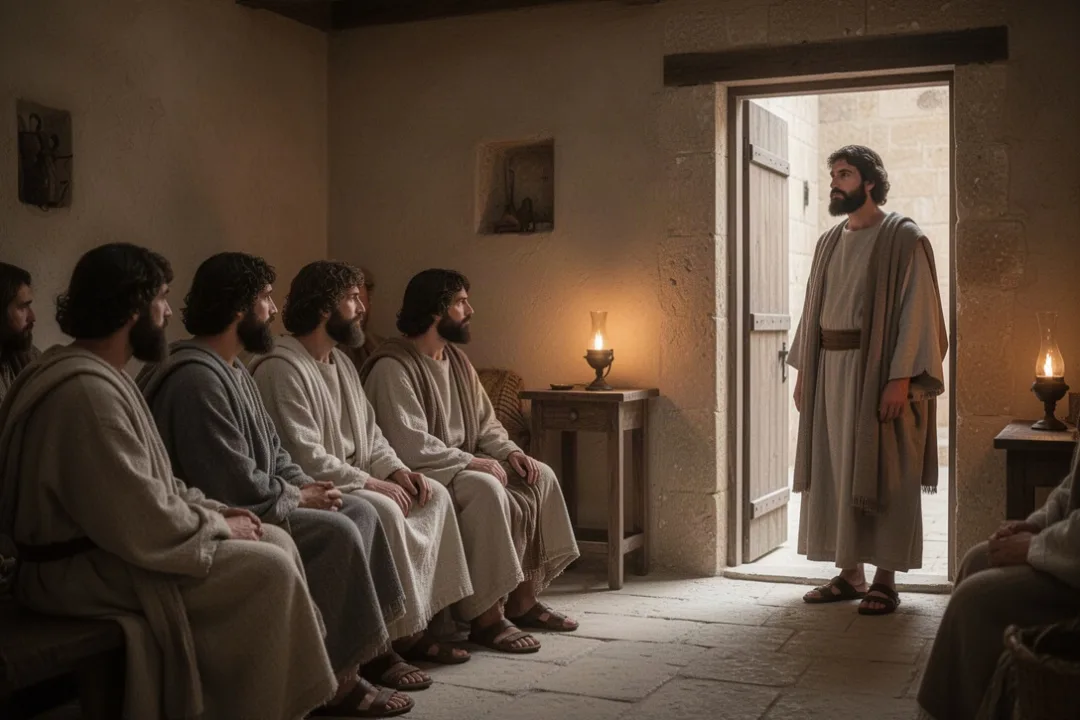
The best-known episode involving Thomas appears in John 20:19-29. After Jesus’ crucifixion, several disciples tell Thomas that they have seen the risen Lord. Thomas says that he will not accept their testimony based only on their report; he wants direct evidence of Jesus’ wounds.
When Jesus later appears to the disciples and Thomas is present, he invites Thomas to examine the evidence for himself. Thomas then responds with a confession that identifies Jesus as “my Lord and my God”, as described by the passage. The text does not record Thomas actually touching Jesus, despite the way the story is sometimes retold.
Jesus then speaks about those who believe without having seen him in the same direct way. This statement addresses later believers, including Christians who rely on the apostolic witness rather than a physical encounter with the resurrected Jesus.
A careful reading of John 20: Thomas’s doubt is real, but it is not the final word about him. The scene ends with a strong confession of faith, making Thomas both an honest questioner and a witness to Christian belief in the resurrection.
The label “Doubting Thomas” can therefore be misleading when it becomes a permanent judgment. Thomas was not the only disciple who struggled to believe the resurrection. The Gospels describe other disciples as confused, fearful, or slow to understand as well.
Thomas’s story can be read as an encouragement to bring difficult questions into the open. The passage does not present uncertainty as the ideal destination, but it does show that a questioning disciple can move toward conviction. His honesty is preserved in the Gospel rather than hidden.
What Thomas’s confession means
Thomas’s declaration is significant because it addresses Jesus directly and gives him titles associated with divine authority. In John’s Gospel, it functions as a powerful response to the resurrection appearance and fits the Gospel’s larger emphasis on Jesus’ identity.
The wording also makes the confession personal: Thomas says “my Lord” and “my God,” as represented by the passage. The statement is not merely an abstract claim about religious ideas. It expresses allegiance, recognition, and trust directed toward Jesus.
Where Thomas appears in the New Testament
Thomas is mentioned in all four lists of the twelve apostles, but most of the information about him comes from John. Reading these passages together gives a fuller picture than focusing only on the resurrection scene.
Matthew 10:2-4: Thomas appears in the list of the twelve apostles.
Mark 3:16-19: Thomas is included among the disciples appointed by Jesus.
Luke 6:13-16: Thomas is named in Luke’s list of the twelve.
John 11:16: Thomas expresses willingness to go with Jesus into danger.
John 14:5-7: Thomas asks how the disciples can know the way if they do not know where Jesus is going.
John 20:24-29: Thomas encounters the risen Jesus and makes his confession of faith.
John 21:1-2: Thomas is listed among disciples who are together after the resurrection.
Acts 1:12-14: Thomas is not named individually, but the apostles are described as gathering in prayer after Jesus’ ascension.
These references do not provide a complete biography. The New Testament does not clearly identify Thomas’s occupation, hometown, family history, or later missionary route. Many later traditions attempt to fill in those details, but they should be distinguished from what the Bible itself says.
The biblical evidence supports several conclusions. Thomas belonged to the inner group of twelve, knew Jesus personally, faced uncertainty about Jesus’ teaching and resurrection, and remained connected with the apostolic community after the resurrection appearances.
What the Gospel of Thomas is
The Gospel of Thomas is an early Christian writing attributed to Jesus’ disciple Thomas. It is not one of the four New Testament Gospels, and most Christian traditions do not include it in the biblical canon. The text is mainly a collection of sayings rather than a story about Jesus’ life.
A nearly complete Coptic manuscript of the Gospel of Thomas was found among the Nag Hammadi texts in Egypt in 1945. Scholars also know that fragments of Greek copies existed earlier. The surviving material has led to continuing discussion about the text’s date, sources, and relationship to the New Testament Gospels.
The work opens by presenting its contents as hidden or difficult sayings of the living Jesus. It then moves through sayings attributed to Jesus without arranging them into a continuous account of his ministry. Some sayings resemble material in Matthew, Mark, and Luke, while others are not found in the canonical Gospels.
How the Gospel of Thomas differs from the four Gospels
The canonical Gospels combine teaching, narrative, and interpretation. They describe events such as Jesus’ baptism, ministry, conflicts, death, and resurrection. The Gospel of Thomas is structured differently and contains little narrative connection between one saying and the next.
Several differences stand out:
No continuous passion story: Thomas does not tell the story of Jesus’ arrest, crucifixion, burial, and resurrection as the New Testament Gospels do.
Sayings-centered format: The work presents individual teachings, often with brief scenes or questions connecting them.
Different emphasis: Many sayings stress discovering meaning, understanding one’s true condition, and seeking insight.
Overlap with biblical material: Some sayings resemble teachings found in Matthew, Mark, or Luke, though the wording and setting may differ.
Different theological profile: Some passages sound compatible with themes in the New Testament, while others are difficult to reconcile with central canonical teachings.
The Gospel of Thomas should not be treated simply as a “missing chapter” of the Bible. It is an independent ancient text with its own arrangement, language, and theological interests. Reading it alongside the New Testament can be historically useful, but it does not make the two collections interchangeable.
Why the Gospel of Thomas is not in most Bibles
Christian communities formed their collections of authoritative writings over time. The status of a text was influenced by factors such as its connection to the apostles, its use across churches, and its consistency with the faith taught in widely received Christian writings.
The Gospel of Thomas was not included in the New Testament canon accepted by most Catholic, Eastern Orthodox, and Protestant churches. Some other Christian groups also do not treat it as Scripture. Its attribution to Thomas does not by itself prove that the apostle wrote it; ancient religious texts were sometimes associated with respected figures to express a connection with their teaching.
Scholars continue to examine whether some sayings in Thomas preserve very early traditions, whether the text used material related to the canonical Gospels, and how its final form developed. Those historical questions are separate from the question of whether a church regards the text as inspired Scripture.
When comparing texts: Start with the biblical passages about Thomas in John, then read the Gospel of Thomas as a separate ancient document. Similar wording does not automatically mean identical authorship, date, or authority.
How to read the Thomas passages carefully
A useful reading begins with the setting of each passage. Thomas’s statement in John 11 occurs before the crucifixion, his question in John 14 occurs during Jesus’ farewell teaching, and his doubt in John 20 occurs after the disciples report seeing the risen Jesus. The same person appears in different circumstances, so one scene should not erase the others.
Pay attention to what the text says directly and what later tradition adds. John names Thomas as Didymus, meaning twin, but does not name the twin. The Bible records his presence among the apostles, but it does not provide a detailed account of his later travels or death.
It also helps to distinguish questioning from rejection. Thomas asks for evidence because the resurrection claim is extraordinary. When he encounters Jesus, the Gospel presents him as responding with worshipful recognition rather than remaining permanently opposed.
Read the whole passage: Include the verses before and after the line about Thomas.
Identify the speaker: Notice whether Thomas is speaking to Jesus, to the other disciples, or about a practical decision.
Separate observation from tradition: Mark what the text states and what comes from later Christian stories.
Compare related passages: Read John 11, John 14, John 20, and John 21 together.
Consider the larger Gospel: John’s presentation of Thomas belongs within its wider teaching about faith, signs, witness, and Jesus’ identity.
This approach avoids two common mistakes. One is reducing Thomas to a negative nickname. The other is treating every later story about him as if it were a direct biblical record.
What Thomas can teach readers today
Thomas’s story speaks to people who want faith to be intellectually honest. He does not accept a major claim simply because others tell him it is true. His request is demanding, but the Gospel keeps the focus on what happens when he meets the risen Jesus.
His example also shows the value of asking precise questions. In John 14, Thomas does not offer a vague objection; he identifies the exact point he does not understand. That question leads to one of Jesus’ most significant teachings about the way to the Father.
Thomas also demonstrates that courage and uncertainty can exist together. In John 11, he is ready to accompany Jesus into danger, yet later he struggles with the resurrection report. A person can be devoted in one moment and confused in another without those experiences being mutually exclusive.
For Christian readers, the passage in John 20 places personal faith within the testimony of the first disciples. Thomas sees the risen Jesus directly, while later believers hear the apostolic witness. The Gospel recognizes that difference and presents belief without physical sight as meaningful.
For readers studying early Christianity, the Gospel of Thomas provides evidence that different Christian communities preserved and arranged Jesus traditions in different ways. It is valuable for understanding the diversity of ancient Christian literature, but it should be read with attention to its genre, historical setting, and differences from the New Testament.
The clearest answer to “What does the Thomas Bible say?” is therefore twofold: the Bible portrays Thomas as an apostle whose honest doubt leads to a strong confession of Jesus, and the Gospel of Thomas is a separate ancient collection of sayings that most churches do not recognize as biblical Scripture.
Frequently asked questions
Is the Gospel of Thomas part of the Bible?
No. The Gospel of Thomas is not included in the New Testament canon accepted by most Catholic, Eastern Orthodox, and Protestant churches. It is an ancient collection of sayings attributed to Jesus, preserved most fully in a Coptic manuscript found at Nag Hammadi. It may be studied as historical religious literature, but it does not have the same scriptural status as the four canonical Gospels.
Did Thomas actually touch Jesus’ wounds?
John 20 says Thomas wanted to see physical evidence and records Jesus inviting him to examine the wounds. However, the passage does not explicitly say that Thomas touched them. The text moves from Jesus’ invitation to Thomas’s confession that Jesus is his Lord and God, followed by teaching about believing without seeing.
What does “Didymus” mean in the Bible?
“Didymus” is a Greek term meaning “twin.” John uses it alongside Thomas’s name, but the biblical text does not identify Thomas’s twin. Later traditions have proposed possibilities, yet those suggestions are not established by the New Testament itself. The name is best understood as a detail the Gospel provides without supplying a complete family biography.
Where did the apostle Thomas preach?
The New Testament does not give a detailed account of Thomas’s missionary destinations after the resurrection. Later Christian traditions associate him especially with missionary work in parts of the East, including India, but these accounts come from sources outside the Bible and vary in historical detail. They should be presented as tradition rather than as a direct biblical statement.




Leave a Reply