Esther was a Jewish woman who became queen of Persia and helped prevent the destruction of her people. She was an orphan raised by her older cousin Mordecai, and she later risked her life by approaching King Ahasuerus to expose Haman’s plot against the Jews.
Her story appears in the Book of Esther, one of the historical books of the Old Testament. Esther is also known by her Hebrew name, Hadassah. The narrative explains how a young woman living in the Persian Empire used her position, wisdom, and courage during a national crisis.
Esther’s Hebrew name, Hadassah, is introduced in Esther 2:7. The name Hadassah is commonly associated with the myrtle plant, while Esther was the name she used in the Persian setting. She belonged to the Jewish community living in exile after the Babylonian conquest and later Persian rule.
Esther had lost both of her parents, so Mordecai took her into his household and raised her as his daughter. The text describes Mordecai as a Jewish man from the tribe of Benjamin. This connects their family to the broader history of Israel, since Benjamin was one of Jacob’s sons and one of the tribes of Israel.
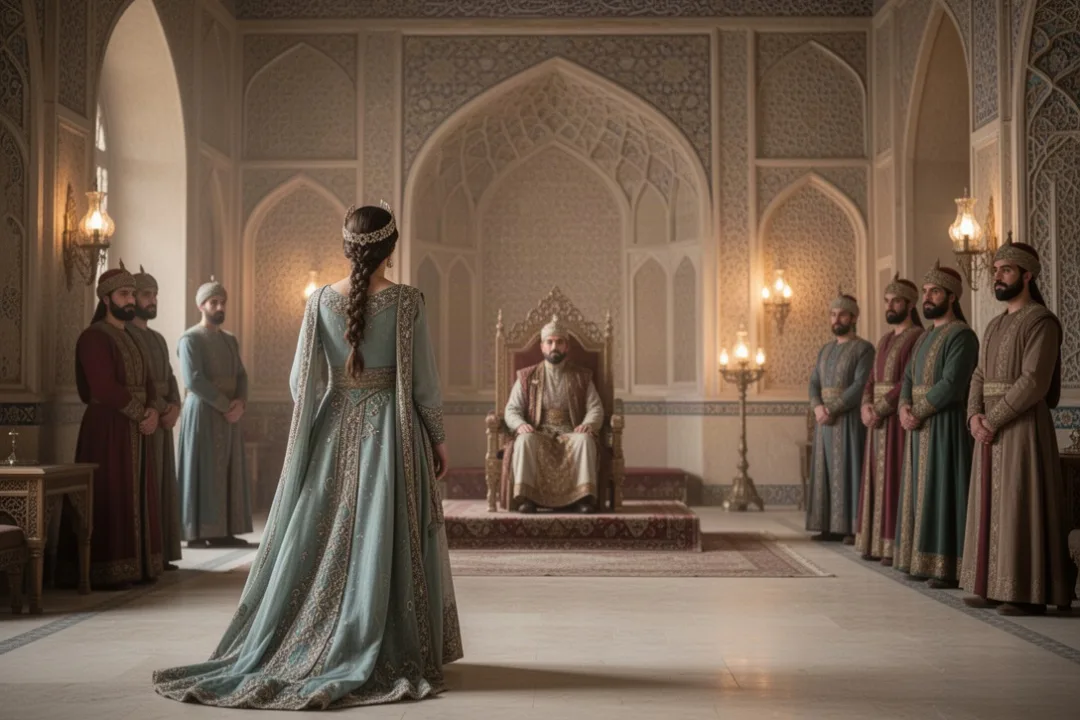
Esther’s story takes place in Susa, the Persian capital. The book presents a royal court marked by wealth, banquets, political rivalries, strict protocols, and rapid changes in royal favor. Esther’s position as queen placed her close to the king, but it did not give her unlimited freedom or safety.
The king in the Hebrew text is called Ahasuerus. Many historians identify him with Xerxes I, who ruled the Persian Empire in the fifth century B.C., although discussions about the book’s historical setting continue. The biblical account focuses less on providing a modern political history and more on showing how Esther and Mordecai responded to a threat against their people.
How Esther became queen of Persia
Esther becomes central to the story after King Ahasuerus removes Queen Vashti from her position. During a royal celebration, Vashti refuses the king’s command to appear before his guests. The king’s advisers portray her refusal as a threat to royal authority, and Vashti is dismissed.
Afterward, the king’s officials search the empire for young women who might become the next queen. Esther is taken to the royal residence along with other candidates. Mordecai instructs her not to reveal that she is Jewish, and Esther follows his guidance.
The book describes Esther as attractive and appealing, but her rise is not presented as the result of beauty alone. She gains favor with the officials responsible for the women in the palace and receives special treatment. When she is brought before the king, he chooses her as queen.
Esther’s coronation creates a complicated situation. She has gained influence, but she is still living under a ruler who may act unpredictably. She also remains separated from much of her Jewish identity in public. The secrecy that protects her at first later becomes part of the danger she must confront.
Key idea: Esther’s position gave her access to the king, but access was not the same as power. She could not freely enter his presence, and approaching him without being summoned could result in death.
What happens between Esther and Mordecai
Mordecai continues to watch over Esther even after she becomes queen. He sits near the palace gate, where he learns of a plot by two royal officials to assassinate the king. Mordecai tells Esther, and she reports the threat to the king in Mordecai’s name.
The plot is investigated and confirmed, and the two officials are executed. The event is recorded in the royal records, but Mordecai does not immediately receive a reward. That overlooked record later becomes one of the most important details in the story.
Mordecai and Esther have a relationship shaped by family loyalty and shared responsibility. He first protects her by helping her keep her identity secret. Later, he challenges her to use her position when keeping silent would endanger the entire Jewish population.
When Esther initially hesitates, Mordecai reminds her that her royal position may have placed her in the palace for a larger purpose. His message does not promise that she will be protected if she refuses to act. Instead, he tells her that help may arise from another source, while she and her family could still suffer the consequences of silence.
This exchange shows that Esther is not portrayed as an isolated hero. Her courage grows through a conversation with Mordecai, and her decision affects a community much larger than her immediate family. Their partnership drives the central movement of the book.
Why Haman wanted to destroy the Jews
Haman is the chief official promoted by King Ahasuerus. The king commands others to honor him, but Mordecai refuses to bow before Haman. The book connects Mordecai’s refusal with his Jewish identity, although the immediate conflict also involves Haman’s pride and anger.
Haman does not limit his response to Mordecai. He seeks to destroy all the Jews throughout the Persian Empire. He presents them to the king as a separate people whose laws and customs could threaten royal authority. The king authorizes a decree setting a date for their destruction and allows Haman to use the royal seal.
The decree creates fear and grief among the Jewish population. Mordecai mourns publicly, and many Jews fast and cry out. Esther learns that Mordecai is distressed and sends him clothing, but he refuses to stop mourning until the threat is addressed.
Haman also builds a large structure intended for Mordecai’s execution. The plot seems to be moving in his favor, and the king has already granted him authority. Yet the narrative begins turning when the king cannot sleep and orders the royal records to be read aloud.
How Esther risked her life to save her people
Esther’s most important decision comes after Mordecai asks her to intervene. She explains that anyone who enters the king’s inner court without being summoned may be put to death unless the king extends approval. She has not been called to see him for a significant period.
Esther does not rush into the king’s presence. She asks Mordecai to gather the Jews in Susa and have them fast for three days. She and her attendants will fast as well. Then she will go to the king, accepting the possibility that she may die.
Her response is often remembered as a statement of courage and surrender. Esther understands the danger, gathers communal support, and chooses to act despite uncertainty. She does not know whether the king will receive her favorably or whether her appeal will succeed.
When Esther enters the inner court, the king extends the royal scepter to her. This gesture indicates that he accepts her presence and offers her protection. He asks what she wants, even offering to grant a request of great value.
Esther responds with careful planning. Instead of immediately accusing Haman, she invites the king and Haman to a banquet. At that banquet, she invites them to another gathering on the following day. Her approach creates time, builds suspense, and allows the king’s attention to focus on her request.
Her strategy also demonstrates discernment rather than impulsiveness. Esther’s courage is not reckless. She prepares, chooses her moment, and presents the crisis in a way the king is likely to hear.
How Haman’s downfall changes the story
On the night between Esther’s two banquets, the king reads the royal records and discovers that Mordecai was never rewarded for exposing the assassination plot. He asks Haman what should be done for a person the king wishes to honor.
Assuming the king means him, Haman suggests a public ceremony involving royal clothing, a royal horse, and a proclamation of honor. The king orders Haman to carry out these honors for Mordecai. This reversal humiliates Haman and reveals that his influence is not secure.
At the second banquet, Esther tells the king that she and her people have been sold for destruction. She identifies Haman as the person responsible. The king reacts with anger, and Haman’s own plan against Mordecai becomes the instrument of his death.
The first decree cannot simply be erased because Persian royal edicts carry legal authority. Instead, the king gives Mordecai permission to issue a new decree. This second decree allows the Jews to assemble and defend themselves when attacked.
The Jews survive the planned assault, and the events are remembered through the festival of Purim. The name is linked to the lots, or purim, that Haman cast when selecting the date for the intended attack. The celebration marks the reversal from danger to deliverance.
What Esther teaches about courage and responsibility
Esther is often described as courageous, but the book shows several specific forms of courage. She risks her safety by entering the king’s presence, risks her position by identifying with the Jews, and risks rejection by accusing a powerful official.
Her courage is closely connected with responsibility toward other people. Esther could have remained silent and protected her own life for a time. Mordecai’s challenge forces her to consider whether royal status carries an obligation to act when others are in danger.
The story also presents courage as something that can exist alongside fear. Esther does not appear fearless. She knows the possible punishment and asks others to fast before she proceeds. Her decision is meaningful precisely because the danger is real.
Esther also shows the value of using existing opportunities wisely. She does not begin with military strength or formal authority over the empire. She has limited access to the king, knowledge of court customs, and a relationship with Mordecai. She uses those resources carefully rather than pretending to possess power she does not have.
For readers today, Esther’s example can raise practical questions:
What responsibility comes with the access, authority, or influence you have?
Are you remaining silent because silence is wise, or because speaking would be uncomfortable?
Have you gathered trustworthy support before confronting a serious problem?
Can you communicate a difficult truth in a way that is both clear and carefully timed?
Are you protecting your own position at the expense of people who have less power?
Why God is not named in the Book of Esther
One unusual feature of Esther is that God is not directly named in the Hebrew book. The narrative does not contain a clear prayer, divine speech, or explicit statement that God caused a particular event. This absence has led readers to pay close attention to the story’s patterns of timing, reversal, and deliverance.
Mordecai’s words suggest confidence that the Jews will receive help, even if Esther refuses to act. His statement does not name the source of that help directly. Many Jewish and Christian readers understand this as an indication of divine providence operating behind the visible events.
Providence, in this reading, appears through ordinary circumstances: Esther is chosen as queen, Mordecai discovers the assassination plot, the king cannot sleep, the royal records are opened, and Haman arrives at the exact moment the king is considering how to honor Mordecai.
Other readers emphasize the book’s political and human dimensions. Esther and Mordecai make decisions, Haman manipulates the king, officials carry out decrees, and the Jewish community responds collectively. The book allows readers to consider how divine care and human responsibility may be understood together.
The absence of God’s name does not make the story religiously empty. Instead, it invites attention to hidden providence, moral courage, and communal survival. It also makes the book distinctive among biblical narratives.
Common mistakes people make when reading Esther
Esther’s story is familiar, but several assumptions can oversimplify it. Reading the whole narrative helps you see both the courage of its main characters and the difficult features of its setting.
Calling Esther only a beauty queen: Her appearance helped her enter the royal selection, but her defining actions involve judgment, preparation, courage, and advocacy.
Assuming she controlled the king: Esther had influence, not complete authority. She needed permission to enter his presence and presented her request with great care.
Ignoring her hidden identity: Her Jewish background is central to the crisis. The secrecy that once protected her later has to be broken for her people’s sake.
Reducing Mordecai to a side character: Mordecai raises Esther, uncovers the assassination plot, confronts Haman, and helps organize the response to the royal decree.
Overlooking the communal fasting: Esther’s action is supported by the Jewish community in Susa. The story does not portray her courage as entirely solitary.
Forgetting the legal problem: The first royal decree is not simply canceled. A second decree permits the Jews to defend themselves against the authorized attack.
Skipping the difficult violence: The book describes battles and the deaths of enemies. Readers should acknowledge those passages rather than presenting the narrative as a simple court success story.
Claiming certainty about every historical detail: The identity of Ahasuerus and the relationship between the book’s narrative and Persian history are discussed by scholars. Interpretive confidence should not become invented precision.
Reading tip: Track every reversal in the story. The person who seems powerful becomes vulnerable, the overlooked record becomes decisive, and the planned execution turns against the plotter.
How the Book of Esther differs from other biblical stories
Esther differs from many biblical accounts because it does not center on a prophet delivering a direct message from God. There is no Moses-like lawgiver, Elijah-like prophetic contest, or Daniel-like interpretation of a dream. Instead, the story unfolds through palace decisions, political documents, banquets, and private conversations.
The book also gives a woman the central role in a high-stakes political rescue. Esther does not lead an army in the traditional sense. Her influence comes through identity, timing, hospitality, careful speech, and willingness to risk her place in the court.
Her story can be compared with other biblical women who act decisively under pressure. Like Deborah, she contributes to the preservation of Israel in a time of danger. Like Ruth, she is a woman whose loyalty and actions affect the future of her people. Unlike Ruth, Esther’s setting is an imperial court rather than a village or agricultural community.
The story also has a strong theme of reversal. Banquets that seem to honor Haman expose him instead. Haman’s plan to elevate himself leads to his humiliation. Mordecai’s public mourning is followed by public honor. The Jews’ anticipated destruction becomes an occasion for celebration.
What Esther means for Jewish life and Purim
The Book of Esther provides the foundation for Purim, a Jewish festival commemorating the deliverance of the Jews in the Persian Empire. Purim is associated with the reading of the Megillah, the Hebrew name often used for the scroll of Esther.
Purim traditions vary by community, but commonly include hearing the story read aloud, giving gifts of food, providing support for people in need, and sharing a festive meal. The celebration keeps the story connected to communal memory rather than treating Esther’s experience as a private moral lesson.
The festival also remembers the role of both Esther and Mordecai. Esther represents courageous advocacy from within a dangerous political system. Mordecai represents persistence, public mourning, communal organization, and resistance to unjust demands.
The name Purim recalls the lots Haman used to determine the date of the planned attack. The celebration therefore emphasizes the contrast between what appeared to be an irreversible decree and the unexpected reversal that followed.
How to study Esther with care
A careful reading begins with the complete book rather than isolated scenes. The first chapters establish the court, Esther’s identity, Mordecai’s position, and Haman’s rise. The later chapters make more sense when you remember those earlier details.
It helps to notice who knows what at each stage. Esther initially knows her Jewish identity must remain secret. Mordecai knows the threat is immediate. The king does not appear to understand Haman’s intentions fully. Haman knows the decree is dangerous but does not expect Esther to identify him.
You can also watch for repeated phrases and objects. Royal records, decrees, banquets, clothing, the king’s signet ring, and public honor all carry meaning. The story repeatedly shows that words written under royal authority can shape people’s lives, even when the ruler does not understand their consequences.
When applying Esther’s example, avoid turning it into a promise that every difficult situation will end in a visible reversal. The book celebrates a specific deliverance in a specific setting. Its broader lessons concern courage, wise action, solidarity, and responsibility, not a guarantee that every danger will resolve in the same way.
Esther is also not a model for confronting every problem alone. She seeks support, communicates with Mordecai, asks for communal fasting, and plans her approach. A wise response to danger may include trusted counsel, collective action, and careful assessment of risk.
Why Esther remains a significant biblical figure
Esther remains significant because her story joins personal identity with public responsibility. She begins as an orphan whose Jewish background is concealed, becomes queen in a foreign empire, and eventually claims that identity when silence could no longer protect her people.
Her influence does not come from having an easy path. She lives within a system where the king holds extraordinary power and where women can be treated as possessions of the court. Her actions matter because she works within real limitations while refusing to let those limitations decide the fate of others.
The book presents Esther as thoughtful, courageous, and strategically wise. It also presents her as part of a wider network involving Mordecai and the Jewish community. Her story asks what you do when your position gives you a chance to speak for people who are being threatened, and what kind of courage is required when the outcome is uncertain.
Frequently asked questions
Was Esther a Jewish woman?
Yes. Esther was Jewish, although she initially kept her identity hidden in the Persian court at Mordecai’s instruction. Her Hebrew name was Hadassah. Her Jewish identity becomes central when Haman’s decree threatens Jewish communities throughout the Persian Empire, forcing Esther to reveal who she is to King Ahasuerus.
Who raised Esther in the Bible?
Esther was raised by Mordecai, her older cousin. The Book of Esther says that she became his daughter after her parents died. Mordecai continued to guide her after she entered the royal palace, and their relationship remained central to the decisions that led to the rescue of the Jewish people.
Did Esther marry King Xerxes?
The biblical text names her husband King Ahasuerus. Many historians associate Ahasuerus with Xerxes I, a Persian king, so Esther is commonly described as Xerxes’ queen. The identification is widely discussed, but the Bible itself uses the name Ahasuerus rather than the Greek form Xerxes.
What is Esther remembered for?
Esther is remembered for risking her life to approach the king and expose Haman’s plan to destroy the Jews. Her actions helped bring about the reversal of the decree and are commemorated during Purim. She is especially associated with courage, wise timing, loyalty to her people, and responsible use of influence.









Leave a Reply