Revelation 4 centers on God’s throne, showing that heavenly worship and divine authority stand behind everything John is about to witness.
The chapter marks a clear change in the book’s movement. Revelation 1 introduces John’s vision of the risen Christ, and chapters 2–3 deliver messages to seven churches in Asia Minor. In chapter 4, John is taken into a vision of heaven, where he sees the throne of God surrounded by living worshipers.
The scene is not presented as a tour of heaven or a detailed map of the afterlife. It is a carefully arranged vision that answers a crucial question: Who rules when earthly powers appear frightening or unstable? Revelation 4 answers with the image of God seated on the throne, receiving worship from heaven and from all creation.
John begins by describing an open door in heaven and a voice that calls him upward. He says he is “in the Spirit,” meaning that the scene comes through a prophetic vision rather than ordinary physical travel. The voice resembles a trumpet and directs his attention to what must be shown next.
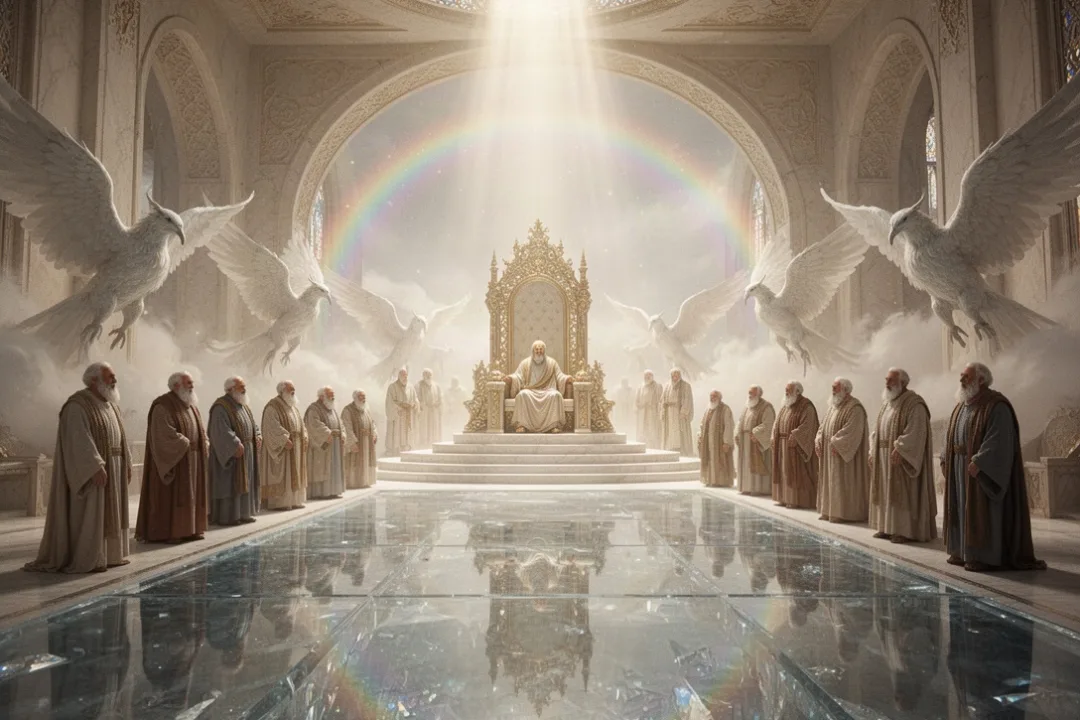
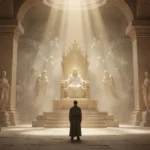
At the center of the vision stands a throne in heaven, with someone seated on it. John does not give a physical description of God. Instead, he uses precious stones and brilliant colors to communicate majesty, radiance, and mystery. The imagery invites awe without reducing God to an ordinary visible object.
A rainbow resembling an emerald surrounds the throne. In Scripture, a rainbow can recall God’s covenant faithfulness, especially the sign associated with the flood in Genesis. Here, the rainbow appears within the throne-room vision, suggesting that divine power is not chaotic or arbitrary. It is joined with faithfulness, mercy, and covenant purpose.
Flashes of lightning, rumblings, and peals of thunder come from the throne. These sounds recall the dramatic manifestations of God’s presence at Mount Sinai and in other prophetic visions. They communicate power and holiness. The throne is not a quiet decoration in the background; it is the source of the scene’s authority.
Seven burning lamps stand before the throne, identified as the seven Spirits of God. The number seven often represents fullness or completeness in Revelation. Many Christian interpreters understand this phrase as symbolic of the Holy Spirit in the fullness of divine activity, while others emphasize the connection with the sevenfold imagery of Isaiah and the seven churches.
Before the throne is something like a sea of glass, clear as crystal. John repeatedly uses phrases such as “something like” because visionary objects do not fit ordinary categories. The image may suggest stillness, purity, distance, or the mastery of God over the sea, which often symbolizes danger and disorder in biblical imagery.
Read the visual language as symbolism before treating it as a literal blueprint. Revelation communicates through images, numbers, colors, sounds, and contrasts. The central message is usually clearer than every detail of the picture.
What the throne and its surroundings mean
The throne is the controlling image of Revelation 4. It appears repeatedly in the chapter, and nearly every other feature is positioned in relation to it. The elders sit around it, the living creatures are near it, the lamps burn before it, and worship rises toward it.
This arrangement establishes God’s sovereignty. John’s original readers lived under the power of the Roman Empire, where rulers displayed authority through titles, ceremonies, armies, and public loyalty. Revelation does not ignore those earthly pressures, but it places them beneath a greater reality: the ultimate seat of authority is in heaven.
The chapter does not describe God by naming a human ruler or comparing God directly to an emperor. Instead, it presents a throne surrounded by signs of glory. That approach makes the vision both specific and universal. It speaks to political fear, religious compromise, social pressure, and personal uncertainty without being limited to one historical crisis.
The gemstones surrounding the throne should not be turned into a rigid code in which every stone has one universally agreed meaning. John’s emphasis is on brilliance and splendor. The imagery recalls descriptions of divine glory in prophetic books, including Ezekiel and Isaiah, but Revelation combines those traditions into its own dramatic scene.
The lightning and thunder also connect the throne with God’s holiness and judgment. These sounds can be unsettling because holiness exposes the difference between God and everything created. Yet the vision does not present judgment as random violence. The throne is surrounded by ordered worship, and the worshipers praise God as the one whose will brought all things into existence.
The crystal-like sea adds another layer. In ancient biblical imagination, the sea could represent untamed forces, threatening depths, or opposition to God’s order. In Revelation 4, the sea is calm and transparent beneath the throne. The picture suggests that what appears uncontrollable from an earthly perspective is not beyond God’s authority.
The chapter also uses circles and layers: the throne at the center, the rainbow around it, the living creatures closest to it, and the elders surrounding them. This arrangement directs the reader’s attention inward toward God and outward toward the whole created order. Heavenly worship is organized around God’s presence, not around the worshipers themselves.
Who the twenty-four elders and four living creatures are
Twenty-four elders sit on thrones around the central throne. They wear white clothing and golden crowns. When the living creatures offer praise, the elders fall before God, place their crowns before the throne, and acknowledge that God deserves glory, honor, and power because God created all things.
The identity of the elders has been interpreted in several ways. Some readers see them as representatives of God’s people, combining the twelve tribes of Israel with the twelve apostles. Others understand them as a heavenly council or a group of exalted angelic beings. Revelation does not provide a single explanatory sentence that settles every detail.
Their clothing and crowns offer useful clues. White clothing often represents purity, victory, or faithful participation in God’s purposes elsewhere in Revelation. Crowns may signify honor or victory. Yet the elders immediately surrender those crowns before God. Their authority is real within the vision, but it is always received and returned to the one seated on the throne.
The four living creatures are located around the throne, with eyes covering them and six wings each. John compares their faces to a lion, an ox, a human being, and an eagle in flight. These figures represent different qualities of the created world: strength, service, intelligence, and swift movement.
Some interpretations connect the four faces with the four living creatures in Ezekiel 1. Later Christian tradition also associated them with the four Gospel writers, though that connection is not stated in Revelation 4 itself. It is better to distinguish the chapter’s original imagery from later symbolic traditions rather than treating every later association as the chapter’s direct meaning.
The eyes suggest alertness, perception, and complete awareness. The creatures are not passive ornaments. They remain attentive to God and lead the worship that surrounds the throne. Their many wings suggest readiness and movement, while their location near the throne emphasizes their role in heavenly service.
The creatures repeatedly praise God’s holiness and eternal existence. Their words are not presented as a private mystical formula to be decoded. They express the basic reason worship is appropriate: God is holy, God has always existed, and God is the source of all creation.
The elders display honor, representative leadership, and surrendered authority.
The living creatures display vigilance, strength, service, and participation in worship.
Their shared posture shows that every heavenly rank remains dependent on God.
Their repeated praise keeps attention on God’s character rather than on the visionaries themselves.
The chapter’s heavenly beings should not distract from the central point. Revelation 4 does not invite readers to speculate endlessly about angelic hierarchies. It shows a created order that recognizes its Creator. The beings closest to the throne do not compete for worship; they direct it toward God.
Why worship is the main action in Revelation 4
Worship is not a brief response added to the vision. It is the main activity of the chapter. The living creatures praise God, and the elders respond by bowing down and presenting their crowns. The scene repeatedly returns to God’s holiness, eternal life, glory, honor, power, and creative authority.
This focus matters because Revelation is often approached mainly as a book of predictions. Revelation 4 shows that its prophetic message begins with the identity of the one who rules. Before John sees seals, beasts, disasters, or conflicts, he sees the throne. The future is interpreted from the perspective of heaven’s worship.
The elders’ crowns provide a vivid picture of humility. They possess symbols of status, but they do not treat those symbols as independent achievements. They lay them before God. In the vision, honor reaches its proper destination when it is returned to the Creator.
The worship also emphasizes creation. God is praised because all things came into being by divine will. This does not give a scientific account of creation, nor does it answer every question about how creation unfolded. Its purpose is theological: the world is not self-owned. Creation depends on God and owes its existence to God.
That claim challenges every attempt to make power, wealth, empire, technology, or human achievement ultimate. Revelation 4 does not deny the value of human work or earthly authority. It puts them in their proper place. Whatever honor people possess is secondary to the authority of the Creator.
The worship is also communal. John does not see one isolated spiritual figure having a private experience. He sees many creatures and elders participating together. The vision presents worship as a response shared across heaven, joining different kinds of beings in a single acknowledgment of God.
“You are worthy” expresses the chapter’s central response: God deserves honor because God is the source and sustainer of all creation.
The language of worthiness prepares readers for chapter 5, where the question of who is worthy to open the scroll receives a further answer in the vision of the Lamb. Revelation 4 therefore should be read with chapter 5 as a connected throne-room scene. Chapter 4 highlights the Creator; chapter 5 brings the Redeemer into the center of the heavenly drama.
How Revelation 4 connects with the rest of the book
Revelation 4 follows the messages to the seven churches, but it also explains why those messages matter. The churches face temptation, suffering, compromise, false teaching, and spiritual weariness. The throne-room vision gives them a larger frame for faithfulness.
Earthly congregations may look small and vulnerable. They may be judged by powerful institutions or pressured to conform. Revelation 4 shows that their situation must be viewed from heaven’s perspective. God’s rule is not measured by what appears strongest on earth.
The chapter also establishes patterns that return throughout Revelation. The throne remains central in later scenes, worship accompanies major acts of divine judgment and redemption, and heavenly voices interpret earthly events. Readers who notice these patterns are less likely to treat each frightening image as disconnected from the book’s central message.
Several details also prepare for chapter 5:
The throne is already established before the scroll appears.
The heavenly beings are already gathered in worship.
The elders already possess crowns and a position of honor.
The question of worthiness will become the next major focus.
Creation’s praise will be joined by praise directed toward the Lamb.
Revelation 4 also echoes earlier biblical throne visions. Isaiah 6 includes heavenly beings proclaiming God’s holiness. Ezekiel describes living creatures, wheels, and a radiant divine presence. Daniel presents heavenly court imagery and a throne associated with judgment. Revelation draws from these traditions without simply repeating any one of them.
These connections help explain why the imagery feels both strange and familiar. John’s vision belongs to the symbolic world of biblical prophecy. Knowing the earlier patterns helps readers recognize themes such as holiness, kingship, judgment, creation, and divine presence without assuming that every visual feature has a separate secret meaning.
Keep chapter 4 and chapter 5 together. Revelation 4 establishes the throne and the Creator’s worthiness; Revelation 5 develops the question of who can carry out God’s purposes and identifies the Lamb as worthy.
How to interpret Revelation 4 responsibly
A responsible reading begins with the chapter’s own emphasis. Ask what the vision repeats, where the action moves, and what the worshipers say and do. In Revelation 4, the repeated center is the throne, and the repeated response is worship.
It is also wise to separate clear themes from uncertain details. The chapter clearly presents God as sovereign, holy, eternal, and Creator. It clearly depicts heavenly beings offering worship. It is less clear whether the twenty-four elders represent redeemed humanity, angels, a heavenly council, or a symbolic combination of these possibilities.
Different Christian traditions may interpret the chapter within different approaches to Revelation. Some read its images primarily as events tied to the end times. Others see recurring patterns of judgment and faithfulness across the church age. Still others emphasize its first-century setting and the challenge it posed to claims of imperial power. Each approach should take the chapter’s symbolism and historical setting seriously.
The number four may suggest universality, especially when connected with the four living creatures and the four directions of the world. The number twenty-four may recall the organization of Israel’s priestly divisions or symbolize a complete people of God. These possibilities can illuminate the passage, but they should not be stated as certain when the text leaves room for interpretation.
Colors and materials should be handled with similar care. White, gold, emerald, crystal, and precious stones contribute to the vision’s atmosphere of glory and purity. Their presence does not require a detailed chart assigning one fixed spiritual definition to every color or object.
Readers should also avoid using Revelation 4 to predict a specific modern political event. The chapter speaks powerfully about earthly power, but it does not name current nations, leaders, or technologies. Attempts to force every detail into a contemporary headline can obscure the enduring message: God remains worthy of worship when the world appears disordered.
A practical reading process can keep the chapter balanced:
Read the chapter as a whole before focusing on individual symbols.
Mark repeated words and images, especially throne, worship, glory, holiness, and creation.
Compare related passages in Isaiah, Ezekiel, Daniel, and Revelation 5.
Distinguish the text from later traditions about the four creatures or the elders.
Apply the chapter’s main claim without pretending that every symbolic detail has been decoded.
For Christian readers, Revelation 4 can shape prayer and worship by directing attention away from human status and toward God’s character. It can also provide perspective during uncertainty. The chapter does not promise that earthly trouble is imaginary or insignificant. It declares that trouble does not occupy the highest throne.
That is why the chapter’s imagery remains important even apart from debates about the timeline of end-time events. Revelation 4 teaches readers to see history from the standpoint of divine sovereignty, to understand worship as a response to God’s holiness and creative authority, and to recognize that every created power remains accountable to the one seated on the throne.
Frequently asked questions
What is the main message of Revelation 4?
Revelation 4 presents God as the sovereign Creator seated on the heavenly throne. The chapter’s worship scene reassures readers that earthly rulers and frightening events do not have ultimate authority. Its main emphasis is not a schedule of future events but God’s holiness, eternal existence, creative power, and rightful claim to worship.
Who are the twenty-four elders in Revelation 4?
The chapter does not identify the twenty-four elders in one definitive statement. Common interpretations understand them as heavenly beings, representatives of God’s people, or a symbolic combination of Israel’s twelve tribes and the twelve apostles. Their white clothing, crowns, and surrender of those crowns emphasize honor that remains subject to God.
What do the four living creatures represent?
The four living creatures are heavenly beings positioned around God’s throne. Their lion, ox, human, and eagle-like appearances may represent different dimensions of created life, while their many eyes and wings suggest vigilance and readiness. Later Christian tradition connected them with the four Gospels, but Revelation 4 itself does not make that identification.
How does Revelation 4 relate to Revelation 5?
Revelation 4 establishes the heavenly throne room and praises God as Creator. Revelation 5 continues the same scene by introducing a sealed scroll and asking who is worthy to open it. The answer centers on the Lamb. Reading both chapters together shows how creation, divine authority, redemption, and the unfolding of God’s purposes are connected.






Leave a Reply