Ephesus in the Bible: History, meaning, and lessons
Ephesus in the Bible: History, meaning, and lessons
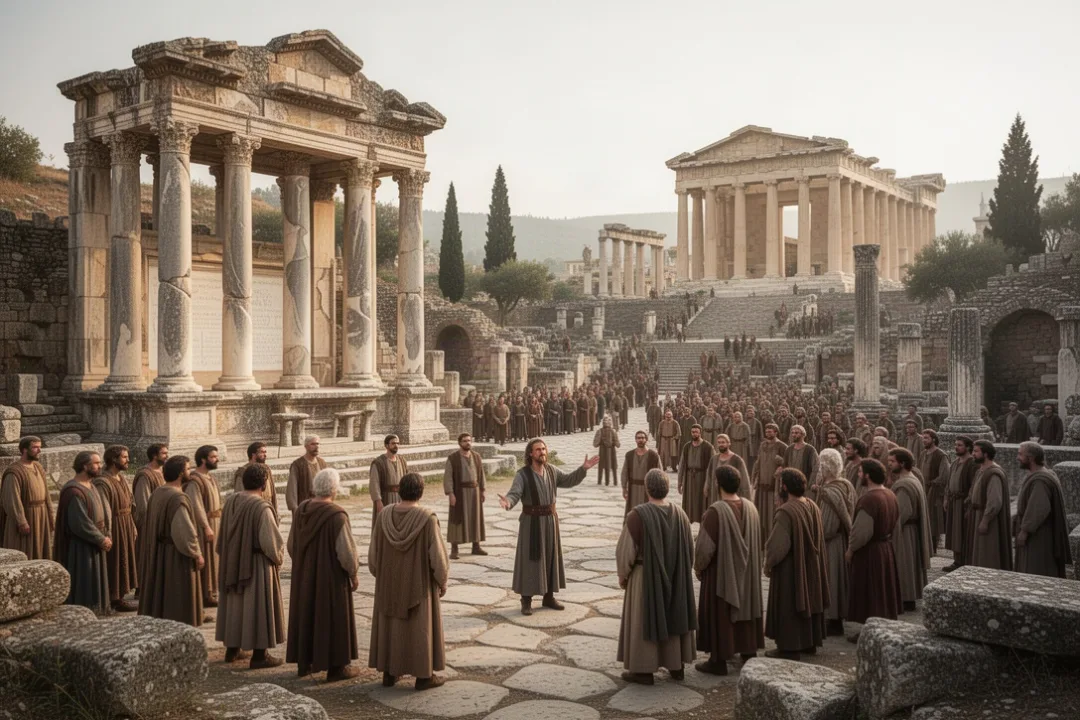
Ephesus was one of the most influential cities in the New Testament world and one of the early church’s most important centers. Located on the western coast of Asia Minor, in what is now Turkey, it became a strategic base for Christian teaching throughout the region.
The Bible presents Ephesus as a place of remarkable spiritual opportunity and serious opposition. Paul taught there for an extended period, many people responded to the gospel, and the church became influential across the Roman province of Asia. At the same time, the city’s commerce, pagan worship, social pressures, and internal church problems tested Christian faithfulness.
Ephesus stood near the Aegean coast in the Roman province of Asia. Its location connected inland trade routes with a major port, although the coastline gradually changed because of sediment. In the first century, Ephesus was a prosperous and crowded urban center with commercial, political, religious, and cultural influence.
The city was especially famous for the Temple of Artemis, one of the best-known religious landmarks of the ancient Mediterranean world. Artemis was worshiped as a powerful local deity, and the temple helped support a large religious economy involving craftsmen, merchants, pilgrims, and civic leaders.
That setting helps explain why the Christian message created such a strong reaction. The gospel did not arrive in an isolated village. It was proclaimed in a city where religious identity and business interests were closely connected. People who abandoned idol worship could affect the income of those who produced and sold religious objects.
Historical setting: Ephesus mattered to the early church because it combined a strategic location, a large population, religious prominence, and access to surrounding communities.
Ephesus also had an important political status. It functioned as a leading city of the province and was associated with Roman administration, public assemblies, and legal activity. Its large theater, marketplace, public buildings, and roads made it a natural place for public teaching and debate.
When Acts describes the spread of Christianity from Ephesus into the wider province of Asia, the statement reflects the city’s regional reach. People could hear the message there and carry it to other communities. Ephesus was therefore more than one local congregation; it became a center from which Christian teaching traveled.
How Paul’s ministry developed in Ephesus
Paul’s first recorded visit to Ephesus appears in Acts 18. He traveled there with Priscilla and Aquila after leaving Corinth. Paul reasoned in the synagogue, but his stay was brief because he wanted to continue his journey. Priscilla and Aquila remained in Ephesus, where they met Apollos.
Apollos was an eloquent and knowledgeable teacher who understood aspects of John the Baptist’s message. Priscilla and Aquila helped him gain a fuller understanding of the Christian faith. This account shows that personal instruction and patient correction played an important role in the growth of early Christian leaders.
Paul returned to Ephesus during another missionary journey, as recorded in Acts 19. He encountered a group of disciples who had received John’s baptism but did not yet understand the full Christian message about the Holy Spirit. After Paul taught them, they were baptized in the name of Jesus, and the account describes their reception of the Holy Spirit.
Paul then spent time teaching in the synagogue. When some people opposed the message, he moved his teaching to the lecture hall of Tyrannus. Acts says he taught there for an extended period, and the result was that the message reached people throughout the province of Asia.
The passage does not give a complete schedule of Paul’s teaching, but it shows a flexible approach to ministry. He began in a familiar Jewish setting, continued in another public teaching space, and trained people who could carry the message beyond the city. His work included both public proclamation and long-term discipleship.
Paul explained the gospel publicly in settings where people could listen and ask questions.
He adapted the location when opposition made the synagogue unsuitable.
He remained long enough for teaching to influence the surrounding province.
Other workers shared the ministry, including Priscilla, Aquila, Apollos, and local believers.
Acts 19 describes extraordinary works associated with Paul’s ministry, including healings and deliverance from evil spirits. These signs drew attention, but the account also warns against treating the name of Jesus as a magical formula. Some Jewish exorcists attempted to use Jesus’ name without belonging to him, and the attempt ended disastrously.
The episode involving the sons of Sceva emphasizes that Christian authority is not a technique. The power described in Acts belongs to Jesus, not to a phrase people can repeat for personal advantage. The public result was a deeper reverence for Jesus and a growing recognition that discipleship required a real change of life.
Many people who practiced magic brought their scrolls together and burned them publicly. Acts presents this as evidence of repentance and a decisive break with former practices. The value of the destroyed materials is mentioned to show the seriousness of the response, but the central point is not the financial loss. It is the willingness to reject practices that conflicted with allegiance to Christ.
What the Ephesian riot reveals about Christian witness
As the Christian message spread, a silversmith named Demetrius became concerned that the new teaching threatened his trade. Craftsmen made silver objects connected with the worship of Artemis, and Demetrius argued that Paul’s preaching could damage both their business and the reputation of the city’s goddess.
His complaint combined economic fear, civic pride, and religious devotion. A large crowd gathered in the theater and began shouting in support of Artemis. The event became chaotic, and many people did not even know why they had assembled.
Acts 19 does not describe a simple dispute between two religious groups. It shows how religious systems can be supported by commerce, public identity, and social pressure. When people change their beliefs, those who benefit from the old system may feel threatened.
Paul wanted to address the crowd, but his companions and some local officials prevented him from entering the theater. The city clerk eventually calmed the assembly by arguing that legal procedures existed for genuine accusations. The crowd then dispersed.
Several lessons emerge from this event:
Faithfulness can affect public life. The gospel challenged practices that shaped both worship and business.
Opposition may be driven by profit. Religious language sometimes hides economic self-interest.
Christians should not create disorder deliberately. Paul’s companions acted to protect him from an uncontrolled crowd.
Truth does not need manipulation. The Christian message spread through teaching and changed lives rather than through a manufactured uprising.
The riot also illustrates the cost of rejecting idols. In Ephesus, worship was visible, profitable, and deeply tied to local identity. Believers who followed Jesus were not merely adding another religious preference to their lives. They were making a commitment that could affect family customs, professional relationships, and public expectations.
For modern readers: Ephesus reminds you to examine whether your convictions are shaped by truth or by the approval, income, and social belonging connected to a particular way of life.
Paul later referred to hardships associated with Ephesus. In 1 Corinthians 15:32, he used figurative language about fighting wild beasts at Ephesus while explaining the importance of the resurrection. The verse should not be treated as a detailed report of a specific event; it shows that Paul remembered Ephesus as a place connected with serious danger and hardship.
He also mentioned that he planned to remain in Ephesus until Pentecost because a significant opportunity for effective ministry had opened, despite the presence of many opponents. That statement in 1 Corinthians 16:8-9 captures a recurring New Testament pattern: open doors and resistance can exist at the same time.
What the Bible says about the church at Ephesus
The Ephesian church appears in several New Testament settings. Paul’s ministry established a strong Christian presence there, and his letters show that the city remained connected with important coworkers. The church was not shaped by one personality alone; it belonged to a wider network of apostles, teachers, elders, and congregations.
In 1 Timothy 1:3, Paul instructed Timothy to remain in Ephesus and confront teachers who were promoting false doctrines. This suggests that the church faced disputes about speculative ideas, myths, and misuse of the law. Timothy’s assignment was not simply to encourage believers. He was expected to protect the congregation from teaching that distracted people from faithful Christian living.
The issue was not that every difficult question had to be avoided. The problem was teaching that produced controversy rather than love, a clean conscience, and sincere faith. Paul’s concern was practical: beliefs should shape character and Christian conduct.
First Timothy also addresses prayer, leadership, worship, care for vulnerable people, financial attitudes, and the qualifications of overseers and deacons. These instructions give a broader picture of what a healthy church required. Spiritual maturity involved both sound teaching and responsible relationships.
Paul’s farewell to the elders from Ephesus appears in Acts 20, although the meeting took place at Miletus. He had summoned the Ephesian elders there while traveling toward Jerusalem. His speech is one of the clearest descriptions of his ministry priorities and his expectations for church leaders.
Paul reminded them that he had served with humility, tears, and perseverance. He had taught publicly and from house to house, warning both Jewish and Gentile hearers to turn to God and trust in Jesus. He also said he had not avoided declaring what was beneficial, even when the message was difficult.
He warned the elders that fierce opponents would arise from outside the church and that some people within the community would distort the truth to attract disciples to themselves. His response was to urge vigilance, care for the flock, and dependence on God’s grace.
The speech highlights several responsibilities of Christian leaders:
Teach the whole counsel of God rather than selecting only popular themes.
Watch over the congregation with humility and personal responsibility.
Guard against destructive teaching from both outside and inside the church.
Serve without greed, remembering that ministry is not a way to exploit people.
Prepare others to continue the work after the present leader is gone.
The elders’ emotional farewell shows that Paul’s ministry involved genuine relationships, not merely public speaking. He had taught, corrected, warned, and shared life with the people. The church at Ephesus therefore stands as an example of both theological influence and pastoral responsibility.
Why Jesus addressed Ephesus in Revelation
The risen Jesus addressed the church at Ephesus in Revelation 2:1-7. He commended the congregation for its hard work, perseverance, opposition to wickedness, and testing of people who claimed to be apostles without being genuine. The church had also endured hardship for Jesus’ name and had not grown weary.
These commendations describe a congregation with strong discernment and endurance. The Ephesian believers did not accept every teacher uncritically. They examined claims, resisted corrupt behavior, and continued serving under pressure.
Yet Jesus identified a serious spiritual decline: they had abandoned their first love. The wording has been understood in relation to love for Christ, love for fellow believers, or the devotion and affection that should accompany faithful service. The passage does not praise cold correctness. It shows that a church can defend sound teaching while losing the love that should animate its obedience.
Jesus called the Ephesians to remember where they had fallen, turn back, and return to the works they did at first. The warning about removing their lampstand communicates the seriousness of persistent unrepentance. A congregation can have a respected history, careful doctrine, and impressive endurance, yet still require repentance.
“To the one who conquers…” — Revelation 2:7
The promise at the end of the message points to access to the tree of life in God’s paradise. It connects the church’s present faithfulness with the hope of restored life with God. The Ephesian message is therefore both corrective and hopeful: Jesus exposes decline, but he also calls his people back to faithful love and promises life to those who overcome.
The church in Revelation should not be reduced to the idea that “love” means ignoring false teaching. Ephesus was praised for discernment. Nor does sound doctrine excuse lovelessness. The message holds both together: truth must be defended, and truth must be lived with love.
What Ephesus teaches Christians today
Ephesus offers a balanced picture of Christian ministry. The city saw remarkable growth, courageous teaching, changed lives, and regional influence. It also witnessed conflict, false teaching, spiritual danger, and the gradual possibility of losing its first love.
One lesson concerns opportunity. Paul recognized that an effective door had opened in Ephesus even though many opponents were present. Difficult circumstances do not automatically mean that a ministry is misguided. Sometimes resistance appears precisely because the message is reaching people and challenging established interests.
A second lesson concerns repentance. The believers who burned their magic scrolls demonstrate that faith may require concrete changes. Repentance is more than regret or agreement with a doctrine. It can involve ending practices, relationships, habits, or business arrangements that conflict with devotion to Jesus.
A third lesson concerns teaching. The church needed people who could explain the faith accurately, correct confusion, and protect the congregation from ideas that produced endless arguments. Priscilla and Aquila’s instruction of Apollos shows that correction can be respectful and constructive rather than humiliating.
A fourth lesson concerns leadership. Paul’s farewell to the Ephesian elders emphasizes integrity, service, vigilance, and generosity. Leaders were responsible not only for what they taught from a platform but also for how they treated people and what kind of example they set.
A fifth lesson concerns spiritual affection. The warning in Revelation is especially searching for active churches. Attendance, labor, doctrinal defense, endurance, and public reputation are not substitutes for love of Christ and love for his people.
You can use the Ephesian story as a practical examination of your own faith:
Ask what your beliefs produce. Do they lead to love, integrity, humility, and faithful action?
Identify influences that compete with devotion to God. These may include money, reputation, comfort, ideology, or social approval.
Test teaching carefully. Compare claims with Scripture and consider whether they produce godliness or merely controversy.
Accept correction. A teachable spirit helped Apollos become more useful in ministry.
Keep love connected to truth. Avoid both careless tolerance and harsh faith without compassion.
Ephesus remains significant because its biblical story includes both success and warning. The city became a center from which the gospel spread, but its church still needed correction. Its believers showed courage against false teaching, yet Jesus called them to recover their first love.
That combination makes Ephesus more than an ancient location. It represents the challenge of remaining faithful when Christianity is influential, opposed, organized, and busy. The New Testament invites you to value clear teaching, reject destructive practices, serve with integrity, and keep devotion to Christ at the heart of every Christian work.
Frequently asked questions
Is Ephesus the same place as the church mentioned in Ephesians?
Yes. The letter known as Ephesians was addressed to Christians associated with Ephesus, though some ancient manuscript evidence has led scholars to discuss whether it may also have circulated among several churches in Asia Minor. Ephesus itself was a major setting for Paul’s ministry and became closely connected with the letter’s teaching about the church, unity, spiritual maturity, and life in Christ.
Did Paul write the book of Ephesians while he was in Ephesus?
The New Testament does not say that Paul wrote Ephesians from Ephesus. The letter identifies Paul as its author and presents him as imprisoned, so it is commonly associated with one of his imprisonments. The exact location is debated, and the safest answer is that the biblical text does not settle the question.
What happened to Ephesus after the New Testament period?
Ephesus gradually declined as its harbor became less useful and regional conditions changed. The city’s importance diminished over time, although Christian communities continued in the wider area. The Bible itself does not provide a full later history of the Ephesian church, so claims about its eventual condition should be distinguished from what Scripture directly records.
Why is the Ephesian church often used as a warning to churches?
Revelation presents Ephesus as a church that worked hard, resisted false teachers, and endured hardship, yet had lost its first love. Its warning is useful because outward faithfulness can coexist with inward spiritual decline. The passage encourages churches to preserve both doctrinal discernment and genuine love for Christ and other believers.








Leave a Reply