In the Bible, circumcision is first the physical sign of God’s covenant with Abraham, but its meaning develops into a question of faithful hearts and obedience.
The Bible first presents circumcision in Genesis 17, when God establishes a covenant with Abram, later called Abraham. God promises to make Abraham the father of many nations, to bless his descendants, and to give them a lasting relationship with him. Circumcision becomes the bodily sign of that covenant, marking Abraham’s household and future descendants as belonging to this covenant community.
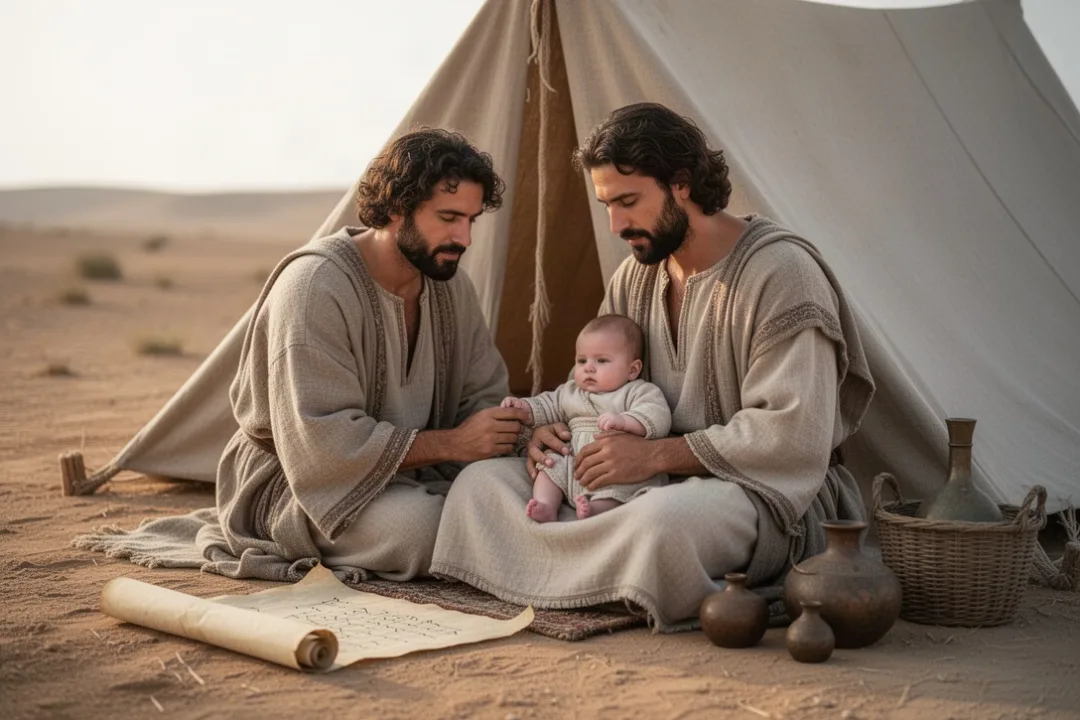
The command applied to Abraham, his descendants, and the males in his household, including servants and those acquired from outside the family. The biblical account says that circumcision was to take place on the eighth day for newborn boys. It also records Abraham’s immediate obedience, showing that the rite was not presented as an optional family custom but as a covenant obligation.
The sign had several connected meanings:
Belonging: it identified a person with Abraham’s covenant family.
Obedience: it demonstrated submission to a specific command from God.
Promise: it pointed to God’s commitment to Abraham and his descendants.
Separation: it distinguished the covenant people from surrounding nations.
Circumcision was not described as a way to earn God’s favor through a physical act alone. The covenant included God’s promises, but it also called Abraham and his descendants to walk faithfully before God. The outward mark had meaning because it represented a relationship of trust and obedience, not because the ritual itself could replace faithfulness.
Central idea: Biblical circumcision was a covenant sign, not an isolated religious procedure. Its significance came from the relationship with God that it represented.
Genesis 17 also uses strong language about any male who refused circumcision. Such a person was regarded as having rejected the covenant. This explains why later biblical writers treat the subject seriously: the issue was not merely a medical practice or cultural preference, but a person’s response to a covenant command.
The timing of the rite reinforced its covenant meaning. A male child was circumcised on the eighth day, before he could make a personal decision or demonstrate mature obedience. That detail shows that membership in the covenant community was connected to family identity and God’s promise, even though personal faithfulness would still be expected later in life.
How circumcision functioned in Israel’s law and history
After Abraham, circumcision remained part of Israel’s identity. Leviticus 12:3 gives the eighth-day requirement within the laws concerning childbirth. The Gospel accounts also show that Jesus was circumcised according to Jewish practice; Luke 2:21 places this event within the account of his early life. His circumcision indicates that he was born into Israel and lived within the obligations of the Jewish law.
Circumcision also affected participation in Israel’s worship. According to Exodus 12:48, a foreigner who wanted to celebrate Passover with Israel had to be circumcised, along with the males of his household. The rule connected participation in this central covenant meal with identification with Israel’s covenant community.
The book of Joshua describes another major moment in Joshua 5. After the Israelites entered the land, the men of the new generation were circumcised because those born during the wilderness period had not been circumcised. The event prepared the people to observe Passover and marked a renewal of their covenant identity before they continued their life in the land.
These passages show that circumcision was tied to several aspects of Israel’s life:
Family identity: it marked male descendants as members of Abraham’s people.
National identity: it distinguished Israel from neighboring nations.
Worship: it could be required for participation in covenant celebrations.
Obedience to the law: it represented submission to God’s revealed commands.
At the same time, the Old Testament repeatedly warns that the physical sign is not enough by itself. Moses tells Israel to circumcise their hearts in Deuteronomy 10:16, using circumcision as a picture of removing stubbornness and becoming receptive to God. A related appeal appears in Deuteronomy 30:6, where God is described as transforming the hearts of his people so that they love him fully.
The prophets make the same point in different language. Jeremiah speaks of the need for the people to be circumcised to the Lord and to remove the stubbornness of their hearts in Jeremiah 4:4. He also criticizes those who possess the physical sign while remaining inwardly resistant to God in Jeremiah 9:25-26.
“Uncircumcised” can therefore function in the Bible as more than a literal description. It may describe an unresponsive heart, closed ears, or resistant lips. The language does not erase the physical practice, but it shows that God’s concern reaches deeper than the body. The outward mark was meant to correspond to inward loyalty.
What circumcision meant for Jesus and Jewish believers
Jesus was circumcised as an infant and lived as a Jew under the law of Moses. The Gospel of John records Jesus discussing circumcision in connection with the Sabbath in John 7:22-23. His point is that Jewish people performed circumcision even when it fell on the Sabbath, because the practice was tied to the law and covenant tradition.
This conversation does not present Jesus as dismissing circumcision. Instead, he uses the accepted practice to challenge people who objected to a healing performed on the Sabbath. The larger issue is whether they can recognize God’s good work rather than judging by a narrow or inconsistent standard.
During Jesus’ lifetime, circumcision remained a normal and important sign for Jewish people. The first disciples were also Jews, and the earliest Christian community began within Israel. The major question arose when Gentiles began believing in Jesus. Did they need to become circumcised and keep the full law of Moses in order to belong to God’s people?
This question was especially serious because circumcision could mean more than undergoing a physical act. For an adult Gentile, accepting circumcision could signify taking on Jewish covenant identity and legal obligations. The debate was therefore about the basis of membership in the people of God, not simply about one ritual.
Acts 15 records a council in Jerusalem that addressed this dispute. Some believers from a Pharisaic background argued that Gentile Christians needed circumcision and obedience to the law of Moses. The apostles and elders rejected the demand that Gentile believers must be circumcised as a condition of salvation.
The decision did not mean that circumcision was sinful for Jews or that Jewish believers had to abandon their heritage. It addressed a specific claim: Gentiles did not need to become Jews in order to follow Christ. The council’s letter gave several instructions concerning conduct and fellowship, but it did not require Gentile converts to receive circumcision.
Paul’s letters reflect the same controversy. In Galatians, he strongly opposes the idea that Gentile believers must be circumcised to be accepted as members of God’s people. His concern is that adding circumcision as a requirement would change the foundation of the gospel from trust in Christ to reliance on law-based identity.
Paul can speak sharply because the issue threatened to divide Christians into superior and inferior groups. If Gentiles had to adopt circumcision before they could fully belong, then the church would effectively say that faith in Christ was insufficient. Paul argues instead that people are made right with God through faith in Christ and God’s grace, not through receiving the physical sign of Abraham’s covenant.
Important distinction: The New Testament rejects circumcision as a requirement for Gentile salvation; it does not present the physical practice itself as morally wrong in every circumstance.
How Paul explains physical and spiritual circumcision
Paul discusses circumcision in several letters, and his wording needs to be read in context. He is not always answering the same question. Sometimes he addresses Jewish identity, sometimes Gentile conversion, sometimes church division, and sometimes the deeper meaning of belonging to God.
In Romans 2, Paul argues that physical circumcision has value when a person obeys God, but it cannot protect someone who persistently breaks the law. He then speaks of a person who is inwardly a Jew and whose circumcision is a matter of the heart, accomplished by the Spirit rather than merely by written regulations.
His argument is not that every Jewish identity marker has no meaning. Rather, Paul refuses to let the external sign become a substitute for genuine obedience and transformed character. A person cannot claim covenant faithfulness merely because of a mark on the body while rejecting God in daily life.
In Romans 4, Paul returns to Abraham to show that Abraham was counted righteous by faith before he received circumcision. Circumcision then functioned as a sign and seal of the righteousness associated with that faith. This order matters to Paul: the physical sign did not create Abraham’s trusting relationship with God; it confirmed a relationship already present.
That reasoning allows Paul to describe Abraham as the father of both circumcised and uncircumcised believers. Jewish believers could see themselves in Abraham, but Gentile believers could also share in Abraham’s faith without taking on the physical sign.
In 1 Corinthians 7:18-19, Paul tells believers not to treat circumcision or uncircumcision as the central measure of their standing before God. The significant issue is keeping God’s commands. This does not mean that every command in Scripture is identical in purpose or covenant setting; it means that physical status cannot replace faithful living.
Paul makes a similar point in Galatians 5:6, where he describes faith working through love as the relevant reality in Christ. In Galatians 6:15, he says that neither circumcision nor uncircumcision is the decisive matter, but becoming a new creation. For Paul, the gospel creates a renewed people whose identity is centered on Christ rather than on ethnic boundary markers.
Colossians 2 uses the language of circumcision in a spiritual sense. Paul connects believers’ union with Christ to a circumcision not performed by human hands and describes baptism as part of the imagery of dying and rising with Christ. Christians have interpreted the precise relationship between baptism and circumcision in different ways, but the passage clearly emphasizes inner union with Christ rather than dependence on a physical operation.
Paul’s teaching can be summarized through several contrasts:
External sign versus inward transformation: the mark on the body cannot replace a changed heart.
Ethnic boundary versus shared faith: Gentiles do not need to become Jews to belong to Christ.
Human effort versus God’s grace: covenant membership is not earned by performing a ritual.
Religious status versus faithful conduct: love and obedience reveal the reality of faith.
What the Bible says about circumcision for Christians today
The New Testament does not give a universal medical command requiring or forbidding circumcision for Christian men. Its central teaching is that circumcision is not a condition of salvation and is not required for Gentile believers to enter the church.
A Christian family may consider circumcision for medical, cultural, family, or personal reasons. Those decisions belong to the sphere of conscience, family responsibility, and medical advice rather than to a universal New Testament rule. The Bible’s teaching about covenant membership should not be used to pressure every Christian family toward one medical choice.
At the same time, Christians should be careful not to treat the practice with contempt. Jewish circumcision remains a significant religious and cultural tradition for many Jewish families. The New Testament’s debate concerns the requirements for salvation and fellowship in Christ, not permission to mock Jewish identity or dismiss the historical importance of the covenant sign.
Christians from different traditions also explain the relationship between circumcision and baptism in different ways. Some see baptism as the covenant sign that replaces circumcision for the church; others emphasize that the two practices belong to different covenant settings and should not be equated too closely. Both views seek to account for the Bible’s emphasis on covenant signs, faith, and the inclusion of Gentiles.
When making a present-day decision, it helps to keep several questions separate:
What does the Bible require for salvation? The New Testament does not require Gentile circumcision.
What does a family’s tradition mean? Jewish, Christian, and cultural communities may attach different significance to the practice.
What medical information applies? Parents should discuss benefits, risks, timing, and aftercare with a qualified health professional.
What does personal conscience allow? Romans 14 provides a broader principle of avoiding contempt and unnecessary judgment over disputable practices.
The Bible’s larger message is that an outward sign must never be separated from the inward reality it is meant to represent. Circumcision can mark a covenant body, but Scripture repeatedly calls people to trust God, love him, obey him, and receive a renewed heart.
For Christians reading the whole biblical story, circumcision begins with Abraham’s covenant, continues through Israel’s law and history, and becomes part of the early church’s debate about Gentile inclusion. The New Testament ultimately places the decisive emphasis on faith in Christ, life in the Spirit, and transformed character rather than on physical circumcision.
Frequently asked questions
Was Jesus circumcised?
Yes. Luke 2:21 records that Jesus was circumcised as an infant and given his name according to Jewish custom. This places him within the Jewish covenant community and shows that he lived under the law of Moses. His circumcision does not mean that the New Testament later requires the same rite for Gentile Christians.
Does the Bible say circumcision is required for salvation?
No. Acts 15 rejects the demand that Gentile believers must be circumcised to be saved. Paul makes the same argument in Galatians and Romans, teaching that acceptance by God rests on faith and grace rather than on adopting a physical Jewish covenant marker. Circumcision may have cultural or medical significance, but it is not a requirement for Christian salvation.
What does “circumcision of the heart” mean?
It describes inward openness and loyalty to God rather than a physical mark alone. The idea appears in passages such as Deuteronomy 10:16 and Jeremiah 4:4, then develops in Paul’s teaching about spiritual transformation. A circumcised heart is receptive to God, turns away from stubborn resistance, and produces faithful conduct.
Can a Christian man be circumcised for medical or cultural reasons?
Yes. The New Testament does not forbid circumcision as a medical, cultural, or family decision. It forbids treating the procedure as necessary for salvation or as proof that one believer is spiritually superior to another. Families considering circumcision should weigh their circumstances and seek reliable advice from a qualified medical professional.








Leave a Reply