The Hezekiah story in the Bible: faith under pressure
The Hezekiah story in the Bible: faith under pressure
When a crisis arrives, you may wonder whether prayer can change the situation or whether faith simply helps you endure it. The story of Hezekiah in the Bible addresses both questions. Hezekiah was a king of Judah who faced religious corruption, a terrifying Assyrian invasion, a life-threatening illness, and the temptation to show off his wealth to foreign visitors.
His story is not a simple account of a flawless hero. Hezekiah trusted God courageously, led major reforms, and prayed honestly. He also made a serious mistake near the end of his life. The biblical account presents all of these moments together, showing how faith can shape leadership while warning that sincere devotion does not remove the need for humility and wise decisions.
The main accounts of Hezekiah are found in 2 Kings 18–20, 2 Chronicles 29–32, and Isaiah 36–39. These passages describe the same broad period from different perspectives. Kings emphasizes Judah’s political and spiritual history, Chronicles gives special attention to worship and the temple, and Isaiah highlights God’s word, Hezekiah’s prayer, and the threat from Assyria.
Hezekiah ruled the southern kingdom of Judah after his father, Ahaz. Ahaz had pursued policies that dishonored the Lord and had allowed Judah’s worship to become deeply compromised. Hezekiah inherited a kingdom under pressure, but he chose a very different direction from the beginning of his reign.
The Bible portrays Hezekiah as one of Judah’s most faithful kings. He removed unauthorized worship sites, destroyed the bronze serpent that had become an object of devotion, repaired the temple, restored the priests and Levites to their duties, and called the people back to worship. His reforms were not merely political changes; they were an attempt to return the nation to covenant faithfulness.
The central picture: Hezekiah’s story moves through four pressures—spiritual decline, military threat, personal illness, and human pride. In each situation, his response reveals something about trust in God.
Hezekiah’s story in sequence
The events can be followed in a fairly clear progression. Reading them in order helps you see how the biblical narrative develops rather than treating each incident as an isolated lesson.
Hezekiah becomes king and begins correcting the spiritual damage left by Ahaz.
He restores temple worship and calls Judah to renewed devotion to the Lord.
He faces Assyrian pressure after resisting Assyria and preparing Jerusalem for attack.
He prays during the siege instead of surrendering to the enemy’s intimidation.
God delivers Jerusalem from the Assyrian threat.
Hezekiah becomes seriously ill and asks God for mercy.
God grants him additional years and gives a sign connected with his recovery.
Hezekiah welcomes Babylonian envoys and displays the wealth of his kingdom.
Isaiah announces future judgment, and Hezekiah’s reign eventually ends with his son Manasseh succeeding him.
This sequence matters because Hezekiah’s strongest victories do not prevent later weakness. The Bible keeps both truths visible: faithfulness is real, and pride remains dangerous, even after remarkable answers to prayer.
Hezekiah begins by repairing Judah’s worship
Second Kings says that Hezekiah did what was right in the sight of the Lord, following the pattern of David. This description does not mean he lived without error. It identifies the main direction of his reign: he sought the Lord rather than continuing the policies of his father.
According to 2 Chronicles 29, Hezekiah opened and repaired the doors of the temple early in his reign. He gathered the priests and Levites, challenged them to consecrate themselves, and directed them to remove the uncleanness associated with previous disobedience. The temple was cleansed, sacrifices were offered, and worship was reorganized.
Hezekiah’s reforms included several concrete actions:
He reopened the temple and restored its proper use.
He brought priests and Levites back into ordered service.
He removed idols and objects connected with false worship.
He destroyed the bronze serpent Moses had made because people had begun burning incense to it.
He encouraged the people to return to the Lord and observe the covenant.
The bronze serpent is especially revealing. It had originally been associated with an act of God’s mercy in the wilderness, as recorded in Numbers 21. But a reminder of God’s work had become an object of worship itself. Hezekiah destroyed it because even a legitimate religious symbol can become spiritually harmful when people trust the object instead of God.
That detail gives the story a practical edge. Good beginnings do not guarantee good use forever. A tradition, building, symbol, or practice may once have helped people remember God, yet later become a substitute for genuine dependence on him. Hezekiah’s reform required discernment, not merely preservation of everything connected with the past.
Hezekiah calls Judah to celebrate Passover
Hezekiah also invited people from across Judah and from the remaining northern tribes to come to Jerusalem for Passover. The northern kingdom of Israel had been weakened and largely conquered by Assyria, but Hezekiah still appealed to its survivors. His invitation called them to return to the Lord and worship at the temple.
Some people mocked the invitation, while others humbled themselves and came. Chronicles emphasizes that the celebration brought joy, generosity, singing, and a renewed sense of shared worship. The event was not presented as a political campaign to rebuild national prestige. It was a spiritual appeal to people who had been divided and had wandered from God.
The account also acknowledges that the celebration was not perfectly orderly. Some participants had not prepared themselves according to the usual requirements, but Hezekiah prayed for them. He asked God to pardon those whose hearts were set on seeking him even though their ritual preparation was incomplete. This does not erase the standards of worship; it shows Hezekiah’s concern that repentant hearts should not be pushed away carelessly.
For Hezekiah, reform meant more than removing bad practices. It meant rebuilding a community around worship, repentance, generosity, and shared responsibility. The temple could be cleaned, but the people also needed to return to God personally.
Assyria threatens Jerusalem
Hezekiah’s faith was tested by a powerful empire. Assyria had already conquered the northern kingdom and had taken many fortified cities in Judah. Hezekiah had rebelled against Assyria, and the Assyrian king Sennacherib responded by sending a large force against Judah.
The biblical accounts describe Jerusalem under intense pressure. Hezekiah prepared the city by strengthening its defenses, organizing the army, and securing the water supply. Second Chronicles records the construction of a tunnel that brought water into Jerusalem from the Gihon spring. He also encouraged the people not to fear the size of the Assyrian army.
Hezekiah’s preparations show that trust in God did not mean refusing practical action. He fortified walls, managed resources, and planned for a siege. Faith and responsible preparation worked together rather than standing in opposition.
The Assyrian officials then tried to break Jerusalem’s confidence before fighting began. The chief spokesman, often called the Rabshakeh, spoke publicly near the city wall. He used several tactics:
He questioned Judah’s confidence in Egypt as a possible ally.
He claimed that the Lord had sent Assyria against Jerusalem.
He argued that Hezekiah had offended God by removing local worship sites.
He described the Assyrian army as stronger than Judah’s defenses.
He addressed the people directly in a language they could understand, hoping to make them doubt their leaders.
The speech was not only a military warning. It was an attempt to redefine reality. The Assyrian official wanted the people to believe that resistance was foolish, that their God could not save them, and that surrender would bring security. Threats often work this way: they seek control over your interpretation of events before they take control of the circumstances themselves.
Hezekiah responds to intimidation with prayer
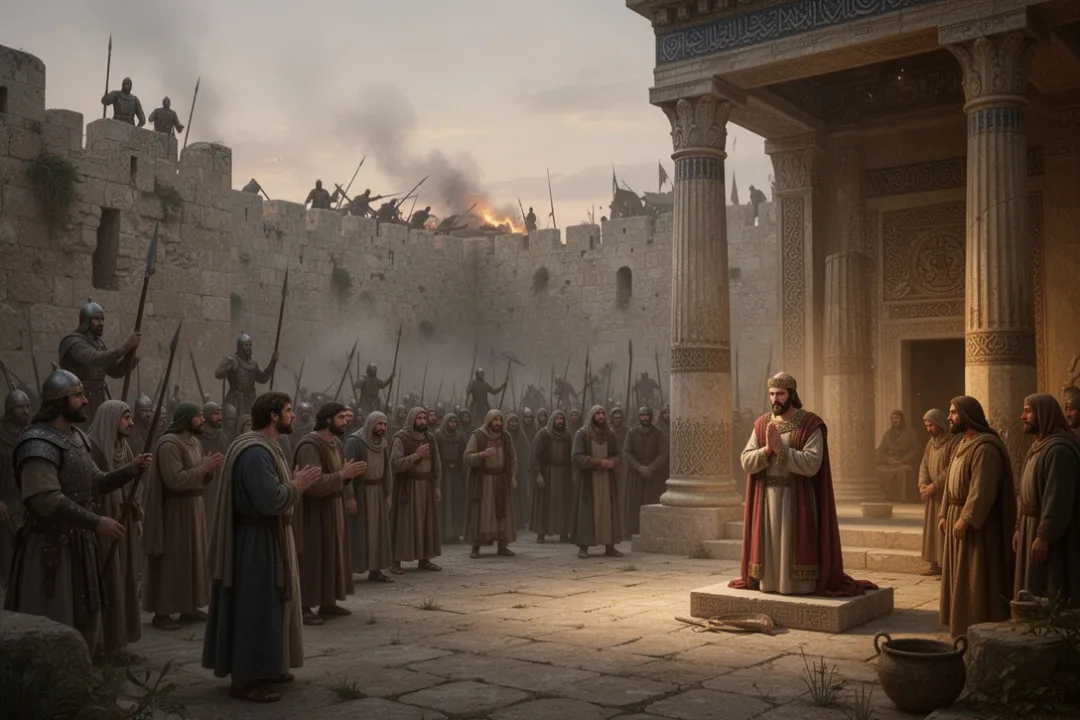
When Hezekiah heard the Assyrian message, he tore his clothes and put on sackcloth, signs of grief and humility. He sent officials to Isaiah the prophet and asked for prayer. Isaiah responded with a message that told the king not to fear the Assyrian words and assured him that the enemy would not capture Jerusalem.
The crisis intensified when Sennacherib sent another message. This time, Hezekiah took the letter to the temple and spread it before the Lord. His prayer, recorded in 2 Kings 19 and Isaiah 37, begins by acknowledging God’s greatness and authority. He then describes the Assyrian threat and asks God to act so that the kingdoms of the earth will recognize the Lord.
Hezekiah did not pretend the danger was small. He named the enemy’s victories and admitted that the nations Assyria had conquered could not rescue themselves. His prayer was neither denial nor panic. It was a deliberate act of placing an overwhelming situation before God.
Hezekiah’s prayer does not minimize the threat; it places the threat under God’s authority.
The prayer also shows that Hezekiah cared about more than Judah’s survival. He wanted God’s name to be honored. That concern shaped the request: deliverance would show that the Lord was not merely one local deity among many, but the living God who could save his people.
For prayer today: Hezekiah’s example offers a simple pattern—describe the threat honestly, recognize God’s authority, resist fear-based conclusions, and ask for help with a purpose larger than personal relief.
God delivers Jerusalem from the Assyrian threat
The biblical account says that God answered Hezekiah’s prayer and Jerusalem was spared. Second Kings, Chronicles, and Isaiah describe a devastating blow against the Assyrian forces, followed by Sennacherib’s withdrawal. The text presents this as divine deliverance, not as the result of Judah’s military strength.
The exact details of the event differ in emphasis across the accounts, but their shared message is clear: Assyria’s power was not ultimate. The empire that had conquered other nations could not simply decide the fate of Jerusalem. The Lord defended the city in response to the crisis.
This victory should not be read as a promise that every faithful person will receive immediate rescue from every danger. The Bible itself contains many faithful people who suffered, were displaced, or died. In Hezekiah’s specific situation, God gave deliverance to Jerusalem and confirmed the prophetic word spoken to the king.
The story does teach that intimidation is not the same as authority. A powerful voice can make confident claims without possessing final control. Hezekiah had to decide whether he would measure reality by the enemy’s message or by God’s character and promise.
Hezekiah becomes ill and asks for more time
After the Assyrian crisis, Hezekiah became seriously ill. Isaiah came to him with a message telling him to put his affairs in order because he would die. Hezekiah turned his face toward the wall and prayed, reminding God of his faithful devotion and weeping deeply.
The passage can feel difficult because Hezekiah had already received a promise of deliverance, yet he now faced death. His response is personal and emotional. He did not offer a detached theological explanation. He grieved, prayed, and asked God to remember how he had walked before him.
God then sent Isaiah back with an answer: Hezekiah’s prayer had been heard, and additional years would be given to him. A sign involving the shadow moving on the steps is recorded in 2 Kings and Isaiah. The sign confirmed that the Lord would fulfill his promise.
Second Chronicles places this experience alongside the Assyrian crisis but gives less detail about the medical event. Taken together, the accounts show a king who had witnessed national deliverance and still needed to bring his own fear and mortality before God.
Hezekiah’s illness raises questions about prayer and divine action. The text does not present prayer as a technique for forcing God to do whatever a person wants. It presents God as sovereign while also showing that prayer is meaningful and that God may respond to it. Hezekiah’s life was extended, but the added years did not remove the need for wisdom.
Hezekiah’s pride appears when Babylon sends envoys
After Hezekiah recovered, the king of Babylon sent envoys with letters and a gift. Second Kings and Isaiah say that Hezekiah welcomed them and showed them everything in his storehouses: silver, gold, spices, precious oil, weapons, and other possessions. He hid nothing from them.
The text does not explicitly state every motive behind this display, but Chronicles says that God left Hezekiah to test him and to reveal what was in his heart. The context suggests that Hezekiah’s response involved pride. He showed foreign visitors the wealth and resources of Judah instead of directing attention to the God who had delivered and healed him.
When Isaiah asked what the visitors had seen, Hezekiah admitted that they had seen everything. Isaiah then announced that a future generation would lose those treasures to Babylon. Some of Hezekiah’s descendants would be taken away and would serve in the Babylonian king’s palace.
Hezekiah’s response to this prophecy is troubling. He acknowledged that the word of the Lord was good, partly because it meant there would be peace during his own lifetime. The statement may reveal relief that the judgment would not arrive immediately, but it also sounds self-focused. The future suffering of his descendants did not move him as deeply as his own short-term peace.
This episode prevents a shallow reading of Hezekiah as a perfect model. He trusted God in public crisis, but after success and healing he became vulnerable to self-display and short-term thinking. His mistake was not simply showing possessions. It was allowing achievement and prosperity to shift his attention from dependence on God to confidence in what he owned and could present.
What Hezekiah’s failures teach about pride
Hezekiah’s weakness is especially instructive because it follows remarkable faithfulness. People often expect spiritual danger to come only through obvious rebellion. Hezekiah shows another pattern: a person may stand firm under attack and then stumble when admiration, comfort, or political opportunity arrives.
His story identifies several warning signs of pride:
Success becomes personal credit instead of a reason for gratitude.
Resources become a source of security rather than tools to use responsibly.
Public image becomes central, encouraging people to display what they have.
The future is treated as someone else’s problem when present comfort is protected.
Prayer decreases after a crisis ends, even though dependence on God remains necessary.
Second Chronicles says Hezekiah’s heart became proud after he received great wealth and honor, but he humbled himself. The account does not erase the pride; it shows that repentance was possible. Humility is not the claim that you never fail. It is the willingness to recognize your failure and return to the right posture.
Hezekiah’s leadership combines courage and organization
Hezekiah is often remembered mainly for prayer, but the biblical record also presents him as an effective administrator. He organized priests and Levites, restored temple offerings, directed the collection of contributions, prepared defenses, managed water supplies, and encouraged military leaders.
His leadership offers a balanced picture. He did not say that practical planning showed a lack of faith. He also did not treat planning as a substitute for dependence on God. When Jerusalem faced Assyria, he did what a responsible king could do and then brought the threat to God in prayer.
That balance can shape how you approach your own responsibilities. Faith may include:
seeking wise counsel before making a major decision;
repairing neglected responsibilities instead of only expressing regret;
preparing for foreseeable difficulties;
asking others to pray and work with you;
refusing to let fear dictate your choices;
giving God credit when an outcome is beyond your control.
Hezekiah’s example does not promise that careful preparation will always produce the desired result. It shows that trust is not passivity. A person can act diligently while recognizing that ultimate control belongs to God.
How the three biblical accounts differ
Reading the parallel passages gives a fuller understanding of Hezekiah’s reign. Second Kings 18–20 places Hezekiah within Judah’s royal history and stresses his trust in the Lord, the Assyrian crisis, his illness, and the Babylonian envoys.
Isaiah 36–39 closely parallels the crisis and illness narratives. Its arrangement connects Hezekiah’s political troubles with Isaiah’s prophetic ministry and emphasizes the meaning of God’s word during national danger.
Second Chronicles 29–32 gives more space to the temple reforms, Passover, worship organization, offerings, and Hezekiah’s preparations for Assyria. It also records Hezekiah’s pride and humility in a way that helps explain the spiritual condition of his reign.
The differences are not a reason to dismiss one account. They reflect the purposes of each biblical writer. Together they show Hezekiah as a reformer, worship leader, military planner, praying king, healed patient, and imperfect human being.
Why Hezekiah’s story still matters
Hezekiah’s story speaks to several situations that remain familiar. You may be trying to correct the effects of someone else’s decisions, as Hezekiah did after Ahaz. You may face loud opposition that insists your faith is unreasonable. You may need to act responsibly while still admitting that you cannot control the outcome.
You may also experience a more personal crisis: illness, fear of death, or the realization that your life is shorter and more fragile than you expected. Hezekiah’s prayer shows that bringing grief directly to God is compatible with faith. His words do not sound polished or detached; they come from a person who knows he is vulnerable.
At the same time, the story warns against assuming that one answered prayer guarantees lifelong spiritual strength. Hezekiah survived invasion and illness, yet he still needed humility afterward. Victory can test character just as hardship can.
The broad lessons of the story include:
Reform may require removing practices that have become harmful, even if they have religious associations.
Prayer can face a crisis honestly without pretending the danger is insignificant.
Responsible preparation and trust in God can belong together.
God’s deliverance should lead to gratitude, not self-promotion.
Faithful people can make serious mistakes and still respond through repentance.
Leadership should consider the effect of present decisions on future generations.
Hezekiah’s reign ends with a mixed legacy. He was remembered as a king who trusted the Lord and removed many forms of idolatry, yet his pride contributed to a warning about Babylon’s future domination. The Bible does not flatten his life into either praise or condemnation.
That complexity is part of the story’s value. Hezekiah shows what courageous faith can look like under pressure, while his later failure shows why every success still calls for humility. His life invites you to pray when threatened, act responsibly when possible, receive mercy gratefully, and examine your heart after the crisis has passed.
Frequently asked questions
Was Hezekiah a good king in the Bible?
Yes. The Bible generally presents Hezekiah as one of Judah’s most faithful kings. He removed idols, restored temple worship, celebrated Passover, and trusted God during the Assyrian invasion. However, he was not portrayed as perfect. His pride after recovering from illness and his display of Judah’s treasures to Babylonian envoys led to a prophetic warning about future judgment.
What was Hezekiah’s greatest mistake?
His most notable mistake came when he showed Babylonian visitors all the wealth and military resources of Judah. The biblical account connects this action with pride and announces that Babylon would eventually carry those treasures away. The deeper problem was misplaced confidence: Hezekiah appeared more focused on displaying his resources than on honoring the God who had helped him.
How long did Hezekiah reign?
Second Kings describes Hezekiah as reigning over Judah for twenty-nine years. His reign began after Ahaz and ended when his son Manasseh became king. The biblical accounts focus less on the exact political chronology than on the major spiritual and national events of his rule, including temple reform, the Assyrian crisis, his illness, and the visit from Babylonian envoys.
What can Christians learn from Hezekiah’s prayer?
Hezekiah’s prayer shows that you can bring a frightening situation to God honestly and specifically. He acknowledged the enemy’s power rather than pretending the danger was small, then appealed to God’s authority and reputation. His example encourages prayer that combines clear facts, humility, trust, and concern for God’s honor rather than relying only on confidence in personal strength.



Leave a Reply