Acacia wood in the Bible refers to the durable desert wood used for many parts of Israel’s tabernacle and its furnishings. The Hebrew term is commonly translated as shittim or shittah, while most modern English translations use “acacia wood.”
It was used for the ark of the covenant, the table for the bread of the Presence, the altar of burnt offering, the incense altar, the tabernacle frames, and the poles used to carry sacred objects. The Bible presents acacia as a practical material suited to Israel’s wilderness setting, but it does not give one official symbolic meaning for the wood itself.
The English phrase “acacia wood” comes from a Hebrew word usually transliterated as shittim, the plural form of a word related to a thorny desert tree. In some older English Bibles, the same material appears as “shittim wood.” The difference is mainly one of translation style, not a difference between two materials.
Acacia trees grow in dry regions, including areas associated with the Sinai Peninsula, the Negev, and parts of the eastern wilderness. They can survive with limited water and produce wood that is naturally resistant to decay. These features make acacia a plausible and useful choice for a portable sanctuary built in a harsh environment.
The biblical text does not identify the exact modern species of tree. Several acacia species grow across the broader biblical region, and the ancient Hebrew term may have covered related trees rather than one precisely classified species. For that reason, “acacia” is a careful translation, but it should not be treated as a modern botanical identification with absolute certainty.
Acacia is first prominent in the instructions for the tabernacle in Exodus. God tells Moses to use the wood for a series of sacred objects, then cover many of those objects with gold or bronze. The same material appears again when the craftsmen construct those items in Exodus 35–38.
Translation note: “Shittim wood,” “acacia wood,” and related wording can refer to the same biblical material. The spelling varies among English translations, but the main passages are found in Exodus, Deuteronomy, Isaiah, and references to places called Shittim.
The word also occurs in geographical names. Shittim was associated with a location in the plains of Moab where Israel camped near the end of its wilderness period. Numbers 25 and 33, Joshua 2 and 3, and Joel 3 refer to places connected with Shittim. These place names show that the term was tied to the landscape as well as to the wood used in worship.
Why acacia was suitable for the wilderness tabernacle
The tabernacle had to be transported as Israel traveled. Its furnishings were not permanent stone structures in a settled city; they were constructed for a mobile community moving through the wilderness. Lightweight, workable, and durable wood was therefore more suitable than heavy stone for many of the inner structures and furnishings.
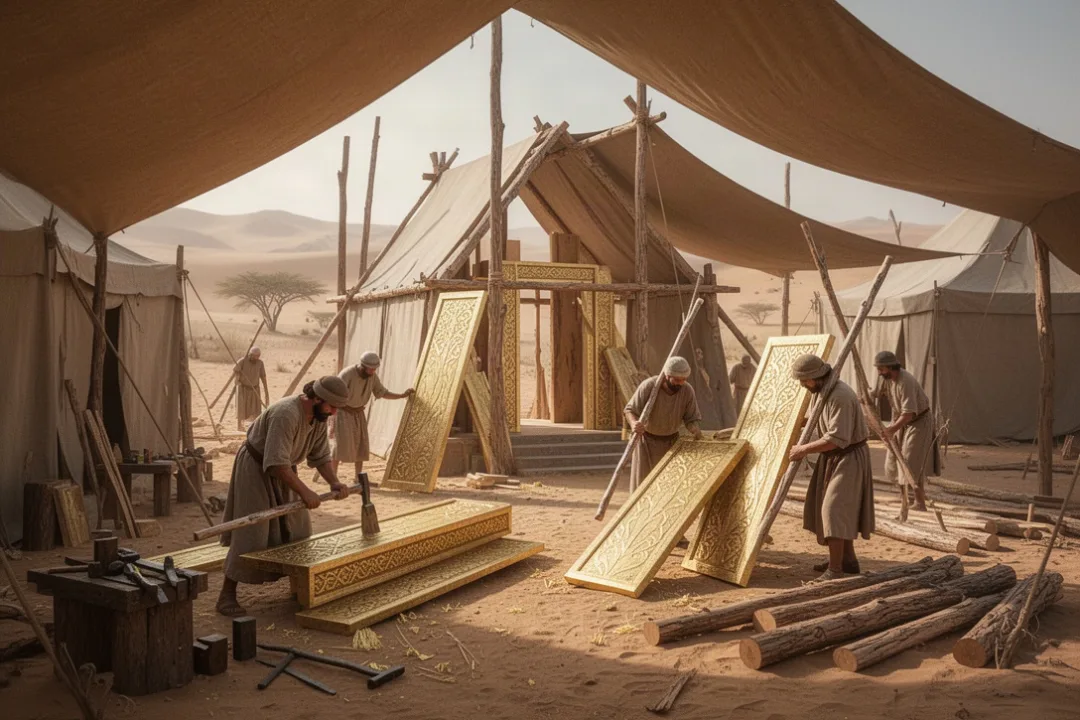
Acacia wood has qualities that fit this purpose. It is generally hard and strong, and its natural resistance to insects and decay can help it endure in dry conditions. It could be cut into boards, poles, frames, and panels, then covered with metal surfaces where the instructions required them.
The Bible emphasizes craftsmanship as well as material. Bezalel, Oholiab, and other skilled workers were responsible for making the tabernacle objects according to the pattern given to Moses. Exodus 31 and 35–38 connect the work with skill, wisdom, and willing contributions from the people.
That detail matters because the tabernacle was not assembled from wood casually collected and roughly shaped. The wood formed part of a carefully ordered design. It was measured, joined, overlaid, fitted with rings, and prepared for carrying. Function and worship were connected: the material had to work in real conditions while serving a sacred purpose.
Acacia’s availability also fits the biblical setting. A wilderness does not mean a treeless landscape. Dry regions can contain shrubs and trees concentrated near seasonal water sources, valleys, and wadis. Acacia trees are particularly adapted to such environments, making them one of the more natural sources of usable timber in the area.
Still, the text does not say that acacia was selected because it represented one particular virtue such as purity, strength, or immortality. Those ideas may appear in sermons or devotional writing, but they should be distinguished from what Scripture directly states. The Bible gives detailed instructions about where the wood was used, while its explicit emphasis falls on God’s presence, holiness, covenant, and worship.
Which tabernacle objects were made from acacia wood
Exodus names several major objects made from acacia. In many cases, the wood was covered with gold or bronze, so worshipers would see a finished metal surface rather than exposed timber. The repeated use of one material across different objects helped create a unified structure while allowing each item to serve a distinct purpose.
The ark and its carrying poles
Exodus 25:10–16 describes the ark of the covenant as a chest made from acacia wood and overlaid with pure gold inside and out. Gold molding surrounded it, and rings were attached to its corners. Acacia poles covered with gold passed through the rings so the ark could be carried without being handled directly.
The ark represented the central place of the covenant relationship. The tablets of the covenant were kept inside it, and the cover above it was associated with God’s meeting with Moses. The wood gave the chest a strong core, while the gold expressed the special status of the object within Israel’s worship.
Deuteronomy 10:1–5 also refers to an ark made from acacia wood. That passage describes Moses making the ark after the first tablets were broken and then placing the replacement tablets inside it. The account connects the ark with the covenant words and with Israel’s continuing responsibility to remain faithful.
The table for the bread of the Presence
The table described in Exodus 25:23–30 was also made from acacia wood and covered with gold. It had a rim, molding, rings, and poles for transport. The table held the bread placed before God, often called the bread of the Presence in English translations.
Its design shows how the tabernacle combined ordinary furniture with sacred use. A table is a familiar object, but this table belonged to the sanctuary and was prepared according to specific instructions. The acacia core provided the structure, while the gold covering distinguished it from common household furniture.
The frames and crossbars of the tabernacle
Exodus 26:15–30 describes upright frames made from acacia wood for the tabernacle’s walls. Acacia crossbars helped stabilize those frames, and some of the bars were covered with gold. The structure also included sockets and connecting features that allowed the sanctuary to be assembled and taken down.
These frames are easy to overlook because they were part of the tabernacle’s supporting structure rather than its most visible religious objects. Yet they demonstrate that acacia was not reserved only for symbolic furnishings. It supplied the framework of the sanctuary itself, helping create a portable worship space.
The altars and their poles
The altar of burnt offering was made from acacia wood and covered with bronze, according to Exodus 27:1–8. It was larger and more exposed to heat and weather than many of the inner furnishings. Its construction required a strong frame, horns at the corners, a grating, rings, and carrying poles.
The smaller altar of incense, described in Exodus 30:1–10, was made from acacia wood and covered with gold. It stood inside the sanctuary near the curtain separating the Holy Place from the Most Holy Place. Like the ark, it had gold rings and poles for transport.
The two altars show that the same basic wood could support different forms of worship. The outer altar was associated with animal offerings and was protected by bronze, while the inner altar was associated with fragrant incense and was covered with gold. The covering and location mattered as much as the underlying wood.
Ark: acacia wood covered with gold, with gold-covered carrying poles.
Table: acacia wood covered with gold, used for the bread of the Presence.
Tabernacle frames: acacia wood used for upright boards and structural bars.
Burnt offering altar: acacia wood covered with bronze.
Incense altar: acacia wood covered with gold.
Poles and bars: acacia used to make the furnishings portable and stable.
How acacia wood relates to carrying and holiness
One of the clearest themes in the acacia passages is portability. The ark, table, altars, and other items had rings and poles so the Levites could carry them as Israel moved. The furnishings belonged to a sanctuary that traveled with the people rather than remaining in one permanent building.
The poles were not decorative additions. They were part of the practical design and helped preserve the proper way to transport sacred objects. Exodus 25:15 says the poles for the ark were to remain in its rings, a detail that underscores the object’s readiness for movement and the importance of following the prescribed arrangement.
Numbers 4 gives further instructions for covering and transporting the holy furnishings. The priests first prepared the objects, and the Kohathites carried them. The passage makes a distinction between those responsible for covering the sacred items and those assigned to carry them, showing that transport itself was treated with care.
This setting helps explain why acacia wood appears so often. A sanctuary designed to move required materials that could withstand repeated assembly, disassembly, lifting, and travel. Durability was part of reverence because the objects had to remain intact and properly used during the community’s journeys.
Reading principle: The Bible’s strongest direct message in these passages concerns God’s holy presence and Israel’s covenant worship. Acacia’s physical qualities support that design, but Scripture does not require readers to assign a separate symbolic meaning to every feature of the wood.
The use of poles also distinguishes the tabernacle from a fixed temple. Later, Solomon’s temple became a permanent center in Jerusalem, although some of its furnishings continued to reflect patterns established in the tabernacle. The acacia passages belong especially to the wilderness period, when Israel’s worship had to function while the people were traveling.
Holiness in these passages does not mean that acacia wood was magical or inherently sacred. The wood became part of sacred furniture because it was set apart according to God’s command and incorporated into the tabernacle’s worship. The same type of tree could provide ordinary material elsewhere, while the completed object had a consecrated role within the sanctuary.
What acacia references outside the tabernacle describe
Acacia-related language appears in several passages that do not describe tabernacle furniture. These references help place the material in the physical landscape of the Bible and prevent the term from being understood only as a technical construction word.
Numbers 25:1 says Israel was staying at Shittim when the people became involved in the worship of Baal of Peor. Numbers 33:49 lists the area among Israel’s later wilderness encampments, and Joshua 2:1 and 3:1 describe Shittim as the place from which Joshua sent spies and later led the people toward the Jordan.
In these passages, Shittim is a place name, not a reference to a piece of wood. The name may be connected with the presence of acacia trees in the area. English readers should therefore examine the context rather than assume that every appearance of “Shittim” means a building material.
Joel 3:18 refers to a valley associated with acacias. The image contrasts a dry or barren setting with water flowing from the house of the Lord. The acacia reference contributes to the landscape of the prophecy, but the passage does not explain the tree as a symbol with a fixed theological definition.
Isaiah 41:19 names the acacia among trees that God will cause to grow in the wilderness. The verse forms part of a larger promise that God will provide trees and water in an inhospitable place. Here the acacia is an example of visible transformation in the desert: a tree associated with dry country becomes part of a flourishing landscape.
These references show two complementary uses of the term. In Exodus and Deuteronomy, acacia is a construction material for worship. In Numbers, Joshua, Joel, and Isaiah, related language helps identify a place or describe the wilderness environment.
How to understand the spiritual meaning of acacia wood
Many readers ask what acacia wood symbolizes. Christian teaching and Jewish interpretation may draw spiritual applications from its use in the tabernacle, especially its durability, wilderness setting, and connection with sacred objects. Such applications can be meaningful, but they should be labeled as interpretation rather than presented as an explicit biblical definition.
A responsible reading begins with the text’s clear emphasis. Acacia was selected for specific objects, shaped by skilled workers, covered with gold or bronze where commanded, and used within a sanctuary that represented God’s dwelling among Israel. The theological meaning comes primarily from God’s presence, covenant, sacrifice, prayer, and holiness, not from the tree considered by itself.
Several observations can still be made without overstating the evidence:
Acacia shows usefulness in a difficult setting. A tree adapted to dry country supplied strong material for a traveling sanctuary.
Acacia connects ordinary creation with worship. Wood from the wilderness became part of objects set apart for God.
Acacia highlights ordered obedience. The material had to be prepared and used according to detailed instructions.
Acacia emphasizes portability. The sanctuary and its furnishings accompanied Israel during movement through the wilderness.
Acacia does not function as an independent object of worship. Its sacred role came from how God commanded it to be used.
Gold and bronze also help establish the meaning of the finished furnishings. Gold appears on objects associated with the inner sanctuary, while bronze is prominent in the outer altar and related equipment. These details communicate distinctions within the tabernacle, while the acacia wood often provides the underlying strength and structure.
The tabernacle itself points beyond its materials. Exodus 25:8 describes God’s desire to dwell among the Israelites, and the following instructions explain how the sanctuary should be made. Rather than turning attention toward the wood as an isolated symbol, readers can see how every material contributes to a larger pattern of God dwelling among a redeemed people.
Acacia wood can therefore support thoughtful reflection on faithfulness, endurance, service, and worship in difficult surroundings. The safest approach is to ground those reflections in the passages themselves. The Bible clearly teaches that acacia was used for the tabernacle and its furnishings; it leaves more freedom regarding additional symbolic applications.
How to study acacia wood passages accurately
Start with the immediate context. When a translation says “acacia wood,” read the surrounding instructions to identify the object being made, its dimensions, its covering, its rings or poles, and its place within the tabernacle. A single word becomes clearer when viewed as part of the complete design.
Then compare the construction instructions with the completion account. Exodus 25–30 gives many of the commands, while Exodus 35–38 describes the work being carried out. Reading both sections shows that the material was not merely mentioned in passing; it was repeatedly incorporated into the finished sanctuary.
It also helps to separate three questions that are often blended together:
What does the word mean? It refers to a Hebrew term commonly translated as acacia or shittim.
Where was the material used? It formed the core of the ark, table, altars, frames, bars, and poles.
What does it symbolize? Scripture gives no single official symbolic definition, so applications should remain connected to the text.
Useful passages to read together include Exodus 25–27, Exodus 30, Exodus 35–38, Deuteronomy 10, Numbers 25 and 33, Joshua 2 and 3, Isaiah 41, and Joel 3. Looking across these references clarifies both the technical use of the wood and its connection with wilderness places.
Finally, be cautious with claims that go beyond the evidence. Acacia is not described as morally pure, immortal, or spiritually powerful. Nor does the Bible say that the wood itself made the ark or altar holy. The objects were holy because of their place in God’s commanded worship and the presence associated with the sanctuary.
Acacia wood stands at the meeting point of geography, craftsmanship, mobility, and worship. A tree suited to dry country became the structural material for objects at the heart of Israel’s tabernacle. Its biblical importance is best understood not through a single symbolic slogan, but through the complete picture of a holy, portable sanctuary built for a people traveling with God.
Frequently asked questions
Is acacia wood the same as shittim wood in the Bible?
Yes. “Shittim wood” is the wording found in some older English translations, while most modern translations use “acacia wood.” Both terms generally represent the Hebrew word associated with the acacia tree. The exact modern species cannot be identified with complete certainty, but the translation refers to the same biblical material in the main tabernacle passages.
Why did God command acacia wood for the tabernacle?
Acacia was strong, workable, and naturally suited to dry wilderness conditions. It could be shaped into frames, poles, tables, chests, and altars, then covered with gold or bronze. The Bible does not state that the wood had a special magical or symbolic quality. Its selection fit the tabernacle’s portable design and the detailed instructions for worship.
Was the Ark of the Covenant made from acacia wood?
Yes. Exodus 25:10–16 describes the ark as an acacia-wood chest covered with gold inside and outside. Acacia poles covered with gold were placed through rings so the ark could be carried. Deuteronomy 10:1–5 also refers to an ark made from acacia wood for holding the covenant tablets.
Does acacia wood have a specific spiritual symbolism?
Scripture does not assign one fixed meaning to acacia wood itself. Readers may reasonably reflect on its durability, wilderness setting, usefulness, and role in a portable sanctuary, but those are interpretive applications. The passages place greater emphasis on God’s presence, covenant, holiness, and the proper worship of Israel.





Leave a Reply