Island of Patmos Bible: meaning and biblical history
Island of Patmos Bible: meaning and biblical history
When you hear the island of Patmos mentioned in the Bible, you may wonder whether it was the setting for an important event in Jesus’ life or one of Paul’s missionary stops. The answer is more specific: Patmos appears in Revelation, where John says he was on the island because of his testimony about Jesus Christ.
Patmos is a small Greek island in the Aegean Sea, part of the Dodecanese island group. In biblical history, its importance comes from one passage: Revelation 1:9. John describes Patmos as the place where he received the visions later written in the Book of Revelation, including messages to seven churches in Asia Minor and visions of judgment, worship, and the renewal of creation.
The central biblical point: Patmos is not presented as a destination Jesus visited or as a major center of early Christian ministry. It is the island where John received and recorded the visions of Revelation.
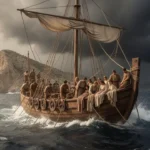
Patmos lies in the eastern Aegean, off the western coast of modern Turkey. It is one of the Greek Dodecanese islands, positioned among other islands that were connected by sea routes to the cities of Asia Minor. Its location helps explain why a message from Patmos could be directed to congregations in places such as Ephesus, Smyrna, Pergamum, and Laodicea.
The island has a rugged landscape with hills, rocky ground, small bays, and limited level land. Its natural harbors made it useful to travelers moving through the Aegean, while its relative isolation made it suitable for banishment or forced residence. The Patmos described in Revelation was not a large urban center. It was a remote island within the wider Roman world.
Modern Patmos has villages, churches, roads, ferries, and visitors. The biblical setting would have been far simpler. A person arriving there in the first century would have encountered a small island community rather than the developed religious and tourist destination known today.
What Revelation says about John on Patmos
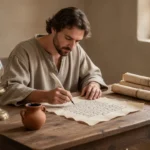
The Bible names Patmos in Revelation 1:9. John identifies himself as a fellow believer who shares with his readers in suffering, God’s kingdom, and patient endurance in Jesus. He then says that he was on Patmos because of the word of God and his testimony about Jesus.
This statement gives both the location and the reason for John’s presence. It does not describe Patmos as a voluntary retreat chosen for quiet reflection. The wording connects the island with faithful witness under pressure. John’s circumstances were difficult, yet his exile became the setting for a message intended for churches facing their own trials.
Revelation 1:10 says that John was “in the Spirit” on the Lord’s Day. Rather than reproducing the verse, its meaning can be described this way: John presents himself as receiving a spiritual vision on a day associated with Christian worship. He hears a voice like a trumpet and is instructed to write what he sees.
The voice directs him to send the message to seven churches in the Roman province of Asia. These churches were located in cities across western Asia Minor, in what is now Turkey. Patmos therefore functions as the geographical starting point for a letter that travels outward across the eastern Mediterranean world.
Revelation 1:9 places John on Patmos because of his witness to the word of God and to Jesus Christ.
Why John was on Patmos
The most direct biblical explanation is that John was on Patmos because of his Christian testimony. The passage does not give a detailed legal charge, name an emperor, or describe the exact form of punishment. It presents John’s presence on the island as connected to opposition or hardship arising from his proclamation.
Many readers understand this as exile or banishment. In the Roman world, authorities could remove people from their communities and send them to islands or remote locations. Such punishment could involve forced residence, restricted movement, hard labor, or other difficult conditions. The exact conditions John experienced cannot be established from Revelation 1:9 alone.
Some popular accounts describe Patmos as a place where John worked in mines. That claim is often repeated, but the Bible itself does not say that John was a miner or that he was assigned to a particular kind of labor. It is safer to say that John was on the island under adverse circumstances connected with his Christian witness.
The passage also does not identify the specific Roman official who sent John there. Later Christian writers provide traditions about John’s life and exile, but those traditions should be distinguished from the information explicitly given in Scripture.
Read the text carefully: Revelation tells you why John associates himself with Patmos, but it does not provide every historical detail about his arrest, sentence, daily work, or release.
Who was John in the Book of Revelation?
Revelation begins with a writer who calls himself John. He does not identify himself in the opening chapters as one of the Twelve apostles, the son of Zebedee, or the author of the Gospel of John. Because of that, the identity of the Johannine author has been discussed by Christians and scholars for centuries.
Many early Christian writers identified the author of Revelation with John the apostle, traditionally associated with the Gospel of John and the three letters bearing his name. This view remains common in many churches. Other interpreters distinguish the author of Revelation from the author of the Gospel and describe him simply as John of the early Christian community in Asia Minor.
Revelation itself gives us several firm points. Its author is a Christian leader known to the churches receiving the message. He understands himself as sharing their suffering and hope. He is able to communicate with congregations in Asia and presents the visions as a prophetic message centered on Jesus Christ.
For understanding Patmos, the precise debate about authorship does not change the central fact: the author of Revelation says he received the vision there. The island’s biblical significance comes from the testimony of this John and from the message he sent to the churches.
What John saw on Patmos
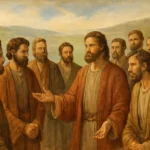
Revelation does not describe the island itself in great physical detail. The focus shifts quickly from Patmos to John’s visions. He sees a majestic figure described as “one like a son of man,” a phrase that echoes biblical imagery from Daniel 7. The vision presents Jesus as the living Lord who knows the condition of his churches and holds authority over history.
John then receives messages for seven congregations: Ephesus, Smyrna, Pergamum, Thyatira, Sardis, Philadelphia, and Laodicea. These messages contain commendation, correction, warnings, and promises. They address issues such as endurance, false teaching, spiritual compromise, suffering, moral failure, and the need for renewed faithfulness.
The seven churches were not located on Patmos. They were communities in cities across Asia Minor. Patmos was the place from which the message originated, while the churches were its intended recipients. This distinction matters because readers sometimes treat the island as though all the events of Revelation occurred there.
After the opening visions, Revelation expands into symbolic scenes of heavenly worship, conflict, judgment, and hope. John sees the throne of God, the Lamb, the opening of the seals, the sounding of trumpets, and the final defeat of evil. The book ends with a vision of new heaven and new earth, including the holy city and the presence of God with his people.
These later visions are not described as a tour of Patmos. They are prophetic visions received by John while he was on the island. Patmos is the historical setting for the beginning of the revelation, not the landscape represented by every symbol in the book.
How Patmos fits into the message of Revelation
Patmos gives Revelation a concrete human setting. The book contains dramatic visions, but its opening is anchored in the experience of a real person living under pressure in a particular region. John is not writing from a position of political power. He writes as someone who shares the churches’ tribulation and patient endurance.
This setting reinforces one of Revelation’s major themes: Christian faithfulness may involve suffering, but suffering does not mean that God has abandoned his people. John’s isolation becomes the place where he receives a message of encouragement and warning for congregations facing their own challenges.
The book also shows that Christian communication continued across distance. John was on an island, yet the message was intended for churches connected by roads, ports, trade, and sea travel. The letters to the seven churches speak to local problems while also forming part of a larger vision of God’s purposes.
Patmos can therefore be understood in three related ways:
A place of hardship: John was there because of his testimony about God’s word and Jesus.
A place of revelation: John received the visions that make up the Book of Revelation.
A place of transmission: From Patmos, John sent a message to churches in Asia Minor.
What the Bible does not say about Patmos
Patmos appears only in Revelation 1:9, so many details associated with the island come from later history, church tradition, archaeology, or popular teaching rather than from the biblical text. Keeping these categories separate makes interpretation more accurate.
The Bible does not say that Jesus visited Patmos. It does not record a church founded there by Paul, and it does not describe a conversation between John and local island residents. Patmos is not named in the Gospels or in Acts.
The Bible also does not tell us how long John stayed on the island. It does not name the ruler who ordered his exile or explain whether John was eventually released, escaped, or moved elsewhere. Later sources may preserve memories about John’s life, but they do not fill every gap with certainty.
Likewise, the Bible does not identify a specific cave as the place where John received the visions. The site commonly called the Cave of the Apocalypse is connected with a longstanding Christian tradition, but the biblical passage itself only says that John was on Patmos.
Patmos and the Cave of the Apocalypse
A cave on Patmos is traditionally associated with John’s reception of the visions recorded in Revelation. It is located near the Monastery of Saint John the Theologian, a major Christian site on the island. Visitors commonly encounter a small, irregular cave-like space connected with the tradition that John lived or prayed there with the assistance of a disciple named Prochorus.
This tradition is meaningful to many Christians, but it should not be presented as a detail directly stated in Scripture. The Bible names the island, not the cave. It also does not mention Prochorus as John’s companion on Patmos.
The site can still help visitors reflect on the book’s setting. A quiet, rocky shelter makes the isolation of the island easier to imagine. However, the spiritual value of a pilgrimage does not depend on proving that a particular stone, crack, or room was the exact location of John’s vision.
The tradition and the text can be held together responsibly: Revelation establishes Patmos, while the cave represents a later Christian memory about where John may have stayed or received the message.
The Monastery of Saint John and Patmos today
The Monastery of Saint John the Theologian stands above the settlement of Chora and has become one of Patmos’s most recognizable landmarks. It was founded centuries after the New Testament period and is dedicated to John. Its library, manuscripts, icons, architecture, and religious traditions reflect the long development of Christianity on the island.
The monastery should not be confused with a building from the time of Revelation. It belongs to a much later period, when Christian communities were preserving and honoring the memory of John and the Apocalypse. Its presence shows how strongly Patmos became associated with the biblical book over time.
Modern visitors may also see chapels, religious art, narrow streets, and landscapes overlooking the Aegean. These features can illuminate the island’s cultural history, but they do not provide a complete reconstruction of the first-century setting. The Roman-era Patmos of Revelation and the later Byzantine and Greek Christian island are related through memory, not identical in appearance.
Common mistakes when studying the island of Patmos Bible connection
Patmos is easy to misunderstand because later traditions and dramatic images of Revelation are often blended together. The following distinctions help keep a Bible study, sermon, or travel plan grounded in the evidence.
Do not say Patmos is mentioned throughout the Bible. Its direct biblical reference is Revelation 1:9.
Do not describe Patmos as one of Paul’s destinations. Paul’s journeys included many cities in Asia Minor, but Patmos is not listed among them.
Do not claim that Jesus visited the island. Scripture gives no account of such a visit.
Do not treat every Revelation scene as a physical event on Patmos. John received visions on the island, but the visions use symbolic and heavenly imagery.
Do not state that John worked in a mine as a biblical fact. Revelation does not specify his work or living conditions.
Do not present the Cave of the Apocalypse as certain from Scripture. It is a respected Christian tradition tied to the island.
Do not assume the seven churches were located on Patmos. They were in cities across the Roman province of Asia.
Do not ignore the book’s pastoral purpose. Revelation was sent to real congregations dealing with suffering, compromise, pressure, and hope.
Practical tips for reading Revelation through its Patmos setting
Reading Revelation with Patmos in mind can make the book’s opening more understandable without reducing its symbolism. Start with the historical setting, then follow the book’s movement from John’s circumstances to the churches and finally to the larger vision.
Read Revelation 1:9-20 first. Pay attention to John’s location, his reason for being there, the voice he hears, and the command to write.
List the seven churches. Notice that the messages are addressed to congregations in Asia Minor, not to people living on Patmos.
Separate setting from symbolism. Patmos is a real island; images such as beasts, lamps, seals, and the heavenly city belong to the book’s prophetic vision.
Compare encouragement with correction. The messages to the churches do more than predict events. They call Christians to endurance, worship, discernment, and faithfulness.
Read the ending alongside the beginning. John starts as an isolated witness on Patmos and ends with a vision of God dwelling with his people in renewed creation.
A map can also help. Locate Patmos in relation to Ephesus and the other six churches. This makes the opening chapters feel less abstract and shows that Revelation was addressed to a connected network of early Christian communities.
Why Patmos matters to Christians today
For many Christians, Patmos represents the way God can use a difficult setting for faithful witness. That does not mean suffering is automatically good or that every hardship should be romanticized. John’s exile was a real deprivation, but the biblical story emphasizes that his isolation did not prevent him from serving the churches.
Patmos also encourages careful attention to context and testimony. John does not introduce himself as a detached observer. He is part of the community he addresses, shares its trials, and writes from a place of vulnerability. His message combines warning with hope because the churches’ present struggles are viewed in light of God’s ultimate victory.
The island’s importance is therefore not based mainly on its size, scenery, or later religious landmarks. Patmos matters because Revelation connects it with a witness who remained faithful under pressure and because the vision received there continues to direct attention to Jesus Christ, the church’s endurance, and God’s renewal of creation.
What to remember when visiting Patmos
A visit to Patmos can combine biblical study, Christian pilgrimage, and interest in Greek history. Read Revelation 1 before you go, and keep the difference between biblical evidence and later tradition in view. The island’s churches, monastery, and cave are meaningful places, but they belong to different periods of its history.
Respect religious sites by following local instructions about clothing, photography, silence, and access. If you visit the Cave of the Apocalypse or the monastery, treat the tradition with care without claiming more certainty than the biblical text provides.
Most of all, remember the setting that Revelation itself emphasizes: John was not on Patmos for a scenic retreat. He was a Christian witness facing hardship, yet he continued to serve distant congregations through the message he received. That combination of isolation, faithfulness, and hope explains why this small Aegean island has held such a prominent place in Christian memory.
Frequently asked questions
Is Patmos mentioned anywhere besides Revelation?
The island is directly named in Revelation 1:9, where John says he was on Patmos because of his testimony about God’s word and Jesus Christ. It is not named in the Gospels, Acts, or Paul’s letters. References to Patmos in Christian teaching usually come from this passage and from later traditions about John’s life there.
Was John definitely exiled to Patmos by the Roman emperor?
Revelation clearly connects John’s presence on Patmos with his Christian witness, and many readers understand this as exile or banishment. However, the passage does not name the emperor, specify the legal process, or describe the exact conditions of his sentence. Those details come from later historical traditions rather than from the biblical text itself.
Is the Cave of the Apocalypse the exact place where John wrote Revelation?
The cave is traditionally associated with John and the reception of the visions in Revelation. It is an important Christian pilgrimage site, but Scripture does not identify a cave or give its location on the island. It is more accurate to call it a longstanding tradition connected with John than a detail proved directly by the Bible.
Did the events described in Revelation all happen on Patmos?
No. John received the visions while he was on Patmos, but the visions range across heavenly scenes, symbolic judgments, spiritual conflict, and the future renewal of creation. The seven churches addressed at the beginning were located in cities in Asia Minor. Patmos is the setting for John’s prophetic experience, not the physical location of every scene he describes.




Leave a Reply