The 27 books of the New Testament in order are: Matthew, Mark, Luke, John, Acts, Romans, 1 Corinthians, 2 Corinthians, Galatians, Ephesians, Philippians, Colossians, 1 Thessalonians, 2 Thessalonians, 1 Timothy, 2 Timothy, Titus, Philemon, Hebrews, James, 1 Peter, 2 Peter, 1 John, 2 John, 3 John, Jude, and Revelation.
They are arranged in four broad groups: the Gospels, the history of the early church, the letters, and apocalyptic prophecy. The order is not a strict timeline of when every book was written; it is a recognized canonical arrangement that moves from Jesus’ life and ministry to the growth, teaching, and future hope of the Christian church.
Quick way to remember the arrangement: The New Testament begins with four accounts of Jesus, continues with the church’s expansion in Acts, presents 21 letters for Christian teaching and encouragement, and ends with Revelation.
How the New Testament is organized
The New Testament contains 27 separate books written by several authors and addressed to different audiences. Some books tell a continuous story, while others respond to particular questions, conflicts, churches, or individuals.
The order used in most English Bibles follows literary and theological groupings more than a strict writing schedule. The Gospels come first because they introduce Jesus. Acts follows because it describes what happened among his followers after his death, resurrection, and ascension.
Romans through Jude are letters, also called epistles. Most are connected with the apostles and early Christian leaders. Revelation stands last because it uses visions and symbolic imagery to address God’s judgment, the perseverance of believers, and the hope of final renewal.
Gospels: Matthew, Mark, Luke, and John
History: Acts
Paul’s letters: Romans through Philemon
General letters: Hebrews through Jude
Apocalyptic prophecy: Revelation
The four Gospels: books 1 through 4
1. Matthew
Matthew presents Jesus as the promised Messiah and a teacher who brings God’s purposes to fulfillment. It frequently connects Jesus’ life and ministry with the Hebrew Scriptures, making the book especially attentive to themes such as the kingdom of heaven, righteousness, discipleship, and the identity of God’s people.
Major sections include Jesus’ birth, the Sermon on the Mount, his miracles, parables, conflict with religious leaders, crucifixion, and resurrection. The closing passage commissions Jesus’ followers to make disciples among all nations.
2. Mark
Mark is the shortest Gospel and moves quickly from one event to another. It emphasizes Jesus’ actions, authority, suffering, and death, while also showing that even his closest followers often struggled to understand who he was.
The book portrays Jesus as the powerful Son of God who serves others and gives his life. Its pace makes it a practical starting point for readers who want a concise account of Jesus’ public ministry.
3. Luke
Luke offers a carefully arranged account of Jesus’ life and ministry, with particular attention to people who were often overlooked. The Gospel highlights mercy, prayer, the Holy Spirit, forgiveness, and concern for the poor.
Luke includes several well-known parables and stories that are not found in the other Gospels. It also sets up the next book, Acts, by describing the events surrounding Jesus’ resurrection and his instructions to the disciples.
4. John
John differs in style and selection from Matthew, Mark, and Luke. It focuses on Jesus’ identity, his relationship with the Father, and the meaning of believing in him. Repeated themes include life, light, truth, love, witness, and glory.
John arranges much of Jesus’ ministry around significant signs and extended conversations. The book states its purpose in terms of leading readers toward faith in Jesus and life through him.
Reading tip: Matthew, Mark, and Luke are often called the Synoptic Gospels because they share many events and can be viewed together. John should be read alongside them, not treated as a replacement for them, because it presents distinctive material and emphasis.
Acts: the fifth book and the story of the early church
Acts continues the story begun in Luke. It describes the coming of the Holy Spirit, the public witness of the apostles, the growth of Christian communities, and the spread of the message from Jerusalem toward the wider Roman world.
Peter is especially prominent in the early chapters, while Paul becomes central in the later part of the book. Acts includes the conversion and missionary work of Paul, major decisions among early believers, opposition from authorities, and journeys through cities around the Mediterranean.
Acts is not simply a collection of biographies. It shows how the early church dealt with questions about identity, Gentile inclusion, leadership, persecution, travel, and communication across cultural boundaries. It also provides background for several of Paul’s letters.
Paul’s letters: books 6 through 18
The next 13 books are traditionally grouped as Paul’s letters. They are arranged mainly by length, with the longer letters first and the short personal letter to Philemon near the end. This arrangement does not mean that Romans was necessarily the first letter Paul wrote.
6. Romans
Romans presents a sustained explanation of the gospel and its implications for Jews and Gentiles. Paul discusses human sin, faith, grace, new life, the role of Israel, Christian conduct, and the unity of believers from different backgrounds.
Because of its breadth, Romans is often used as a guide to major Christian doctrines. It also contains practical teaching about humility, love, service, government, conscience, and peaceful relationships within the church.
7. 1 Corinthians
First Corinthians addresses serious problems in the church at Corinth, including division, sexual misconduct, lawsuits, worship practices, spiritual gifts, and confusion about the resurrection. Paul combines correction with instruction about how Christian freedom should serve others.
The letter’s central concerns include church unity, love, holiness, and the resurrection of the dead. It is especially useful for understanding how early Christian communities handled disagreement and competing ideas about maturity.
8. 2 Corinthians
Second Corinthians is more personal and emotionally direct. Paul defends his ministry, explains the nature of Christian service, discusses suffering and comfort, and urges the Corinthians to complete a financial contribution for believers in need.
The letter presents weakness and hardship not as proof of failure but as circumstances in which God’s strength can be displayed. It also helps readers understand the trust, tension, and affection involved in Paul’s relationship with the churches he served.
9. Galatians
Galatians responds to teaching that Gentile believers needed to adopt specific Jewish boundary markers in order to belong fully to God’s people. Paul strongly argues that people are made right with God through faith in Christ rather than through reliance on the law as a basis for acceptance.
The letter also explains Christian freedom. Freedom is not permission for selfish behavior; it is a life shaped by love and the work of the Spirit.
10. Ephesians
Ephesians describes God’s purpose to unite all things in Christ and to form one people from previously separated groups. It explores salvation, grace, the church as Christ’s body, spiritual maturity, and the reconciliation of Jews and Gentiles.
The latter part turns toward daily conduct, including truthfulness, forgiveness, family relationships, work, speech, and resistance to evil. Its broad vision makes it one of the New Testament’s most influential treatments of the church’s identity.
11. Philippians
Philippians is a warm letter to a supportive church. Paul writes from imprisonment about joy, partnership, humility, perseverance, and contentment in difficult circumstances.
The letter calls believers to place the interests of others before selfish ambition and to remain steady amid opposition. It also contains a celebrated early Christian passage about Christ’s humility and exaltation, though the passage is best understood within the letter’s appeal for unity.
12. Colossians
Colossians emphasizes the supremacy and sufficiency of Christ. Paul warns against teachings and practices that could diminish Christ’s authority or lead believers to depend on regulations and spiritual claims instead of remaining rooted in him.
The letter connects Christian belief with practical behavior. It addresses compassion, patience, forgiveness, gratitude, household relationships, and the use of speech.
13. 1 Thessalonians
First Thessalonians encourages a young church that had received the Christian message amid opposition. Paul praises its faith and love, explains his concern for the believers, and urges them to continue growing in holiness and mutual care.
The letter also discusses the future return of Christ and the resurrection of believers who have died. Its emphasis is pastoral: hope about the future should strengthen faithful living in the present.
14. 2 Thessalonians
Second Thessalonians addresses confusion about the day of the Lord and corrects reports that the final events had already arrived. Paul encourages the church to endure persecution while warning against idleness and disorder.
The book combines teaching about future judgment and Christ’s return with practical instructions about responsible work and community life. It shows that expectation about the future should not produce panic or neglect of ordinary duties.
15. 1 Timothy
First Timothy gives guidance for church leadership, public worship, teaching, care for widows, and the conduct of different groups within the Christian community. Timothy is instructed to confront false teaching and to model sound behavior.
The letter includes qualifications for overseers and deacons, making it an important source for discussions about church structure and leadership. It also warns against greed and encourages contentment, generosity, and faithful service.
16. 2 Timothy
Second Timothy has the tone of a final charge to a younger coworker. Paul urges Timothy to remain loyal to the message, endure hardship, correct others patiently, and continue in the teaching he has received.
The book speaks directly to discouragement, opposition, and the responsibilities of ministry. Its focus is perseverance: faithful leadership requires courage, discipline, patience, and a willingness to keep serving when circumstances are difficult.
17. Titus
Titus addresses the organization of churches on the island of Crete. It explains the character expected of elders, warns against disruptive teaching, and describes how older and younger believers should live in ways that support healthy community life.
A repeated connection runs through the letter: sound teaching should lead to good works and self-controlled conduct. Belief and behavior are presented as inseparable parts of Christian witness.
18. Philemon
Philemon is a short personal letter concerning Onesimus, a man connected with Philemon’s household who had become associated with Paul. Paul appeals for Onesimus to be received as a beloved brother rather than treated only according to his previous social status.
The letter does not provide a general legal treatise on slavery, but it does place a personal relationship under the demands of Christian love, fellowship, and reconciliation. Its brief form shows how theological convictions can affect a concrete human relationship.
The general letters: books 19 through 26
Hebrews through Jude are commonly called the general letters, although Hebrews is not formally identified by an author within the text and was historically associated with different Christian traditions. These writings address broad Christian audiences rather than one congregation or one individual in the way many Pauline letters do.
19. Hebrews
Hebrews presents Jesus as superior to angels, Moses, the priesthood, and the sacrificial arrangements associated with the earlier covenant. It describes him as the decisive mediator and high priest through whom believers draw near to God.
The book combines careful theological reflection with urgent encouragement. Its readers are called to remain faithful, resist spiritual drift, endure suffering, and draw strength from the examples of faithful people in Israel’s history.
20. James
James emphasizes practical obedience. It addresses trials, wisdom, favoritism toward the wealthy, careless speech, conflict, pride, exploitation, and prayer.
The letter insists that genuine faith becomes visible in conduct. Its teaching about helping vulnerable people and controlling speech makes it especially direct and practical, while its discussion of wisdom contrasts humble, peaceable behavior with envy and ambition.
21. 1 Peter
First Peter encourages Christians experiencing social pressure and suffering. It describes believers as people with a new identity and calls them to holiness, hope, respectful conduct, and endurance.
The letter speaks to households, church leaders, and the wider Christian community. Suffering is not treated as proof that God has abandoned his people; instead, believers are encouraged to remain faithful and to respond to hostility without abandoning their conduct.
22. 2 Peter
Second Peter warns against false teachers and destructive behavior while reminding readers of the apostles’ message. It addresses questions about the apparent delay of the Lord’s return and calls believers to grow in grace and knowledge.
The book connects moral integrity with sound teaching. It also points toward a future in which God’s judgment and renewal will be fully revealed.
23. 1 John
First John explores assurance, truth, obedience, love, and the identity of Jesus. It warns against claims that separate spiritual knowledge from righteous conduct and care for fellow believers.
The letter uses recurring contrasts such as light and darkness, truth and falsehood, love and hatred. Its purpose is pastoral: it helps readers test teachings and recognize the marks of genuine Christian life.
24. 2 John
Second John is a brief letter to a Christian community described as a chosen woman and her children, or possibly using those terms symbolically. It joins the commands to love one another and remain faithful to the truth.
The letter also warns readers not to support teachers who deny the true identity of Jesus. Its practical concern is how hospitality should be balanced with discernment.
25. 3 John
Third John commends Gaius for welcoming traveling Christian workers. It contrasts his hospitality with the behavior of Diotrephes, who seeks prominence and refuses to receive fellow believers.
The letter gives a small but valuable picture of leadership conflict, missionary support, reputation, and hospitality in an early Christian network. It shows that even short personal correspondence can address significant community issues.
26. Jude
Jude urges believers to defend the faith against people whose conduct is corrupt and whose teaching distorts Christian freedom. It recalls examples of judgment from Israel’s Scriptures and other traditions familiar to its audience.
At the same time, Jude instructs the community to show mercy wisely, helping those who are wavering while remaining alert to the damage caused by destructive behavior. The letter ends with praise directed to God’s power to preserve believers.
Revelation: the 27th and final book
Revelation is a book of visions given to John while he was on the island of Patmos. It contains messages to seven churches, scenes of heavenly worship, symbolic judgments, conflict between good and evil, and the final defeat of evil powers.
The book uses numbers, animals, heavenly beings, disasters, and other images symbolically. Readers should be cautious about treating every image as a simple prediction tied to a modern event. Revelation first addressed real churches facing pressure, compromise, and fear, and it called them to faithful endurance.
Its closing visions portray the removal of death and mourning and the renewal of creation. The book therefore ends the New Testament with judgment, hope, worship, and restoration, rather than with an unresolved defeat of God’s people.
How to read the New Testament books in order
Reading from Matthew through Revelation gives you the canonical sequence and allows Acts to follow naturally after the Gospels. The letters then build on the story of Jesus and the early church, while Revelation provides a final vision of the church’s hope.
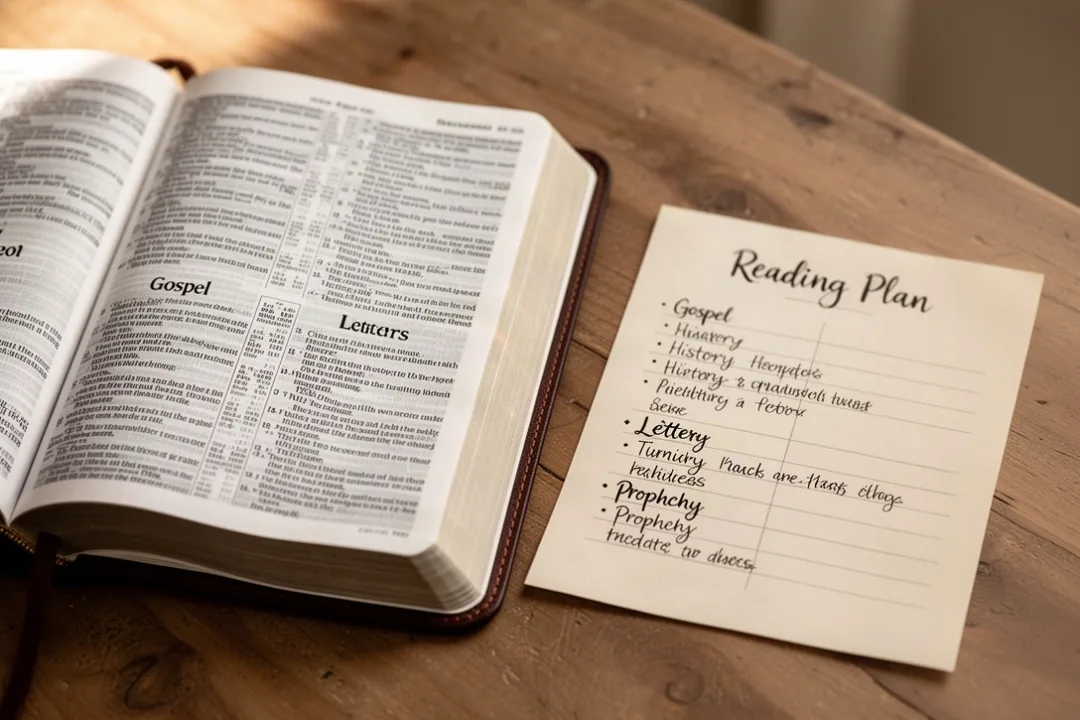
A simple reading plan can help you keep track of the different genres. Read narrative books as connected accounts, letters according to their local concerns, and Revelation with attention to its symbolism and original audience.
Begin with one Gospel. Mark offers a brief, action-centered account; Luke connects naturally to Acts; Matthew emphasizes fulfillment and teaching; John focuses on Jesus’ identity and signs.
Read Acts next. Notice how the message moves from Jerusalem to other regions and how the church responds to cultural and practical challenges.
Read the letters with their settings in mind. Romans is broad and systematic, while Corinthians, Galatians, and Thessalonians respond to particular situations.
Compare repeated themes. Pay attention to faith, grace, holiness, suffering, love, the Spirit, resurrection, and the return of Christ.
Read Revelation slowly. Look for encouragement to faithful churches before trying to match every symbol to a modern event.
Why the New Testament order differs from chronological order
The canonical order is not a complete timeline. Acts covers a period that overlaps with the settings behind several letters, and some letters may have been written before the Gospels reached their final written forms. The New Testament itself does not provide a full publication schedule for all 27 books.
The placement of Paul’s letters likely reflects their grouping and approximate length rather than a sequence of composition. The general letters follow them as a separate collection, and Revelation is placed last because of its literary character and its vision of the future.
A chronological reading plan can be useful, but proposed dates and sequences sometimes differ among scholars. For a first reading, the standard order has a major advantage: it gives you the familiar narrative flow from Jesus to the early church and then to Christian instruction.
Useful ways to remember all 27 books
Memorizing the books becomes easier when you learn them in groups instead of as one long list. The first five are especially easy to anchor: four Gospels followed by Acts. After that, divide the letters into Paul’s longer church letters, his personal letters, the general letters, and Revelation.
Another helpful method is to say the list aloud in sections and then write it from memory. When you reach the letters of John, remember the numerical pattern: 1 John, 2 John, 3 John, followed by Jude and Revelation.
What the New Testament order helps you see
The sequence creates a broad theological movement. The Gospels show who Jesus is and what he does. Acts shows the Spirit-empowered community that emerges from his ministry, and the letters explain how those communities should believe and live.
The letters also show that early Christians faced many of the same kinds of questions churches face now: How should believers handle disagreement? What does mature faith look like? How should leaders serve? How should a community respond to suffering, wealth, false teaching, and cultural pressure?
Revelation then places those concerns within a larger hope. Christian faith is presented not merely as private belief but as participation in a people who are called to worship God, love one another, endure hardship, and await the renewal of all things.
Frequently asked questions
How many books are in the New Testament?
The New Testament has 27 books. They include four Gospels, one history book, 21 letters, and one apocalyptic book. Together they form the second major section of the Christian Bible and focus on Jesus, the early church, Christian teaching, and the hope of God’s future renewal.
What is the shortest book in the New Testament?
Second John is generally considered the shortest New Testament book by word count in the original Greek text. Third John and Philemon are also very short. The number of verses or words can vary slightly depending on the language, manuscript tradition, and translation being counted.
Should I read the New Testament in the listed order?
The standard order is a good choice because it begins with Jesus’ life, moves into the early church’s expansion, and then presents Christian teaching and hope. Some readers prefer starting with Mark or Luke and Acts, then reading the letters connected with Paul’s ministry.
Are the New Testament books listed in the order they were written?
No. The standard order is primarily canonical and literary, not strictly chronological. The Gospels come first, Acts follows, Paul’s letters are grouped together, the general letters come afterward, and Revelation closes the collection. Proposed writing dates vary, especially for some Gospel and letter traditions.










Leave a Reply