Hebrews 12:22 and the meaning of heavenly Jerusalem
Hebrews 12:22 and the meaning of heavenly Jerusalem
Hebrews 12:22 means that those who belong to Christ have come spiritually to Mount Zion, the city of the living God, and the heavenly Jerusalem. The verse describes access to God’s presence through faith, not a physical trip to an earthly mountain. It also places believers among angels, God’s people, and the redeemed community gathered around Jesus.
The wording appears in a contrast between two mountains. The first is Mount Sinai, associated with fear, distance, fire, darkness, and the giving of the law. The second is Mount Zion, associated with welcome, worship, heavenly citizenship, and the completed work of Christ. Hebrews 12:22 begins the description of what Christians have received under the new covenant.
What Hebrews 12:22 says about the believer’s spiritual position
Hebrews 12:22 does not present God’s people as merely hoping to reach heaven someday. It says they have already come to the heavenly reality represented by Zion. This is a statement about their present spiritual standing: through Jesus, they have been brought into fellowship with God and joined to a community that extends beyond what can be seen.
The verb carries a relational and worshipful sense. Believers have come before God as members of his household, not as strangers trying to find an entrance. Their access rests on Jesus’ mediation, not on personal perfection, ancestry, social status, or obedience to a system of rituals.
This does not mean Christians already experience every promise in its final form. Hebrews still expects a future, unshakable kingdom and the completion of God’s purposes. The verse holds together two truths: believers have a present share in heavenly realities, and they still await the full renewal of creation.
Central idea: Hebrews 12:22 describes a present spiritual reality with a future fulfillment. Through Christ, believers have access to God now while still looking forward to the final heavenly kingdom.
How Mount Zion differs from Mount Sinai in Hebrews 12
The wider passage begins by recalling Mount Sinai, where Israel encountered God when the covenant law was given. The scene was marked by dramatic physical signs: blazing fire, darkness, storm, a loud trumpet, and a voice that made the people afraid. Hebrews uses that scene to show the seriousness of approaching the holy God under the old covenant.
Mount Sinai was not evil, and the law was not presented as worthless. Instead, the passage emphasizes that sinful human beings could not casually enter God’s holiness. The people asked not to hear the divine voice directly because the experience overwhelmed them. Even Moses expressed fear in the scene described by Hebrews.
Mount Zion presents a different aspect of access. The contrast is not between an angry God and a kind God, as if God’s character changed between the two mountains. It is a contrast between two covenant settings: one reveals the holiness that judges sin, while the other reveals the access and cleansing provided through Christ.
Mount Sinai emphasizes distance, warning, and the seriousness of the law.
Mount Zion emphasizes welcome, heavenly fellowship, and access through Jesus.
The old covenant scene highlights humanity’s inability to approach God safely by its own strength.
The new covenant scene highlights God’s provision for reconciliation and confident worship.
Hebrews does not encourage careless worship at Mount Zion. God remains holy, and the chapter later calls believers to worship with reverence and awe. The difference is that Christ has dealt with the barrier created by sin, allowing God’s people to approach without treating holiness as something ordinary.
What “Mount Zion” means in Hebrews 12:22
Mount Zion was a hill in Jerusalem and became closely connected with David’s royal city, the temple, and God’s covenant purposes. In the Old Testament, Zion often represents Jerusalem as the place of God’s dwelling and the center of his reign. Prophetic passages also portray Zion as the place from which salvation, justice, and restoration extend to the nations.
In Hebrews 12:22, Zion points beyond the earthly hill. The phrase heavenly Zion identifies the ultimate dwelling of God and the perfected order of his kingdom. It is not simply a geographical location in the sky. It represents God’s presence, rule, redeemed people, and the future city that cannot be shaken.
Later in the chapter, Hebrews contrasts everything that can be shaken with what remains firm. Earthly structures, institutions, and kingdoms are temporary. The heavenly Zion belongs to the permanent kingdom of God. Christians therefore receive an identity and hope that do not depend on the stability of earthly circumstances.
The image also connects Hebrews with the broader biblical expectation of a renewed Jerusalem. The city is not primarily valuable because of its buildings or scenery. Its significance comes from the presence of God, the reconciliation of his people, and the perfect justice and peace of his reign.
Why Hebrews calls Jerusalem “the city of the living God”
Calling it the city of the living God distinguishes heavenly Jerusalem from every merely human city. Earthly cities can represent culture, power, wealth, safety, or political authority, but they remain vulnerable to decay and loss. The heavenly city belongs to the God who is alive, active, and faithful to his promises.
The title also shows that the city is not an empty spiritual landscape. A city is a place of shared life, belonging, relationship, and ordered community. Hebrews presents salvation as entrance into a living fellowship centered on God rather than isolation from other people.
For Christians, this description reshapes the meaning of citizenship. Their deepest belonging is not determined by nationality, birthplace, ethnicity, political party, or economic class. Those identities may matter in ordinary life, but they do not define the believer’s highest allegiance. The believer belongs to the kingdom of the living God.
This does not permit contempt for earthly communities. Christians still have responsibilities toward neighbors, families, churches, and public institutions. The heavenly city instead gives those responsibilities a different foundation: earthly life is important, but it is not ultimate.
Who the “innumerable angels” are in Hebrews 12:22
The verse next presents an immense assembly of angels. The point is not to encourage speculation about the exact number or hierarchy of heavenly beings. Hebrews uses the image to communicate the scale, holiness, and joy of God’s heavenly court.
Angels appear throughout Scripture as servants and messengers of God. They worship him, carry out his purposes, and are associated with his presence. Their inclusion in Hebrews 12:22 shows that believers are approaching the same heavenly court where God’s faithful servants continually honor him.
The scene is not threatening in the same way as the fearful assembly at Sinai. The angels form part of a celebratory gathering. This suggests that the heavenly community is marked by worship and gladness, not by chaotic spiritual power. Believers enter a community that already recognizes God’s worth.
Angels do not replace Jesus, and Hebrews never presents them as objects of Christian trust. They are created servants within God’s order. Their presence magnifies the glory of the God whom they worship and the greatness of the salvation Christ provides.
What “the assembly of the firstborn” means
Hebrews then refers to the gathered community of the firstborn, whose names are recorded in heaven. In the biblical world, the firstborn often held a position of inheritance and privilege. Here, the term points to God’s people as those who share in the inheritance promised through Christ.
The phrase is plural, so it does not identify only one individual. Jesus is uniquely God’s Son and the central heir of all things, but those united to him receive the status and inheritance associated with God’s family. The community consists of people whose identity is granted by God rather than earned by social rank.
The names recorded in heaven communicate secure belonging. The picture resembles an official register of citizens: those who belong to God are known and included. The emphasis is not on human recognition but on divine acknowledgment.
This heavenly register also presents salvation as communal. A Christian is not saved into a solitary relationship with God while remaining disconnected from everyone else. Believers are gathered with the whole people of God, including those from different generations, cultures, and backgrounds.
The assembly is large, because it includes God’s people beyond the limits of one local congregation.
The assembly is recognized by God, because its members’ names are recorded in heaven.
The assembly is an inheritance community, because its members share the privileges given through Christ.
The assembly is united across time, because heavenly citizenship reaches beyond one generation.
How Hebrews 12:22 relates to God the judge
The next description identifies God as the judge of all. This may seem surprising in a passage about welcome, but it is essential to the meaning of heavenly access. The God who receives believers is not a less holy version of the God revealed at Sinai. He remains the righteous judge of every person.
The verse therefore avoids two opposite errors. One error treats God as distant and unreachable, ignoring the access provided through Christ. The other treats God as harmless and unconcerned with evil, ignoring his justice. Hebrews presents both truths together: God welcomes the redeemed, and God judges with perfect righteousness.
For those who belong to Christ, God’s judgment is not a reason to hide in despair. The surrounding passage explains that believers approach through a better covenant and through Jesus, whose blood speaks more effectively than the blood of Abel. The judge is also the God who provides the means of reconciliation.
God’s judgment also means that injustice will not have the final word. Hidden wrongs, abused power, and human failures are not overlooked forever. Heavenly Zion is a place where truth is fully exposed and justice is perfectly established.
Who are “the spirits of the righteous made perfect”?
Hebrews 12:22 continues with a reference to the spirits of righteous people made perfect. This language points to believers who have been brought to completion in God’s presence. Their righteousness is not the result of flawless human performance; it reflects God’s saving work and the final removal of sin’s corrupting power.
The phrase may especially evoke faithful believers who have died and are now with God, although the larger passage describes the entire heavenly community. Hebrews has already spoken of Old Testament men and women who trusted God without receiving every promise during their earthly lives. Their faith now finds its intended fulfillment in God’s presence.
“Made perfect” in Hebrews often means brought to the intended goal or completed in relation to God’s saving plan. It does not imply that these people were spiritually complete through their own effort. Their perfection rests on Christ’s work, which cleanses the conscience and opens the way into God’s presence.
This gives Christians a strong hope about death. The faithful who have gone before are not lost from God’s care. They belong to the completed heavenly community and await, with all God’s people, the full resurrection and restoration promised by God.
Why Jesus is the mediator of the new covenant
Although Hebrews 12:22 describes the heavenly gathering, the next verse identifies Jesus as the mediator of the new covenant. That connection explains how sinners can belong in the presence of the living God. Jesus stands between God and humanity as the one who establishes reconciliation through his life, death, resurrection, and ongoing priestly work.
A mediator does more than pass along information. In Hebrews, Jesus creates and guarantees a relationship that human beings could not establish on their own. He is the faithful Son, the perfect priest, and the sacrificial offering whose work brings lasting cleansing.
The new covenant is better because it addresses the inner problem of sin rather than only regulating external behavior. God writes his law on the hearts of his people, forgives their wrongdoing, and provides direct access to him through Christ. The heavenly Zion scene is therefore the destination of a covenant relationship, not a reward for religious achievement.
Hebrews 12:22-24 presents heaven as a gathered community centered on God, made possible through Jesus, and marked by reconciliation rather than human merit.
The reference to Jesus also protects the passage from being interpreted as a vague vision of spiritual unity. The way to heavenly Jerusalem is specifically Christian in its foundation. The believer’s confidence comes from Christ’s mediation, not from generic spirituality or personal sincerity.
What the reference to Jesus’ blood means
Hebrews contrasts Jesus’ blood with the blood of Abel. Abel’s blood, after his murder, cried out for justice against the wrong done to him. Jesus’ blood speaks a better message because it brings forgiveness, reconciliation, and access to God while still demonstrating the seriousness of sin.
This does not mean God ignores evil. The cross reveals how seriously God treats sin, but it also reveals his mercy toward sinners. Jesus bears the consequences of sin and opens a new way for people to be cleansed and restored.
The image of blood can sound unfamiliar to modern readers, but in Hebrews it refers to sacrificial death and covenant establishment. Jesus’ death is not an accidental tragedy. It is the decisive act through which he offers himself for his people and secures the new covenant.
When Hebrews connects Jesus’ blood with heavenly Zion, it teaches that access to God is costly but secure. Christians do not approach because they have accumulated enough good deeds. They approach because Christ has done what they could not do.
How Hebrews 12:22 should shape Christian worship
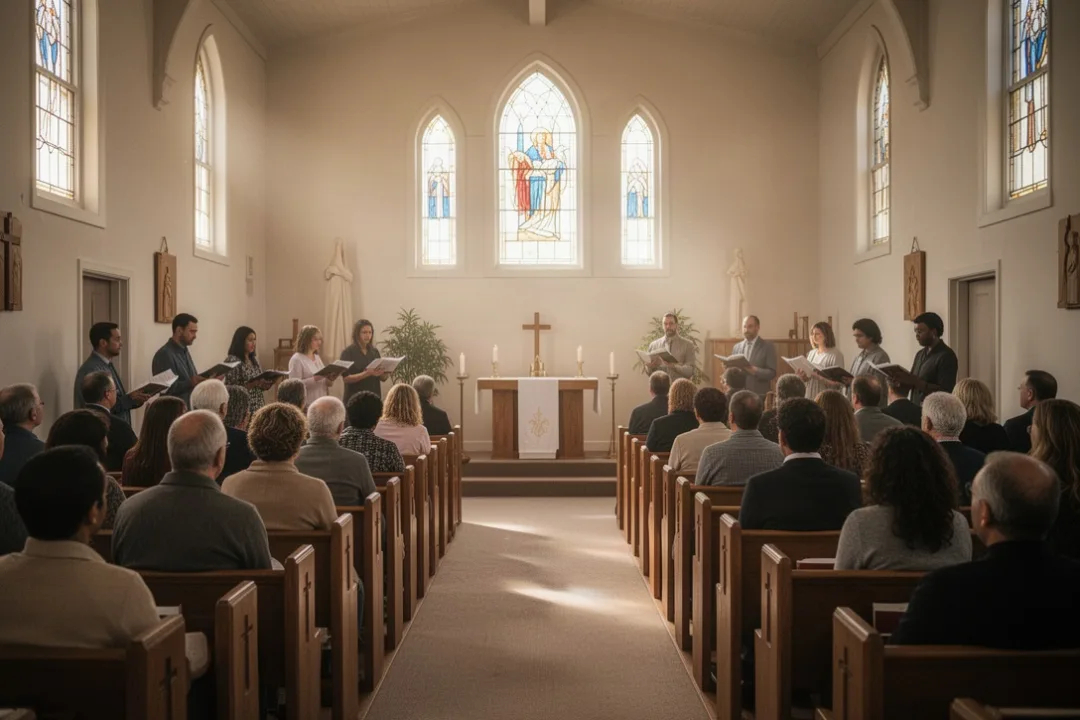
The verse gives worship a larger frame. A local congregation may look small, ordinary, or imperfect, yet worship joins believers to a heavenly assembly of angels and redeemed people. The visible gathering is connected to a reality far greater than the room, music, speaker, or schedule.
That perspective can deepen reverence without requiring a particular worship style. Quiet prayer, congregational singing, public Scripture reading, communion, preaching, and acts of service can all express the reality that believers have come before the living God through Christ.
Hebrews does not use heavenly worship to detach Christians from daily obedience. The chapter moves from the heavenly assembly to practical commands about peace, holiness, gratitude, hospitality, and faithful endurance. A genuine awareness of Zion should produce a changed life rather than religious escapism.
Worship shaped by Hebrews 12:22 should therefore include:
Reverence because God is the righteous judge.
Confidence because Jesus provides access through the new covenant.
Joy because believers join a heavenly celebration.
Humility because citizenship is received as grace.
Unity because God gathers one people across generations and cultures.
Perseverance because the heavenly kingdom cannot be shaken.
Practical ways to apply Hebrews 12:22
Hebrews 12:22 is not merely a description of the afterlife. It speaks to how you understand your identity, your worship, your suffering, and your relationship with other believers. Its application becomes clearer when you connect heavenly citizenship with ordinary decisions.
Approach God through Christ rather than self-confidence. When you pray, do not base your acceptance on a perfect week or a successful spiritual routine. Bring your need to God because Jesus is the mediator of the new covenant.
Remember that your deepest identity is heavenly. National, professional, family, and political identities can be meaningful, but none should replace your belonging to God’s kingdom.
Join Christian worship with attention. Do not view church as a performance provided for an audience. See it as participation in the worship of the living God with the wider people of God.
Treat other believers as members of the heavenly assembly. Differences in age, background, income, or tradition do not cancel the shared identity created by Christ.
Let God’s judgment strengthen your commitment to justice. Because God judges rightly, you do not need to excuse wrongdoing or seek revenge. Practice truthfulness while entrusting final judgment to him.
Persevere when earthly circumstances feel unstable. The city of the living God cannot be shaken. That hope does not remove pain, but it keeps temporary losses from becoming the measure of your ultimate future.
Common mistakes when interpreting Hebrews 12:22
The verse is rich in imagery, so several interpretations can distort its message. Paying attention to the context helps keep the meaning centered on God’s covenant and Jesus’ work.
Reducing Zion to a physical destination: The verse uses Jerusalem imagery to describe heavenly access and God’s kingdom, not merely a travel destination on earth.
Assuming the old covenant was evil: Hebrews contrasts covenant arrangements without claiming that God’s law or Sinai was morally bad. The issue is humanity’s inability to approach God through the old arrangement.
Separating verse 22 from Jesus: Heavenly access is not presented as an achievement available through human spirituality. The following verses place Jesus and his blood at the center.
Ignoring judgment: God’s welcome does not mean moral indifference. The same scene includes God as judge and calls believers to reverent worship.
Turning angels into the focus: Angels are part of the assembly, but they direct attention toward God’s glory rather than replacing Christ.
Using heavenly citizenship to avoid earthly responsibility: The chapter leads to holiness, peace, gratitude, and faithful relationships. Hope in heaven should make daily obedience more meaningful.
Assuming perfection means personal flawlessness: The righteous are made perfect by God’s saving work. The phrase points to completion in his presence, not self-earned moral achievement.
Reading tip: Read Hebrews 12:18-29 as one connected movement. The passage contrasts Sinai and Zion, names the heavenly community, identifies Jesus as mediator, and then calls believers to grateful, reverent worship.
How Hebrews 12:22 gives hope during suffering
Hebrews was written to people who needed endurance. The surrounding chapters speak about discipline, opposition, weariness, and the temptation to drift away. Against that background, the vision of heavenly Zion reminds believers that suffering does not mean they have been abandoned by God.
Earthly hardship can make the present world feel more real than God’s promises. Hebrews reverses that impression. The visible world is subject to shaking, but the heavenly kingdom is permanent. Believers can endure temporary instability because their true home and inheritance rest with the living God.
The verse also gives comfort when grief separates you from faithful Christian friends or relatives. The people of God who have died are not erased from the heavenly community. They belong among the righteous made complete, awaiting the final fulfillment of resurrection hope.
This hope is not a demand to deny sadness. Christians may grieve, pray for relief, and seek help from others. Heavenly Jerusalem provides a firm destination and identity while leaving room for honest sorrow in the present.
How Hebrews 12:22 connects to the church
The church is not identical to the heavenly Jerusalem in every respect. Local congregations remain imperfect communities living in a world affected by sin. Yet the church is meant to display the values of the city to which believers belong: holiness, reconciliation, truth, worship, generosity, and hope.
Because believers are part of a heavenly assembly, church membership should involve more than private religious preference. Christians are joined to a people. They learn to bear burdens, receive correction, forgive one another, welcome strangers, and serve those with different gifts.
The verse also challenges narrow ideas about who belongs among God’s people. The heavenly assembly is not organized around human prestige. Its members are known by God and gathered through Christ. A congregation should therefore resist favoritism and make room for people whose backgrounds differ from the majority.
At the same time, heavenly citizenship does not excuse disorder or doctrinal indifference. The God of Zion is holy, and the new covenant has ethical consequences. A church that celebrates access to God should also pursue the holiness and peace that reflect his presence.
What Hebrews 12:22 ultimately promises
Hebrews 12:22 promises that believers belong to a reality greater than the unstable structures of the present world. Through Jesus, they have access to the city where God lives, the heavenly assembly where angels worship, and the community of the redeemed whose names are known in heaven.
The verse does not promise an easy life or immediate escape from suffering. It promises that God’s people are already connected to an unshakable kingdom and will one day experience its fullness. Their future is not an uncertain attempt to earn acceptance; it rests on the finished and ongoing work of Jesus, the mediator of the new covenant.
For that reason, Hebrews 12:22 calls you to approach God with confidence, worship with reverence, live as a citizen of heaven, and endure with hope. The heavenly Jerusalem is both a present spiritual reality and the promised home of God’s perfected people.
Frequently asked questions
Is Hebrews 12:22 talking about heaven?
Yes, but it uses more than a simple description of a place after death. “Heavenly Jerusalem” represents God’s presence, his eternal kingdom, the angelic assembly, and the redeemed community. Hebrews presents believers as having spiritual access to this reality now through Christ, while also looking forward to its complete manifestation in the future.
What is the difference between Mount Sinai and Mount Zion?
In Hebrews 12, Sinai represents the fearful revelation of God’s holiness under the old covenant, while Zion represents access to God through the new covenant. The contrast is not between a bad God and a good God. It shows the difference between approaching through the law and approaching through Jesus’ mediating work.
Who are the firstborn in Hebrews 12:23?
The “assembly of the firstborn” refers to God’s people who share in the inheritance granted through Christ. Their names are recorded in heaven, emphasizing secure belonging and divine recognition. The phrase describes a community, not just one person, and includes believers united to God across generations.
How should Christians respond to Hebrews 12:22?
Christians should approach God through Jesus rather than relying on personal merit, worship with reverence, and live as members of a heavenly community. The verse also encourages endurance when life is unstable. It calls believers to pursue holiness, peace, gratitude, and faithful relationships while waiting for God’s unshakable kingdom.







Leave a Reply