The Bible is not a single book written at one time. It is a library of ancient Jewish and Christian writings composed over many centuries, preserved through manuscripts, and gradually gathered into recognized collections. Its books were written mainly in Hebrew, Aramaic, and Greek, with different communities using somewhat different lists and arrangements.
The history of the books of the Bible has three connected parts: how individual writings were composed, how scribes and communities preserved them, and how Jewish and Christian traditions recognized their authoritative collections. Understanding those stages also explains why Bibles can contain different numbers of books and place them in different orders.
Why the Bible is a collection rather than a single volume
The word “Bible” comes from a Greek term meaning “books.” That description fits the Bible’s structure: it includes law, history, poetry, wisdom literature, prophecy, biographies of Jesus, letters, and apocalyptic writing. Each work had its own author or authors, setting, audience, and purpose before later communities bound it together with other writings.
The books also emerged in different periods. The writings traditionally associated with Moses concern Israel’s covenant and law; the historical books describe Israel’s story in different theological and literary ways; the prophets address particular political and religious crises; and the New Testament writings come from the first generations of the Christian movement.
“Author” can also mean different things in ancient literature than it does in modern publishing. Some books identify an author directly, while others developed through oral tradition, editing, compilation, or anonymous authorship. A traditional attribution and the conclusions of modern scholarship do not always match, so responsible explanations distinguish between what a text claims, what a community traditionally teaches, and what scholars infer from the text itself.
Core idea: The Bible’s history is not only the story of when its books were written. It is also the story of copying, reading, collecting, translating, and recognizing those books.
How the books of the Hebrew Bible developed
The first major part of the Christian Bible is closely related to the Hebrew Bible, also called the Tanakh in Jewish tradition. Christians often call these writings the Old Testament, although the arrangement and numbering differ between Jewish and Christian Bibles.
The Hebrew Bible is commonly grouped into three sections:
The Torah: Genesis, Exodus, Leviticus, Numbers, and Deuteronomy.
The Prophets: historical and prophetic books such as Joshua, Judges, Samuel, Kings, Isaiah, Jeremiah, Ezekiel, and the Twelve.
The Writings: works such as Psalms, Proverbs, Job, Ruth, Esther, Daniel, Ezra-Nehemiah, and Chronicles.
The Hebrew names for these three divisions form the word Tanakh. This arrangement places some books in a different order from the Christian Old Testament. For example, Chronicles appears at the end of the Jewish collection, while it appears much earlier in most Christian arrangements.
The Torah and Israel’s foundational traditions
The Torah stands at the center of Jewish Scripture. It contains creation and ancestral narratives, the exodus from Egypt, laws, covenant traditions, wilderness accounts, and Israel’s preparation to enter the land. Jewish and Christian traditions have often associated the Torah with Moses, while scholars have also examined the ways in which different traditions and editorial layers may be present in its final form.
The Torah was not preserved as one modern-style manuscript from the beginning. Its traditions were transmitted through oral teaching, written documents, public reading, and scribal copying. The final form known through later manuscripts reflects a long history of preservation and shaping, though the exact stages cannot always be reconstructed with certainty.
Prophets, history, poetry, and wisdom
The books that Christians often call historical books include Joshua through Esther, although Jewish classifications organize several of them under the Prophets or Writings. These works recount conquest, settlement, monarchy, division, exile, and restoration. They do more than list events: they interpret Israel’s history through themes such as covenant faithfulness, justice, worship, leadership, and judgment.
The prophetic books grew from messages associated with figures who addressed real communities during periods of war, political change, social injustice, and religious conflict. Isaiah, Jeremiah, Ezekiel, and the Twelve Minor Prophets are not simply chronological collections of speeches. Their books contain poetry, symbolic actions, warnings, promises, historical references, and material shaped for later readers.
The Writings include several literary forms. Psalms preserve prayers and songs; Proverbs collects wisdom sayings; Job wrestles with suffering and divine justice; Ecclesiastes reflects on life’s limits; and Daniel combines court tales with visions. These books show that biblical literature includes reflection, lament, worship, instruction, and imaginative storytelling, not only narrative history.
When the Hebrew Scriptures became a recognized collection
There was not one universally documented moment when every Jewish community formally closed a complete list of Scripture. Different books gained recognition at different times, and communities used authoritative writings before historians can identify a final canon with precision.
The Torah had a particularly central status in Jewish life. The Prophets were also treated as authoritative, and evidence from the Second Temple period shows that many other writings were being copied, studied, and valued. The discovery of the Dead Sea Scrolls demonstrated that Jewish groups before and around the time of Jesus preserved biblical books alongside other religious writings.
The Dead Sea Scrolls include copies or fragments of many books later found in the Hebrew Bible. They also reveal textual variation and show that the boundaries between authoritative Scripture and other respected writings were not always expressed in the same way across every Jewish community.
Some Jewish writings were composed or preserved in Greek rather than Hebrew. The Greek translation of Jewish Scriptures, commonly called the Septuagint, became especially important among Greek-speaking Jews and later among Christians. It sometimes follows a different book order and includes writings that are not part of the later Jewish Hebrew canon.
By the early centuries of the Common Era, Jewish communities had inherited a strong scriptural collection centered on the Torah, Prophets, and Writings. Discussions about the exact boundaries of the Writings continued in various settings, but the idea that Scripture was a defined and authoritative body was already firmly established.
How the books of the New Testament were written
The New Testament was produced within the first generations of the Christian movement. Its books were written in Koine Greek, the widely used form of Greek in the eastern Roman world, although they preserve Jewish ideas, Aramaic expressions, Hebrew Scripture references, and traditions that originated in a multilingual setting.
The earliest Christian writings in the New Testament are generally understood to be some of Paul’s letters. They were written to specific congregations or individuals dealing with questions about worship, ethics, leadership, conflict, suffering, and the meaning of Jesus’ death and resurrection. These letters were copied and circulated beyond their original recipients.
The four Gospels present the story and teaching of Jesus from different perspectives. Matthew, Mark, Luke, and John are not four editions of one identical biography. Each Gospel selects, arranges, and emphasizes material for its audience. The opening of Luke, for example, describes an effort to provide an orderly account based on earlier testimony, while John presents a distinctive theological portrait of Jesus.
Acts continues the narrative begun in Luke and describes the spread of the Christian message from Jerusalem into the wider Mediterranean world. The remaining New Testament writings include letters linked to Paul, general or catholic letters associated with figures such as Peter, James, John, and Jude, and Revelation, a work of apocalyptic prophecy addressed to churches in Asia Minor.
The New Testament books were not created as one bound collection. Individual letters and Gospel accounts circulated separately or in smaller groups. Churches read them alongside Israel’s Scriptures, oral teaching, worship practices, and other Christian writings.
How early Christians recognized New Testament books
Early Christians did not decide the New Testament canon at one universally recognized meeting. Instead, recognition developed through regular use, theological agreement, apostolic association, and broad circulation. A book’s acceptance could grow gradually, while other writings remained respected but were not included in the final collection.
Several factors influenced the process:
Connection to the apostles: Churches valued writings associated with apostles or with close apostolic witnesses.
Consistency with received teaching: A book was more likely to be accepted when its message fit the faith taught and practiced by established churches.
Widespread use: Books read in many churches carried greater authority than texts known only in a limited region.
Public reading: Regular use in worship helped communities identify writings as suitable for instruction and spiritual formation.
Some books were accepted early and widely, including the four Gospels, Acts, many Pauline letters, and several other writings. Other books, including Hebrews, James, 2 Peter, 2 and 3 John, Jude, and Revelation, received differing levels of acceptance in some regions before the final 27-book New Testament became standard across most Christian traditions.
The earliest surviving document known to list exactly the 27 books found in the modern New Testament is associated with Athanasius of Alexandria’s Festal Letter from 367. This does not mean that one letter instantly created the canon. It shows that the collection had reached a clearly defined form in at least one influential Christian setting by that time.
Late fourth-century church gatherings in North Africa, including those associated with Hippo and Carthage, affirmed the same 27 New Testament books in a Western Christian context. Their decisions reflected a process already underway rather than an act that made previously unknown books authoritative overnight.
Why Christian Bibles contain different numbers of books
Christian traditions largely agree on the 27 books of the New Testament, but they do not all use the same Old Testament collection. The main difference concerns books often called the Deuterocanonical books by Catholics and the Apocrypha in many Protestant contexts.
Catholic Bibles include books such as Tobit, Judith, Wisdom, Sirach, Baruch, and 1 and 2 Maccabees, along with additional sections of Esther and Daniel. Eastern Orthodox traditions include these and may recognize additional books, although the exact collection varies among Orthodox churches.
Most Protestant Bibles contain 39 Old Testament books and 27 New Testament books, for a total of 66. This Old Testament count divides and rearranges material that the Jewish Bible counts differently, so the number does not mean Protestant Bibles contain a completely different body of Hebrew Scripture.
Many Protestant traditions place the additional Jewish writings in a separate section called the Apocrypha or omit them from the main Bible. The Catholic Church calls its additional books deuterocanonical, meaning that their canonical status was recognized through a distinct historical process in the Catholic tradition.
These differences arose from several factors, including the authority given to the Hebrew Jewish collection, the use of the Greek Septuagint, regional Christian practice, and decisions made during the Reformation and later periods. They should not be reduced to the claim that one meeting simply “added” or “removed” books without a longer history.
When comparing Bibles: Check both the number of books and the names used for them. A difference in arrangement does not automatically mean that the text is absent, and a difference in canon reflects a community’s tradition of authority.
How biblical manuscripts preserved the text
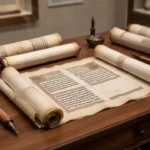
Before printing, every copy of a biblical book had to be produced by hand. Scribes copied manuscripts onto materials such as papyrus and parchment, sometimes working carefully in professional settings and sometimes in less formal circumstances. Copyists made occasional mistakes, corrected earlier readings, and sometimes introduced small changes through harmonization or clarification.
Textual criticism compares surviving manuscripts, ancient translations, and quotations by early writers to identify the earliest recoverable wording. This discipline does not assume that every manuscript is identical. Instead, it examines patterns of agreement and difference among witnesses.
For the Hebrew Bible, important textual witnesses include the medieval Masoretic tradition, the Dead Sea Scrolls, the Samaritan Pentateuch for the Torah, and ancient translations such as the Greek Septuagint. These sources do not all preserve exactly the same wording, but their comparison helps scholars understand how the text was transmitted.
For the New Testament, manuscripts exist in forms such as papyrus fragments, parchment codices, and later handwritten copies. Ancient translations into languages including Latin, Syriac, and Coptic provide additional evidence. Early Christian quotations can also show how particular passages were read, although quotations may be adapted to fit a writer’s purpose.
Most textual differences are minor, involving spelling, word order, or repeated phrases. Some passages raise more substantial questions because they appear in later manuscripts but are absent from some of the earliest available witnesses. Modern Bibles often signal these issues in footnotes rather than hiding them.
How translation shaped the Bible’s history
Translation has been part of the Bible’s history from an early stage. The Septuagint made Jewish Scripture available to Greek-speaking communities, and New Testament authors frequently quoted or echoed Greek forms of biblical passages. Later Christians translated the Bible into Latin and other languages as the faith spread.
The Latin Vulgate became especially influential in Western Christianity. In the Middle Ages, biblical manuscripts were copied, studied, and decorated in monasteries and schools. Biblical interpretation also appeared in sermons, theological works, poetry, and visual art, although access to the full text varied by region, language, and social position.
The invention of printing in Europe made it possible to reproduce biblical texts in larger numbers and with greater consistency than hand copying allowed. The Bible was among the most significant works printed in early European print culture. Printing did not end textual questions, but it helped standardize particular editions and made vernacular translations more widely available.
The Protestant Reformation encouraged translation into languages spoken by ordinary readers and placed strong emphasis on the authority of Scripture. Catholic translation and scholarship also continued, sometimes in response to Protestant debates. English Bibles developed through several stages, including earlier medieval translations, the work associated with William Tyndale, the King James Version, and numerous modern translations.
Modern translations differ because translators make decisions about ancient manuscripts, grammar, literary style, and how closely to follow the structure of the source language. A word-for-word approach and a thought-for-thought approach can communicate the same passage with noticeably different English wording.
Practical ways to study the history of biblical books
The history can become confusing when discussions mix up authorship, canon, manuscript evidence, and translation. A careful reading plan keeps these questions separate while showing how they relate.
Identify the tradition being discussed. Ask whether the source means the Jewish Tanakh, a Protestant Bible, a Catholic Bible, or an Orthodox Bible.
Check the book’s literary type. A prophetic oracle, a Gospel, a wisdom poem, and a historical narrative should not be evaluated in exactly the same way.
Separate composition from canon. The date or setting of a book’s composition is a different question from when a community recognized it as Scripture.
Compare several translations. Differences can reveal choices about manuscripts, sentence structure, ancient idioms, and literary style.
Read the footnotes. Translation notes often identify significant manuscript variations without interrupting the main reading.
Use primary evidence carefully. Ancient manuscripts, early quotations, and historical lists can show what communities used, but each source has limits.
Common mistakes when discussing the Bible’s history
Assuming one council created the entire Bible: Canon recognition developed over time and differed among communities.
Treating the Bible as one genre: Poetry, law, narrative, letters, and apocalyptic writing use different conventions.
Equating “historical book” with modern history writing: Biblical narratives interpret events through theological and literary aims.
Calling every textual difference a contradiction: Many variations are ordinary results of hand copying or translation.
Assuming different book counts always mean different teachings: Some traditions divide or combine books differently, while others differ over which writings are canonical.
Confusing the oldest surviving manuscript with the original: The original physical copies of biblical books have not survived, so conclusions come from comparing later witnesses.
What the history reveals about the Bible today
The Bible’s present form reflects a long process of preservation and interpretation. Its books retain traces of different periods, communities, languages, and literary purposes, yet Jewish and Christian traditions have read them as connected collections rather than unrelated documents.
Knowing this history can make differences between editions easier to understand. A chapter heading, order of books, footnote, or translation choice may reflect a particular tradition rather than a modern editorial accident.
It also helps to distinguish historical questions from theological claims. History can examine manuscripts, language, dates, circulation, and canon lists. Religious communities may additionally affirm beliefs about inspiration, revelation, and authority. Those theological convictions are central to faith traditions, while the historical evidence describes how the texts came to be written and transmitted.
When you read the Bible with that background, each book can be appreciated on its own terms while also being understood as part of a larger library. The result is a clearer view of how ancient writings became the collections used in Jewish, Catholic, Orthodox, Protestant, and other Christian communities.
Frequently asked questions
Were all the books of the Bible written by one person?
No. The Bible contains writings by many authors and communities, composed across a long period. Some books name an author, while others are anonymous or reflect layers of tradition and editing. Christian tradition attributes the Gospels to Matthew, Mark, Luke, and John, but the texts themselves present them differently from modern books with author biographies and publication details.
Which Bible is the oldest?
No single complete Bible manuscript is the oldest in every sense. The Dead Sea Scrolls preserve some of the earliest surviving copies of biblical books and fragments, while later large codices preserve broad collections. “Oldest” can mean earliest fragment, oldest substantial manuscript, oldest complete collection, or oldest surviving translation, so the answer depends on the category.
Did the Catholic Church add books to the Bible?
Catholic, Protestant, Jewish, and Orthodox traditions inherited different views about the status of several Jewish writings. Catholics call these books deuterocanonical, while many Protestants call them Apocrypha. The disagreement developed through different uses of Hebrew and Greek scriptural collections, regional practice, and later church decisions; it was not simply one late addition to a universally identical Bible.
Why do Bible translations have different wording?
Translators work from ancient Hebrew, Aramaic, and Greek texts and must decide how to express grammar, idioms, poetry, and cultural concepts in modern English. They may also use different manuscript traditions or approaches, such as formal equivalence or more natural contemporary phrasing. Footnotes often explain notable textual or translation differences.







Leave a Reply