How is the Bible organized? A clear guide to its structure
How is the Bible organized? A clear guide to its structure
Have you ever opened a Bible to a reference such as “Romans 8:28” and wondered what the numbers mean or why Romans appears where it does? The Bible is not arranged as one continuous story from page one to the last page. It is a collection of separate books, grouped by type and tradition, with chapters and verses added to help readers locate specific passages.
Most Christian Bibles contain two major divisions: the Old Testament and the New Testament. Within those divisions, books are generally organized by literary category rather than by the exact order in which events happened. The Bible’s structure becomes easier to follow once you know what each section contains and how the books relate to one another.
The short answer: The Bible is organized into books, the books into chapters, and the chapters into verses. Its major sections are based mainly on covenant, subject, and literary genre—not a strict historical timeline.
The word testament means a covenant or binding agreement. The two major parts of the Christian Bible are therefore connected by the idea of God’s relationship with humanity. The Old Testament describes the covenant story centered on Israel, while the New Testament focuses on Jesus, the early Christian community, and the new covenant proclaimed through him.
The Old Testament comes first because it establishes the setting for the New Testament. It tells of creation, humanity’s rebellion, God’s promises to Abraham, the formation of Israel, the giving of the law, the kingdom of Israel, exile, restoration, and the hope of a future Redeemer. The New Testament presents Jesus as the fulfillment of many of those promises and develops the meaning of his life, death, and resurrection.
The division does not mean that the two parts are unrelated. The New Testament frequently refers to the Old Testament, and many New Testament ideas assume knowledge of earlier stories, laws, poems, and prophecies. Reading the Bible well often requires seeing the connections between the two Testaments, rather than treating them as completely separate books.
How the Old Testament is grouped
In most Protestant Bibles, the Old Testament contains 39 books. These books are usually arranged in four broad groups: the Pentateuch, historical books, wisdom and poetry, and the major and minor prophets. The labels describe the books’ main literary features, although some books contain more than one kind of writing.
The Pentateuch tells Israel’s foundational story
The first five books are called the Pentateuch, a Greek term meaning “five books.” They are also known as the Torah, especially in Jewish contexts. These books are Genesis, Exodus, Leviticus, Numbers, and Deuteronomy.
Genesis describes creation, the early human story, the flood, and the ancestors of Israel, including Abraham, Isaac, Jacob, and Joseph.
Exodus tells how God delivers Israel from slavery in Egypt and gives the covenant and law through Moses.
Leviticus focuses heavily on worship, sacrifice, holiness, priests, and the responsibilities of the covenant community.
Numbers follows Israel’s wilderness experiences after leaving Egypt, including rebellion, judgment, travel, and preparation to enter the promised land.
Deuteronomy presents Moses’ final instructions and speeches before Israel enters the land of Canaan.
These books combine narrative, laws, genealogies, speeches, poetry, and ritual instructions. They are not simply five volumes of uninterrupted history. Their central role is to establish Israel’s identity, covenant obligations, worship, and relationship with God.
The historical books follow Israel’s national story
After the Pentateuch, the Bible moves into books that describe Israel’s life in the promised land. In Protestant Bibles, these include Joshua, Judges, Ruth, 1 and 2 Samuel, 1 and 2 Kings, 1 and 2 Chronicles, Ezra, Nehemiah, and Esther.
These books cover a broad period: the conquest and settlement of Canaan, the era of the judges, the rise of the monarchy, the reigns of David and Solomon, the division into two kingdoms, exile, and the return of some Jewish communities. They include political events, military conflicts, family stories, religious failures, acts of courage, and reflections on leadership.
The order is broadly historical, but it is not a complete chronology. For example, 1 and 2 Chronicles retell much of the period covered by Samuel and Kings, emphasizing different details and themes. Ruth belongs in the historical group but tells a focused family story set during the time of the judges. Esther takes place in the setting of the Persian Empire after the exile.
Wisdom and poetry explore faith and human experience
The next group is commonly called wisdom literature and poetry. It includes Job, Psalms, Proverbs, Ecclesiastes, and Song of Solomon, followed by additional poetic or wisdom material in some Christian traditions.
These books do not all work like historical narratives. They ask questions about suffering, justice, love, work, mortality, worship, and wise decision-making. Psalms contains prayers and songs for many situations, including celebration, grief, confession, trust, and protest. Proverbs gathers short teachings about character and practical wisdom. Job examines the problem of suffering through dialogue and poetry rather than offering a simple explanation.
Ecclesiastes reflects on the limitations of human achievement and the uncertainty of life. Song of Solomon is a collection of love poetry. Because these books use poetic language, imagery, repetition, and symbolism, readers should not always interpret every line in the same way they would interpret a historical report.
The prophets warn, encourage, and point toward restoration
The final Old Testament grouping in most Protestant Bibles contains the prophets. Isaiah, Jeremiah, Lamentations, Ezekiel, and Daniel are called the Major Prophets because their books are longer. Hosea through Malachi are called the Minor Prophets because their books are shorter, not because they are less significant.
Prophetic books commonly address injustice, idolatry, oppression, false worship, and unfaithfulness to the covenant. They also offer promises of forgiveness, restoration, renewed worship, and hope. Many prophetic messages speak first to the historical circumstances of Israel or Judah, even though later Jewish and Christian readers may understand some passages as having broader or future significance.
The prophets are not arranged strictly according to the dates when they preached. Some overlap in time, and their messages often address different kingdoms or crises. The placement of these books at the end of the Old Testament also creates a literary movement toward expectation, leaving readers looking ahead to what God will do next.
How the New Testament is grouped
Most Protestant Bibles contain 27 New Testament books. They are arranged in four main groups: the four Gospels, Acts, the letters, and Revelation. Unlike the Old Testament, the New Testament has a tighter historical focus, centering on Jesus and the first generations of the Christian movement.
The four Gospels present Jesus from different perspectives
The New Testament opens with Matthew, Mark, Luke, and John. These books are called the Gospels, a word associated with good news. Each presents the life, teaching, actions, death, and resurrection of Jesus, but each has its own arrangement, emphasis, and style.
Matthew strongly connects Jesus with Israel’s Scriptures and presents him as the promised Messiah and authoritative teacher.
Mark is concise and fast-moving, emphasizing Jesus’ actions, authority, suffering, and identity.
Luke gives a carefully shaped account that highlights God’s concern for outsiders, the poor, women, prayer, the Holy Spirit, and the spread of salvation.
John uses distinctive language and extended conversations to emphasize Jesus’ identity, signs, relationships, and mission.
The Gospels are not four unrelated biographies, nor are they four chapters of one book. They are four accounts that overlap in many events while arranging and interpreting those events in different ways. Matthew, Mark, and Luke are often called the Synoptic Gospels because they can be compared more closely in their structure and content.
Acts continues Luke’s story through the early church
The book of Acts follows the Gospel of Luke and describes what happens after Jesus’ resurrection and ascension. It begins in Jerusalem and traces the spread of the Christian message through Judea, Samaria, and other regions of the Roman world.
Acts features the work of the Holy Spirit, the apostles’ preaching, the growth of local congregations, conflicts within the early church, and the missionary activity of figures such as Peter and Paul. It is both a historical narrative and a theological account of how the movement expands across cultural and geographic boundaries.
Acts does not tell everything that happened to every apostle or every Christian community. It follows selected people and events, with particular attention to the movement from Jerusalem toward Rome. Its placement after the Gospels creates a natural transition from Jesus’ ministry to the church’s mission.
The letters explain Christian belief and practice
Most of the remaining New Testament books are letters, also called epistles. They were written to churches, groups, or individuals facing particular questions and circumstances. The letters discuss topics such as faith, grace, worship, leadership, relationships, suffering, ethical conduct, and hope.
Paul’s letters are arranged first. In many Bibles, they begin with Romans and continue through 2 Thessalonians, followed by letters connected with Paul’s ministry to individuals: 1 Timothy, 2 Timothy, and Titus. Philemon is also associated with Paul. The order is generally based on length, with longer letters appearing before shorter ones, rather than on the precise date of writing.
The remaining letters are commonly called the General Epistles because they are not all addressed to one specific congregation. They include Hebrews, James, 1 and 2 Peter, 1, 2, and 3 John, and Jude. Hebrews does not identify its author within the text, and the letters differ in audience, style, and purpose.
Letters should be read with their original setting in mind. A passage may answer a local dispute, correct a specific behavior, encourage a persecuted community, or explain a point of belief. That does not make it irrelevant today, but understanding the first audience helps you avoid applying a sentence without its surrounding argument.
Revelation uses visions and symbols to express hope
Revelation is the final book of the New Testament. It is an example of apocalyptic literature, a form that communicates through visions, symbols, dramatic images, heavenly scenes, warnings, and promises. It addresses real communities facing pressure and calls them to faithful endurance.
Because Revelation uses imagery extensively, it should not be read like a straightforward sequence of newspaper reports. Numbers, animals, colors, heavenly beings, and other images may carry symbolic meaning. The book’s broad themes include God’s justice, the defeat of evil, the perseverance of believers, judgment, and the renewal of creation.
Its position at the end of the Bible gives the whole collection a forward-looking direction. The Bible begins with creation and ends with the promise of restoration, but Revelation also depends heavily on images and themes found in earlier books. Its symbolism is best understood by comparing it with the rest of Scripture rather than isolating individual visions.
Why the Bible is not arranged in exact chronological order
A common assumption is that the Bible’s books appear in the order their events occurred. That is only partly true. Some sections follow a broad historical progression, but many books overlap, retell earlier events, or address different audiences during the same period.
For example, the Psalms were written across a long span of Israel’s history, not all at one time. Several prophets ministered during periods also described in Kings and Chronicles. The letters of Paul are usually grouped together by form and length, even though their writing dates do not match their location in the New Testament.
The Bible’s arrangement serves several purposes:
Literary grouping: Similar kinds of writing are placed together, such as poetry, prophecy, Gospels, and letters.
Theological movement: The structure moves from creation and covenant to redemption and anticipated restoration.
Practical reference: Grouping books makes it easier to locate familiar types of material.
Historical connection: Major transitions, such as the move from the Gospels to Acts, link related books.
If you want to read the Bible chronologically, you need a separate reading plan that places books and passages alongside the historical periods they describe. Such plans can be useful, but they involve judgments about dates and sequence, and they do not replace the standard arrangement found in your Bible.
Why different Christian Bibles have different numbers of books
Not every Christian Bible contains exactly the same collection of books. Protestant Bibles generally have 66 books: 39 in the Old Testament and 27 in the New Testament. Catholic Bibles include additional books commonly called the Deuterocanonical books, while Orthodox traditions may include a somewhat different collection.
These differences are mainly about the boundaries of the Old Testament and related Jewish Scriptures. The New Testament collection is shared across the major Christian traditions, although translations and ordering details can vary. Catholic and Orthodox Bibles also arrange some books differently from Protestant editions.
You may encounter terms such as Apocrypha, Deuterocanonical, or canonical. These terms reflect differences in religious tradition and recognition, not simply differences in translation quality. A Bible edition normally identifies which books it includes, so check the table of contents when comparing editions.
When comparing Bibles: Do not assume that a missing book means pages were accidentally removed. Check the edition’s tradition—Protestant, Catholic, Orthodox, or another tradition—to understand why its contents differ.
How chapters and verses help you find passages
The original biblical manuscripts were not divided into the modern chapter and verse system used by most readers. Chapters were added during the medieval period, and verse numbering was developed later. These divisions are navigation tools, not necessarily the natural boundaries of an argument, poem, or story.
A reference such as “John 3:16” has three parts. John identifies the book, 3 identifies the chapter, and 16 identifies the verse. A reference such as “Matthew 5:3–12” means the reader should look at verses 3 through 12 of chapter 5 in Matthew.
Some references contain more information. “1 Corinthians 13:4–7” points to the first letter to the Corinthians, chapter 13, verses 4 through 7. “Psalm 23” identifies the entire twenty-third psalm; because Psalms are already short individual compositions, people often refer to a psalm without mentioning a verse.
Chapter and verse divisions can occasionally interrupt a thought. A sentence may begin near the end of one verse and finish in the next, while a new section may begin in the middle of a chapter. Read the surrounding paragraphs, or the whole chapter when possible, to understand the passage’s meaning.
Practical tips for reading the Bible’s structure accurately
Knowing the basic organization can prevent common misunderstandings. You do not need to memorize every book before reading, but a few habits make it much easier to interpret what you find.
Identify the book’s genre. Ask whether you are reading narrative, law, poetry, wisdom, prophecy, a Gospel, a letter, or apocalyptic writing.
Read the surrounding section. Do not base your understanding on one isolated verse when the paragraph or chapter gives essential context.
Check the speaker and audience. A statement may come from a narrator, prophet, king, opponent, disciple, or letter writer addressing a particular community.
Locate the passage in the larger story. Ask what happened before it and what follows afterward.
Compare related passages carefully. Parallel accounts may emphasize different details without needing to be read as identical transcripts.
Use headings as guides, not as original Scripture. Section headings are supplied by editors and can vary between Bible editions.
Read poetry as poetry. Images such as mountains singing or trees clapping communicate meaning through figurative language.
Separate description from instruction. A narrative may report that someone acted in a certain way without presenting that action as a model to copy.
Common mistakes when locating and interpreting books
Several errors occur simply because readers assume the Bible is organized differently from the way it actually is. Recognizing them can save time and reduce confusion.
Looking for a strict timeline: The book order is not a complete chronology, so events described in separate books may overlap.
Treating every book as the same genre: A proverb, a command, a prayer, a prophecy, and a historical narrative communicate in different ways.
Assuming “chapter” means a complete subject: Chapter divisions are helpful, but an argument may continue across them.
Reading every promise as addressed directly to you: Some promises were made to particular people or communities in specific circumstances.
Confusing a Bible’s edition with all Bibles: Book counts, order, notes, headings, and translation choices may differ.
Using a single verse to settle a broad question: Major themes should be considered across related passages and literary contexts.
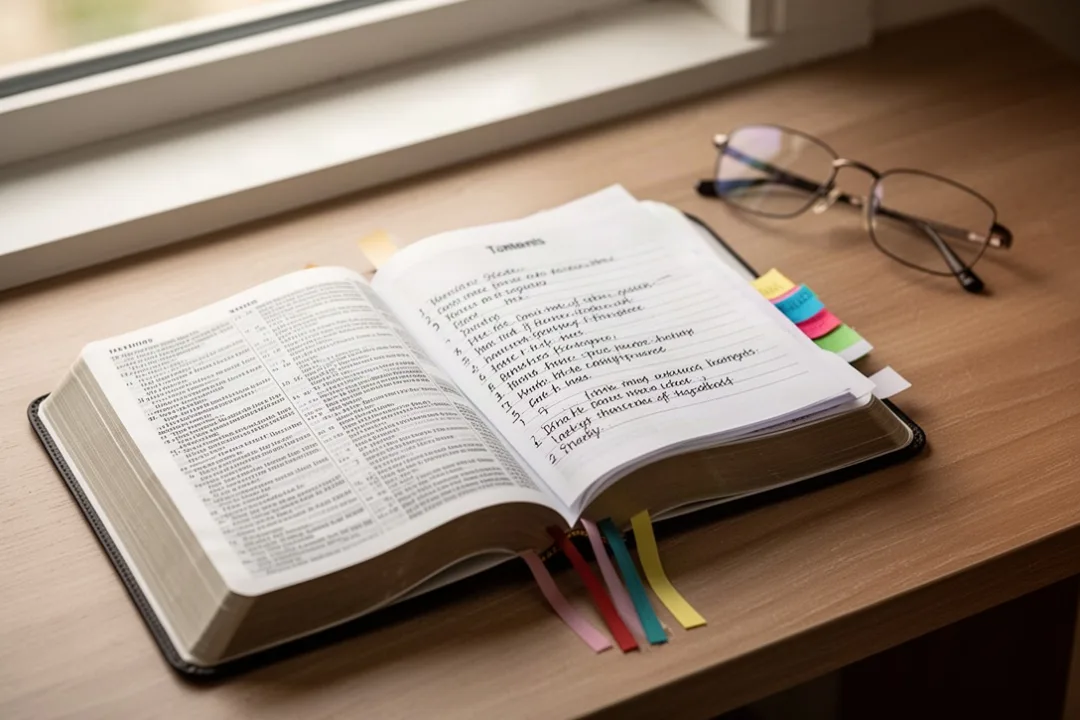
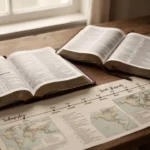
A Bible’s table of contents can help you learn the order of the books. Many editions also include maps, cross-references, timelines, introductions, and notes. These tools do not replace the text, but they can clarify unfamiliar names, places, historical periods, and connections between books.
How to choose a reading path through the Bible
The best starting point depends on what you want to understand. Reading from Genesis to Revelation lets you experience the standard arrangement and follow the broad movement of the biblical collection. It also places the foundational stories before the writings that refer back to them.
Starting with one of the Gospels can provide a more direct entry into the central New Testament story. Mark is relatively concise, Luke leads naturally into Acts, and Matthew contains many links to Israel’s Scriptures. John has a distinctive style and focuses deeply on Jesus’ identity and signs.
Other approaches can also work:
Read the Pentateuch first to understand creation, the patriarchs, the exodus, covenant, and the law.
Read Luke and Acts together to follow one continuous account from Jesus’ ministry through the early church.
Read a Gospel alongside selected Psalms and prophets to notice how the New Testament presents Jesus in relation to earlier Scripture.
Read a letter with Acts when you want historical context for Paul’s travels and the communities he visited.
Read Psalms or Proverbs regularly when you want shorter selections focused on prayer, worship, wisdom, and daily conduct.
Whichever path you choose, keep the book’s location and genre in mind. The Bible’s organization is not merely a filing system. It guides readers from foundational stories and covenant themes through wisdom, prophetic hope, Jesus’ ministry, the church’s witness, and the promised renewal of all things.
Frequently asked questions
Is the Bible one book or many books?
The Bible is one unified collection of sacred writings made up of many individual books. Those books were written by different authors, in different settings, and in several literary forms. Christian traditions connect them through shared themes such as creation, covenant, sin, redemption, worship, and hope, while still recognizing the distinct purpose and voice of each book.
Are the books of the Bible arranged by the dates they were written?
No. The arrangement is mainly based on literary category and the relationship between major sections. Historical books often follow a broad sequence, but poetry, prophecy, letters, and the Gospels are not placed in exact writing order. A chronological reading plan therefore rearranges books and passages according to estimated historical periods.
Why are some Bibles longer than others?
Christian traditions recognize different collections of Old Testament books. Protestant Bibles usually contain 66 books, while Catholic Bibles include additional Deuterocanonical books, and Orthodox editions may include a somewhat different selection. The New Testament collection is shared among the major Christian traditions, though book order and translation details can vary.
What is the easiest way to find a Bible verse?
Begin with the book name, then locate the chapter number and verse number. In “Luke 15:11–32,” Luke is the book, 15 is the chapter, and 11 through 32 are the verses. Use the table of contents if you cannot find the book, and read the surrounding passage instead of relying on the cited verse alone.





Leave a Reply