There is no single correct way to read the Bible in order; the best sequence depends on whether you want its published arrangement, its historical timeline, or a guided understanding of its main themes.
The Bible is a library of different books, not one continuous narrative written in a single sitting. It includes history, poetry, wisdom literature, prophecy, biography, letters, and apocalyptic writing. Because of that variety, “in order” can mean several different things.
For many readers, the simplest starting point is the Bible’s normal table of contents: Genesis through Revelation. That arrangement gives you the familiar sequence used in most printed Bibles and helps you see how the major sections fit together. A chronological plan can be more helpful if you want events arranged according to when they happened.
Best general advice: Read the Bible in its standard order at least once if you are new to it, then try a chronological or thematic plan when you want more historical context or focused study.
Choose the Bible reading order that fits your purpose
Before choosing a plan, decide what you want your reading to accomplish. Someone reading the Bible for the first time may need clarity and momentum, while a longtime reader may want to compare related books or trace a particular theme.
The four most useful approaches are the canonical order, chronological order, historical-context order, and thematic order. Each has strengths, and none removes the need to pay attention to the individual book you are reading.
Read in canonical order to follow the standard arrangement
Canonical order means reading the books as they appear in your Bible. In the Old Testament, that usually begins with Genesis and ends with Malachi. In the New Testament, it begins with Matthew and ends with Revelation.
This is the most accessible option because the structure is already in front of you. It also lets you experience the Bible’s broad movement from creation and Israel’s story to Jesus, the early church, and the hope presented in the final book.
Canonical order is especially useful when you want to learn where books are located. It helps you become familiar with divisions such as the Law, historical books, poetry, prophets, Gospels, and letters. That familiarity makes future study easier because you can find passages and recognize how books relate to one another.
Read chronologically to follow events through time
A chronological plan rearranges books, sections, or passages according to the approximate historical setting of the events. For example, you may read parts of Samuel and Kings alongside Chronicles, then place some of the prophets within the reigns or crises associated with them.
This approach can clarify the development of Israel’s monarchy, exile, and restoration. It can also help explain why certain prophetic messages appear when they do. In the New Testament, a chronological plan may place the four Gospels side by side or arrange their material around the ministry of Jesus.
Chronological reading requires caution because the exact order of some events is debated. The Bible does not always provide enough information to establish a precise timeline, and books sometimes arrange material by theme rather than date. Treat a chronological plan as a helpful reconstruction, not as an unquestionable historical schedule.
Use historical-context order for cultural and political background
A historical-context plan groups books according to the setting in which they were written or the events they address. This may mean reading the letters of Paul near the events described in Acts, or reading prophetic books alongside the periods of Assyrian, Babylonian, or Persian influence.
This method is valuable when you want to understand why a book was written. A letter about conflict, persecution, worship, or moral questions becomes easier to follow when you know something about its original audience and circumstances.
Historical context should support the text rather than replace it. You do not need to master ancient geography, politics, or customs before beginning. Read the book first, identify what seems unclear, and then use a reliable study Bible or reference work to investigate those questions.
Use thematic order for a focused spiritual or literary study
A thematic plan follows a subject across several books. You might study prayer through the Psalms, the Gospels, and the letters, or trace covenant, wisdom, justice, kingdom, exile, faith, or discipleship across the biblical library.
This option works well when you have a specific question or limited time. It can also prevent a difficult section from stopping your entire reading habit. However, thematic reading should not become an excuse to ignore less familiar books. The harder passages often provide the context needed to understand the themes you already enjoy.
Choose canonical order if you want the simplest first reading and a firm sense of the Bible’s published structure.
Choose chronological order if you want events arranged approximately by historical sequence.
Choose historical-context order if you want to connect books with their original settings and audiences.
Choose thematic order if you have a focused question or want to study one subject across multiple books.
Follow the Bible’s standard order from Genesis to Revelation
Reading from Genesis to Revelation is a sound choice for a first complete reading. You will encounter the books in the order most people expect, and you will gradually learn the Bible’s major divisions without having to manage a complicated schedule.
The standard Protestant arrangement contains 39 Old Testament books and 27 New Testament books. Catholic and Orthodox Bibles include additional books or sections, and their arrangements differ. If your Bible belongs to a particular tradition, use its table of contents and confirm which books are included before choosing a plan.
Read the Old Testament by its main sections
The opening section is often called the Law or Pentateuch. It includes Genesis, Exodus, Leviticus, Numbers, and Deuteronomy. These books establish the creation account, the ancestors of Israel, the exodus from Egypt, the covenant, the wilderness years, and the laws and teachings given to Israel.
The historical books continue the story through Israel’s entry into the land, the period of the judges, the monarchy, the division of the kingdom, exile, and return. In a typical Protestant Bible, this section runs from Joshua through Esther.
Job, Psalms, Proverbs, Ecclesiastes, and Song of Solomon are commonly grouped as poetry and wisdom books. Their placement after Esther does not mean that every poem or conversation occurred at that point in history. These books explore worship, suffering, wisdom, love, mortality, justice, and the search for faithful living.
The prophetic books come at the end of the Old Testament. The longer books—Isaiah, Jeremiah, Lamentations, Ezekiel, and Daniel—are commonly called the Major Prophets because of their length, not because they are more important. The twelve shorter books from Hosea through Malachi are known as the Minor Prophets.
When you reach the prophets, expect shifts in time and setting. Some speak before the exile, some during it, and some after the return. Their messages often address covenant faithfulness, injustice, judgment, repentance, and restoration.
Read the New Testament in manageable groups
The New Testament begins with four accounts of Jesus’ life and ministry: Matthew, Mark, Luke, and John. They overlap in subject but differ in emphasis, structure, and selection of events. Reading them as four independent books rather than trying to combine every detail immediately will make each one easier to appreciate.
Acts continues the story of the early Christian movement after Jesus’ resurrection and connects naturally with the letters that follow. The letters address particular churches, individuals, and communities, while Revelation uses distinctive symbolic and prophetic imagery to present its message of perseverance and hope.
A first-time reader who finds the Old Testament difficult may choose to read one Gospel and Acts before returning to Genesis. That is not a failure to follow the Bible in order; it is a practical adjustment. The Gospels provide a central reference point for understanding the Christian reading of the rest of Scripture.
One workable canonical sequence is:
Read Genesis through Deuteronomy to learn the foundational story and teachings.
Continue through Joshua and the historical books to follow Israel’s national story.
Read the poetry and wisdom books slowly, allowing time for reflection.
Finish the Old Testament prophets, paying attention to their historical settings.
Read Matthew through John, then continue with Acts and the letters.
Read Revelation after becoming familiar with the major themes and images used elsewhere in the Bible.
When a book feels difficult: Keep reading for several chapters before deciding that you cannot understand it. Look for repeated ideas, changes in speaker, historical clues, and the book’s stated purpose; then consult a trustworthy guide.
Build a chronological Bible reading plan without forcing the timeline
Chronological reading is not simply moving every book into a perfect date sequence. It usually means combining related material so that you can see how events, rulers, prophets, songs, and letters fit into the larger story.
Genesis begins with primeval history and then focuses on Abraham, Isaac, Jacob, Joseph, and their families. Exodus through Deuteronomy develops the story of Moses and Israel’s formation as a covenant community. Joshua through Kings follows the settlement, judges, monarchy, division, and eventual exile.
Chronicles retells much of the monarchy from a different perspective, with particular interest in worship, the temple, and David’s line. Reading it near the books of Samuel and Kings can reveal both shared history and different emphases. Ezra, Nehemiah, and Esther belong to the broad period of Persian rule and the Jewish community’s life after exile, although the precise order of some events is debated.
The prophets should be placed near the situations they address when the evidence allows. For example, a plan may group some prophets with the Assyrian threat, others with Jerusalem’s fall and the Babylonian exile, and others with the post-exilic community. This positioning can make references to foreign powers, national sin, judgment, and restoration more concrete.
Place the Psalms and wisdom books thoughtfully
The Psalms do not form a single chronological diary. Some are associated with David or other figures, but many cannot be dated confidently. A chronological plan may distribute them through the historical narrative, yet you should regard those placements as approximate.
Proverbs, Ecclesiastes, and Song of Solomon are also not easy to place with precision. Their themes connect with the royal and wisdom traditions of Israel, but the value of reading them does not depend on assigning each passage an exact date. Read them as poetic and reflective works that invite careful attention to images, contrasts, and recurring observations.
Read the Gospels together only when it helps
A chronological New Testament plan often places Gospel passages in a proposed sequence of Jesus’ ministry. This can help you notice which events appear in more than one account and where each Gospel gives distinctive attention.
However, forcing the Gospels into one harmonized timeline can distract from their individual purposes. Matthew, Mark, Luke, and John each present Jesus with their own organization and emphasis. Read each Gospel on its own at least once before relying heavily on a harmony.
Connect Acts and the letters carefully
Acts provides the setting for many of Paul’s journeys, but it does not mention every event in Paul’s life and does not identify the exact placement of every letter. A chronological plan may place letters such as Galatians, 1 and 2 Corinthians, Romans, Philippians, 1 and 2 Thessalonians, or the prison letters near proposed periods of Paul’s ministry.
Those placements are useful for context, but some are disputed. Focus on what the letter itself says about its audience, problems, and purpose. Use a study Bible’s introduction or a reputable reference work to compare views rather than treating one reading schedule as certain.
Use a reading pace you can sustain
The most effective Bible reading plan is one you can continue. A demanding schedule may look impressive for a week and then become discouraging. A modest plan that you follow consistently will give you a better understanding of the whole Bible than an ambitious plan you abandon.
Decide whether you prefer a daily, weekly, or flexible rhythm. Daily reading creates continuity, while a weekly schedule may suit people whose work, family responsibilities, or worship routines change from day to day. Flexibility is useful, but give yourself a clear next reading so that a missed day does not quietly become a missed month.
Many readers choose a chapter-based plan, while others use a time-based plan. Chapter lengths vary, so reading for a set amount of time may create a more consistent experience. You could read for 15 to 20 minutes, five days a week, and use another day for review or catching up.
Choose a start date and write down the books or chapters you plan to read.
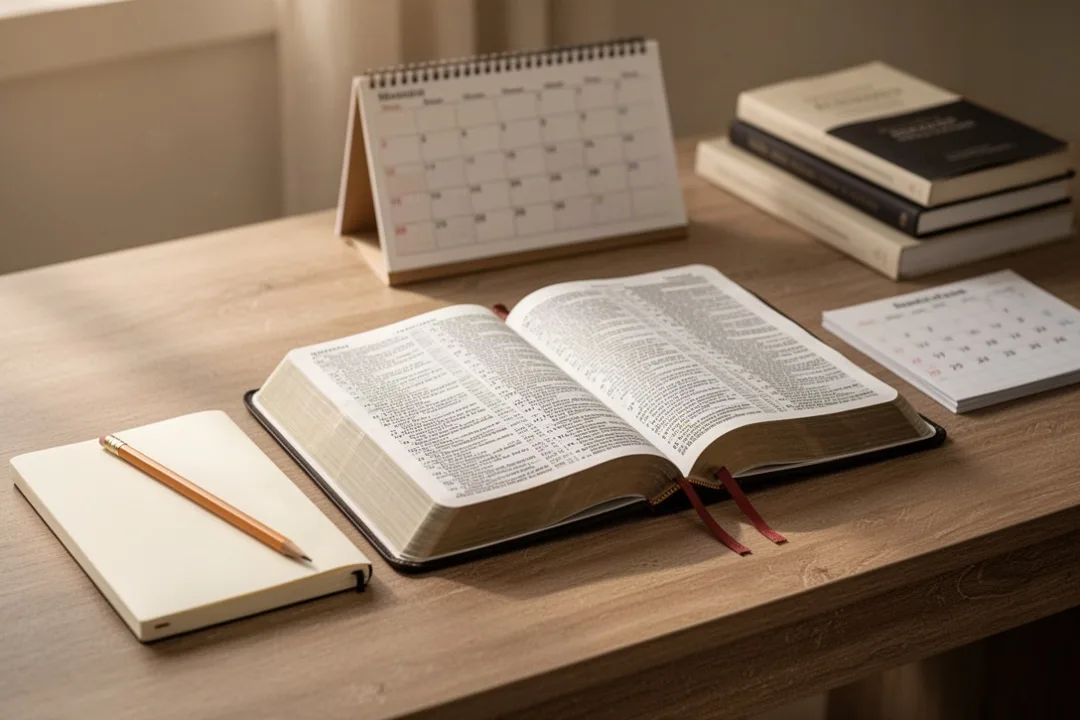
Keep your Bible, notebook, and reading plan in one dependable place.
Read the assigned passage before checking outside explanations.
Record one sentence describing the main point of each reading.
Mark questions without stopping for every detail.
Use a catch-up day instead of doubling the workload after a missed session.
Read longer books in sections
Some books are easier to understand when divided into natural sections. Genesis can be read through its major family narratives, Isaiah through its broad movements, and the Gospels through episodes or teaching blocks. Breaking a book into meaningful units helps you retain its structure rather than experiencing it as a series of disconnected chapters.
Short books can often be read in one sitting. Philemon, Jude, several of the shorter prophets, and some letters are brief enough to read repeatedly. A second reading may reveal the argument, emotional tone, and repeated words more clearly than a single pass.
Recover intelligently after missing days
Do not restart from Genesis every time you miss a reading. Mark where you stopped, read the next assigned passage, and return to the missed material on a catch-up day. If you have fallen far behind, reduce the plan temporarily or move to the next major section.
A reading plan is a tool, not a test of personal worth. The goal is to encounter the text with enough continuity to understand it. Consistency matters, but careful attention is more valuable than speed.
Understand each book while you read it
Reading the Bible in order gives you a path, but order alone does not explain meaning. Before starting a book, identify its genre, audience, setting, and main concern. These four questions can prevent many misunderstandings.
Genre matters because poetry uses images and parallel lines differently from historical narrative, and prophetic writing often uses symbolic language. Letters develop arguments and address real situations, while wisdom literature frequently presents observations and principles rather than promises that apply mechanically in every circumstance.
Read paragraphs and scenes in context instead of treating isolated verses as complete statements. Ask what comes before and after the passage, who is speaking, who is being addressed, and what problem or question the section appears to answer.
Keep a simple set of reading questions
You do not need extensive notes to read carefully. A short set of repeated questions will help you notice both details and the book’s larger direction.
What is happening? Identify the people, setting, conflict, command, promise, or argument.
What repeats? Look for recurring words, images, actions, locations, and contrasts.
How does this section fit the book? Connect it with the surrounding chapters and the book’s overall purpose.
What does it show about God, people, worship, justice, suffering, or hope? Let the text establish its own emphasis.
What remains uncertain? Write down questions and investigate them without allowing one difficult detail to halt your reading.
Pay attention to transitions. Words such as “therefore,” “but,” “then,” “because,” and “afterward” often show how an author connects ideas or events. In narrative books, notice changes in location, time, speaker, and conflict. In letters, identify the main claim and the reasons given for it.
Use outside help without outsourcing your reading
A study Bible, Bible dictionary, map, or commentary can provide valuable information about geography, names, customs, and historical settings. Start with resources that explain rather than merely assert, and compare more than one perspective when a question is disputed.
Read the biblical passage first and consult a resource afterward. This keeps you from remembering only someone else’s explanation. It also helps you identify whether a resource is addressing the text itself or applying a particular theological tradition.
Read difficult passages with patience. Some parts address ancient laws, warfare, genealogies, judgment, or symbolic visions that require more context than a quick reading provides. You can mark them for later study and continue reading while preserving the question for careful attention.
A useful long-term pattern is to read once for the main movement, a second time for structure, and a third time for details or application. You do not need to use that method for every chapter, but it works especially well for short letters, prophetic books, and passages that seem confusing on a first reading.
Frequently asked questions
Should I read the Bible from Genesis to Revelation the first time?
Yes, that is a practical choice for many first-time readers because it follows the standard arrangement and teaches you where the books belong. You can also begin with one Gospel, such as Mark or Luke, if you need an immediate introduction to Jesus before reading the Old Testament. Afterward, continue with a full-book plan rather than isolated passages.
Is chronological Bible reading more accurate than normal Bible order?
Chronological reading can provide helpful historical context, but it is not always exact. The dates of some events, the placement of certain prophets, and the order of Gospel episodes remain debated. Treat a chronological plan as an informed arrangement that highlights relationships, not as a definitive timeline that the biblical text explicitly supplies.
How long does it take to read the entire Bible?
The answer depends on your reading speed, Bible edition, and schedule. Reading for a short period each day can complete the Bible within a year, while a slower pace may take longer. A plan based on regular time rather than a strict deadline is often easier to maintain, especially when you pause to reread difficult books.
What should I do when I do not understand a passage?
First, read the surrounding section and identify its genre, speaker, audience, and main subject. Write down the specific question instead of assuming the whole book is unclear. Then consult a study Bible, Bible dictionary, or trusted teacher. Keep moving through your plan and return to the passage after gaining more context from later readings.






Leave a Reply