When you read Ephesians, you may wonder why the letter speaks so broadly about the church, spiritual identity, unity, and life in Christ. Was it written only to one local congregation, or was it meant for Christians across a wider region? The background of the book of Ephesians points to a major Roman city, a diverse Christian community, and a letter shaped by questions about how Jewish and Gentile believers could become one people.
Ephesians is traditionally associated with Paul the apostle, who spent an extended period ministering in Ephesus. The letter was probably written during a period of imprisonment, although scholars disagree about its exact date and even about whether Paul personally wrote every word. Its central concern is clear: God has brought people together in Christ and calls them to live as a unified, holy community.
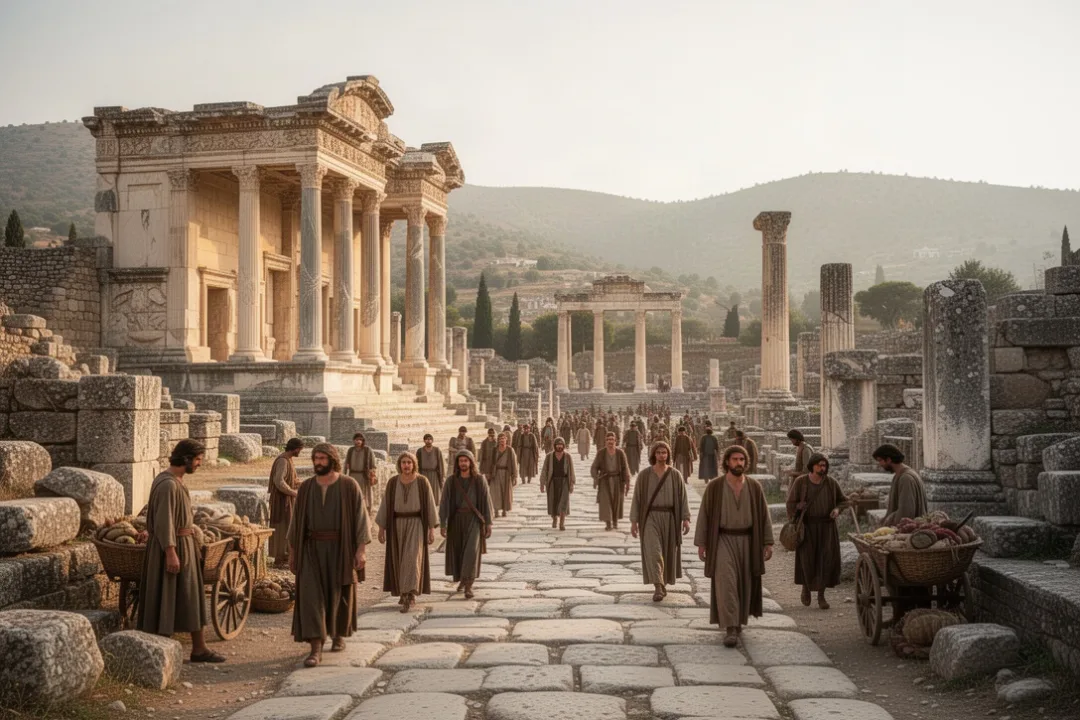
Ephesus was an important city on the western coast of Asia Minor, in the region that is now western Turkey. During the Roman period, it served as a prominent city in the province of Asia. Its position near the Aegean coast and major inland routes made it a center for trade, travel, government, religion, and communication.
The city’s influence extended well beyond its immediate population. Merchants, sailors, officials, artisans, pilgrims, and visitors passed through the area. A Christian message established in Ephesus could therefore spread to other towns and congregations in the surrounding region. Acts 19:10 describes Paul’s ministry as reaching many people throughout Asia, showing the city’s value as a base for missionary work.
Ephesus was also famous for the worship of Artemis, a major goddess honored throughout the region. The temple associated with Artemis was one of the city’s defining institutions, and religious devotion was connected to local identity, public ceremonies, tourism, and commerce. Acts 19 describes a disturbance involving craftsmen whose business was threatened by the Christian message. This episode shows that the gospel challenged more than private beliefs; it could affect the city’s economy and social order.
The city’s religious environment included many spiritual practices and competing claims about divine power. Acts 19 mentions magical practices and the public renunciation of occult books by people who accepted the Christian message. Against this setting, Ephesians emphasizes God’s supreme authority, Christ’s exaltation, and the believer’s need to stand firmly against spiritual evil.
Historical setting: Ephesus was not an isolated village church. It was a large, influential urban center where trade, Roman government, popular religion, spiritual practices, and ethnic diversity met.
The city’s urban character helps explain why Ephesians often sounds larger than a private pastoral letter. Its language reaches beyond one congregation’s immediate dispute. It describes God’s plan for the whole created order, the church’s worldwide identity, and the transformation of everyday behavior within a complicated public culture.
Paul’s connection with the Ephesian church
Paul did not create the Ephesian church in a single visit. Acts 18 records an earlier visit connected with the ministry of Priscilla and Aquila, while Apollos also appears in the wider story. Paul later returned and found disciples in Ephesus. His work there developed into one of the most significant periods of ministry described in Acts.
According to Acts 19, Paul taught first in a synagogue and then continued teaching in the lecture hall of Tyrannus. The account presents his ministry as lasting for an extended period, commonly understood as about two years. During that time, people from the surrounding region heard the word, and a substantial Christian community took shape.
Paul’s ministry in Ephesus included public teaching, personal discipleship, and encounters with people influenced by other religious practices. Acts 19 also records extraordinary healings and the confrontation with itinerant exorcists who tried to use Jesus’ name as a formula. These events underline the difference between Christian faith and attempts to control spiritual power through rituals or secret knowledge.
The Ephesian mission also produced serious opposition. The craftsmen’s protest was led by Demetrius, who feared that Paul’s preaching would discredit Artemis and damage the trade connected with her worship. The resulting crowd gathered in the theater and created a public crisis. The episode reveals how closely religion, economics, civic pride, and social identity were linked in Ephesus.
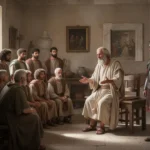
Paul later met with the elders of the Ephesian church at Miletus, as recorded in Acts 20. His speech there is emotionally significant because he warned them about hardship, false teachers, and the responsibility of caring for the congregation. He reminded them of his conduct among them and urged the leaders to watch over the community. That farewell provides useful background for understanding the concern for faithfulness, leadership, and spiritual protection found in Ephesians.
Several features of Paul’s Ephesian ministry help explain the letter’s themes:
A multicultural setting: The church included people shaped by Jewish and Gentile backgrounds.
Religious pressure: Believers lived among temples, spiritual practices, and claims about divine power.
Public opposition: The Christian message could create social and financial tension.
Regional influence: Ephesus helped spread the gospel throughout the province of Asia.
Leadership responsibility: Local overseers needed to protect the church and teach sound doctrine.
This background makes Ephesians more concrete. The letter’s teaching about leaving behind an old way of life was not abstract advice. Converts had to reconsider patterns connected with their former communities, religious assumptions, social status, sexual ethics, speech, work, and relationships.
Who wrote Ephesians and when it was written
Ephesians identifies its author as Paul and presents him as a prisoner because of his service for Christ. The traditional view is that Paul wrote the letter while imprisoned, commonly dated around A.D. 60–62 if the imprisonment occurred in Rome. Philippians, Colossians, and Philemon are often discussed alongside Ephesians as letters associated with Paul’s imprisonment.
The letter mentions Tychicus as the person who would inform the recipients about Paul’s circumstances and encourage them. Tychicus is also connected with the delivery of Colossians. This suggests that Ephesians circulated through the same network of churches and messengers that carried other Pauline correspondence.
Some scholars, however, question whether Paul was the direct literary author. They point to the letter’s vocabulary, sentence structure, style, and theological development, as well as its relationship to other Pauline letters. On this view, a later follower may have written in Paul’s name or shaped Paul’s teaching for a new generation of Christians. Proposed dates for this view commonly fall later in the first century.
Other scholars defend Pauline authorship. They argue that a writer’s vocabulary and style can change according to subject, audience, secretary, or circumstances. They also see the letter’s teaching as consistent with Paul’s broader message about grace, Christ, the church, holiness, and the inclusion of Gentiles.
The authorship question should be handled carefully. Traditional Christian interpretation receives the letter as Pauline, while much modern scholarship remains divided. Either position recognizes that Ephesians emerged from the Pauline tradition and addresses churches shaped by Paul’s mission and teaching.
Why the date matters: A date during Paul’s imprisonment places the letter near the first generation of Christian missions. A later date presents it as a faithful expansion of Pauline teaching for churches facing new challenges after Paul’s lifetime.
The opening greeting addresses “the saints” in Ephesus in many English Bibles, but some early manuscript evidence does not include the words “in Ephesus.” This has led some scholars to suggest that the letter may have been designed as a circular letter for several churches in Asia Minor rather than as a message intended exclusively for Ephesus.
The letter’s general tone supports that possibility. Unlike 1 Corinthians or Galatians, Ephesians does not directly address a named local controversy, greet many individual members, or respond to a specific church crisis. It reads more like a broad theological and pastoral presentation that could be shared among congregations.
Who received Ephesians and what problems shaped them
The original recipients were Christians living in and around Ephesus, whether the letter was sent to one congregation or circulated among several. They likely included both Jewish and Gentile believers, although the letter gives particular attention to Gentiles who had once been separated from Israel’s covenant traditions.
Ephesians 2 describes Gentiles as formerly distant from the promises associated with Israel, but now brought near through Christ. The point is not that Gentile Christians had to become culturally Jewish before belonging to God. Instead, Christ’s death is presented as the basis for creating one new humanity and removing the hostility that divided the groups.
This teaching addressed a major question in the early church: Could people from different ethnic, religious, and cultural backgrounds truly share one people of God? Ephesians answers by placing unity in Christ’s reconciling work, not in shared ancestry, social customs, or equal conformity to one ethnic identity.
The recipients also lived in a culture where public reputation and social status mattered. Household relationships were organized by accepted Roman and Greco-Roman patterns, and religious identity could affect a person’s business, family expectations, and place in the community. Ephesians speaks into those realities by applying Christian faith to marriage, parenting, labor, speech, anger, sexuality, money, and power.
The letter does not describe one simple crisis, but several pressures can be seen in its teaching:
Division between Jewish and Gentile believers: The church needed a shared identity that did not erase either group.
Former religious practices: New Christians had to separate themselves from idolatry and occult traditions.
Moral habits from the old life: The letter addresses falsehood, uncontrolled anger, theft, corrupt speech, sexual impurity, and greed.
Spiritual opposition: Believers needed endurance and discernment rather than fear or fascination with spiritual powers.
Immature teaching: The church needed stability, truth, and growth into a mature body.
These concerns explain why Ephesians moves from a sweeping description of God’s saving purpose to very practical instructions. The identity of the church was not merely a doctrine to affirm. It was supposed to reshape the way Christians treated one another and the way they conducted themselves in public and private life.
The letter also describes the church as a body, a household, a temple, and a bride. These images communicate belonging, shared responsibility, holiness, and unity. They also show that Christianity was not presented as a solitary spiritual experience. Believers were joined to one another and expected to grow together.
What Ephesians was written to accomplish
Ephesians first establishes what God has done in Christ before explaining how believers should live. The opening section speaks about spiritual blessing, adoption, redemption, forgiveness, and the gift of the Holy Spirit. These themes give Christian conduct a foundation: believers do not earn their identity through moral performance; they respond to grace already given.
The letter then emphasizes the resurrection and exaltation of Jesus. Christ is portrayed as above every authority and power, with all things placed under his rule. This language would have been meaningful in a city filled with claims about divine beings, spiritual forces, imperial authority, and religious protection. Ephesians directs confidence away from competing powers and toward the lordship of Christ.
Another purpose is to explain the church’s place in God’s plan. Ephesians presents the church as Christ’s body and as the community through which God’s wisdom becomes visible. The church is not simply a collection of saved individuals. It is a new people whose unity displays the reconciliation accomplished through Christ.
The letter also clarifies the role of apostles, prophets, evangelists, pastors, and teachers. These ministries are given to equip believers for service and to help the body grow toward maturity. Leadership is therefore not described as a way to elevate a few powerful personalities. Its purpose is to build up the whole community in truth and love.
Practical instruction occupies much of the second half of Ephesians. Readers are told to live in a way that matches their calling. That includes speaking truth, dealing with anger promptly, working honestly, sharing with those in need, using words that build others up, forgiving as God has forgiven them, and rejecting patterns associated with their former life.
The household instructions in Ephesians 5–6 address husbands and wives, children and parents, and enslaved people and masters. These passages must be read within the realities of the ancient Roman household, where slavery and strong hierarchy were legally established. The text does not present the modern institution of slavery as acceptable, and Christians should not use it to defend slavery. Its instructions also place every relationship under the authority of Christ and call for conduct shaped by love, responsibility, and accountability before God.
For readers today, the household material requires careful interpretation. It reflects the social world of the first century while also introducing obligations that challenge self-centered power. Husbands are commanded to love sacrificially, fathers are warned not to provoke their children, and masters are reminded that they share the same Lord as those under their authority.
The final section uses the image of the armor of God to describe spiritual endurance. The pieces of armor represent truth, righteousness, readiness for the gospel of peace, faith, salvation, and God’s word. The passage does not encourage aggression against human opponents. It calls believers to stand firm, pray continually, and resist evil without treating other people as the enemy.
How the book of Ephesians is organized
Ephesians has a clear movement from identity to conduct. The first half concentrates on God’s work in Christ and the church’s place within that work. The second half applies those truths to personal behavior, relationships, worship, unity, and spiritual resistance.
A useful outline includes these major movements:
Greeting and blessing: The letter opens by identifying Paul and praising God for blessings given in Christ.
Prayer for understanding: Paul prays that believers will grasp their hope, inheritance, and Christ’s authority.
Salvation by grace: The recipients are reminded that salvation is God’s gift, not a reward for human achievement.
Reconciliation of divided people: Christ creates one new humanity from Jews and Gentiles.
Paul’s ministry to the Gentiles: Paul explains his role in announcing the previously hidden purpose of God.
Unity and maturity: The church is urged to preserve unity and grow together in truth and love.
A transformed way of life: Believers are taught how to leave behind destructive habits.
Christian relationships and spiritual steadfastness: The letter addresses households and calls the church to stand firm in spiritual conflict.
Chapters 1–3 are especially rich in theological reflection. They discuss election, adoption, redemption, grace, resurrection, reconciliation, the church, and God’s eternal purpose. Chapters 4–6 are more directly ethical, but they are not disconnected from the earlier teaching. The repeated logic is that new identity produces new behavior.
Prayer is another thread holding the letter together. Paul prays for spiritual insight near the beginning and for strength, comprehension of Christ’s love, and fullness near the center. The closing appeal for prayer shows that Christian life depends on God’s power rather than determination alone.
The background of Ephesians therefore includes more than the name of an ancient city. It includes the experience of a multicultural church in a powerful urban center, the memory of Paul’s long ministry, the pressure of competing religious systems, the challenge of ethnic division, and the need for communities to live consistently with the gospel they profess.
Reading the letter with that setting in mind clarifies its scope. Ephesians speaks to people asking how grace changes their identity, how divided groups can become one, how a church can mature, and how Christians can remain faithful amid spiritual and social pressure. Its answer centers on Christ’s reconciling work and the church’s calling to embody that reconciliation in everyday life.
Frequently asked questions
Was Ephesians written only to the church in Ephesus?
Possibly, but the evidence allows a broader view. Some early manuscripts do not include the phrase “in Ephesus,” and the letter lacks the personal greetings and specific crisis-response material found in several other Pauline letters. Many scholars therefore think it may have circulated among churches in Asia Minor, with Ephesus serving as an important destination or center.
Was Paul definitely the author of Ephesians?
Paul is named as the author, and many Christian traditions accept that attribution. Some modern scholars question direct Pauline authorship because the letter’s style, vocabulary, and theological presentation differ from other letters. Others explain those differences through changing circumstances, assistants, subjects, or audiences. The letter clearly belongs to the Pauline tradition regardless of the position taken.
What was Ephesus famous for in the first century?
Ephesus was a major city in the Roman province of Asia, known for trade, regional influence, public institutions, and devotion to Artemis. Its location connected coastal and inland routes. Acts presents it as a strategic center for Christian mission, while also showing how the gospel created tension with businesses and religious practices tied to Artemis worship.
What is the main message of Ephesians?
Ephesians teaches that God has united believers to Christ by grace and has formed one people from previously divided groups. It then calls that community to live differently through humility, truth, love, holiness, forgiveness, and spiritual endurance. The letter joins broad teaching about God’s plan with practical guidance for church life and personal relationships.





Leave a Reply