If you have read the New Testament’s shortest letter and wondered, “Who is Philemon in the Bible?”, the answer begins with the letter addressed to him. Philemon was a Christian whom the apostle Paul knew personally, a man who hosted believers in his home and was connected to a household that included Onesimus, an enslaved person.
Paul wrote to Philemon after Onesimus had come into contact with him. The apostle appealed to Philemon to receive Onesimus not merely as property or a servant, but as a dearly loved brother in Christ. The letter gives few biographical details, so some conclusions must be stated carefully. Still, Philemon’s brief story provides a close look at forgiveness, Christian fellowship, authority, and the social realities of the early church.
Philemon appears by name in only one New Testament letter: Paul’s Letter to Philemon. Paul addresses him as a beloved friend and fellow worker, showing that Philemon was not an unknown recipient. He seems to have been a respected Christian associated with Paul’s ministry and the wider network of churches in the first century.
Paul also mentions Apphia and Archippus in the opening greeting. Apphia may have been a close family member or household leader, while Archippus is called a fellow soldier in Christian service. The letter does not explain their exact relationships to Philemon, so it is safer to say that they were part of the Christian household or community connected with him.
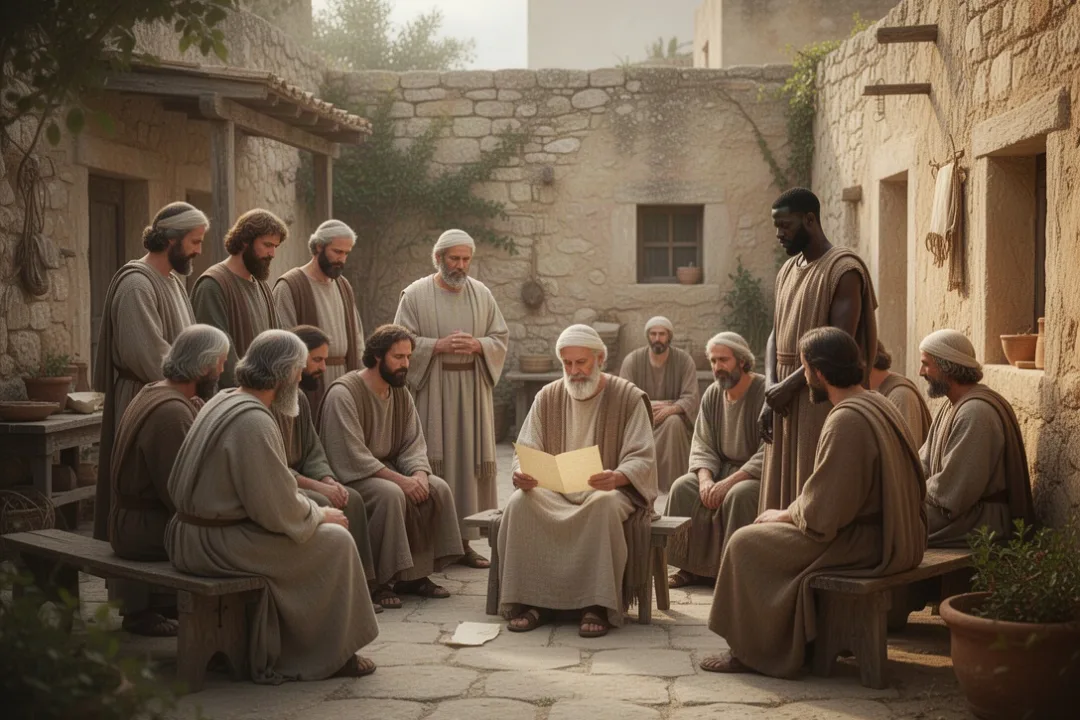
Believers met in Philemon’s house. Paul refers to “the church in your house” in Philemon 1:2, meaning that Philemon’s home served as a gathering place for Christians. Before purpose-built church buildings existed, Christian communities commonly met in private homes for prayer, teaching, worship, meals, and mutual support.
Paul’s greeting also includes other Christians, including Epaphras, Mark, Aristarchus, Demas, and Luke. These names connect the letter to the same broad circle of coworkers found in Paul’s other letters. The exact timing and location of the writing are debated, but the letter clearly comes from a period when Paul was imprisoned.
The Bible does not give Philemon’s occupation, birthplace, age, or complete family history. It also does not explicitly state that he was wealthy. His ability to host a church and his connection to an enslaved person may suggest that he had substantial household resources, but those details should remain in the category of reasonable inference rather than certainty.
A careful distinction: The letter tells us that Philemon was a Christian house-church host and Paul’s fellow worker. Claims about his wealth, marital status, or exact social position go beyond what the biblical text directly confirms.
How Philemon was connected to Onesimus
Onesimus was connected to Philemon’s household and is described in the letter as someone who had become useful to Paul during the apostle’s imprisonment. The traditional interpretation is that Onesimus was an enslaved person who had left Philemon’s household, possibly after taking something or causing a financial loss. However, the letter does not plainly describe every detail of what happened.
Paul says that Onesimus had once been “useless” to Philemon but had become useful to both Philemon and Paul. That wordplay likely relates to the meaning of Onesimus’s name, which is associated with usefulness or benefit. Paul uses the contrast to show that Onesimus’s relationship and character had changed through his encounter with Christ.
Paul sent Onesimus back to Philemon with the letter. This can feel difficult to modern readers because the setting involved Roman slavery, an institution that denied freedom and treated human beings as property. The letter does not present a modern legal argument against slavery, and it should not be used to minimize the cruelty or injustice of enslavement.
At the same time, Paul’s appeal radically changes the relationship he asks Philemon to recognize. Onesimus is no longer to be viewed only according to his household status. Paul asks Philemon to receive him as a brother, with the same affection he would show Paul himself.
Paul even offers to repay any financial obligation Onesimus may have had. He reminds Philemon that Philemon owes him his own spiritual life, apparently because Paul played a role in bringing him to faith. The apostle does not use that debt to demand obedience; instead, he appeals to love and voluntary action.
The letter leaves the practical outcome unstated. We do not know from Scripture whether Philemon immediately forgave Onesimus, released him, continued employing him, or made another arrangement. The absence of a recorded response means readers should avoid presenting a specific ending as certain.
Why the slavery question requires care
Some readers have assumed that Onesimus was a runaway slave, but the text does not explicitly use all the details required to prove that conclusion. He may have left Philemon’s household, and Paul’s request for reconciliation strongly suggests a serious breach, but the precise circumstances remain uncertain.
The Roman world included several forms of dependency and enslavement, and experiences varied widely. None of that makes the institution acceptable. It does mean that responsible interpretation should distinguish between what the letter says, what historical context helps us understand, and what later tradition has supplied.
What the letter says: Onesimus was connected to Philemon’s household, had become a Christian through Paul’s ministry, and was being sent back.
What is strongly implied: Philemon had authority over Onesimus and needed to decide how to respond to the situation.
What is not fully explained: Whether Onesimus stole money, how long he had been away, and what happened after he returned.
What Paul emphasizes: Christian identity and brotherhood must reshape how Philemon sees Onesimus.
What Paul asked Philemon to do
Paul’s request is the central action of the letter. He asks Philemon to welcome Onesimus as he would welcome Paul. That appeal is personal, relational, and practical. Paul does not merely tell Philemon to feel differently; he asks him to demonstrate the change through the way he receives Onesimus.
Paul identifies himself as a prisoner of Christ Jesus and describes Onesimus as his child in the faith. The language shows the closeness that developed between Paul and Onesimus. It also establishes that Onesimus was now part of the Christian family, regardless of his previous social position.
The apostle says he could command Philemon to do what was right, but he chooses to appeal on the basis of love. This does not mean the request was unimportant. Rather, Paul wanted Philemon’s response to arise from transformed Christian conviction instead of external pressure alone.
Paul presents the situation as an opportunity for Philemon to act in a way that reflects the gospel. Philemon’s faith had already brought encouragement to other believers, and Paul wants that same faith to guide his treatment of Onesimus. The private conflict becomes a test of whether Christian confession affects ordinary relationships.
Paul also says that he would welcome Onesimus as a partner. That word suggests shared participation and fellowship. The request is striking because it treats a socially subordinate person as someone who belongs within the same spiritual community and deserves to be received with dignity.
The letter’s main requests can be expressed in several practical terms:
Receive Onesimus with welcome rather than hostility or humiliation.
Recognize his new identity in Christ as a brother and fellow believer.
Settle any legitimate financial loss in a way that protects reconciliation.
Let love guide the response instead of relying only on rank, power, or personal authority.
Make Christian fellowship visible in the treatment of someone with less social power.
Paul’s language also shows that Christian forgiveness is not the same as pretending nothing happened. He acknowledges that Onesimus may have caused harm and offers to address the cost. Reconciliation includes truth about the injury, a willingness to make amends, and a changed relationship where possible.
The heart of Paul’s appeal: A person’s status, past failure, or social disadvantage must not erase the new identity and equal spiritual worth that come through belonging to Christ.
What Philemon teaches about Christian relationships
Philemon is addressed to one man, but it was also meant to be heard by the church meeting in his home. That public setting matters. Philemon’s decision would affect not only a private relationship but also the community’s understanding of Christian fellowship.
The letter shows that faith is tested in concrete relationships. It is easy to speak about love, grace, and brotherhood in general terms. It is more demanding to practice them when another person has caused financial damage, offended your dignity, challenged your authority, or returned after a painful separation.
Philemon also demonstrates the importance of restored identity. Paul does not deny Onesimus’s past, but he refuses to let that past define his whole future. Onesimus is now a believer, a beloved brother, and a person capable of faithful service.
This does not mean every relationship must be restored in exactly the same form. Forgiveness, reconciliation, trust, and the removal of harmful power differences are related but distinct. A Christian may forgive while still setting wise boundaries or requiring evidence of changed behavior.
The letter also challenges leaders to use influence responsibly. Paul had enough authority to issue a command, yet he chooses a persuasive appeal. His approach is not weakness. It is a deliberate attempt to guide Philemon toward an action that reflects love rather than mere compliance.
For churches and families, the letter raises difficult but valuable questions:
Do our words about equality match the way we treat people with less power?
Do we allow a person’s past to become a permanent label?
When harm has occurred, do we make room for honest repair?
Do our communities protect the vulnerable when relationships become unequal?
Are spiritual leaders using authority to control people or to encourage faithful action?
Philemon’s household church would have included people from different social backgrounds. The gospel did not erase every social structure overnight, but it introduced a new way of seeing people within those structures. A slaveholder and an enslaved believer could not remain spiritually unchanged once both were described as members of one Christian family.
How Philemon fits into the New Testament
Philemon is one of Paul’s shortest letters and is often called a personal letter. That label can be misleading if it makes the letter seem unimportant or purely private. Because it was preserved and read by the church, its personal situation became a source of instruction for Christian communities.
The letter shares themes with Paul’s wider teaching. In other places, Paul emphasizes that believers are united in Christ across social and ethnic divisions. Galatians 3:28 expresses the spiritual equality of believers, while Colossians 3:11 describes Christ as the one who is all and in all. Philemon shows what such convictions can look like in one strained relationship.
Philemon is also closely associated with Colossians because Onesimus and Archippus appear in both letters, and Epaphras is connected with both settings. The letter itself does not explicitly name the city where Philemon lived. Many readers and scholars associate him with Colossae, but that identification should be described as probable or traditional rather than stated directly in Philemon.
Onesimus later appears in early Christian history under the same name, but it is difficult to determine with certainty whether every later reference concerns the same person. Some church traditions connect him with later Christian leadership, yet the biblical letter itself gives no account of his later life.
Paul closes by expressing confidence that Philemon will respond positively and by asking him to prepare a guest room. This suggests that Paul hoped to visit and perhaps see the outcome of the reconciliation himself. He also sends greetings from fellow workers, reminding readers that the situation belongs within a larger Christian network.
The letter’s brevity makes every detail significant. It does not offer a long teaching section on social institutions. Instead, it puts a specific human relationship under the pressure of the gospel and asks what Christian love requires when authority, money, reputation, and personal hurt are involved.
What Philemon’s story means for readers today
Philemon is not mainly remembered because of a detailed biography. He matters because his response became the setting for a profound Christian appeal. He was a person with authority who had to decide whether his faith would change the way he received someone who had wronged him and occupied a lower social position.
For readers, the first lesson is that forgiveness should take people seriously. Paul does not erase the possibility of loss or wrongdoing. He makes room for repayment and repair while also calling Philemon to see Onesimus as more than his failure.
The second lesson concerns Christian community. Philemon’s house was a meeting place for believers, so his treatment of Onesimus would communicate what kind of community the church was. Hospitality is more than opening a door; it includes honoring the dignity of people who may have little ability to protect themselves.
The third lesson is about power. The person with greater authority often controls whether reconciliation is possible, safe, or sincere. Paul’s letter directs that person toward generosity, but modern applications should also consider the protection of anyone vulnerable to coercion. Reconciliation should not pressure victims to return to unsafe situations.
The fourth lesson is that spiritual growth becomes visible through decisions that cost something. Philemon’s faith was not evaluated only by his beliefs or reputation. It was tested by whether he could act with mercy when mercy might require him to surrender status, money, pride, or control.
You can read the letter by asking four questions:
Who in my life do I still define mainly by a past failure?
Where has unequal power made forgiveness or reconciliation complicated?
What practical repair would make an apology credible?
How can my church or household treat people as brothers and sisters in practice, not only in language?
Philemon was a Christian leader, a house-church host, and Paul’s fellow worker. His most lasting significance comes from the decision placed before him: whether to receive Onesimus according to old status and past conflict, or according to the new relationship created by faith in Christ.
Frequently asked questions
Was Philemon a slave owner?
Philemon appears to have held authority over Onesimus, who was connected to his household and is commonly understood to have been enslaved. The letter does not provide a complete description of Philemon’s household or legal status, so “slave owner” is a reasonable description of the situation but should be handled with historical care.
Was Onesimus Philemon’s runaway slave?
Many interpreters believe Onesimus had left Philemon’s household, possibly after causing a loss, but the letter does not explicitly give every detail of his departure. It clearly presents a broken relationship, Paul’s involvement, and a request that Philemon receive Onesimus as a Christian brother.
Did Philemon forgive Onesimus?
The Bible does not record Philemon’s response, so no definite outcome can be claimed. Paul expressed confidence that Philemon would act favorably and asked him to welcome Onesimus. Later tradition connects Onesimus with Christian leadership, but it cannot prove exactly what happened after the letter.
Where did Philemon live?
Many scholars associate Philemon with Colossae because of the links among Philemon, Onesimus, Archippus, and Epaphras in the New Testament. However, the Letter to Philemon does not explicitly name his city. Colossae is therefore a strong traditional identification rather than a detail directly stated in the letter.










Leave a Reply