When Did Jewish Religion Begin? Exploring Its Origins and Key Milestones
When Did Jewish Religion Begin? Exploring Its Origins and Key Milestones
Exploring when the Jewish religion began involves a long review of ancient texts, archaeological clues, and centuries of scholarly debate. This article traces the question from its roots in the ancient Near East through pivotal moments that shaped Judaism as a faith, a culture, and a people. Throughout, we will consider alternative phrasings such as when did Judaism begin, the origins of Judaism, and how Judaism emerged, to reflect the varying perspectives scholars use when discussing origins, development, and identity.
Origin and early context: when did the Jewish tradition begin in the ancient world?
The story of Judaism begins in a landscape of interconnected ancient peoples in the Near East. The earliest seeds are often traced to the biblical patriarchs—Abraham, Isaac, and Jacob—and to the idea of a covenant between a specific people and their God. However, the way historians and theologians phrase the question when did Judaism begin yields more than a single date. It depends on what one means by “Judaism”: a religion with a formal set of teachings, a people with shared rituals, or a textual tradition that later generations would codify. Below are key elements that shape the early timeline:
- The patriarchal narratives in Genesis describe a people who worship a single God and who are promised land, descendants, and blessings. For many, this marks the spiritual seedbed of the later faith.
- The rise of a distinct Israelite identity emerges gradually as families and tribes form a shared memory and law code, possibly during the late Bronze Age.
- The concept of a covenant—an agreement between God and the people—becomes a central motif. Circumcision as a sign of the covenant functions as a ritual marker that later generations reference.
- The question “when did Judaism arise” can be reframed as a question about when a people and a text-based tradition coalesced around moral law, liturgical practice, and communal memory.
The patriarchal groundwork
The figure of Abraham is often singled out as a foundational moment in Jewish religious memory. In biblical narrative, Abraham receives a divine promise and initiates a relationship with God that becomes the template for later generations. If one asks when did the Jewish religion begin in terms of its spiritual commitments, many scholars point to this era as the seed of monotheistic faith in a polytheistic world. Yet it is equally accurate to note that the earliest concrete religious practices and social structures belonging to an emerging Israelite group would crystallize later, as communities formed around shared law and worship.
The Mosaic era and Sinai: the defining moment for the law and the covenant
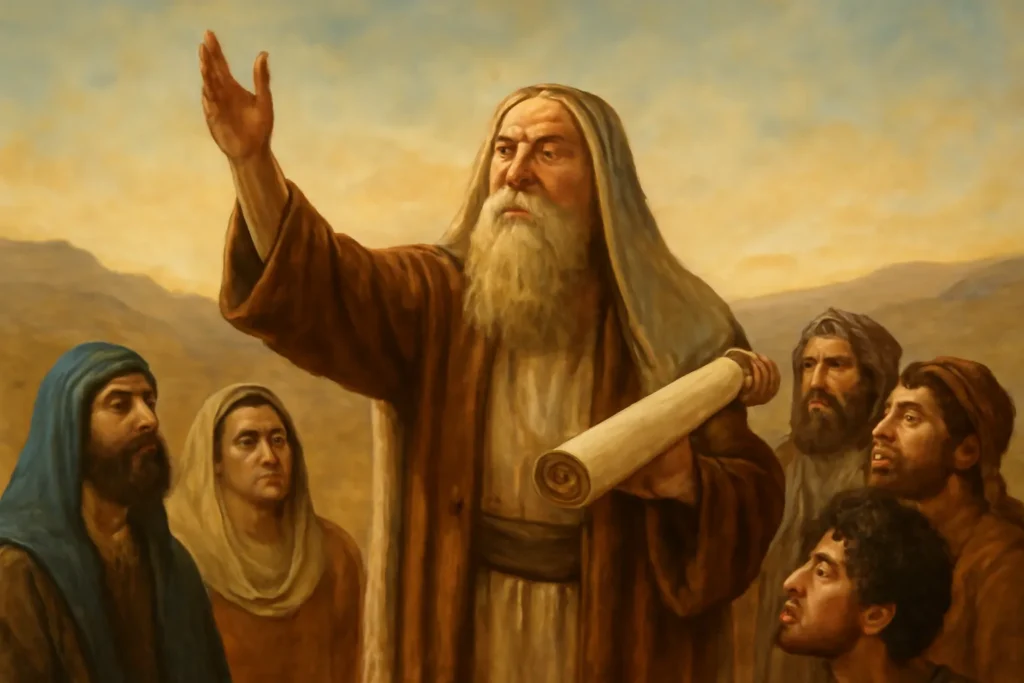
Many discussions about when Judaism began center on the figure of Moses and the revelation at Sinai, where the people receive the Torah and the laws that guide communal life. This period is often described as a turning point that transforms a tribal memory into a covenantal system with a defined legal framework. Although historical dating is debated, the Sinai event is a cornerstone in Jewish self-understanding for several reasons:
The Torah as a written law code becomes central to Jewish religious life, shaping ethics, ritual, dietary laws, and civil conduct.
The concept of a formal covenant between Israel and God becomes the organizing principle of a religion with a people who carry memory, law, and liturgy together.
The expectation that God’s law applies to all aspects of life—family, community, worship, and justice—moves the tradition toward a comprehensive way of life rather than a purely ceremonial cult.
Law, liturgy, and the Torah’s authority
For those asking when did Judaism begin to take shape as a system of laws, the Sinai revelation is frequently cited as the moment when law-bearing texts acquire absolute authority for religious and social order. The Torah’s laws cover ritual observance, temple service (in the period when the Temple stood), civil justice, and ethical obligations. The interpretation and expansion of these laws would continue for centuries, through exilic experiences, temple changes, and the work of later scholars.
The Hebrew Bible’s development and the rise of monotheism
Another critical lens on the question when did Jewish religion begin looks at the formation and consolidation of doctrine within the Hebrew Bible, especially the steady movement toward monotheism. The early scriptural materials reveal a transition from a broader ancient Near Eastern milieu, with multiple divine beings invoked in some traditions, toward a more exclusive worship of a single God. Key aspects include:
The emergence of the name YHWH as the primary divine designation for a God who demands exclusive loyalty.
The Shema (declaration in Deuteronomy 6:4) that “the LORD our God, the LORD is one” becomes a concise creed that anchors later Jewish belief.
The consolidation of worship practices and ethical teachings into a coherent theological framework that could be transmitted across generations.
In this sense, the question when did Judaism begin can be framed as a gradual intensification of monotheistic devotion and textual self-definition. The biblical canon, formed over centuries, provides the narrative backbone that later communities would rely on for identity, ritual, and interpretation.
From temple-centered Israelite religion to a text-based Rabbinic tradition
Following the destruction of the First Temple and the Babylonian exile in the 6th century BCE, Jewish religious life underwent significant transformation. The question when did Judaism start to move from temple-centric worship to a more text-centered practice is central to understanding the shift from pre-exilic to post-exilic religion. Several forces influenced this transition:
The loss of a permanent temple in Jerusalem necessitated new modes of worship that did not depend exclusively on temple sacrifice.
Since exiled communities were dispersed, the study of sacred texts and the sharing of interpretations through studying law and prophecy became essential for maintaining community cohesion.
The emergence of synagogues as local centers of prayer and study laid a new foundation for communal life beyond temple rites.
During the Persian and Hellenistic periods that followed, the religious community continued to interpret and preserve the Torah while adapting to new circumstances. This era is often described as the transition from a temple-centered cult to a scholarly and devotional culture that would eventually form the basis of Rabbinic Judaism. In other words, when did Judaism begin to function as a rabbinic tradition is best understood as a gradual evolution that culminated after the Temple’s destruction with a new emphasis on interpretation, study, and communal law.
Second Temple Judaism and the rise of Rabbinic interpretation
The period from roughly the 6th century BCE to the 2nd century CE is commonly named Second Temple Judaism. It encompasses a diversity of groups and movements, including the Pharisees, Sadducees, Essenes, and early Christians. The question when did Jewish religious life become codified into a form recognizable as Rabbinic Judaism is tied to the emergence of authoritative legal interpretation and the eventual compilation of core rabbinic texts. Important facets include:
The Pharisees, who emphasized the oral law and the interpretive tradition that would come to be central in the Talmud.
The scribal and legal cultures, which developed extensive commentaries, rulings, and debates on how to observe the Torah in daily life.
The destruction of the Second Temple in 70 CE, which accelerated the pivot away from temple-centered ritual toward study, prayer, and community life anchored in the synagogue and home.
In this framework, Judaism as a dynamic living tradition begins to look more like a system of beliefs and practices transmitted through learned interpreters. The eventual compilation of the Mishnah (around 200 CE) and later the Talmud (completed in the form of the Babylonian Talmud in the 5th century CE) marks a decisive stage in the formalization of Rabbinic Judaism. Thus, the question when did Judaism become a rabbinic religion points to a historical continuum rather than a single moment of birth.
Key differences among Second Temple groups
Understanding the diversity within Second Temple Judaism can help answer the broader question of origins. Some notable distinctions include:
The Pharisees emphasized oral law and universal accessibility of law to the layperson, influencing post-Temple practice.
The Sadducees held to a more literal interpretation of the written Torah and tended to be associated with the Temple priesthood.
The Essenes practiced communal purity and awaited apocalyptic events in different ways, contributing to the broader religious landscape.
Milestones in the development of Jewish religion
To grasp the arc of origins, it helps to identify a sequence of milestones that scholars cite when tracing the emergence of a distinct Jewish religious identity. The following list presents a broad, non-exhaustive timeline. Dates are approximate and interpreted differently by historians and religious scholars.
Patriarchal era and the covenant narratives: foundations for a unique relationship with God.
Exodus and Sinai revelation: the moment many tie to the giving of the Torah and formal law.
Consolidation of Israelite identity under various tribal and monarchical structures in the late Bronze Age and early Iron Age.
Formation of the Hebrew Bible corpus: a gradual process of compiling, editing, and canonizing sacred texts.
Babylonian exile and return: a turning point toward textual study, law, and synagogue-centered life.
Second Temple period: diverse movements, temple worship, and early rabbinic thought begin to take shape.
Destruction of the Second Temple (70 CE) and the rise of Rabbinic Judaism through interpretation and community practice.
Compilation of Mishnah and later Talmudic scholarship: the formalization of a method to interpret Torah for all generations.
Medieval, early modern, and modern developments: codifications, commentaries, and reformulations of Jewish law and belief across communities.
Interpreting the question: does Judaism begin with Moses, Abraham, or a later textual tradition?
Scholars and communities often answer when did Jewish religion begin in different ways, depending on how they weigh sources and what they consider essential. The three most common anchors in the discussion are:
Abrahamic seed and covenant: for some, the religious line begins with the patriarchs and the promise of a special relationship with God.
Mosaic law and Sinai revelation: others see the legal and covenantal framework given to Moses as the birth of a formalized religious system.
Text and community: a third view emphasizes the development of sacred texts (the Torah and later rabbinic writings) and the formation of a disciplined interpretive tradition that sustains Jewish life across generations.
Each perspective has merit, and many scholars describe the origins of Judaism as a layered process in which belief, practice, law, and identity reinforce one another over time. The idea of a single birth moment is less widely supported than the idea of an evolving tradition with several turning points that together define “the beginnings of Judaism.”
Judaism and the idea of a people of the Book
Another frame for the question when did Judaism begin centers on the relationship between a people and their sacred texts. The emergence of a robust textual tradition—comprising the Torah, Prophets, Writings, and later rabbinic literature—helps explain how a real and lasting religious identity could endure through exile, diaspora, and cultural change. Several themes are integral to this frame:
Scriptural authority provides norms for ethics, ritual, and community life.
Interpretation becomes a central skill, enabling generations to apply ancient laws to new circumstances.
Community memory, ritual practice, and study foster continuity that transcends political or territorial changes.
In this sense, the question when did Judaism begin can be reframed as: when did a text-based, legally oriented, and diaspora-ready religion crystallize in a way that could be maintained across centuries? The answer points to a gradual crystallization from the late Second Temple period onward, rather than a single, clear-cut birth moment.
From exile to continuity: the enduring form of Jewish religious life
Historically, the experience of exile and return has been pivotal for the development of Jewish religious life. The destruction of the temples, the challenges of diaspora, and the need to sustain a distinct identity under foreign rule all contributed to a way of living that could persist beyond the political fortunes of a single land or governing power. Some guiding ideas include:
The Temple’s destruction shifted primary religious life toward study, prayer, and community guidance by teachers and leaders known as rabbis or scribes.
Communities learned to pray in Hebrew, study sacred texts, and observe laws in the home and synagogue, creating a durable religious culture.
Scholastic and legal traditions flourished, laying the groundwork for the comprehensive legalistic approach that characterizes much of Rabbinic Judaism.
Thus, the question when did Judaism begin is answered not by a single date, but by recognizing the continuity of rebuilding, reinterpretation, and resilience that allowed Judaism to survive, adapt, and flourish across centuries and continents.
Modern reflections: how historians and communities view origins today
In modern scholarship and contemporary Jewish life, the origin question is often reframed to emphasize nuance and pluralism. Some widely cited themes include:
The recognition that Judaism is both a religious tradition and a cultural-ethnic identity that can be expressed in many ways across diverse communities.
The acknowledgment that different communities emphasize different formative moments—patriarchs, Sinai, exile, rabbinic law, or the rabbinic interpretive tradition—without denying the others.
A cautious approach to dating, with scholars offering ranges (for example, late Bronze Age to early Iron Age for early Israelite religion, and classical Rabbinic Judaism emerging prominently in the centuries following 70 CE) rather than precise single dates.
From a theological perspective, many believers maintain that Judaism began in a covenantal relationship with God, while from a historical-critical perspective, one might describe it as the evolution of a people’s beliefs, laws, and practices across generations. To speak of when did the Jewish religion begin is, in practice, to speak about a living tradition whose origins lie in a web of story, ritual, law, and memory that grew more intricate as centuries passed.
Readers often encounter different formulations when exploring origins. Here are common variations and concise responses to each:
When did Judaism begin? A gradual emergence spanning from ancient patriarchal memory, through Sinai revelation, to the codification of rabbinic law after the Temple’s destruction.
When did the Jewish religion start? Similar to the above, with emphasis on the shift from ritual temple life to a text-centered, synagogue-based religious practice after exile.
What is the origin of Judaism? A multi-layered origin combining biblical narratives, covenantal ideas, law, ritual, and communal identity developed over many centuries.
When did Rabbinic Judaism appear? More definitively in the period after 70 CE, with key texts such as the Mishnah and Talmud shaping practice for generations to come.
Did Moses or Abraham found Judaism? Both figures hold central places in memory and law; Abraham is often described as the founder of the covenantal relationship, while Moses is seen as the lawgiver who received and organized the Torah for the people.
In sum, the question when did Jewish religion begin invites a nuanced answer. The faith did not spring from a single flash of divine revelation in a precise year, but rather emerged through a long process in which ritual, law, story, and community life cohered across different historical periods. From the patriarchal narratives and the imagined Sinai covenant to the exile, the Second Temple era, and the rise of Rabbinic Judaism, each phase contributed essential pieces to what would become Judaism. The result is a tradition that has endured for more than two millennia—a tradition that continues to be interpreted and reinterpreted by communities around the world. When asked how Judaism began, scholars and practitioners alike point to a layered origin: a memory of covenant with God, a developing law, a robust textual tradition, and a resilient communal life that has adapted to the changing circumstances of history.
For readers seeking a concise takeaway: Judaism began not in a single moment, but through a spectrum of events and ideas—an evolving conversation about how to live with God, how to study sacred texts, and how to shape a people through law, ritual, and memory. The journey from ancient Near Eastern roots to contemporary global communities reflects a dynamic religious tradition that has continually redefined what it means to be a Jewish person in relation to God, Torah, and community.









Leave a Reply