A year of Jubilee was a special biblical year of restoration in which ancestral land was returned, certain Israelite servants were released, and agricultural land received a full rest.
The Jubilee appears mainly in Leviticus 25, within instructions given to Israel after the exodus from Egypt. The rules addressed how an agricultural society could handle poverty, land sales, debt, and the loss of family freedom without allowing hardship to become permanent.
Jubilee was connected to the Sabbath year. Israel was told to work the land for six years and let it rest during the seventh year. Seven cycles of seven years produced 49 years. The following year, the 50th, was designated as the Jubilee.
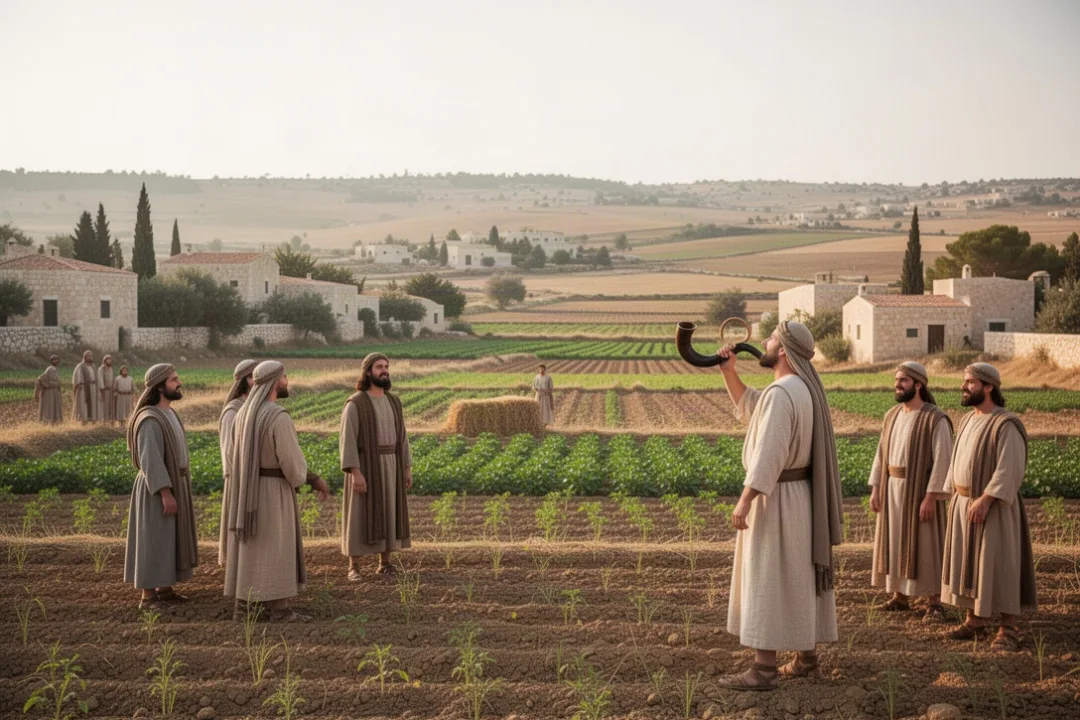
The Hebrew term is related to yobel, commonly associated with a ram’s horn or trumpet. A horn was sounded on the Day of Atonement, the sacred day in the seventh month, to announce the beginning of the Jubilee. The announcement signaled release and restoration throughout the land.
The central idea: Jubilee declared that economic hardship and loss of family land were not meant to continue indefinitely. The land ultimately belonged to God, while Israelite families held it as an inherited trust.
How the biblical Jubilee cycle worked
The instructions in Leviticus 25 follow a clear sequence. Jubilee was not simply a festival held every few years; it was part of a long-term social and agricultural system.
Six years of cultivation: Farmers could plant crops, prune vineyards, and gather the produce of the land.
A seventh-year rest: Every seventh year, the land was to lie fallow. The people were not to manage it as they did during ordinary farming years.
Seven Sabbath-year cycles: Seven groups of seven years created a total of 49 years.
A public announcement: On the Day of Atonement in the 49th year or at the transition into the 50th year, a ram’s horn announced liberty throughout the land.
Restoration in the Jubilee year: Land returned to its original family, qualifying Israelite servants were released, and the land again received a special rest.
The timing also affected agricultural planning. Because the Jubilee year followed a Sabbath year, the people faced more than one year without normal planting and harvesting. Leviticus 25 addresses the concern by promising that the harvest before the rest period would provide enough food until ordinary cultivation resumed.
This detail shows that Jubilee was not only a religious symbol. It required economic trust, careful stewardship, and confidence that the community would have enough to eat while the land rested.
What happened to land during the Jubilee
Land was the foundation of family identity and livelihood in ancient Israel. When an Israelite became poor, the person might sell the use of family land. Under the Jubilee system, that sale was not treated as a permanent transfer of ownership. The land was to return to the family associated with it in the next Jubilee.
Leviticus explains that transactions should be valued according to the number of harvests remaining before Jubilee. A sale made shortly after Jubilee would cover more productive years and therefore have a higher value. A sale made shortly before Jubilee would cover fewer harvests and should cost less.
This was closer to a time-limited lease than to a permanent sale. The arrangement recognized that a family could lose the use of its land for a period, but it prevented one person or household from permanently gathering all ancestral land into its own possession.
There were also provisions for redeeming land before Jubilee. A relative could sometimes buy back land that a poorer family member had sold. The original seller could also regain it under the rules described in Leviticus. If neither happened, the land was restored at Jubilee.
Houses in walled towns were treated differently from agricultural land in the countryside. The biblical regulations distinguish between these types of property, so the phrase “everything returned in Jubilee” is too broad. The restoration rules focused especially on family inheritance and farmland.
How Jubilee addressed poverty and servitude
Jubilee also dealt with Israelites who became so poor that they sold themselves to another Israelite. The law did not treat this person as an ordinary permanent slave. The individual was to be treated more like a hired worker or resident laborer, and the relationship had an end point.
The person’s service could continue until the Jubilee, when release was required. Family members could also help redeem the person earlier if they had the means. The calculation considered the remaining years before Jubilee, much as the price of land was connected to the number of harvests left.
The text also instructs the prosperous Israelite not to rule harshly over a poor fellow Israelite. This placed limits on the way economic dependence could be used. It did not erase every distinction in ancient society, and the biblical laws contain separate rules concerning foreign slaves, but it established a particular release provision for impoverished members of Israel.
The Jubilee rules therefore connected land restoration and personal release. A family’s loss of property and a person’s loss of economic independence were treated as related problems. Both were subject to limits because the Israelites were understood to belong first to God.
Did Jubilee cancel every debt?
Many explanations describe Jubilee as a universal debt cancellation. That language captures part of the idea of economic release, but the biblical text is more specific. Leviticus 25 clearly addresses the return of land and the release of certain Israelite servants. It does not present one simple statement that every financial debt in Israel disappeared automatically in the 50th year.
Another passage, Deuteronomy 15, describes a separate remission connected with the seventh year. That provision concerns loans and debt among Israelites and should not be casually merged with the Jubilee legislation. The two systems share a concern for preventing permanent poverty, but they are not identical rules.
A careful description would say that Jubilee brought economic reset and restoration, especially through land return and release from Israelite servitude. It supported debt relief in the broader biblical vision of compassion, but “all debts were canceled” is an oversimplification unless the speaker explains which biblical provision is meant.
Why the land itself had to rest
Jubilee extended the Sabbath principle beyond weekly worship. The land was not viewed as an unlimited resource that owners could exploit without interruption. It had a rhythm of work and rest, and that rhythm applied even when resting the land created a short-term economic challenge.
Leviticus presents the reason in theological terms: the land belongs to God. Israel’s families were residents and caretakers rather than absolute owners. That belief shaped the rules for buying land, calculating prices, and restoring inheritance.
The agricultural rest also protected the community from treating productivity as the only measure of value. A field did not have to produce crops every year to be considered useful. Rest, restraint, and trust were built into the social order.
Jubilee should not be reduced to a modern environmental policy, since the biblical system had a particular religious and legal setting. Still, its land-rest principle raises recognizable questions about soil use, limits on extraction, and the obligations of people who control productive resources.
What the Jubilee says about ownership and inequality
At the heart of Jubilee is a challenge to permanent concentration of wealth. If land stayed in the hands of the same powerful families forever, poorer households could lose not only income but also their place within the covenant community. Returning ancestral land interrupted that process at regular intervals.
Jubilee did not promise that every household would have identical wealth at every moment. Families could differ in resources, and hardship could still occur. Instead, the system placed a boundary around how far a family’s economic collapse could permanently alter its inheritance.
The rules also placed responsibilities on those with greater resources. A relative who could redeem land or help a family member regain freedom had a defined opportunity to do so. Lenders and buyers were expected to remember that a transaction took place within a larger moral framework.
These principles explain why modern discussions use “Jubilee” to describe debt relief, land reform, poverty reduction, and economic renewal. Such uses draw on the biblical pattern, although they may not reproduce the ancient legal system exactly.
Jubilee, the Day of Atonement, and the announcement of freedom
The Jubilee announcement took place on the Day of Atonement, known in Hebrew tradition as Yom Kippur. That connection links social restoration with repentance, reconciliation, and the renewal of the community’s relationship with God.
The sequence matters. Release was not presented as a private business decision made whenever an owner felt generous. It was proclaimed publicly as part of a sacred calendar. The whole community was reminded that land, labor, and wealth were subject to God’s authority.
The trumpet also made the release visible and communal. People were not expected to discover the change through private negotiations. The sound marked a recognized moment when the community’s economic relationships had to be reordered.
Because Jubilee was announced with a horn, English translations and religious teaching sometimes refer to it as the “year of the trumpet”. The word “Jubilee” itself has come to mean a special anniversary or celebratory milestone, but its biblical background is more specific: it concerns release, return, and restoration.
How later biblical writers used Jubilee themes
Jubilee themes appear beyond Leviticus. The prophet Isaiah describes a mission involving good news for the poor, healing, liberty for captives, and the proclamation of the Lord’s favor. The language echoes the release and restoration associated with Jubilee, although Isaiah presents it in a prophetic and theological setting.
In the Gospel of Luke, Jesus reads from Isaiah in a synagogue and applies the passage to his own mission. Christians commonly understand this scene as showing that Jesus fulfills or embodies the deeper purpose of Jubilee: God brings freedom, restoration, healing, and good news to people experiencing oppression and need.
The New Testament does not establish a regular 50-year agricultural and property cycle for Christian communities. Instead, Jubilee becomes a powerful image for salvation and liberation. Christian traditions differ in how directly they connect the Levitical law with the mission of Jesus, so explanations should distinguish the original law from later interpretation.
Was the biblical Jubilee actually observed?
The biblical text provides detailed instructions, but the surviving biblical history does not give a clear record of a regularly observed Jubilee cycle. The Old Testament mentions Sabbath years in places such as Jeremiah and 2 Chronicles, but it does not offer an unbroken account showing that every Jubilee was proclaimed and carried out as prescribed.
That uncertainty matters. It is accurate to say that Leviticus commands and describes a Jubilee year. It is less certain to claim that historians can document a continuous series of Jubilee observances in ancient Israel.
Some interpreters argue that the exile was connected with neglected Sabbath-year obligations, based on the wording of 2 Chronicles. That passage is important for understanding how later biblical writers viewed the land’s rest, but it does not by itself prove a complete historical record of Jubilee observance.
The absence of clear evidence does not make the idea insignificant. Biblical laws often function as a vision for communal life, even when the text does not show that the ideal was fully practiced. Jubilee can therefore be studied both as an ancient legal prescription and as a moral challenge to economic arrangements.
What “Jubilee” means in Catholic Christianity
In the Catholic Church, a Jubilee or Holy Year is a designated period focused on pilgrimage, repentance, reconciliation, prayer, and God’s mercy. It draws inspiration from the biblical Jubilee but is not the same as the land-and-servitude regulations in Leviticus.
The first formally designated Christian Jubilee is traditionally associated with Pope Boniface VIII in 1300. Later Catholic practice developed the idea of ordinary Holy Years occurring at regular intervals, along with extraordinary Holy Years called for special reasons. The interval has changed across history; the current ordinary pattern is generally 25 years.
During a Catholic Holy Year, participants may be invited to make a pilgrimage, receive the sacraments, perform works of mercy, and seek a plenary indulgence under the Church’s stated conditions. An indulgence concerns the remission of temporal punishment due to sin after forgiveness; it is not the same thing as erasing financial debt or returning ancient land.
The Catholic use of Jubilee keeps the language of mercy, renewal, and release, while giving it a different institutional form. A reader should ask which meaning is intended when encountering the word: the biblical year in Leviticus, a Christian theological theme, or a Catholic Holy Year.
Keep the meanings distinct: The biblical Jubilee was a 50th-year social and agricultural institution, while a Catholic Holy Year is a period of spiritual observance. Both use restoration language, but they are not interchangeable.
How to explain a year of Jubilee accurately
A short answer can be useful, but it should include enough detail to avoid common misunderstandings. Use the following points when explaining the term in a classroom, sermon, study group, or conversation.
State the source: Jubilee is described especially in Leviticus 25.
Give the timing: It followed seven cycles of seven years and was associated with the 50th year.
Name the main actions: Land returned to its ancestral family, the land rested, and qualifying Israelite servants were released.
Explain the purpose: The system limited permanent dispossession and reminded Israel that the land belonged to God.
Handle debt language carefully: Broad debt cancellation is a related idea, but the Jubilee text itself focuses most clearly on land and servitude.
Identify later uses: Isaiah, Christian interpretation, and Catholic Holy Years develop related but distinct meanings.
This approach gives readers both the definition and the setting. It also prevents a modern use of the word from being mistaken for the exact rules of Leviticus.
What Jubilee can mean in modern discussions
Modern speakers often use “Jubilee” as shorthand for a major reset after a period of social or economic strain. A proposal to forgive unsustainable debt, return land to displaced communities, or provide a new start for people trapped in poverty may be called a Jubilee because it echoes the biblical concern with ending permanent disadvantage.
These proposals vary widely. Some focus on international debt, while others address housing, education, racial justice, land access, or personal financial relief. The label does not determine the policy’s details, and using the word does not prove that a proposal matches Leviticus 25.
The strongest modern applications usually preserve several biblical principles:
Hardship should not become permanent: A temporary loss should not automatically destroy a family’s future.
Power needs limits: Ownership and lending should not allow the strong to control every resource indefinitely.
Restoration requires structure: A reset needs clear rules, public recognition, and a way to protect the vulnerable afterward.
Resources carry moral obligations: Land and wealth are not treated as purely private matters when they determine whether other people can live securely.
Community renewal is broader than individual relief: Jubilee seeks a healthier social order, not only a private benefit for one person.
At the same time, modern societies are not ancient Israel. They have different legal systems, economies, property arrangements, and religious commitments. Applying Jubilee today requires interpretation rather than a simple copy-and-paste of an ancient agricultural law.
Why the idea of Jubilee still matters
Jubilee endures because it asks a difficult question: What should happen when ordinary economic rules leave people permanently dispossessed? Leviticus answers by placing a limit on irreversible loss and by building restoration into the calendar itself.
The idea also joins personal mercy to public policy. Helping one poor person matters, but Jubilee imagines a community whose laws prevent poverty from becoming a permanent hereditary condition. The goal is not merely charity after failure; it is a structure that periodically restores access, dignity, and belonging.
For Jewish readers, the concept belongs to the Torah’s vision of Israel’s covenant life. For Christians, it also informs readings of Jesus’ mission and the themes of liberation in the Gospels. For wider audiences, it offers a framework for thinking about limits, repair, economic justice, and the possibility of a genuine new beginning.
So, when someone asks what a year of Jubilee is, the most precise answer is this: it is the 50th year in the biblical cycle described in Leviticus 25, marked by rest, release, and restoration of ancestral land. Its later religious and modern meanings grow from that original vision but should be explained separately.
Frequently asked questions
Is Jubilee the same as a Sabbath year?
No. A Sabbath year occurred every seventh year, when Israel’s agricultural land was to rest. Jubilee followed seven Sabbath-year cycles, making it the 50th year in the biblical pattern. Jubilee included a land rest, but it added distinctive provisions for restoring ancestral land and releasing certain Israelite servants.
Did every person become free during the Jubilee?
The biblical rules specifically address impoverished Israelites who had sold themselves into service to another Israelite. They were to be released at Jubilee, subject to the provisions in Leviticus 25. The text does not describe a universal release of every enslaved person in every circumstance.
Where can I read about Jubilee in the Bible?
The main passage is Leviticus 25, which explains the seven-year cycles, land restoration, release, and the land’s relationship to God. Leviticus 27 contains an additional reference. Isaiah 61 and Luke 4 use related language about liberty and restoration, though they present the theme in prophetic and Christian contexts.
Why do people call modern debt-relief plans “Jubilees”?
The term suggests a reset that prevents financial hardship from becoming permanent. Modern proposals may involve canceling or restructuring debt, expanding land access, or restoring economic opportunity. They borrow the biblical idea of release and renewal, but they are interpretations for modern economies rather than direct implementations of Leviticus 25.








Leave a Reply