What should you make of a manager who is caught wasting his employer’s property, then reduces several customers’ debts before losing his job? The parable of the unjust steward in Luke 16:1–13 can sound as though Jesus is praising fraud. He is not. The manager’s conduct is dishonest, but his employer recognizes his foresight and decisive action.
Jesus uses the story to challenge his listeners about money, responsibility, and the limited time they have to make faithful choices. The central question is not, “How can I copy this man’s dishonesty?” It is, “Do I show the same urgency and practical wisdom when using what has been placed in my hands?”
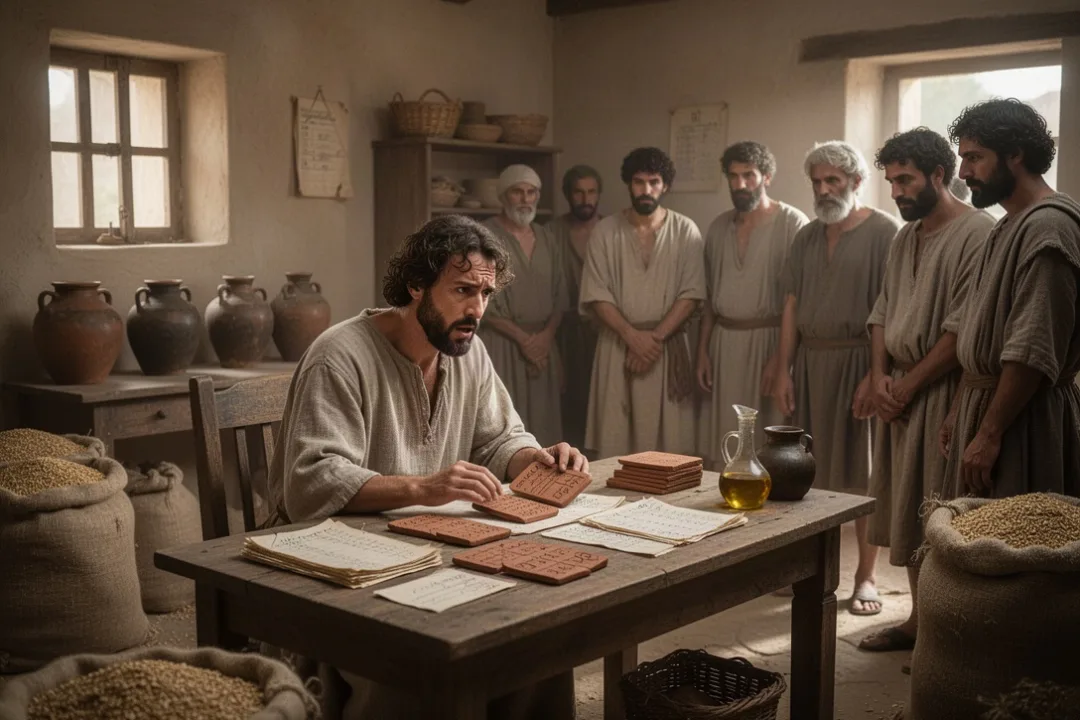
A wealthy man hears that his household manager is wasting his possessions. The manager is summoned and told to prepare an account because he will no longer oversee the estate. He has no attractive alternatives: he does not want to do manual labor, and he feels ashamed to depend on begging.
Facing an uncertain future, he quickly devises a plan. Before his employment ends, he visits people who owe his master money. He asks one debtor how much is owed and instructs him to change the written amount. Another debtor receives a similar reduction. The story presents these transactions briefly, without explaining every detail of the accounting arrangement.
The manager is acting for his own advantage. By reducing the debts, he hopes to create goodwill with people who may welcome him into their homes after he is dismissed. His strategy is morally compromised, but it is focused, timely, and effective from a worldly point of view.
The master then commends the manager—not for being honest, but for acting shrewdly. Jesus observes that people who operate according to ordinary worldly priorities often show more practical determination toward their goals than God’s people show toward spiritual priorities. The lesson turns from the story to the hearers.
Jesus tells them to use worldly wealth in a way that benefits others and has lasting significance. He then adds that a person who is trustworthy with little will also be trustworthy with much, while someone who is dishonest in small matters cannot be trusted with greater responsibility. The parable ends by setting a clear choice between serving God and serving money.
The central distinction: Jesus commends the manager’s urgency and planning, not his dishonesty. The story asks you to imitate his decisiveness while rejecting his corrupt methods.
Why Jesus tells a story about a dishonest manager
Parables often make a point through contrast. A character may possess one quality worth examining without being a moral model in every respect. The unjust steward is not presented as a saint. He is a warning about self-interest, yet he also exposes how seriously people pursue temporary security.
The manager understands that his current position will not last. He does not waste the short period available to him. Once he realizes that his future has changed, he makes a plan and acts immediately. Jesus uses this uncomfortable example to confront spiritual laziness: people may think carefully about employment, retirement, housing, and social connections while treating eternal matters as if they can wait indefinitely.
His conduct also shows that possessions can create relationships and obligations. The manager knows the debtors and understands that financial decisions affect their willingness to receive him later. Jesus is not approving manipulation; he is pointing out that resources can influence human relationships and that people should consider how their resources can serve a greater purpose.
The surrounding context in Luke matters. The preceding chapter includes stories about a lost sheep, a lost coin, and a lost son. Those stories emphasize God’s joy over repentance and restoration. The next material addresses people who are attached to wealth and outward respectability. Against that background, the manager’s behavior raises a searching question: what do your possessions reveal about what you value?
The story also speaks to the original audience’s assumptions about status. Wealth, influence, and control over an estate could make a person appear successful. Yet the manager’s position is fragile. He looks powerful until his employer demands an account. Jesus reminds listeners that earthly security is temporary and that every steward eventually answers for how entrusted resources were used.
What “steward” means in the story
A steward was a person given responsibility to manage another person’s household, property, or business affairs. The steward did not own the estate. His authority was delegated, which meant that he was expected to act for the owner’s interests rather than treat the property as his personal possession.
That role gives the parable a broader spiritual meaning. Money, possessions, abilities, opportunities, and time are not ultimately self-created or permanently controlled. Christians understand them as gifts entrusted by God. The question is not simply how much you possess, but how faithfully you manage what you have received.
The manager fails as a steward because he wastes what belongs to his master. His failure is not only financial. It is a failure of character and accountability. He treats a temporary position as an opportunity for personal benefit instead of as a responsibility requiring faithful service.
What the debt reductions may mean
Readers often ask whether the manager simply removes his own commission, reduces his master’s profit, or falsifies the accounts. The passage does not settle every detail. Several explanations have been proposed, and the parable’s main teaching does not depend on choosing one with complete certainty.
In the economic world behind the story, debts could involve produce, money, interest, commissions, or other arrangements. A manager might have had room to negotiate terms, though the extent of his authority is unclear. The reductions could represent part of his compensation, an inflated amount he had recorded, or a direct loss imposed on the owner. Luke’s description leaves enough ambiguity that dogmatic claims about the exact accounting process can go beyond the text.
What is clear is the manager’s motive. He is not reducing the debts out of compassion or repentance. He is trying to secure future shelter and relationships after his dismissal. His action is calculated for personal advantage, and the story calls attention to his lack of integrity.
The master’s response can seem even more surprising. The owner commends the manager’s shrewdness because he recognizes that the plan is clever and effective. This is an example of limited commendation: the manager is praised for one characteristic without being declared morally good. The same kind of distinction appears in ordinary speech when someone says that an opponent handled a situation intelligently even though the opponent’s goals or methods were wrong.
Jesus’ point depends on that distinction. If the manager were entirely foolish and ineffective, he would offer little instruction. Instead, he is a sharp contrast to disciples who know that their choices have eternal consequences but often act with little urgency. The dishonest manager knows his deadline; Jesus’ followers should recognize theirs.
Do not imitate his fraud: the manager uses deception and self-interest.
Do notice his urgency: he acts when his opportunity is limited.
Do learn from his planning: he considers the consequences of his present choices.
Do redirect the lesson: use your resources for faithful, generous, and lasting purposes.
The reductions may also highlight the relational power of money. A debt is not an abstract number when another person’s livelihood, dignity, or future is affected. Jesus repeatedly warns against allowing wealth to control the heart. In this parable, the manager sees that financial decisions can either close people out or create welcome. The disciple must ask how money can be used to protect dignity, relieve hardship, and support the work of mercy.
What Jesus means by using worldly wealth wisely
Jesus refers to “worldly wealth,” often translated with the word mammon. Mammon can mean material wealth or possessions, especially when wealth becomes an object of trust and devotion. Money itself is not described as morally neutral in every situation; it can be used for good or become a rival master.
The instruction to use wealth for lasting purposes does not mean buying spiritual favor or earning salvation through donations. Scripture consistently presents God’s grace as something received, not purchased. Jesus is teaching that possessions should be placed under God’s authority and used in ways that express love of neighbor.
One practical result is generosity. Money can provide food, housing, medical care, education, transportation, and safety. It can support churches, charities, missionaries, and local ministries. It can help a person leave an abusive situation, recover from a crisis, or regain stability after unemployment. These uses do not make wealth eternal, but they can make temporary wealth serve eternal values.
Another result is hospitality. The manager wants people who will receive him later. Jesus transforms the idea of welcome by directing his followers toward relationships shaped by generosity rather than calculation. You do not give merely to collect favors, improve your reputation, or ensure that others owe you something. You give because people matter and because love must become concrete.
Jesus’ phrase about being welcomed into eternal dwellings should not be treated as a promise that the people you help become your judges or gatekeepers in heaven. It is vivid language about the lasting significance of faithful generosity. Temporary resources can be invested in people, and the good done through them can outlast the resources themselves.
Wise stewardship includes more than giving away every dollar. It may involve paying honest wages, keeping promises, avoiding predatory transactions, using skills to serve others, and making purchases that do not exploit vulnerable people. It also includes refusing to let possessions define your identity or dictate every major decision.
Recognize ownership: treat what you have as entrusted rather than absolutely possessed.
Examine your motives: ask whether a financial choice is driven by love, fear, pride, greed, or a desire for control.
Protect people from unnecessary harm: avoid dishonest deals, exploitative lending, and promises you cannot keep.
Give deliberately: set aside resources for people and causes that reflect God’s priorities.
Act while you can: do not postpone every generous or obedient decision until circumstances become ideal.
Practical test: Before making a significant financial decision, ask, “Does this treat money as a tool for faithfulness, or as the authority directing my life?”
How the parable explains faithfulness in small matters
After discussing wealth, Jesus moves to a principle about trustworthiness. Small matters are not spiritually insignificant simply because they seem private or inexpensive. They reveal habits of truthfulness, self-control, and responsibility that carry into larger assignments.
A person who lies on a small expense report may later misuse a larger budget. Someone who quietly takes what does not belong to them may be tempted to misuse greater authority. By contrast, a person who keeps accurate records, admits mistakes, returns what was borrowed, and follows through on modest commitments is developing the character required for wider responsibility.
This principle applies to money, but it is not limited to money. A few examples include:
Using work hours honestly when no supervisor is present.
Keeping confidential information private instead of using it for personal advantage.
Paying what you owe and communicating early when you cannot do so.
Handling shared property carefully rather than treating it as disposable.
Giving credit to others instead of presenting their work as your own.
Speaking truthfully in ordinary conversations, not only in serious situations.
The parable exposes the weakness of separating “spiritual life” from everyday conduct. A person may attend worship, speak about faith, and still be untrustworthy in business or household responsibilities. Jesus does not accept a religious identity that leaves ordinary decisions untouched.
Small faithfulness also matters because every action forms a person. Repeated choices become habits, habits shape character, and character influences how you respond when pressure arrives. The manager’s crisis reveals what he has become: someone skilled at protecting himself but willing to use another person’s property for that purpose.
Jesus’ teaching is not meant to produce anxious perfectionism. Everyone makes mistakes, misjudges situations, and needs forgiveness. Faithfulness includes telling the truth about failures, making restitution where possible, and accepting accountability. The goal is not to appear flawless; it is to become dependable and honest under God’s direction.
Why the parable ends with a choice between God and money
The final saying gives the story its sharpest edge. No servant can belong fully to two masters whose demands conflict. Jesus identifies God and money as competing claims on loyalty. Wealth promises safety, status, independence, and control, while God calls for trust, obedience, generosity, and love.
The problem is not merely having money. Abraham, Job, Joseph of Arimathea, Lydia, and other biblical figures are associated with significant resources, yet possessions are never presented as proof that a person is spiritually secure. The danger arises when money becomes the master—when it determines identity, ethics, relationships, and hope.
Money becomes a master when you compromise truth to gain it, refuse generosity because you fear losing it, measure people by their income, or believe that a larger balance can remove every vulnerability. It can also become a master through constant comparison: you may have enough for your needs but remain restless because someone else has more.
Serving God changes the purpose of possessions. You still budget, save, work, plan, and make responsible financial decisions. But those decisions are no longer governed only by comfort or accumulation. They are weighed against worship, justice, compassion, family responsibilities, and care for people who are easily overlooked.
The parable therefore calls for a deliberate review of your relationship with money. Ask yourself:
What financial fear most strongly influences my choices?
Where am I tempted to justify dishonesty because the amount seems small?
Do my spending habits reflect my stated values?
Who benefits from the way I earn, save, and give?
What opportunity for generosity or reconciliation am I postponing?
These questions are not a formula for earning God’s acceptance. They are ways to test whether your use of temporary resources agrees with your professed allegiance. The unjust steward shows that people can be highly purposeful when protecting their earthly future. Jesus calls his disciples to bring that same purposefulness to the things that last.
Luke 16:1–13 is difficult because it refuses a simplistic moral lesson. It neither excuses dishonesty nor permits comfortable religious indifference. The manager is a negative example with one striking strength: he understands the urgency of his situation and acts accordingly.
For a Christian, faithful stewardship means using money without worshiping it, helping others without manipulating them, acting honestly when no one is watching, and remembering that every earthly opportunity has an ending. The right response to the parable is not admiration for the manager’s corruption. It is a renewed commitment to wise, generous, and trustworthy service while you still have time.
Frequently asked questions
Is the unjust steward an example Christians should follow?
No. His dishonesty and self-serving motives are not approved. Jesus highlights his ability to recognize a deadline, plan effectively, and act decisively. Christians should imitate those qualities only when pursuing what is right. The story is a contrast: people often show greater energy in securing temporary benefits than believers show in serving God and caring for others.
Why did the master commend the dishonest manager?
The master commended the manager’s shrewdness, not his ethics. The manager understood that his position was ending and quickly prepared for what came next. Jesus uses the employer’s reaction to make a larger point about urgency and foresight. A person can be clever in practical matters while remaining morally corrupt, so the praise is limited rather than complete.
Does this parable teach that giving money earns a place in heaven?
No. Generosity cannot purchase forgiveness or salvation. The teaching concerns how people who belong to God should use temporary resources. Money can express gratitude, compassion, justice, and hospitality, but those actions are responses to God’s grace rather than payments for eternal life. The parable warns against trusting wealth and encourages faithful stewardship.
What is mammon in Luke 16?
Mammon refers to wealth or material possessions, especially when they become an object of trust and devotion. Jesus does not say that every possession is sinful. He warns that money can compete with God for a person’s loyalty. Material resources should remain tools used responsibly, not a master that controls values, relationships, and decisions.











Leave a Reply