Job is a righteous man whose suffering challenges the belief that hardship always results from personal sin.
The Book of Job is one of the Bible’s most searching works about pain, faith, justice, and human limits. Its central character loses his wealth, children, health, and social standing, yet the story does not reduce his suffering to a simple moral lesson. Instead, it asks difficult questions: Why do innocent people suffer? Can faith survive when life appears unfair? Does God owe human beings an explanation for everything that happens?
Job’s story appears in the Old Testament, among the books commonly associated with wisdom literature. Unlike Proverbs, which often describes how wise living tends to produce good results, Job examines what happens when that pattern seems to fail. The book does not deny that actions have consequences, but it rejects the assumption that every tragedy can be explained by identifying a victim’s hidden wrongdoing.
Job is introduced as a man of integrity, reverence, and moral seriousness. He lives in the land of Uz, a setting outside Israel’s usual geographical focus. The text describes him as prosperous and respected, with a large household, many animals, and several children.
Job’s righteousness is presented as genuine rather than self-serving. He regularly worships God and worries about the spiritual well-being of his children. After family celebrations, he offers sacrifices on their behalf in case they may have sinned. This detail establishes him as someone who takes faith seriously even before his troubles begin.
The opening chapters also emphasize that Job’s goodness is not limited to public reputation. He is portrayed as a person who seeks to live rightly when no obvious reward is at stake. That point matters because the book’s central question concerns the nature of faithful devotion: Does a person honor God only because life is comfortable?
Central idea: Job’s suffering is not presented as proof that he was secretly worse than other people. The book specifically challenges the habit of treating another person’s pain as evidence of personal guilt.
What happens to Job in the biblical story
Job’s troubles unfold in a series of devastating losses. He loses his livestock, servants, and economic security. Then messengers arrive with news that his children have died in a catastrophic event. The speed and scale of these disasters leave him grieving, but he initially responds with worship and restraint.
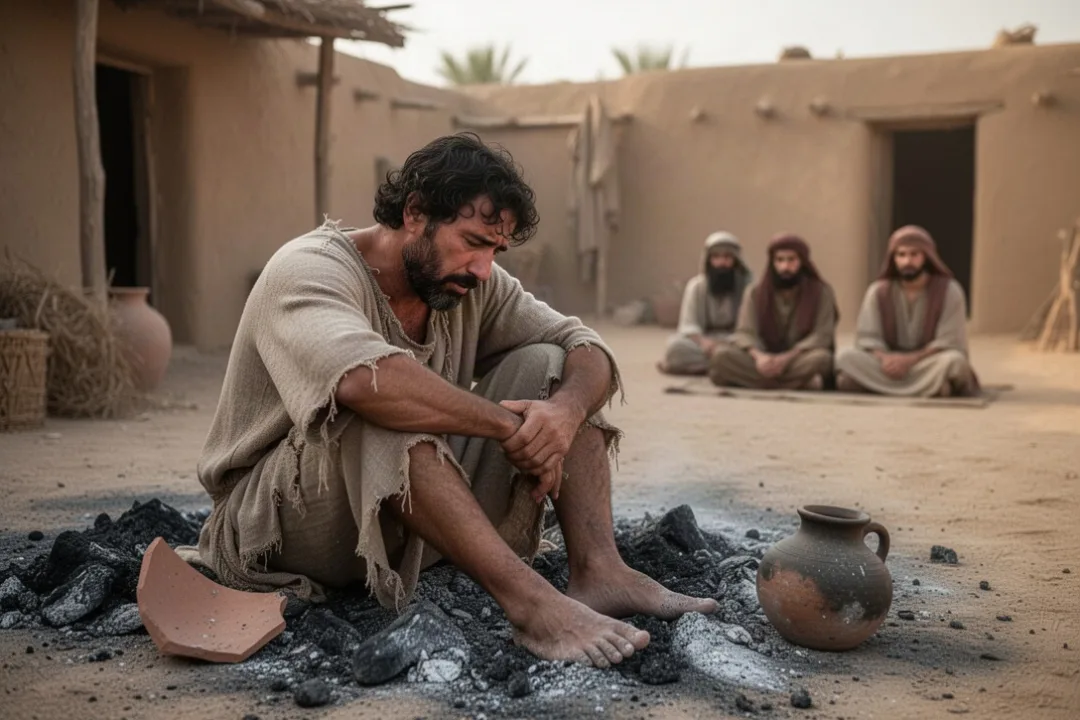
His suffering then becomes physical. Job is afflicted with painful sores over his body. He sits in an ash heap, a traditional sign of mourning and humiliation, and scrapes himself with a piece of pottery. His condition is so severe that his wife tells him to abandon his devotion to God, but Job refuses to treat God as worthy of worship only when circumstances are favorable.
Job does not remain silent or emotionally composed throughout the ordeal. He curses the day of his birth, describes his anguish in vivid language, and repeatedly asks why he has been left to suffer. His grief is not presented as a failure of faith. The book allows lament, protest, confusion, and anger to become part of an honest relationship with God.
Three friends—Eliphaz, Bildad, and Zophar—come to visit him. At first, they do something compassionate: they sit with him in silence for seven days and seven nights because his grief is so great. Their silence is among the most caring things they do. Their later speeches, however, become increasingly harmful as they try to explain the unexplainable.
Why Job’s friends are wrong about his suffering
Job’s friends assume that great suffering must be evidence of great sin. Their reasoning reflects a familiar moral framework: God is just, the wicked are punished, and the righteous are protected. Therefore, if Job is suffering so severely, he must have done something that he has not admitted.
Eliphaz suggests that people reap what they sow. Bildad argues that God does not pervert justice, so Job’s losses must have a moral explanation. Zophar goes further by implying that Job deserves even more punishment than he has received. Each friend defends a belief in divine justice, but they do so by accusing a suffering man without evidence.
Their arguments sound religious because they contain statements about God’s power and justice. Yet the book portrays their use of those ideas as misapplied theology. They value a neat explanation more than compassion, and they force Job’s experience into a system that cannot account for innocent suffering.
At the end of the book, God rebukes Job’s friends for speaking wrongly about him. This does not mean every sentence they say is false. Rather, their overall interpretation is condemned because they claim to know why Job suffered when they did not have that knowledge.
Do not assume suffering proves hidden sin. A person’s hardship may have many causes, including illness, injustice, accidents, other people’s actions, or circumstances no one can fully explain.
Do not use true statements carelessly. A general teaching about justice can become cruel when applied as a judgment against one grieving individual.
Do not confuse explanation with comfort. People in pain often need presence, listening, and practical help before they need a theory about their circumstances.
Do not treat unanswered questions as moral failures. Job’s questions are part of the book’s faithful struggle rather than evidence that he has stopped caring about God.
What the heavenly scenes mean in Job
The first two chapters include scenes in the heavenly court that the human characters do not see. A figure called the adversary questions whether Job’s devotion is sincere or merely the result of God’s protection and blessing. Permission is given for Job to be tested, within limits that are described in the story.
These scenes provide information to the reader that Job himself never receives. That difference is essential. Job spends the entire book trying to understand the reason for his suffering, but he is never told about the heavenly conversation that initiated the test. The reader therefore sees the limits of Job’s perspective while also recognizing the inadequacy of the explanations offered by his friends.
The opening scenes should not be used to suggest that every tragedy is a direct test arranged in the same way. The book is a work of wisdom literature, and its dramatic structure raises questions about faith, accusation, and divine governance. It does not give readers permission to identify a supernatural cause behind each painful event.
The story also resists a shallow definition of faith. Job is not praised because he feels no pain or never asks questions. He is faithful while grieving, protesting, and seeking an answer. His relationship with God includes both trust and confrontation.
How Job’s speeches express grief and faith
Much of the book consists of poetry spoken by Job and his friends. The poetic form gives Job room to describe his suffering from many angles: physical pain, loneliness, humiliation, fear, anger, and longing for a fair hearing. He wants his case to be examined rather than dismissed.
Job repeatedly maintains that he has not committed the kind of wrongdoing that would explain his losses. He does not claim to be flawless in every possible sense, but he rejects the charge that his suffering is a straightforward punishment for secret wickedness. His demand is not simply for comfort; he wants justice and an honest hearing.
At several points, Job expresses confidence that his situation will not remain hidden forever. Readers interpret these passages in different ways, and some Christian traditions connect them with later hope for redemption. Within the immediate story, however, they clearly show Job’s desire for a witness, advocate, or redeemer who can establish the truth about him.
The speeches also show how grief affects a person’s sense of time and identity. Job remembers earlier prosperity, contrasts it with his present disgrace, and imagines death as relief from unbearable pain. The text does not present these words as a simple set of doctrines. They are the speech of a wounded person trying to make sense of a life that no longer resembles what he knew.
“The Lord gave, and the Lord has taken away” is a reference to Job 1:21, where Job responds to sudden loss with grief and worship rather than a detailed explanation.
That famous line should not be used to pressure grieving people into emotional acceptance. Job later speaks at length about his anguish, so the book itself shows that a brief statement of submission does not eliminate sorrow, questions, or the need for care.
What God’s response to Job means
God eventually speaks from a whirlwind. The speeches focus on the creation and management of the natural world: the sea, weather, animals, wild creatures, and patterns of life beyond human control. God asks Job questions about the origins and operations of creation, highlighting the vast difference between divine knowledge and human understanding.
God’s response is not a direct explanation of the heavenly test. Job is not told that his losses were caused by a wager, nor is he given a philosophical answer that makes the deaths of his children acceptable. Instead, he encounters the majesty and complexity of creation and recognizes that his own perspective is limited.
Some readers find this response comforting because it presents a world larger than human judgment. Others find it difficult because Job does not receive a reason that would satisfy ordinary ideas of fairness. Both reactions are understandable. The book does not make every aspect of suffering emotionally easy or intellectually tidy.
God’s speeches also correct Job in a specific way. Job has demanded a hearing, and he has sometimes spoken as if he could fully evaluate the governance of the universe. God does not condemn him for grieving, but Job comes to recognize that human understanding cannot measure all reality.
Job then responds with humility. He acknowledges that he spoke about matters beyond his knowledge and that his encounter with God has changed him. This is not the same as admitting that his friends were right. Job’s repentance concerns his limited claims about God’s purposes, not a confession that he secretly caused every disaster.
How the Book of Job ends
After God addresses Job, the friends are told that they have not spoken rightly about God. Job prays for them, and the story restores his health, household, and prosperity. He has more children and receives renewed material blessing.
The ending has both comfort and tension. Restoration shows that Job’s life is not defined forever by catastrophe, and it affirms that loss is not the final word in the story. At the same time, restored wealth cannot simply replace the children who died. The narrative does not describe grief as erased by receiving new blessings.
For that reason, the ending should not be turned into a promise that every faithful person will recover everything lost. The Bible contains other faithful figures whose lives end in suffering, persecution, or death. Job’s restoration belongs to this particular literary story; it is not a formula that explains what God will do for every reader.
The final chapters also reverse the friends’ accusations. Job, the person they condemned, becomes the one who intercedes for them. The story ends by showing that compassionate relationship is better than confident accusation, especially when a person’s pain cannot be explained.
What Job teaches about suffering and faith
The book’s most direct lesson is that suffering cannot always be interpreted from appearances. A prosperous life is not automatic proof of righteousness, and a painful life is not automatic proof of guilt. This challenges both judgmental religious advice and simplistic assumptions about success.
Job also teaches that lament has a legitimate place in faith. He brings his anger and confusion toward God instead of hiding them behind polite religious language. His example gives readers permission to pray honestly when they feel abandoned, betrayed, or unable to understand what is happening.
Another lesson concerns the danger of speaking too confidently about divine purposes. People often want a reason for tragedy because an explanation can feel more manageable than uncertainty. The Book of Job warns that an attractive explanation may still be false, particularly when it blames the person who is already suffering.
The book does not answer every question about evil. It does, however, change the questions readers ask. Instead of focusing only on whether a victim deserves pain, it draws attention to how people respond to suffering: with presence or accusation, humility or arrogance, honest prayer or empty certainty.
For helping someone who is hurting: Sit with them, listen without forcing an explanation, offer specific practical help, and avoid suggesting that their illness or loss proves spiritual failure.
Common mistakes when interpreting Job
Job is often quoted in ways that flatten its complexity. Reading the whole movement of the book helps prevent several common mistakes.
Reducing Job to patience. Job does show endurance, but he also protests intensely. Describing him only as a silent sufferer ignores most of the book’s poetry.
Claiming that Job’s suffering was caused by his sin. The opening explicitly presents him as upright, and God later rejects the friends’ accusations.
Promising guaranteed restoration. The ending is part of Job’s narrative, not a universal guarantee that every loss will be repaid in this life.
Using Job’s words as isolated slogans. Statements spoken during shock or despair need to be read within the surrounding speeches and the book’s larger argument.
Assuming every hardship is a divine test. The heavenly scenes belong to the book’s dramatic framework and do not give readers knowledge of the cause of every modern tragedy.
Treating questions as unbelief. Job’s questioning is directed toward God and remains connected to his desire for truth. The book makes room for faithful struggle.
How to read Job responsibly today
Begin by reading Job as a complete work rather than selecting only its most familiar lines. Notice the change from prose at the beginning and end to extended poetry in the middle. Pay attention to who is speaking, what each person assumes, and how God evaluates the competing speeches.
It also helps to separate description from instruction. The book describes Job’s wife, friends, and heavenly adversary, but not every statement made by those figures should be treated as guidance for readers. The narrative’s final judgment matters more than the confidence of any individual speaker.
When reading the poetry, allow room for emotional language. Job uses images of darkness, imprisonment, danger, and bodily distress because ordinary speech cannot contain the intensity of his experience. Those images are not necessarily systematic statements about the afterlife, illness, or God’s character.
Readers can also ask practical questions:
Am I assuming that a person’s circumstances reveal their moral worth?
Do I listen to grieving people, or do I rush to explain their pain?
Can I acknowledge uncertainty without pretending to know God’s secret purposes?
What kinds of honest prayer become possible when lament is treated as faithful speech?
How can I offer concrete care instead of only religious advice?
Why Job still matters for readers facing hardship
Job remains meaningful because it takes suffering seriously without offering a cheap explanation. It recognizes that people may lose health, family, work, reputation, security, or hope in ways they cannot prevent. It also shows that grief may include contradictory emotions: trust and anger, worship and protest, love and disappointment.
The story can be especially important for people who have been told that their difficulties prove they are spiritually defective. Job directly challenges that message. A person may be suffering without being punished, and a person offering religious explanations may be wrong even when speaking with confidence.
Job also encourages a more careful kind of community. His friends begin well by showing up and remaining silent. They fail when they make his pain serve their need for certainty. Their example suggests that compassion requires humility: you may care deeply about someone without knowing why their suffering occurred.
For believers, Job presents faith as more than receiving blessings or agreeing with easy answers. Faith may involve continuing to seek God amid confusion while refusing to call evil good or pretend that loss does not hurt. For readers who are uncertain about faith, the book’s honesty can still offer a serious account of the questions suffering raises.
Job does not provide a complete explanation for every tragedy. It offers something different: a warning against cruel certainty, permission to lament, a vision of God greater than human control, and a reminder that another person’s suffering should be met first with compassion.
Frequently asked questions
Was Job a real person in the Bible?
The Book of Job presents Job as a historical figure, but the Bible does not provide enough information to establish his date, location, or biography with certainty. Job is mentioned elsewhere in the Old Testament as an example of righteousness, and the New Testament refers to his endurance. The book itself is shaped as wisdom literature, combining prose narrative with extended poetry.
Did Job lose his children because he sinned?
No. The story introduces Job as upright before his losses occur, and God later rejects the accusations made by Job’s friends. The book’s purpose is partly to challenge the belief that every tragedy is direct punishment for personal wrongdoing. Job’s losses are not presented as evidence of hidden guilt.
What is the main message of the Book of Job?
The book teaches that human beings cannot always know why suffering occurs, and that hardship should not automatically be interpreted as punishment. It also validates honest lament and warns against explaining another person’s pain with unwarranted confidence. Job ends with humility before God rather than a complete intellectual explanation.
Why does God restore Job’s possessions but not simply bring back the children who died?
The restoration at the end signals renewed life and blessing within the story, but it does not erase the earlier deaths or make the grief insignificant. The passage should not be treated as a promise that every loss will be replaced in this life. Its ending remains emotionally complex rather than offering a simple calculation of compensation.











Leave a Reply