There is no single official number of Bible versions. The count depends on what you mean by “version”: an English translation, a revision, a study edition, a Bible in another language, or a collection with a different set of books.
People often ask this question expecting one number, but several different measurements are involved. There are many English translations, thousands of translations and portions across the world’s languages, and multiple Christian traditions with different biblical canons. A new revision may preserve most of an earlier translation while still being marketed as a distinct version.
The word version is used loosely. In everyday conversation, it usually means a translation such as the New International Version, the King James Version, or the New Living Translation. Publishers and Bible organizations may also use the word for a revision, a special edition, or a Bible designed for a particular audience.
Those categories overlap. A large-print Bible may contain the same translation as an ordinary edition, while a study Bible may add notes, maps, and essays without changing the biblical text. A revision can alter vocabulary, punctuation, or passages based on current scholarship, making it different from its predecessor even when the overall wording remains familiar.
The count also changes according to how much of the Bible has been translated. A complete Bible contains both the Old Testament and New Testament, while a New Testament, Gospel, or collection of selected books is only a portion. Some language projects begin with individual books and later produce a complete edition.
Translation: The biblical text is rendered from Hebrew, Aramaic, and Greek into another language.
Revision: An existing translation is updated while retaining much of its earlier structure or wording.
Edition: The same translation is published with different formatting, notes, cross-references, or study materials.
Paraphrase: The message is restated more freely rather than translated closely sentence by sentence.
Portion: Only part of the Bible, such as the Psalms or New Testament, is published.
For that reason, two reliable organizations can report different totals without either one being mistaken. One may count only complete translations, another may include partial translations, and a third may count revisions as separate publications. The best answer is not a single number but a description of which category is being counted.
The short answer: There are hundreds of English Bible translations and revisions, while the Bible has been translated in whole or in part into thousands of languages. The exact total changes as new projects and revisions appear.
How many English Bible versions are commonly used?
English has a particularly large number of Bible versions because translation work has continued for centuries. Older translations remain in use alongside modern ones, and publishers regularly release revisions intended to improve accuracy, readability, or clarity for a particular group of readers.
Among widely recognized English versions are the King James Version, New King James Version, New International Version, English Standard Version, New American Standard Bible, Christian Standard Bible, New Living Translation, New Revised Standard Version Updated Edition, and Common English Bible. This is not a complete list, and popularity differs among churches, denominations, regions, and individual readers.
Some English Bibles are strongly associated with a particular translation philosophy. Others are known for a specific theological tradition, reading level, manuscript preference, or historical role. A version can be respected for careful scholarship even if it is not the one most frequently used in a reader’s church.
Why English has so many translations
English changes over time. Words that were clear several centuries ago can become unfamiliar, and sentence patterns that once sounded natural may now feel formal or confusing. A revision may replace outdated vocabulary, adjust punctuation, or clarify a passage while preserving the translation’s general approach.
Translators also make different decisions about how to represent the original languages. A more formal-equivalence translation generally stays close to the wording and structure of the source languages. A more dynamic-equivalence or functional translation focuses more on communicating the meaning naturally in contemporary English.
Neither label tells you everything about a Bible. Most translations use a mixture of approaches because some passages require close attention to wording while others communicate more clearly when phrased idiomatically. A version’s preface or publisher’s translation notes can explain its stated goals.
Popular versions are not the same as all available versions
Well-known versions represent only part of the English landscape. There are also translations produced for children, people learning English, readers with limited literacy, academic study, liturgical use, or particular Christian communities. Some were created as independent projects, while others were prepared by committees of scholars from different backgrounds.
Online Bible libraries can make the selection seem even larger because they include public-domain texts, historical translations, revisions, paraphrases, and editions that may no longer be widely printed. If a website lists hundreds of English Bibles, that does not necessarily mean hundreds of entirely independent translation projects exist.
How Bible translations differ from one another
Every translation involves decisions. The biblical books were written primarily in Hebrew and Aramaic for the Old Testament and Greek for the New Testament. Translators study those languages, compare ancient manuscripts, examine historical context, and decide how best to communicate the meaning in the target language.
The original manuscripts of the biblical books are not available to us. Instead, scholars work with many ancient copies and quotations, comparing them to identify the wording most likely to reflect the earliest recoverable text. Most differences among major modern translations are small, but some passages have footnotes explaining manuscript variations or why a sentence appears differently.
Translation philosophy affects wording
A formal translation may preserve repeated terms, grammatical patterns, and metaphors that help readers see connections across passages. A more meaning-based translation may explain an idiom in natural English when a literal rendering would sound confusing or misleading. Readability and closeness to the source text can pull in different directions, so translators must balance them.
For example, a Hebrew or Greek expression may have a direct word-for-word equivalent in English, but that equivalent might not convey the same meaning to modern readers. Translators then consider the surrounding paragraph, the author’s purpose, and how the expression was understood in its historical setting.
Paraphrases take greater freedom with wording and often aim to make the text accessible in everyday speech. They can help readers grasp the broad sense of a passage, but they should not be confused with a translation made through the same method as a formal scholarly version. Many readers compare a paraphrase with one or more translations when studying a difficult passage.
Manuscript choices can produce visible differences
Modern translations do not all use exactly the same underlying editions of the Hebrew and Greek texts. Differences in ancient manuscripts sometimes affect whether a phrase is included in the main text, placed in a footnote, or presented with a note about the evidence.
This does not mean that one Bible has all the truth while another has none. It means that translators must report and evaluate the evidence available from ancient copies. A responsible edition often signals these issues in footnotes rather than hiding them from readers.
When two Bibles differ: Check the footnotes and prefaces before assuming that one version has changed the meaning. The difference may reflect an ancient manuscript question, an idiom, a textual decision, or a deliberate difference in translation style.
Why different churches have different numbers of biblical books
“How many versions” can also refer to how many books appear in the Bible. Christian traditions do not all use precisely the same canon, meaning the recognized collection of biblical writings. The Protestant Bible commonly contains 66 books, while Catholic Bibles include additional books often called the Deuterocanonical books. Eastern Orthodox traditions may include still more books or arrange the collection differently.
These differences are not simply translation differences. A Catholic Bible and a Protestant Bible may use the same language and similar wording for many books, but one may include texts that the other places in a separate section or does not include in its canon. Jewish editions of the Hebrew Bible also differ in arrangement and naming from many Christian Old Testaments.
The term Apocrypha is used in different ways. Some Protestant editions use it for books printed between the Testaments but not treated as part of the Protestant canon. Catholic traditions generally use “Deuterocanonical” for several of these books, reflecting their accepted status within that tradition.
Book counts can therefore be misleading. A Bible with more books is not necessarily a different translation in every other respect, and a Bible with fewer books is not necessarily missing material by accident. The difference usually reflects the tradition that produced or authorized the edition.
Protestant editions generally use a 66-book canon.
Catholic editions include the Deuterocanonical books in addition to the books found in Protestant Bibles.
Eastern Orthodox editions may include additional writings and can vary somewhat by church tradition.
Jewish editions contain the Hebrew Bible, with a different organization and naming of books from most Christian editions.
A Bible’s table of contents can answer this question more reliably than its cover. If you need a Bible for a church class, worship service, or academic assignment, check which canon that setting expects. The same translation family may be available in editions with different contents.
How to choose among the major Bible versions
Choosing a Bible is easier when you start with your purpose instead of trying to identify the “best” version for everyone. A person reading Scripture devotionally may prioritize smooth, natural English. Someone studying word choices may prefer a translation with extensive footnotes and a more literal structure.
Consider these questions before selecting an edition:
What will you use it for? Decide whether your main goal is regular reading, public worship, detailed study, memorization, comparison, or learning about a particular tradition.
How much explanatory help do you want? Study notes can provide historical and theological context, but they are interpretations supplied by editors rather than part of the biblical text.
What reading style suits you? Compare a few pages from a formal translation, a meaning-based translation, and a paraphrase to see which remains clear without losing the features you value.
Which canon do you need? Confirm whether the edition includes the books recognized by your church or course of study.
Can you read it comfortably? Font size, page layout, paragraph formatting, and digital accessibility can make a major difference in sustained reading.
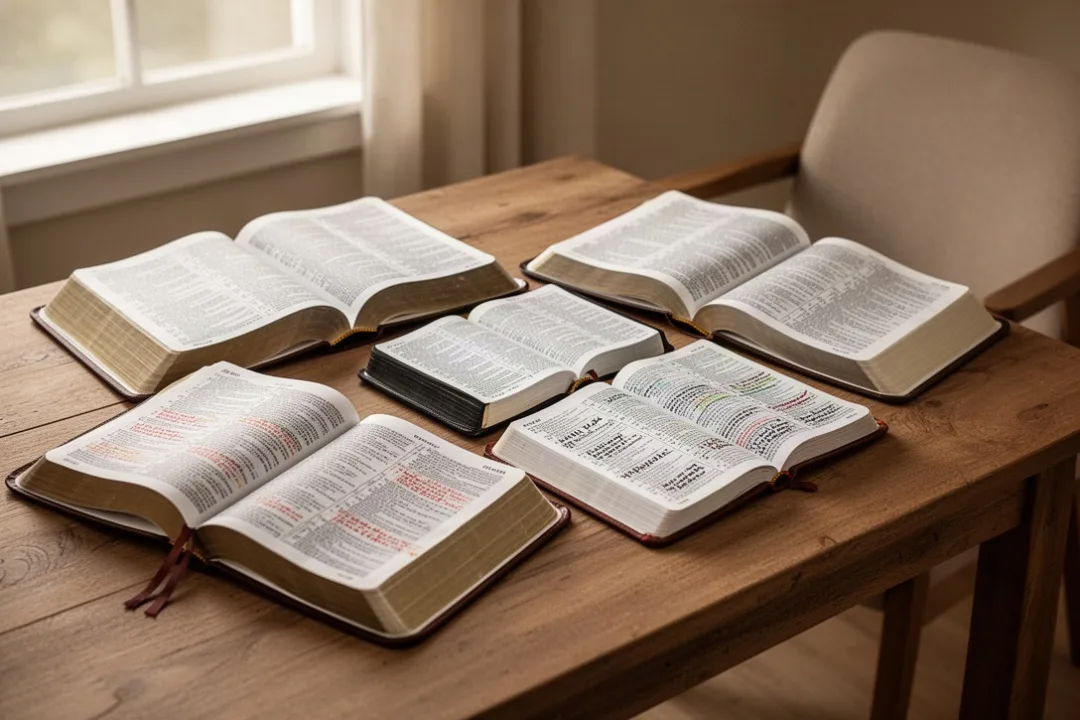
Many readers benefit from using two or more translations. One may help with close study, while another makes long passages easier to follow. Comparing versions can reveal where translators had to make interpretive choices, especially in poetry, ancient idioms, and passages with manuscript variations.
Do not judge a translation from one isolated verse. Read a whole paragraph or chapter, because context reveals whether the wording communicates the author’s argument, imagery, and tone. A version that sounds clear in a short quotation may feel less natural across a complete biblical book.
Study Bibles, standard Bibles, and digital editions
A standard Bible usually contains the text with limited helps such as cross-references or brief footnotes. A study Bible adds commentary, introductions, maps, timelines, and articles. Those materials can be valuable, but the notes reflect the perspective of the editors and should be distinguished from the biblical text itself.
Digital Bible apps often offer many translations in one place. They make comparison convenient and may include audio, search tools, reading plans, and language resources. Still, app listings can combine full translations, partial texts, paraphrases, and older editions, so the total displayed on a platform is not a universal count.
If you are comparing versions for serious study, look at the translation committee’s stated method, the publication date of the current revision, the included notes, and the treatment of manuscript differences. A transparent preface is often more useful than a marketing label such as “literal” or “easy to read.”
What the number of Bible versions tells you
The large number of Bible versions reflects the history and reach of the biblical text rather than a simple competition among books. Translation is necessary whenever people encounter Scripture in a language different from the original languages, and each generation may need wording that communicates naturally in its own setting.
Different versions also preserve different strengths. An older translation may have lasting literary influence and familiar phrasing. A modern translation may communicate ancient expressions more clearly to contemporary readers. A version prepared for a minority language can make Scripture available to people who have never had access to a complete Bible in their first language.
At the same time, more versions do not remove the need for careful reading. Every translation has limits, and every edition reflects decisions about language, manuscripts, formatting, and sometimes theological tradition. Readers can respond by consulting introductions, comparing responsible translations, and paying attention to context rather than treating a single wording as the only possible English expression.
So, how many versions of the Bible are there? There are hundreds of English translations and revisions, thousands of language projects when complete and partial translations are counted, and multiple biblical canons across religious traditions. The precise total depends on the definition and the catalog being used. For practical purposes, the better question is which translation and edition best fit your language, tradition, and reason for reading.
Frequently asked questions
How many different English versions of the Bible are there?
No universally accepted total exists because catalogs count translations, revisions, paraphrases, and partial editions differently. English has hundreds of published versions and revisions, but only a smaller group is widely used today. Some are historical translations, while others were made for children, study, worship, accessibility, or contemporary language. The number also changes as publishers release new revisions.
Is every Bible translation a different version?
Usually, but not always. A new translation created from the original biblical languages is generally treated as a separate version. A revision may also receive its own title even though it builds heavily on an earlier translation. A large-print Bible, study Bible, or special-format edition normally is not a new translation; it contains the same text with different design or supplementary material.
Which Bible version is closest to the original languages?
No single translation is closest in every passage. Translations balance literal wording, natural English, context, manuscript evidence, and readability in different ways. Versions described as more formally equivalent may preserve source-language structure more closely, while meaning-based versions communicate ideas more naturally. Comparing a few respected translations, including their footnotes and prefaces, gives a more accurate picture than relying on one label.
Why do some Bibles have more books than others?
Christian traditions recognize somewhat different biblical canons. Protestant Bibles commonly contain 66 books, Catholic Bibles include the Deuterocanonical books, and Eastern Orthodox editions may contain additional writings or organize the collection differently. These differences reflect the tradition’s history and accepted canon, not merely the translator’s choice of words. Check the table of contents when the number of books matters.











Leave a Reply