The connection between King James I of England and the Bible comes from the translation published in 1611. Its formal title referred to the king, and later generations commonly called it the King James Version, or KJV. That name can make the project sound like a royal writing effort, but the actual work belonged to committees of translators, revisers, editors, printers, and scholars.
King James supplied the political authority and patronage that made the project possible. The translators supplied the linguistic and biblical expertise. Their work also built on nearly a century of English Bible translation, so the KJV was not created from nothing. It revised and refined earlier versions, especially the Bishops’ Bible, while consulting other English and European translations.
The 1611 edition became influential because it combined formal English, careful revision, church approval, and wide public use. Its language later shaped English worship, literature, public speech, and popular memory of the Bible. That influence does not mean the KJV was the first English Bible or that King James was its sole author.
The central fact: King James commissioned and authorized the translation, but several dozen scholars performed the translation work through multiple committees.
The political and religious setting before the 1611 Bible
King James inherited the English throne in 1603 after ruling Scotland as James VI. England already had a long history of religious conflict, and English Bibles were closely connected to those disputes. The Protestant Reformation had encouraged Bible reading in the vernacular, while church authorities and governments debated which translation should be used in public worship.
English readers could already find several important versions. William Tyndale translated much of the New Testament and portions of the Old Testament in the 1520s and 1530s. His wording influenced later translations, including the KJV. The Great Bible, the Geneva Bible, the Bishops’ Bible, and the Roman Catholic Rheims New Testament each occupied a place in the religious landscape.
The Geneva Bible was especially popular among many English Protestants. It included extensive marginal notes that sometimes expressed resistance to unjust rulers. The Bishops’ Bible, authorized for use in the Church of England, was less popular with ordinary readers but had official standing. The existence of competing translations and notes created pressure for a version that could serve the established church more consistently.
At the Hampton Court Conference in January 1604, representatives of the church discussed religious complaints and proposals for reform. Puritan leader John Rainolds suggested a new translation of the Bible. James supported the idea, although the conference did not simply produce a single request from all English Christians. The project developed through royal authorization and church administration after the meeting.
How the King James Bible was produced step by step
The translation process was not a single meeting in which scholars quickly rewrote the Bible. It involved planning, division of labor, comparison of sources, committee review, and later printing. The main stages can be understood in this order:
Royal authorization: King James approved the idea of a new translation for church use.
Translation rules: Instructions guided the scholars toward a formal, consistent, and ecclesiastically suitable version.
Committee assignments: Translators were divided into groups associated with Westminster, Cambridge, and Oxford.
Drafting and comparison: Each group translated assigned passages while consulting earlier English Bibles and original-language resources.
Cross-checking: Representatives reviewed the committees’ work and considered disputed wording.
Final revision and printing: Editors and printers prepared the text that appeared in 1611.
The translators worked from the biblical languages available to them, including Hebrew and Greek, while making extensive use of earlier translations. Their instructions encouraged them to retain familiar wording where it was accurate and useful. This helps explain why the KJV often sounds traditional: it preserved much of the language that English churchgoers already knew.
The translators did not operate as modern individual authors. They worked collectively, which reduced the influence of any one scholar and encouraged consistent decisions. Committee methods also allowed members to debate grammar, vocabulary, manuscript readings, and how a passage should sound when read aloud in worship.
What instructions King James gave the translators
The project was shaped by a set of guidelines often associated with King James’s translation program. These instructions favored continuity with the Church of England and discouraged notes that might challenge established doctrine or royal authority. The translators were also told to use traditional ecclesiastical vocabulary in many places.
One instruction encouraged the scholars to follow the Bishops’ Bible as a basic starting point, except where the original languages or other evidence justified a different rendering. That does not mean the translators merely copied it. They regularly changed its wording and consulted the Geneva Bible, Tyndale’s work, the Great Bible, the Coverdale Bible, the Matthew Bible, and other resources.
The KJV also retained terms familiar from church tradition. Words such as “baptize” and “church” were not translated into more explanatory alternatives in every instance. Such decisions could preserve established usage, but they could also leave modern readers unaware of the range of meaning in the underlying Greek or Hebrew.
King James’s role was therefore significant but limited. He helped create the conditions for the work, approved its direction, and gave it official support. He did not sit with the committees to translate each chapter, and the published Bible was not written in his personal style.
Who translated the King James Bible
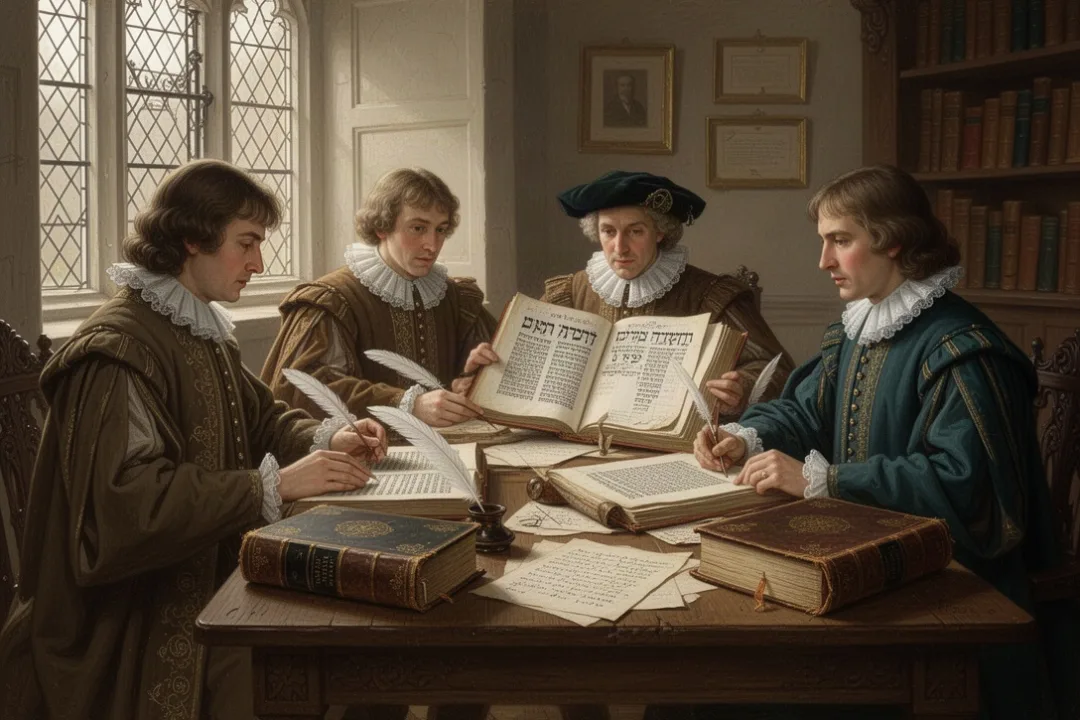
The translation was prepared by committees of highly educated clergymen and scholars. Sources commonly describe 47 translators as having taken part, while the original planning involved a larger number of possible participants. The exact personnel and level of participation varied, and not every scholar contributed equally to every book.
The committees were connected with Oxford, Cambridge, and Westminster. Each group handled particular sections of Scripture. Their members included university scholars, bishops, deans, professors, and experienced preachers. Several were skilled in Hebrew, Greek, Latin, and other languages used in biblical scholarship.
Committee members first prepared translations of assigned passages. The work then went through stages of review, with scholars comparing one another’s drafts. The process was designed to create a unified Bible rather than a collection of unrelated individual translations.
The translators were not working with the full range of ancient biblical manuscripts available to researchers today. Their New Testament text reflected the Greek editions then in use, often described collectively as the Textus Receptus. Their Old Testament work relied on the Hebrew text available in their time, along with ancient-language versions and earlier scholarship.
This historical setting matters when comparing the KJV with modern translations. Modern committees can consult many manuscripts and apply textual discoveries that were unavailable in the early seventeenth century. Differences between versions therefore often reflect changes in the evidence and in translation philosophy, not simply differences in religious seriousness.
Which earlier English Bibles influenced the KJV
The King James Bible inherited a great deal from earlier English translations. Tyndale’s work was particularly important because his clear, compact English shaped the phrasing of later versions. Many familiar expressions associated with the KJV have roots in Tyndale’s translation tradition.
The major influences included:
Tyndale’s New Testament and Old Testament work: his vocabulary and sentence patterns influenced much later English biblical language.
The Coverdale Bible: it helped establish an English Bible tradition drawing on several linguistic sources.
The Great Bible: it was authorized for public church use during the reign of Henry VIII.
The Geneva Bible: it was widely read and offered detailed explanatory notes.
The Bishops’ Bible: it served as the principal official English Bible used as a base for the new revision.
The Rheims New Testament: its Catholic translation sometimes influenced word choices and provided another English comparison.
Because the KJV drew from this tradition, it should be understood as a major revision as well as a new translation. Its achievement was not only accuracy in individual phrases. It also brought existing English biblical language into a form that could be used consistently in the Church of England.
What the 1611 King James Bible actually contained
The first edition was different from many modern KJV copies. It included the Apocrypha, a collection of books placed between the Old and New Testaments. These books had a long history of use in Christian traditions, although Protestant communities differed over their authority and placement.
The 1611 edition also included marginal notes. These notes could identify alternative readings, clarify Hebrew or Greek expressions, or explain certain translation decisions. Later editions and publishing traditions changed the appearance and contents of the KJV, so readers should not assume that every modern edition looks exactly like the first printing.
The original printing used spelling, punctuation, typefaces, and capitalization that may look unfamiliar today. Printers also produced errors, and later editions corrected many of them. The most widely recognized modern form of the KJV comes largely from revisions made in the seventeenth and eighteenth centuries rather than from the 1611 pages alone.
Two early editions are sometimes distinguished as the “Great He” and “Great She” Bibles because of a wording difference in Ruth 3:15. The difference comes from printing, not from two rival translation projects. It illustrates why the history of a Bible edition includes typesetting, proofreading, and printing practices as well as scholarly translation.
How later KJV editions changed the text and spelling
The first KJV did not remain frozen in its original form. Editions published in 1612 and later years corrected typographical mistakes and adjusted presentation. Further revisions addressed spelling, punctuation, marginal material, and other features that affected readability.
Important eighteenth-century revisions were associated with Cambridge scholar Thomas Paris and Oxford scholar Benjamin Blayney. The 1769 edition connected with Blayney became especially influential and is the form that many people now mean when they refer to the KJV. It updated spelling and punctuation and standardized numerous details while retaining the translation’s characteristic wording.
This history challenges the idea that every comma and spelling choice in a modern KJV came directly from the 1611 translators. The core translation tradition is old, but the familiar printed form developed over time. Publishers today may also differ in typography, headings, paragraphing, and whether they include the Apocrypha.
When buying or studying a KJV, check which edition is being used. A modern spelling edition can be easier to read than an original-style facsimile, while a scholarly facsimile can show how the 1611 publication looked. Neither choice changes the basic historical fact that the text has passed through several stages of editing and printing.
Reading tip: “1611 King James Version” often refers to the translation tradition, but many modern copies reflect later editorial revisions, especially the widely circulated 1769 form.
Why the King James Bible sounds distinctive
The KJV’s style comes from several sources rather than from an attempt to imitate ordinary conversation. Its translators aimed for language appropriate for public reading, church worship, and serious literature. They favored balanced clauses, repetition, formal vocabulary, and rhythmic sentence structures.
The translation also reflects the grammar of early modern English. Words such as “thou,” “thee,” “ye,” and “you” once carried distinctions that modern English often no longer makes. Verb endings such as “-eth” also appeared more commonly than they do now. These forms can sound reverent to modern readers because they survive mainly in religious or historical contexts.
Some expressions have changed meaning since the seventeenth century. “Prevent,” for example, could mean to go before or anticipate rather than simply to stop. “Conversation” could refer to conduct or manner of life, not only speech. “Quick” could mean alive, and “charity” could carry a meaning closely related to love.
Readers should therefore distinguish between familiarity and clarity. A phrase may sound beautiful because you have heard it repeatedly, while its individual words may be less clear than they were to the original audience. Study editions and modern translations can help explain these changes without requiring you to abandon the KJV.
What King James hoped the Bible would accomplish
King James wanted a Bible suitable for the Church of England and acceptable to religious leaders who had disagreed about earlier translations. A single authorized version could support a more uniform pattern of public worship. It could also reduce reliance on editions whose notes or wording reflected other church traditions.
The project had political dimensions, but reducing it to royal propaganda gives an incomplete picture. The translators were serious biblical scholars, and their work involved real engagement with language, manuscripts, theology, and earlier translations. At the same time, their instructions and institutional setting placed boundaries around the project.
The KJV did not immediately replace every other English Bible. The Geneva Bible remained popular for years, especially in private reading. Over time, however, the KJV gained authority in Anglican worship and wider cultural acceptance. Its position grew through church use, printing, education, preaching, and the spread of English-speaking communities.
Common myths about King James and the Bible
King James personally translated the Bible
There is no good historical basis for saying that King James translated the biblical books himself. He was educated and interested in theology, but his role was that of sponsor, organizer, and approving monarch. The committees did the translation and revision work.
The KJV was the first English Bible
English translations existed long before 1611. Tyndale, Coverdale, the Great Bible, the Geneva Bible, and the Bishops’ Bible all preceded it. The KJV was a later and highly influential stage in the development of English Bible translation.
The KJV was translated from one perfect set of manuscripts
The translators used the best resources available to them, but modern manuscript research has expanded considerably. The KJV’s textual base was shaped by the editions and manuscripts accessible in the early seventeenth century. Calling it “perfect” describes a theological belief held by some readers, not a neutral account of its production history.
The KJV has never changed
The translation tradition has remained recognizable, but editions have changed spelling, punctuation, formatting, notes, and sometimes wording. The form most readers know is generally associated with later revisions, particularly the 1769 edition.
King James removed books from the Bible
The 1611 KJV included the Apocrypha. Many modern Protestant editions omit it, and some KJV publishers print it separately. The issue reflects differences among Christian traditions and publishing practices, not a simple act by King James to remove those books from the original 1611 Bible.
How the KJV compares with modern Bible translations
Modern translations often differ from the KJV in three main ways: textual sources, translation philosophy, and English style. Some use a broader range of ancient manuscripts. Some aim to reproduce the structure of the original languages closely, while others prioritize clear contemporary English.
The KJV generally uses formal, traditional language. A modern formal-equivalence translation may preserve a similar seriousness while updating grammar and vocabulary. A dynamic-equivalence or thought-for-thought translation may express a passage more naturally for contemporary readers, sometimes sacrificing the compact structure of the original wording.
Neither a modern translation nor the KJV should be judged only by whether it sounds familiar. A useful comparison asks:
What Hebrew or Greek textual evidence does the edition use?
Does the translation aim for literal structure, natural meaning, or a balance of both?
Are difficult terms explained in footnotes?
Does the edition include the Apocrypha?
Who revised or edited the particular edition you are reading?
For close study, comparing several translations can reveal where English wording involves interpretation. A reader who prefers the KJV may use a modern version, lexicon, or study Bible as a companion. A reader who prefers modern English can still benefit from seeing how KJV phrasing has shaped Christian vocabulary and English literature.
Why the King James Bible remains influential
The KJV became more than a church book. Its phrases entered sermons, hymns, novels, speeches, poetry, and everyday expressions. Writers such as John Milton and later English-language authors worked within a culture deeply shaped by biblical language, even when they did not agree with every theological claim associated with the text.
Its influence also came from sound. The Bible was designed for public proclamation, and many passages use parallel structures that are memorable when heard aloud. Repeated rhythms and carefully balanced clauses can make the language easy to remember, even when its vocabulary is no longer conversational.
Religious communities continue to value the KJV for different reasons. Some regard it as the preferred English translation because of its tradition and theological heritage. Others use it alongside newer versions for comparison. Still others read it mainly as a landmark of English literature and cultural history.
Its continuing use does not require ignoring its age. Understanding the KJV well means recognizing both its strengths and its limits: it preserves a powerful literary tradition, but some terms require explanation, and its textual resources were those available before modern biblical scholarship.
How to study the King James Bible responsibly
If you want to read the KJV closely, begin by choosing an edition that identifies its editorial history. A version with cross-references, word explanations, historical notes, and parallel translations can make difficult passages more accessible. An original-spelling reproduction is valuable for historical study but may not be the easiest choice for sustained reading.
Use these practical steps:
Identify the edition: find out whether it follows the 1611 printing, a later revision, or a modernized spelling edition.
Check unfamiliar words: use a historical dictionary or a reputable study Bible rather than assuming a word has its modern meaning.
Compare translations: read a contemporary version beside the KJV when a sentence seems unclear.
Read the surrounding passage: poetic and theological phrases can be misunderstood when isolated.
Consult notes on textual variants: these explain why some modern Bibles phrase certain verses differently.
Consider genre: poetry, narrative, prophecy, wisdom writing, and letters use language in different ways.
It also helps to separate three questions that are often mixed together: What did the original biblical text mean? How did the KJV translators express it? How does the KJV wording affect readers today? Those questions overlap, but they are not identical.
What King James’s legacy means for Bible readers
King James’s lasting connection with the Bible rests on a partnership between royal authority and scholarly labor. He made a new official translation possible, but the words came through a complex committee process grounded in earlier English Bibles and the biblical languages available at the time.
The result was not the first English Bible, nor was it a text untouched by later revision. It was a carefully coordinated translation that eventually became one of the most influential books in the English-speaking world. Knowing how it was made allows you to appreciate its literary power without confusing tradition with historical precision.
For readers today, the KJV can be approached as Scripture within a particular Christian tradition, as a historic translation, as a source of English idiom, or as all three. Its value is best understood when its beautiful language is read with attention to context, edition, vocabulary, and textual history.
Frequently asked questions
Did King James write any part of the King James Bible?
King James did not write or translate the biblical books in the KJV. He authorized and supported the project, while committees of scholars translated and reviewed the text. He was involved in the political and ecclesiastical direction of the work, but the wording came from the translators and the editorial process leading to the 1611 publication.
Was the King James Bible translated directly from Hebrew and Greek?
The translators worked with Hebrew and Greek texts, but they also relied heavily on earlier English and European translations. Their New Testament text reflected the Greek editions available in the early seventeenth century, while their Old Testament work used the Hebrew resources and scholarly tools then accessible. Modern translators have access to additional manuscripts and research.
Why do some people call the KJV the 1611 Bible when many copies look different?
“1611 Bible” often refers to the translation tradition that began with the first edition. Later printings corrected errors and updated spelling, punctuation, and formatting. The version most commonly read today is generally associated with later revisions, especially the form connected with the 1769 edition, rather than an exact reproduction of the original 1611 printing.
Does the King James Bible include the Apocrypha?
The first 1611 edition included the Apocrypha in a separate section between the Old and New Testaments. Many modern Protestant KJV editions omit those books, while some publishers print them as part of the volume. Whether they are included depends on the edition and publishing tradition, not on the wording “King James Version” alone.






Leave a Reply