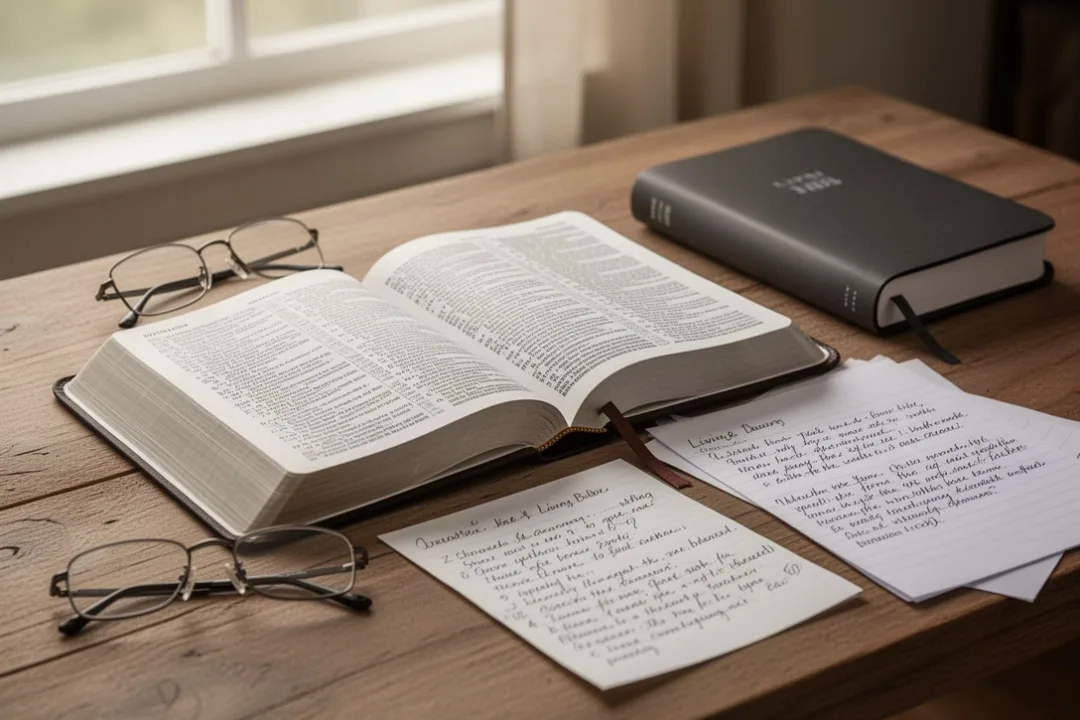
“TLB” stands for The Living Bible. It is not a separate collection of books or a different version of Christianity; it is an English rendering of the Bible designed for clarity and accessibility.
The Living Bible is commonly classified as a paraphrase rather than a direct translation from the original Hebrew, Aramaic, and Greek texts. That distinction helps explain both its strengths and its limitations. A translation aims to represent the wording and meaning of the original languages as closely as possible, while a paraphrase restates the meaning in fresh language, often with more freedom.
The TLB became widely known because it uses contemporary, conversational English. Its wording is generally easy to follow, making it approachable for personal reading, family devotions, and people who find formal Bible language difficult.
Essential distinction: The Living Bible is a paraphrase, while the New Living Translation is a modern translation produced from the original biblical languages. They should not be treated as the same edition.
Who created The Living Bible?
Kenneth N. Taylor developed The Living Bible. He first paraphrased biblical passages for his own family because he wanted his children to understand the Bible more easily. His work eventually expanded into a complete paraphrase.
Portions of Taylor’s paraphrase began appearing in the 1960s, and the complete Living Bible was published in 1971. The book became especially popular among English-speaking readers who wanted a Bible that sounded less formal and more like ordinary speech.
Taylor worked from the American Standard Version, an English Bible translation published in the early twentieth century. He did not produce The Living Bible by translating each passage afresh from the original biblical languages. Instead, he restated an existing English translation in simpler language and added wording intended to clarify the passage for modern readers.
That background matters when you decide how to use the TLB. Its style can make a difficult passage understandable, but its phrasing also reflects the interpretation of the paraphraser. For careful study, you may want to compare it with one or more translations made directly from the original languages.
How The Living Bible differs from a translation
A Bible translation must make many decisions about grammar, vocabulary, idioms, and sentence structure. Translators work from the original manuscripts and related textual evidence, then try to communicate the meaning in another language. The result may be formal, moderately literal, or strongly focused on natural meaning.
A paraphrase takes an additional step. It explains or restates the text in the writer’s own words, which can make the message more immediately understandable. That freedom can also introduce interpretive choices that are less visible in a translation.
For example, an original-language expression may be broad enough to allow several possible English renderings. A translation may preserve some of that openness, while a paraphrase may select one explanation and place it directly in the sentence. The paraphrase may be clear, but the reader may not realize that an interpretive decision has been made.
The difference does not mean that The Living Bible has no value. It means you should use it for the purpose it serves best: clear reading, devotional reflection, and initial understanding. When a doctrine, difficult passage, or disputed interpretation matters, compare the TLB with more formal translations and consult reliable study resources.
What makes the TLB Bible easy to read?
The Living Bible avoids much of the older religious vocabulary found in traditional English Bibles. Its sentences tend to be direct, and many passages use familiar expressions rather than preserving an older literary style. Readers often find that they can move through a chapter without stopping to decode unfamiliar words.
The paraphrase also tries to make connections clear. When the biblical text assumes background knowledge, the TLB may use wording that helps a modern reader understand the situation. This can be helpful in narrative books, letters, and passages with complex arguments.
Its accessible style may be particularly useful for:
First-time Bible readers who feel intimidated by traditional wording.
Children and teens reading Scripture with an adult or youth group.
People learning English or returning to Bible reading after a long break.
Family devotional settings where several people need to follow the passage aloud.
Readers who want to grasp the broad message of a book before studying details.
Readable language can remove an unnecessary barrier, but easy reading is not automatically the same as precise reading. A passage may feel clear because the paraphrase has already supplied an interpretation. That is why the TLB works best as part of a balanced reading plan, not as your only resource for every kind of study.
What are the strengths of The Living Bible?
The TLB’s greatest strength is its immediate accessibility. Its wording can help you understand the general movement of a passage before you consult a more formal version. This is especially useful when an older translation’s vocabulary or sentence structure prevents you from seeing the main point.
It can also help readers hear Scripture as connected thought rather than as a collection of isolated verses. In a long narrative, a letter, or a wisdom book, the conversational style encourages you to read larger sections. That approach can reveal repeated themes, changes in tone, and the relationship between surrounding paragraphs.
The Living Bible is often helpful for devotional reading. You can read a chapter slowly, identify the central idea, and consider how the passage addresses faith, character, relationships, suffering, worship, or hope. Its natural language may make personal reflection feel less like analyzing an ancient document and more like listening carefully to a message.
Another strength is its usefulness for comparison. Reading a passage in the TLB after using a more literal translation may show how a difficult sentence could be understood. Conversely, reading a formal translation after the TLB can help you notice details, repeated words, and possible meanings that the paraphrase has condensed.
Good practice: Read the TLB for flow and understanding, then check a translation based directly on the original languages when you need wording, structure, or doctrinal precision.
What are the limitations of the TLB Bible?
The main limitation is that The Living Bible is not a direct translation from the original languages. Since it is a paraphrase based on an existing English translation, it reflects the paraphraser’s understanding at several stages. That can make it less suitable as the sole source for detailed word studies or close examination of a passage.
Paraphrases can also make ambiguous passages appear more definite than they are. If the original text permits more than one reasonable interpretation, a paraphrased sentence may choose one. The wording may be helpful, but you should treat it as an explanation rather than assuming it captures every possible nuance.
Some readers may also find that the TLB uses expanded language not present in a more literal rendering. Added connective words or explanatory phrases can improve readability, but they may blend interpretation with the biblical text. This is a normal feature of paraphrasing, not necessarily an error, but it should be recognized.
The TLB may be less appropriate when you are:
Preparing a sermon or Bible lesson that depends on precise wording.
Comparing repeated terms across several passages.
Studying how a Hebrew or Greek word is used in different contexts.
Examining a disputed doctrine or a difficult theological argument.
Memorizing a passage for a setting that expects a particular translation.
These limitations do not make the TLB unusable. They point to a sensible division of labor: use it for clarity and broad comprehension, and use direct translations, study notes, and original-language tools for closer analysis.
How the TLB compares with the NLT
The New Living Translation, usually abbreviated NLT, is not simply a revised title for The Living Bible. It is a separate translation project. The NLT was translated from the original biblical languages by a team of scholars and editors, with the goal of producing clear modern English.
The two editions may sound similar because both value readability and natural expression. They can also share familiar wording in some passages. Their underlying methods are different, however: the TLB is a paraphrase associated with Kenneth N. Taylor, while the NLT is a committee translation.
This difference matters when you select a Bible for study. The NLT is generally better suited to regular reading, teaching, and study where you want a modern translation that balances accuracy with natural English. The TLB can still serve as a helpful companion, particularly when you want to hear a passage expressed in a more personal or explanatory way.
Do not assume that a study Bible labeled “Living Bible” is an NLT simply because both editions are associated with similar publishing traditions. Check the title page, copyright page, or edition information to identify the exact version you are reading.
How the TLB compares with other common Bible versions
The best Bible version depends on what you are trying to do. No single English edition will be equally strong for every purpose. The TLB’s place becomes clearer when you compare its general approach with other familiar styles.
King James Version: Known for historic literary language and traditional phrasing. Its style can be meaningful but may require explanation for modern readers.
New King James Version: Retains much of the traditional structure while updating vocabulary and grammar.
New American Standard Bible: Often chosen for close study and formal correspondence to the original languages, though its wording can sound less conversational.
English Standard Version: Uses a more formal style with attention to sentence structure and literary continuity.
New International Version: A widely used contemporary translation that aims to balance accuracy, clarity, and natural English.
Christian Standard Bible: Uses a modern style intended to combine precision with readability.
New Living Translation: A readable translation from the original languages, distinct from The Living Bible paraphrase.
These descriptions are broad, and individual editions may differ in study notes, textual choices, and formatting. The useful question is not which version is universally best, but which one fits your current purpose. You might read the TLB for flow, an accessible translation for sustained study, and a more formal version when examining wording closely.
How to use the TLB for personal Bible reading
Start with a complete paragraph or section rather than isolated verses. The TLB’s conversational style is especially helpful when you allow the surrounding context to shape the meaning. Before reading, identify the book, its apparent audience, and the kind of writing involved, such as narrative, poetry, prophecy, or a letter.
After reading, state the passage’s main idea in your own words. Then ask what the writer says about God, people, relationships, sin, wisdom, suffering, faith, or hope. These questions keep devotional reading connected to the actual passage instead of turning it into a search for unrelated personal messages.
A simple reading process can look like this:
Read the passage once without stopping to research every unfamiliar detail.
Read it again and mark repeated ideas, contrasts, commands, promises, or questions.
Check another translation when the wording seems unusually specific or surprising.
Consider the context by reading the paragraphs before and after the selected passage.
Record one response that follows naturally from the passage’s message.
Reading the TLB aloud can be particularly effective. Its modern phrasing often makes relationships between sentences easier to hear. If a passage sounds strongly different from other versions, that is a reason to compare editions rather than immediately deciding that one wording must be correct.
Practical tips and common mistakes when reading the TLB
A few habits can help you benefit from the TLB without expecting it to do a job it was not designed to do. The goal is not to distrust every paraphrase, but to read it with an accurate understanding of its method.
Do compare versions: Use at least one translation made from the original languages when studying an important passage.
Do read in context: A clear sentence can still be misunderstood when separated from the author’s larger argument.
Do check the edition: Confirm whether your book is The Living Bible or the New Living Translation.
Do use it for first-pass reading: Let the readable style help you understand the shape and movement of a biblical book.
Do consult trustworthy notes: A good study Bible or commentary can explain historical and literary background.
Do not treat paraphrased wording as a word-for-word equivalent: Explanatory language may reflect one interpretation.
Do not build a doctrine on one unusual phrase: Examine several passages and translations before reaching a firm conclusion.
Do not assume difficulty means error: Some biblical ideas are complex, and another version may preserve that complexity more clearly.
One common mistake is using a paraphrase to settle a disagreement before checking how other translations handle the same passage. Another is rejecting the TLB entirely because it is not a formal translation. Both reactions miss its proper role. The wiser approach is to value its clarity while recognizing that clarity can include interpretation.
Is The Living Bible reliable for study and teaching?
The answer depends on what “reliable” means in your setting. The TLB can reliably help you understand the broad message of many passages, follow a story, and reflect on biblical themes. It has been useful to generations of readers because its language is direct and approachable.
For technical study, however, you should not rely on it alone. A teacher who is examining a key term, comparing parallel passages, or explaining a doctrinal claim should consult translations based directly on the original languages. Looking at several versions can reveal where the TLB has clarified, expanded, or narrowed a phrase.
When teaching others, identify the version you are using. If your audience reads a different edition, wording may vary substantially. You can explain the main idea in your own words and invite listeners to compare the passage in their preferred Bible.
The TLB is particularly suitable for group reading and beginning study. It can help everyone follow a passage before the group discusses context and interpretation. For advanced classes, pair it with a formal translation, a language-aware study Bible, and resources that explain the passage’s historical setting.
Where to find a TLB Bible today
The Living Bible is available in different formats, including print editions and digital Bible platforms. Some editions are designed for personal reading, while others include devotional material, notes, reading plans, or large-print formatting. The exact contents vary by publisher and edition.
When choosing a copy, look for the full title The Living Bible and check the publication information. If you specifically want the paraphrase, do not rely only on the word “Living” in a product description. A listing may refer to the New Living Translation, a parallel Bible, or a study edition built around another text.
You may also want to compare:
Print size and page layout for comfortable daily reading.
Whether the edition includes the complete Old and New Testaments.
Additional notes, introductions, maps, or devotional material.
Digital search and highlighting features if you read electronically.
Whether the format uses a particular denominational or devotional emphasis.
A physical copy can be useful for uninterrupted reading, while a digital edition makes it easy to compare the TLB with several other versions. Either format can support thoughtful reading when you pay attention to context and remember the difference between paraphrase and translation.
Who may benefit most from reading the TLB Bible?
The TLB may be a good choice if traditional Bible language has made reading difficult or discouraging. It can give you a clear first encounter with a biblical book and help you see its major themes before you investigate details.
It is also useful for readers who want to read longer sections without frequent interruptions. The natural prose can support a chapter-by-chapter plan, especially in narrative books and New Testament letters. Families may appreciate it when reading together with children or with people who have different levels of Bible familiarity.
Readers doing advanced study should treat it as a companion rather than a foundation for every conclusion. Used in that way, the TLB offers a distinct perspective: it shows how a knowledgeable paraphraser understood and expressed the passage in accessible English.
The most productive approach is to keep several purposes separate. Read the TLB for understanding and reflection, compare translations for accuracy and nuance, and use scholarly tools when the question requires detailed interpretation. That combination lets the TLB do what it does best without asking it to function as a different kind of Bible.
Frequently asked questions
Is the TLB Bible the same as the NLT?
No. The TLB is The Living Bible, a paraphrase associated with Kenneth N. Taylor and based on an earlier English translation. The NLT, or New Living Translation, is a separate translation produced by a team working from the original biblical languages. Both use accessible English, which is why readers sometimes confuse them.
Is the TLB a good Bible for beginners?
It can be. The TLB uses conversational wording that may help beginners follow biblical stories, teachings, and letters without getting stuck on older vocabulary. It is wise to pair it with another modern translation as your understanding develops, especially when you are studying a difficult passage or an important theological question.
Can I use the TLB for serious Bible study?
You can use it as one resource, particularly for reading context and seeing how a passage flows. For serious study, compare it with translations made directly from Hebrew, Aramaic, and Greek, and consult quality study notes or commentaries. The TLB should not be your only basis for analyzing precise wording or disputed interpretations.
Why do some TLB passages sound different from other Bibles?
The TLB restates biblical content in the paraphraser’s own English rather than closely reproducing the structure of the original languages. It may therefore explain an idea, choose among possible interpretations, or use expanded wording. Comparing the passage with several translations can show which details come from the biblical text and which reflect paraphrase.









Leave a Reply