Dove biblical meaning: symbolism and key Bible passages
Dove biblical meaning: symbolism and key Bible passages
When you see a dove in a church window, on a religious card, or in a painting of Jesus’ baptism, you may wonder what the image means. The biblical dove carries several related ideas, including peace, new beginnings, purity, sacrifice, and the presence of the Holy Spirit.
Its meaning depends on the passage. In the story of Noah, a dove signals that the floodwaters are receding and that the earth may support life again. At Jesus’ baptism, the Spirit appears in a form compared to a dove. Elsewhere, doves are ordinary birds used in worship, poetry, and descriptions of human vulnerability.
Core meaning: The dove is not assigned one universal definition in the Bible. Its symbolism comes from the setting, the action of the bird, and the surrounding message.
Modern religious art often gives the dove a simple meaning: peace or the Holy Spirit. Those associations have strong biblical roots, but Scripture uses the bird in more than one way. A careful reading keeps the original scene in view rather than treating every dove as a symbolic code.
For example, Noah’s dove is part of a search for dry land after judgment. The bird’s return with a fresh olive leaf gives Noah evidence that the waters have diminished. The emphasis is on restored creation and the possibility of life after catastrophe, not merely on a general feeling of calm.
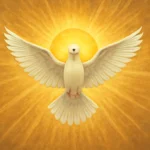
In the Gospels, the dove-like appearance occurs during Jesus’ baptism. The scene identifies Jesus and marks the beginning of his public ministry. Here the dove is connected to the Holy Spirit, divine approval, and a new stage in Jesus’ mission.
Other passages use doves in more literal ways. The Law of Moses permits doves or pigeons as offerings, especially for people who cannot afford larger animals. In the poetic books, a dove can represent beauty, longing, grief, or helplessness. These uses should not be forced into the same interpretation.
The dove in Noah’s ark and the promise of renewed life
The best-known biblical dove appears in Genesis 8. After the flood, Noah sends birds from the ark to learn whether the waters have gone down. A raven goes back and forth, but Noah later sends a dove. The first time, it returns because it finds no suitable place to rest.
Noah waits and sends the dove again. This time, it returns with a freshly plucked olive leaf. The small sign tells him that vegetation has reappeared. After another period of waiting, Noah sends the dove once more, and it does not return. The bird’s absence indicates that the land is becoming habitable.
The dove therefore represents evidence of renewal. Noah does not receive a spoken message from the bird. Instead, its behavior gives him reliable information about the condition of the earth. The olive leaf has become a widely recognized peace symbol, but in Genesis its immediate role is more specific: it confirms that the judgment of the flood is receding.
The story also presents Noah as someone who waits for God’s timing. He does not leave the ark simply because the rain has stopped. He observes, tests the conditions, and responds when the evidence shows that the land is ready. The dove becomes part of a lesson in patient discernment.
Readers sometimes say that the dove in Genesis directly symbolizes peace because of the olive leaf. That interpretation is understandable, but the passage emphasizes life returning to the world. Peace is a reasonable later association because the flood has ended and the earth is beginning again, yet the text itself focuses on restoration and safety.
Genesis 8:11 presents the dove’s olive leaf as evidence that the waters are receding and living growth has returned.
The dove at Jesus’ baptism and the Holy Spirit
All four Gospels connect Jesus’ baptism with the descent of the Spirit in a form associated with a dove. Matthew 3, Mark 1, Luke 3, and John 1 describe the event with differences in wording and emphasis, but the central point is consistent: the Spirit is visibly associated with Jesus as he begins his public work.
The biblical wording does not mean that the Holy Spirit is literally a bird. It describes the Spirit’s appearance or descent like a dove. This distinction matters. The dove is a visual comparison used to communicate something about the event; it is not a complete description of God’s nature.
The baptism scene brings together several themes. Jesus enters the water, the Spirit is revealed, and a voice from heaven identifies him in a special way. The dove-like sign therefore points to divine presence, authorization, and the beginning of Jesus’ ministry.
Many Christians also connect the scene with Genesis 1, where the Spirit of God is associated with creation. That connection can suggest a theme of new creation, although the Gospels do not explicitly explain the dove as a reference to Genesis. The symbolism is strongest when it remains anchored to the baptism itself.
The dove’s gentle appearance has also shaped Christian ideas about the Spirit’s character. Believers may associate it with peace, purity, and gentleness. Those qualities are compatible with biblical teaching, but the Spirit is not portrayed as weak or passive. The same Spirit empowers Jesus’ ministry and stands within the broader biblical picture of God’s active work.
Helpful distinction: At Jesus’ baptism, the dove points to the Spirit’s presence; it does not mean that every image of a dove automatically represents the Holy Spirit.
Doves as offerings in biblical worship
Doves and pigeons appear in the laws governing Israelite worship. Leviticus 5, Leviticus 12, and Leviticus 14 include birds among the offerings that could be brought in particular circumstances. The regulations show that worship was not limited to people with substantial financial means.
Leviticus 12 is especially important for understanding the family of Jesus. After Mary gives birth, Luke 2 says that Joseph and Mary bring an offering associated with those who could not afford a lamb. The passage refers to birds, reflecting the provision in the Law for a less expensive sacrifice.
This detail communicates more than an animal choice. It places Jesus’ family within the life of ordinary Jewish worship and shows that they followed the requirements available to them. The birds represent accessible worship and God’s provision for people of limited means.
The biblical terms can create some confusion because English translations may use dove and pigeon for related birds. The original laws distinguish types of birds in ways that do not always map neatly onto everyday modern English. A reader should avoid building a major theological point on the exact English label.
The sacrificial use also prevents an overly sentimental view of the dove. In Scripture, the bird is not only a peaceful emblem. It can be part of a serious ritual involving sin, purification, thanksgiving, or restoration to the worshiping community. Its meaning comes from the offering’s purpose and the law governing it.
Doves in the poetry and imagery of the Bible
Biblical poetry uses doves to express emotion and appearance. In the Song of Songs, dove imagery appears in descriptions of the beloved. The language is affectionate and lyrical, not a technical explanation of spiritual symbolism. The bird evokes beauty, tenderness, and the value of the person being described.
The Psalms use dove imagery differently. In Psalm 55, the writer wishes he could fly away like a dove to escape distress. The image communicates a longing for distance and shelter. It does not present the dove as a sign of victory; instead, it gives shape to a person’s desire to flee danger and find rest.
Hosea 7 compares a foolish or unstable people to a dove. The comparison highlights vulnerability and lack of sound judgment. This passage is a useful reminder that a dove can symbolize impulsiveness or helplessness, depending on the context.
Isaiah 38 describes mourning with an image that some translations render as a dove’s sounds. The bird becomes a picture of sorrow expressed through repeated cries. Again, the meaning is not peace or purity but grief.
These poetic examples show why readers should ask what the dove is doing in a passage. Is it carrying evidence of dry land, descending at baptism, serving as an offering, longing to escape, or representing beauty? The answer changes the interpretation.
What the dove can symbolize in biblical interpretation
Across these passages, several themes recur. They are not equally present in every verse, but they help explain why the dove has remained important in Jewish and Christian imagery.
Renewal: Noah’s dove confirms that the earth is becoming fruitful again after the flood.
Peace and safety: The end of the flood and the olive leaf support later associations with peace, reconciliation, and secure life.
The Holy Spirit: The dove-like sign at Jesus’ baptism identifies the Spirit’s presence and Jesus’ divine commissioning.
Purity and gentleness: These associations arise especially from Christian reflection on the Spirit and the dove’s appearance.
Accessible worship: Doves or pigeons could be offered by people who could not provide a lamb.
Human vulnerability: Poetic passages can use the dove to express fear, weakness, instability, or the desire to escape.
These meanings overlap in Christian art, but they should not be treated as interchangeable. A white dove in a baptismal painting may suggest the Spirit, while a dove with an olive branch may suggest peace or renewal. A dove mentioned in a lament may communicate distress instead.
How to interpret a dove passage accurately
When you encounter a dove in the Bible, begin with the passage rather than with a familiar symbol. The surrounding verbs and characters usually reveal more than the bird itself. A dove that returns with a leaf carries a different message from a dove used in an offering law.
Read the entire scene. Look at what happens before and after the reference. The larger event may define the image’s purpose.
Identify the bird’s role. Ask whether it is a messenger, sacrifice, comparison, sound, or part of a poetic description.
Check the speaker and genre. A law, historical narrative, Gospel account, and poem use imagery in different ways.
Compare related passages carefully. The baptism accounts can illuminate one another, but a poetic dove should not automatically be interpreted through the baptism story.
Notice translation differences. Some versions use “dove,” “pigeon,” or “turtledove” in places where the original terms refer to related birds.
Separate biblical meaning from later tradition. A symbol may have developed additional associations in Christian art without those associations being stated directly in the passage.
This approach is useful for personal Bible study, sermon preparation, artwork, and conversations about religious symbols. It keeps interpretation grounded in the text while allowing legitimate connections across Scripture.
Common mistakes when explaining the biblical dove
The most common mistake is assuming that every dove has the same meaning. Because the bird is widely associated with peace and the Holy Spirit, readers may overlook passages where it represents fear, poverty, mourning, or a practical sign about the land.
Another mistake is treating the dove at baptism as proof that the Holy Spirit has a bird-like body. The Gospel accounts use comparison language. Christian theology may speak of the Spirit’s manifestation in that event, but it should not reduce the Spirit to the physical symbol used to describe the manifestation.
It is also easy to overstate the meaning of Noah’s olive leaf. The scene certainly supports hope and renewed life, and later tradition strongly connects it with peace. Yet the immediate narrative function is to show that vegetation has returned and that the floodwaters are going down.
Keep these cautions in mind when explaining the symbol:
Do not assign peace to every dove passage without reading the context.
Do not claim that the Bible gives the dove one official symbolic definition.
Do not confuse the dove-like sign at baptism with a literal identification of the Holy Spirit as a bird.
Do not ignore the economic and worship setting of the bird offerings.
Do not treat every reference to a dove as a prophecy about Jesus or the church.
Do not assume that English translation choices perfectly reflect distinctions in the original languages.
Why the dove remains important in Christian symbolism
The dove became a lasting Christian symbol because several biblical themes meet in one recognizable image. It can suggest the Spirit at baptism, the peace associated with restored relationship, and the hope of life after judgment. Its simple shape also works well in stained glass, baptismal art, church architecture, and devotional imagery.
Early Christian communities used a range of symbols, and the dove became particularly meaningful in connection with baptism and resurrection hope. Artistic traditions vary by time and place, so not every dove image has one fixed interpretation. A dove near water may point toward baptism; a dove with an olive branch may refer to Noah or peace; a pair of birds may reflect the offering laws or broader decorative tradition.
The symbol remains useful when it points beyond itself. A dove is not a substitute for the biblical story. It can remind viewers of God’s Spirit, restored creation, faithful worship, or the need for peace, but the meaning becomes clearer when the image is connected to a particular passage.
How to use dove symbolism in prayer or Bible study
A dove image can provide a starting point for reflection, provided that the reflection stays connected to Scripture. You might read Genesis 8 and consider how hope can appear through a small but trustworthy sign. You might read the baptism accounts and reflect on Jesus’ calling and the Spirit’s work.
You can also use the different passages to make your reflection more balanced. The dove is not only soft and peaceful. It can remind you of waiting, vulnerability, sacrifice, grief, and dependence on God. Those dimensions make the symbol more substantial than a decorative sign of calm.
For a focused study, compare these passages:
Genesis 8: the dove as evidence of returning life after the flood.
Leviticus 5, 12, and 14: birds as offerings within Israel’s worship laws.
Psalm 55: the dove as an image of longing for refuge.
Song of Songs: dove imagery in poetic descriptions of love and beauty.
Hosea 7: the dove as a picture of instability and poor judgment.
Matthew 3, Mark 1, Luke 3, and John 1: the Spirit’s dove-like manifestation at Jesus’ baptism.
Reading these texts together gives you a more accurate understanding than relying on a single popular definition. The dove can point to peace, but it can also point to the work required to reach safety, the humility of worship, or the vulnerability of a person who needs refuge.
What “dove biblical” means in one clear explanation
The biblical dove is a context-dependent symbol. In Genesis, it signals that the flood is receding and that the world is becoming habitable again. At Jesus’ baptism, its likeness identifies the presence of the Holy Spirit and the beginning of Jesus’ public ministry. In the worship laws, doves or pigeons provide an offering accessible to people with limited resources. In poetry, the bird can represent beauty, longing, grief, or weakness.
Peace and purity are valid associations, especially in later Christian tradition, but they are not the whole biblical picture. The most reliable interpretation asks what the dove is doing in the passage and how that action serves the passage’s larger message.
Frequently asked questions
What does a dove symbolize in the Bible?
A dove can symbolize several things, depending on the passage. It represents renewed life in Noah’s flood story, the Holy Spirit at Jesus’ baptism, and accessible worship in the laws concerning offerings. Biblical poetry also uses doves to portray beauty, longing, grief, or vulnerability. Peace is a later and widely accepted association, especially because of the olive leaf in Genesis 8.
Does the dove represent the Holy Spirit?
The dove represents the Holy Spirit specifically in the accounts of Jesus’ baptism, where the Spirit is described as appearing or descending like a dove. This is a comparison describing the manifestation, not a statement that the Holy Spirit is literally a bird. Outside the baptism accounts, a dove may have an entirely different function and should be interpreted from its immediate context.
Why did Noah send a dove from the ark?
Noah sent the dove to discover whether the floodwaters had receded enough for the earth to support life. When the bird returned with a fresh olive leaf, it provided evidence that vegetation had reappeared. When it did not return after a later release, Noah understood that conditions had improved further. The episode emphasizes careful waiting and signs of restored creation.
Are doves and pigeons the same bird in the Bible?
English translations sometimes use “dove,” “pigeon,” or “turtledove” for related birds mentioned in biblical laws and narratives. The original terms include distinctions that do not always correspond neatly to modern English usage. The exact species can matter in a detailed study, but the main point of the offering passages is that birds provided a permitted option for worshipers who could not afford a larger animal.










Leave a Reply