What Quakers believe about God and spiritual guidance
Quakers are members of the Religious Society of Friends, a Christian movement that began in England during the 17th century. The name “Quaker” was originally a nickname, while members commonly call themselves Friends. Quaker beliefs vary among different branches, but most emphasize a living relationship with God rather than dependence on a formal creed.
Many Friends use the phrase “Inner Light” to describe the divine presence or spiritual guidance available to every person. This does not usually mean that people are automatically right about everything they think or feel. Instead, it points to the belief that God can make truth known through conscience, prayer, worship, Scripture, community discernment, and faithful action.
Quakers generally believe that spiritual insight should be tested carefully. A private impression may be sincere but still incomplete or mistaken, so Friends often consider whether it agrees with love, truth, humility, justice, and the wider community’s discernment. This practice helps balance individual spiritual experience with shared responsibility.
Many Quakers regard the Bible as an important source of Christian teaching, although they do not all interpret it in the same way. Some Friends describe themselves as evangelical Christians and place strong emphasis on the life, death, and resurrection of Jesus Christ. Other Quakers use more universal or liberal language and may include people who understand Jesus in different ways, or who are comfortable with nontraditional religious beliefs.
Core idea: Quakerism does not depend on one universally required statement of belief. Friends are connected more by shared practices, spiritual experience, and commitments to faithful living than by complete doctrinal uniformity.
Quakers often speak about the presence of God in every person. This belief supports their historic opposition to racism, social hierarchy, and unequal treatment. It does not erase differences between people or mean that every action is equally good; it calls Friends to treat each person as worthy of dignity and careful listening.
How Quaker worship works
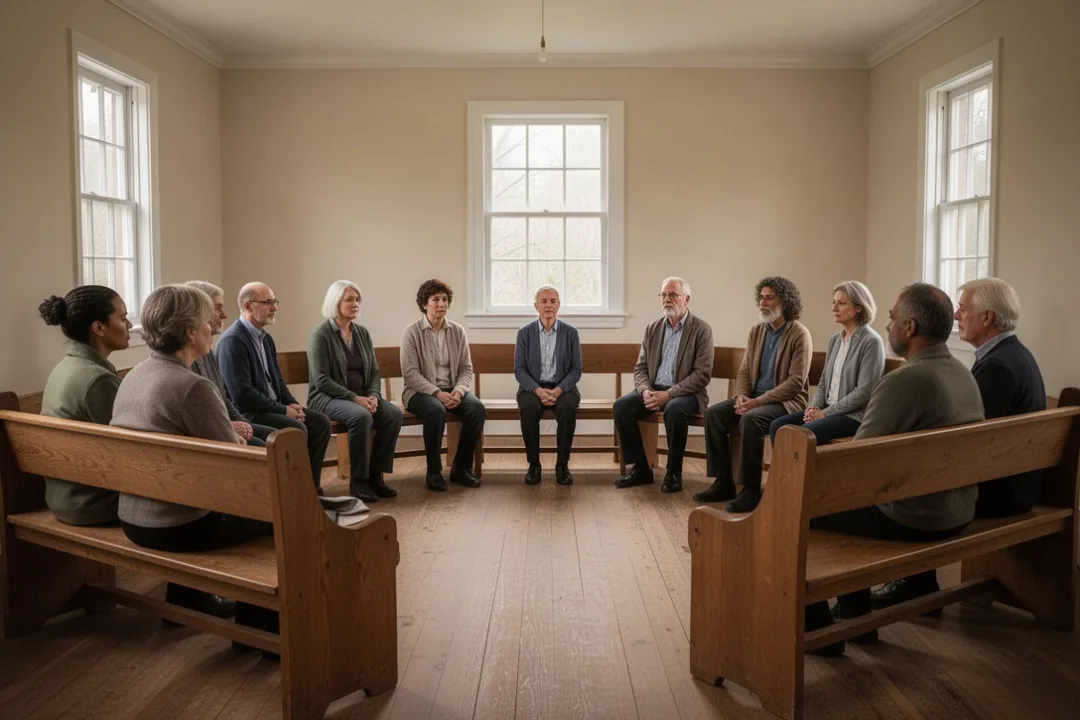
The best-known form of Quaker worship is called unprogrammed worship. The meeting gathers in silence, usually sitting in a circle or facing one another, without a prepared sermon, scheduled hymns, or a designated worship leader. Anyone who feels genuinely called to speak may offer a brief message, prayer, reading, or reflection.
Silence in a Quaker meeting is not simply an absence of activity. Friends use the quiet to become attentive to God and to examine what is happening within the worshiping community. A person may speak only once, or no one may speak during an entire meeting. The aim is not to fill every pause but to make room for spiritual attentiveness and communal listening.
When someone speaks, the message is usually offered simply rather than as a performance. Friends may avoid turning worship into a debate or responding immediately with applause and discussion. The community remains quiet afterward so that the message can settle and be considered.
A typical unprogrammed meeting may include these elements:
People enter quietly and settle into shared silence.
Individuals listen inwardly for spiritual guidance.
A worshiper may offer a message when moved to do so.
The group returns to silence after each spoken contribution.
At the scheduled ending, Friends often shake hands and greet one another.
Not all Quaker worship is silent. Programmed meetings may include a pastor, sermons, Bible readings, congregational singing, hymns, and a more familiar Christian service structure. Some programmed meetings also preserve periods of silence and opportunities for spontaneous ministry.
Quaker worship therefore looks different from one meeting to another. A meetinghouse in the United States may host a quiet, unprogrammed gathering, while a Quaker church in another region may have music, preaching, and a strong evangelical identity. Both can belong to the wider Religious Society of Friends.
Quakers do not generally require ordained priests or ministers to make worship valid. Some meetings employ pastors or recognize people with particular gifts for ministry, but spiritual authority is not reserved for a professional clergy. This reflects the Friends’ belief that the community can be guided through the contributions of many people.
Why Quakers do not usually practice traditional sacraments
Most Quakers do not observe baptism and Communion as outward rites required for membership or salvation. Friends often teach that the realities represented by these practices should be present throughout ordinary life: people should continually seek spiritual renewal, and daily life should become an act of communion with God.
This does not mean Quakers reject everything associated with baptism or Communion. They may value the biblical stories and the meanings those practices hold for other Christians. Their difference is that they generally emphasize an inward, continuing experience over a ceremony performed at a particular time.
Many Friends also avoid religious practices that create a sharp division between sacred and ordinary life. A meeting for worship may be held in a plain meetinghouse, a rented space, a home, or another setting. The setting is less important than the community’s shared attention to God.
Quaker weddings illustrate this approach. In many unprogrammed meetings, the couple and the gathered community sit together in worship. The partners may speak their vows without an officiating priest or pastor, and members of the meeting may also offer ministry. Legal requirements vary by location, so a couple must follow the marriage laws where the wedding takes place.
Funerals and memorial meetings often follow a similar pattern. Friends gather in silence and share memories, prayers, or messages as they feel led. The meeting may be called a meeting for worship in thanksgiving for the life of a person, rather than a service centered on a formal eulogy.
How Quaker history shaped the movement
The Quaker movement developed in England during a period of intense religious and political change. George Fox became one of its most prominent early leaders, teaching that people could experience God directly and did not need to rely entirely on established churches or ordained clergy.
Early Friends challenged common assumptions about worship and social order. They met outside the established church, refused to use honorific titles, and often addressed people of different social ranks in the same way. Their refusal to swear oaths and their commitment to truthful speech reflected the conviction that honesty should be constant rather than limited to moments when an oath was required.
Because they would not always follow customary forms of respect or participate in state-supported religious life, early Quakers faced imprisonment, fines, and other persecution. Friends eventually established communities in places where they could worship with greater freedom. Pennsylvania, founded by William Penn, became especially associated with Quaker principles, although the colony’s history also included serious contradictions and conflicts involving Indigenous peoples and enslaved labor.
Quaker history includes both admirable leadership and failures to live up to stated ideals. Friends became active in campaigns against slavery, prison cruelty, and unequal treatment of women, but Quaker communities did not immediately or consistently reject slavery or other forms of injustice. Understanding the movement requires acknowledging that its principles have often been expressed through gradual struggle rather than perfect agreement.
Quakers played significant roles in the development of abolitionism and humanitarian reform in Britain and the United States. Individual Friends helped organize antislavery efforts, supported the Underground Railroad, promoted prison reform, and advocated for women’s rights. Their emphasis on equality also influenced Quaker schools, relief organizations, and approaches to social work.
Peace work became another major part of Quaker identity. Friends have traditionally opposed participation in war and have supported conscientious objection, mediation, humanitarian relief, and reconciliation. During conflicts, Quaker organizations have provided food, medical assistance, refugee support, and other forms of practical aid without requiring recipients to share Quaker beliefs.
What Quaker testimonies mean in everyday life
Quakers often speak of testimonies rather than a fixed list of rules. A testimony is a way of living that gives public expression to spiritual conviction. Friends may use the acronym SPICE to remember common themes: simplicity, peace, integrity, community, and equality. The acronym is a teaching aid, not a universal official creed.
Simplicity and responsible use of resources
Simplicity encourages Friends to focus attention on what matters most instead of allowing possessions, status, or constant consumption to dominate life. It does not require one specific lifestyle. For one person, simplicity may involve modest spending; for another, it may mean limiting distractions, making careful environmental choices, or protecting time for family and service.
Peace and nonviolence
The testimony of peace grows from the belief that every person has sacred worth. Many Quakers reject war and violence as methods of solving conflict, though Friends differ in how they discuss self-defense, policing, and political action. Peace work can include nonviolent protest, conflict resolution, trauma support, conscientious objection, and efforts to address the conditions that produce violence.
Integrity and truthful speech
Integrity means bringing words, actions, and convictions into alignment. Friends have a long tradition of plain speech and careful honesty. In practice, this can mean avoiding exaggeration, keeping promises, admitting uncertainty, and refusing to participate in dishonest systems. Quakers generally see integrity as a lifelong discipline rather than a claim that a person never makes mistakes.
Community and shared responsibility
Quaker community includes worship, mutual care, education, decision-making, and practical service. Meetings may support members during illness or bereavement, organize local projects, or contribute to larger relief efforts. Friends often believe that spiritual discernment works best when people listen respectfully and accept responsibility for the well-being of the group.
Equality and the dignity of every person
Equality calls Friends to resist systems that rank some people as more valuable than others. It has influenced Quaker opposition to slavery, support for women’s leadership, concern for prisoners and refugees, and advocacy for LGBTQ+ people in many liberal meetings. Policies differ among yearly meetings and branches, so Quakers do not hold identical positions on every social issue.
Speak truthfully, including when admitting uncertainty.
Listen carefully to people whose experiences differ from your own.
Examine whether your choices harm or exclude other people.
Use money, possessions, and influence responsibly.
Seek peaceful solutions while addressing injustice directly.
Make important decisions through patient communal discernment.
Practical distinction: Quaker testimonies are not simply personal preferences or etiquette rules. They are patterns of conduct intended to show what Friends believe about God, human dignity, responsibility, and the possibility of peace.
How Quaker meetings make decisions and organize communities
Many Quaker meetings make decisions through meeting for worship for business. Rather than using ordinary parliamentary debate and majority voting as the main method, participants worship together while considering the matter. The goal is to discover a decision that reflects the meeting’s shared understanding, even when not everyone would have chosen the same option independently.
This process is sometimes called consensus, but Quaker decision-making is more than a requirement that everyone compromise. Participants listen for a sense of spiritual unity. A person may raise a concern, ask for more time, or stand aside without blocking the group. A clerk helps guide the meeting, identifies emerging agreement, and records the decision.
Quaker communities are often organized at several levels. A local meeting gathers for worship and community life. Groups of meetings may belong to a regional body commonly called a yearly meeting, even when it gathers less frequently than once a year. National and international organizations connect Friends for education, peace work, relief, advocacy, and communication.
There is no single worldwide Quaker authority that controls every meeting. Friends belong to different branches and organizations, and practices can differ substantially. Some meetings are closely connected to Christian denominations, while others describe themselves as liberal, universalist, or noncreedal.
A person who wants to attend usually does not need to make a reservation or already hold Quaker beliefs. Visitors can sit quietly, observe the meeting, and speak with members afterward. If someone later wants to become a member, the process commonly includes conversations with the meeting and a written or spoken expression of spiritual interest, but procedures differ by community.
Membership is not always necessary for participation. Many people attend Quaker meetings because they value silence, social justice, peace work, or a thoughtful community without identifying fully as Quaker. Others become convinced Friends after years of participation. The absence of a formal conversion experience does not make the commitment less serious; Quaker communities usually look for a pattern of life and shared discernment.
How Quakerism differs from other Christian traditions
Quakerism shares important features with Christianity, including respect for Jesus, the Bible, prayer, moral transformation, and concern for love of neighbor. Its distinctive character comes from the way Friends understand direct revelation, shared ministry, silent worship, and the unity of sacred and ordinary life.
Compared with many Protestant churches, unprogrammed Quaker meetings generally have no fixed sermon, ordained pastor, baptismal ritual, or Communion service. Compared with churches centered on a formal confession, Friends often allow more room for differences in theology. Compared with purely individual spirituality, Quakerism provides a disciplined community for testing insights and putting beliefs into practice.
There is no single answer to the question of whether all Quakers are Christian. Historically, Quakerism is a Christian movement, and many Friends remain explicitly Christian. Today, however, some Quaker meetings include people with universalist, humanist, Jewish, Buddhist, or other perspectives. A person considering a particular meeting should ask how that community understands Jesus, Scripture, worship, and membership.
The most reliable way to learn about Quakerism is to visit a local meeting, read its statement of faith or welcome materials, and speak with members. Names such as Friends General Conference, Friends United Meeting, and Evangelical Friends may refer to different networks, not interchangeable descriptions of every Quaker group.
Frequently asked questions
Are Quakers considered Christians?
Quakerism began as a Christian movement, and many Friends understand their faith through Jesus Christ and the Bible. However, Quaker communities differ widely today. Some are explicitly evangelical, while others are liberal or universalist and include members with nontraditional beliefs. The answer depends on the particular meeting and the way its members understand Christian faith.
Do Quakers believe in God?
Most Quakers believe in God or use language about the divine presence, though they may describe that reality in different ways. Some speak of the Trinity and a personal God, while others use less traditional theological language. The shared emphasis is that spiritual truth can be encountered directly and tested through worship, conscience, Scripture, and community.
Why are Quaker meetings silent?
Silence gives Friends time to become attentive to God without relying on a scheduled sermon or worship leader. In unprogrammed meetings, anyone may speak if they feel genuinely moved to offer ministry. Some meetings remain silent throughout, while others include music, preaching, Bible readings, and planned elements. Quaker worship varies significantly by branch and location.
Can anyone attend a Quaker meeting?
Most Quaker meetings welcome visitors, whether or not they are Christian or familiar with Quaker customs. You can usually sit quietly, participate in the silence, and introduce yourself afterward. Before attending, check the local meeting’s schedule and worship style, because some gatherings are unprogrammed while others follow a more conventional church service format.









Leave a Reply