The birth of John the Baptist fulfills God’s promise to give a prophetic forerunner to Jesus.
Luke’s account presents John’s birth as a carefully prepared event in the story of salvation. John is not the Messiah, but he is the messenger who will call people to repentance and prepare them to recognize Jesus. His arrival connects the promises of Israel’s Scriptures with the beginning of Jesus’ public ministry.
The main account appears in Luke 1:5–80. Luke begins by introducing Zechariah, a Jewish priest, and Elizabeth, his wife. Both are described as faithful before God, yet they have no children because Elizabeth is unable to conceive, and they are advanced in age.
This detail establishes a pattern found elsewhere in the Bible: God brings life and purpose out of a situation that appears closed. Elizabeth’s pregnancy recalls earlier stories involving women such as Sarah, Rebekah, Rachel, and Hannah. At the same time, John’s story has its own purpose. His birth is not simply an answer to a private longing; it serves God’s plan to prepare Israel for the Messiah.
Luke places the story during the reign of Herod, king of Judea. Zechariah belongs to the priestly division of Abijah, and Elizabeth is also connected with a priestly family. Their religious service and ancestry establish them as faithful members of Israel who are waiting within the promises given to God’s people.
The central distinction: John the Baptist is the promised forerunner of Jesus, not the Savior himself. His entire calling points beyond his own ministry to the coming Messiah.
What happens in the story of John’s birth
Luke’s account can be followed in a clear sequence. Each event adds another detail about John’s identity and mission.
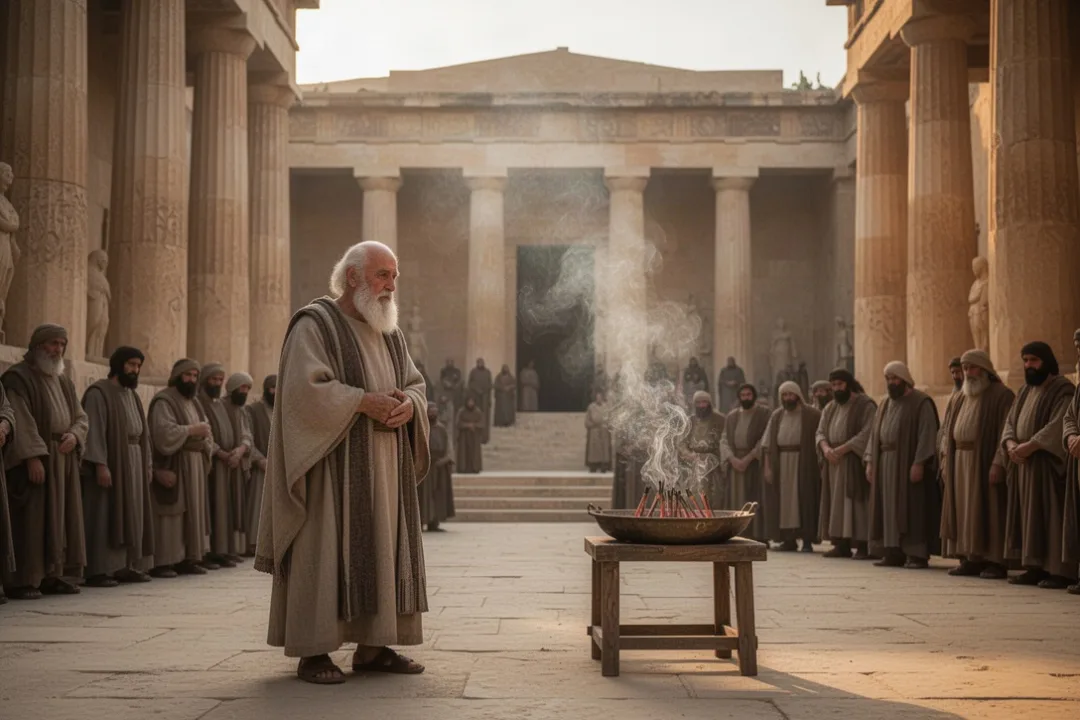
Zechariah serves in the temple. He is chosen to enter the sanctuary and burn incense while the people pray outside.
Gabriel announces a son. The angel tells Zechariah that Elizabeth will have a child and that the child will be named John.
The angel describes John’s mission. John will bring joy, turn people back to God, and go before the Lord in the spirit and power associated with Elijah.
Zechariah responds with doubt. Because he and Elizabeth are old, he asks how he can know that the promise will happen.
Zechariah becomes unable to speak. Gabriel gives him this sign because he did not believe the announcement at first.
Elizabeth conceives. She withdraws for a time and recognizes God’s kindness in removing her disgrace among her people.
Mary visits Elizabeth. During the visit, Elizabeth’s unborn child responds with joy, and Elizabeth recognizes the significance of Mary’s pregnancy.
John is born and named. At his circumcision, relatives expect him to receive a family name, but Elizabeth insists that he will be called John.
Zechariah confirms the name. He writes that the child’s name is John, and his speech returns.
Zechariah praises God and prophesies. His song explains John’s role in God’s unfolding work and celebrates the salvation that is drawing near.
Why Gabriel’s announcement matters
Gabriel’s message in Luke 1:11–20 gives more than the news that Elizabeth will have a baby. It identifies the child’s character, calling, and place in God’s plan. John will be set apart for God, and his life will be marked by unusual spiritual purpose from before his birth.
The announcement says that John will bring joy to many people. His ministry will also involve a strong call to repentance. John’s work will turn people toward God, restore broken relationships, and prepare a people who are ready for the Lord. These descriptions show that biblical preparation is not merely logistical. It means changing direction, rejecting sin, and becoming spiritually ready to receive God’s salvation.
Gabriel also connects John with Elijah. This does not mean that John is literally Elijah returned from the dead. Rather, John will minister with a comparable prophetic authority and purpose. He will confront spiritual rebellion, call people back to covenant faithfulness, and announce that God is acting decisively.
The angel’s words draw on the final prophetic promise in Malachi 4:5–6. Malachi speaks of Elijah’s coming before the great day of the Lord and describes a ministry that turns hearts toward one another. Luke presents John as the one who fulfills that expectation in preparation for Jesus.
Why John was given his name
The angel specifically commands that the child be named John. The name is significant because it means that the Lord is gracious. Luke does not treat the naming as a minor family decision. The name comes from God’s message and confirms that John’s life is defined by divine purpose rather than ordinary family custom.
When the child is eight days old, relatives and neighbors assume he will be named after his father, Zechariah. Naming a son after a family member would have been a reasonable expectation. Elizabeth rejects that assumption, and Zechariah confirms her words in writing because he still cannot speak.
Once Zechariah writes, “His name is John,” his ability to speak returns. The sequence links obedience, naming, and restored speech. Zechariah’s silence began when he questioned the angel’s promise; his speech returns when he publicly accepts the name God has given the child.
The scene also shows that John does not belong only to his parents. His identity is received from God. His name and mission have already been established before the family and neighbors begin making plans for him.
Zechariah’s silence and restored speech
Zechariah’s response to Gabriel is understandable from a human perspective. He and Elizabeth are old, and the promise seems impossible. Yet Gabriel makes clear that Zechariah’s question is not simply a request for information. His hesitation reveals a failure to trust the divine message.
As a sign, Zechariah is unable to speak until the promise is fulfilled. Luke also indicates that he cannot hear normally, since the people communicate with him through gestures. His silence becomes a visible reminder that God’s word does not depend on human confidence or human ability to explain it.
When Zechariah’s speech returns, his first extended words are words of praise and prophecy. He does not begin by complaining about the months of silence. Instead, he blesses God for visiting and redeeming his people. His restored voice becomes an instrument of worship.
This movement from silence to praise is one of the story’s major patterns. God’s promise creates a period of waiting, but the waiting ends in testimony. Zechariah’s experience teaches that doubt may interrupt a person’s participation in God’s work, while fulfilled grace produces a public confession of faith.
Elizabeth’s role in the story
Elizabeth is essential to Luke’s account. She is not merely mentioned as John’s mother. Luke describes her as righteous, and her personal experience gives the story emotional and theological depth.
Before her pregnancy, Elizabeth carried the pain of childlessness in a culture where fertility was often associated with honor, family continuity, and divine favor. Luke does not say that her childlessness resulted from personal sin. Instead, he presents her and Zechariah as faithful people living with an unexplained hardship.
After conceiving, Elizabeth spends five months in seclusion. She recognizes that God has acted graciously toward her and relieved her public shame. Her response is personal, but it also prepares for the larger encounter with Mary.
When Mary arrives, Elizabeth becomes the first person in Luke’s Gospel to recognize the significance of Mary’s unborn child. Elizabeth’s own unborn son responds, and she speaks of Mary as the mother of her Lord. Her words show spiritual insight before Jesus is born and before most people understand who he is.
Elizabeth also models humble joy. She does not compete with Mary, even though she is older and is carrying the child whose birth Gabriel announced first. Instead, she honors Mary and recognizes that God is doing something greater than either woman’s individual experience.
Mary’s visit and the connection between the two births
The birth of John is closely connected with the birth of Jesus. In Luke’s sequence, Gabriel announces John’s conception first and then announces Jesus’ conception to Mary. Mary visits Elizabeth during her pregnancy, creating a meeting between the two families before either child is born.
John’s response in the womb symbolizes his future role. He reacts to the presence of Jesus with joy, just as his later ministry will direct people toward Jesus. Luke is making the relationship clear from the beginning: John recognizes and welcomes the one he is sent to announce.
Mary’s song, often called the Magnificat, follows this meeting in Luke 1:46–55. It praises God for showing mercy, lifting the humble, and remembering his covenant promises. The song does not focus on personal achievement. It interprets both pregnancies as part of God’s faithfulness to Israel.
John’s story therefore cannot be separated from Jesus’ story. John is important because of his own calling, but his calling is preparatory. The two births reveal different aspects of the same divine plan: John will prepare the way, and Jesus will bring the salvation John announces.
What Zechariah’s prophecy says about John
After John’s birth, Zechariah speaks a prophecy recorded in Luke 1:67–79. The first part praises God for remembering his covenant and raising up salvation for his people. The prophecy then turns specifically to the child.
Zechariah calls John a prophet of the Most High. John will go before the Lord to prepare his ways. He will give people knowledge of salvation through the forgiveness of sins, made possible by God’s compassion.
This description explains the heart of John’s ministry. John does not save people through his own power. He prepares them to receive salvation by confronting sin and announcing God’s mercy. His message will later take practical form in his preaching at the Jordan River, where he calls people to repentance and baptism.
Zechariah also describes the coming salvation with images of light. People living in darkness and the shadow of death will be visited by God’s dawn. The imagery points to hope, guidance, and the end of alienation from God.
John’s role is to prepare people to recognize God’s salvation through repentance and forgiveness.
The prophecy ends by describing John’s growth and future life in the wilderness. Luke moves quickly from the infant’s birth to the adult prophet’s setting, showing that John’s early life is oriented toward the ministry he will later undertake.
How John’s birth fulfills earlier biblical patterns
Luke uses familiar biblical patterns while presenting John as a unique prophet. His birth follows the pattern of an unexpected child born to a woman who had been unable to conceive. This pattern connects John with God’s earlier acts of faithfulness in Israel’s history.
The story also resembles accounts in which an angel announces a child’s birth and explains the child’s future mission. The announcement to Zechariah contains details about John’s conduct, spiritual dedication, and public work. John is not simply blessed after birth; he is consecrated for a particular role.
His connection with Elijah is especially important. Elijah was known for confronting idolatry and calling Israel back to worship of the true God. John’s ministry will similarly challenge religious complacency and prepare people for a decisive act of God.
John also resembles the prophetic servants described in Isaiah 40:3. The passage speaks of a voice calling in the wilderness to prepare the way for the Lord. The Gospels apply this image to John’s preaching. His wilderness setting and direct message make him the herald who announces the arrival of the promised king.
These connections show that John’s birth is part of a longer biblical story. Luke is not presenting an isolated miracle. He is showing how God’s promises, prophetic expectations, and covenant purposes converge in the person of John.
What “John the Baptist” means
John is commonly called John the Baptist because baptism becomes the defining public action of his ministry. The title does not mean that baptism was his personal surname. It identifies him as the prophet who baptized people in the Jordan region.
John’s baptism expressed repentance. Those who came to him publicly acknowledged the need to turn away from sin and return to God. His baptism prepared people for the Messiah, but it was not identical to Christian baptism after Jesus’ death and resurrection.
The Gospels show John warning people not to rely on ancestry or religious association. His message applies to everyone: repentance must produce a changed life. He speaks to ordinary people, tax collectors, soldiers, and religious leaders, giving practical guidance about honesty, generosity, and the proper use of authority.
John’s baptism also creates a public community of expectation. People gather at the river because they believe God is calling them to change. The water symbolizes cleansing and a new direction, while John’s preaching explains that genuine repentance must reach conduct and character.
How John’s birth points to Jesus
John’s importance becomes clearest when his ministry is compared with Jesus’ identity. John is a prophet; Jesus is the Messiah. John is the voice; Jesus is the Lord whose way the voice prepares. John baptizes with water, while Jesus brings the fuller work of the Holy Spirit.
John understands this distinction. In the Gospel accounts, he refuses to accept honors that belong to Jesus. He identifies himself as the one crying out in the wilderness and directs his followers toward Jesus instead of building a permanent following around himself.
Luke establishes this relationship before either child is born. John’s conception is announced first, but Jesus’ conception is presented as the greater miracle and the greater mission. John’s birth brings joy and signals the nearness of salvation; Jesus’ birth brings the Savior into the world.
The contrast protects readers from misunderstanding John. He is not an alternative messiah or an independent religious founder. His authority is real, his message is urgent, and his character is remarkable, but his purpose is to point away from himself.
Read the story as a pointer: every major feature of John’s birth—his name, prophetic calling, connection with Elijah, and ministry of preparation—directs attention toward Jesus.
Important themes in the birth of John the Baptist
God works through long periods of waiting
Zechariah and Elizabeth have waited for a child for many years. Their story does not suggest that every delayed hope will be fulfilled in the same way. It does show that delay does not mean God has forgotten a person or abandoned his purposes.
Luke also places the event within Israel’s long wait for prophetic renewal. John appears after a period in which the people are longing for God to act. His birth signals that the waiting is reaching a turning point.
Faithfulness matters even when circumstances remain painful
Zechariah and Elizabeth are described as faithful before the birth of their son. Their righteousness is not presented as a reward they earned by having a child. They remain committed to God while living with disappointment and social pressure.
This detail gives the story a careful balance. John’s birth is a gift, but the parents’ worth did not begin when the gift arrived. Their faithfulness existed before the miracle and is part of why Luke introduces them with respect.
God gives people roles that exceed their family expectations
The relatives expect John to receive his father’s name, but God has assigned him a different identity and mission. His future will not be defined by ordinary family tradition, priestly inheritance, or social expectations.
John will belong to God in a distinctive way. His unusual clothing, diet, location, and preaching will later mark him as a prophetic figure. The naming scene anticipates that separation from ordinary expectations.
Repentance prepares people to receive grace
John’s message is not repentance as empty self-punishment. He calls people to turn back to God because forgiveness and salvation are approaching. Repentance clears away false confidence and makes people ready to welcome the Messiah.
His preaching also shows that repentance should become visible. People must deal honestly with money, power, relationships, and responsibility. John’s message is spiritual, but it is never detached from everyday behavior.
Joy can accompany serious spiritual change
The story repeatedly uses the language of joy. John will bring joy to his parents and many others, the unborn child responds with joy in Elizabeth’s presence, and heaven’s salvation produces praise. Yet the story also includes repentance, silence, hardship, and sacrifice.
Biblical joy is therefore not the denial of difficulty. It is the glad response to God’s faithfulness and approaching salvation. John’s birth shows that serious preparation for God can be marked by hope rather than fear.
Where to read the full account
The most complete passage is Luke 1:5–80. Reading the entire chapter shows how John’s story is deliberately paired with the announcement of Jesus’ birth. Several other passages add details about John’s ministry and identity.
Luke 1:5–25: Gabriel announces John’s birth to Zechariah.
Luke 1:39–45: Elizabeth welcomes Mary and recognizes the significance of her pregnancy.
Luke 1:57–80: John is born, named, and connected with prophetic ministry.
Matthew 3:1–12: John preaches repentance and prepares people for the coming Messiah.
Mark 1:1–8: John appears as the wilderness messenger who announces Jesus.
John 1:19–34: John explains that he is not the Messiah and bears witness to Jesus.
These passages should be read together carefully. Luke emphasizes John’s birth and divine calling, while the other Gospels focus more on his preaching, baptism, and testimony about Jesus.
Questions the story invites you to consider
John’s birth raises more than historical questions. It asks what it means to wait faithfully, how people respond when God’s promise seems impossible, and whether religious expectation has produced genuine repentance.
It also challenges the desire for recognition. John receives an important calling, but his success is measured by how clearly he directs attention to Jesus. His ministry becomes a model of service that does not confuse influence with importance.
The story invites reflection on the difference between religious heritage and personal faithfulness. John comes from a priestly family, but his mission requires a distinct response to God. His relatives know family customs, yet they do not understand the name God has chosen until Zechariah confirms it.
Finally, John’s birth shows that God’s work often begins quietly. The public ministry of repentance at the Jordan comes later. First there is an aging couple, a temple service, an angelic announcement, a silent father, a grateful mother, and a child whose name reveals grace. The large movement of salvation begins in these personal acts of faith and obedience.
Why the birth of John the Baptist still matters
John’s birth matters because it announces a change in the biblical story. The prophetic voice is returning, the promised Messiah is near, and God’s mercy is about to be revealed in a new way.
It also gives a clear picture of faithful preparation. To prepare for Jesus means more than waiting for an event or knowing religious information. It means turning toward God, receiving forgiveness, practicing integrity, and allowing pride to be challenged.
John’s life remains significant precisely because it points beyond John. His birth celebrates God’s grace to Elizabeth and Zechariah, fulfills the expectation of a prophetic forerunner, and prepares the way for Jesus’ saving work. The child whose name means that the Lord is gracious becomes the voice announcing that grace has drawn near.
Frequently asked questions
Was John the Baptist related to Jesus?
Yes. Luke presents Elizabeth, John’s mother, as a relative of Mary, Jesus’ mother. The exact degree of their relationship is not specified, so it is best to describe John and Jesus as relatives rather than assign a precise cousin relationship. Their families meet during Mary’s pregnancy, before either child is born.
How old were Zechariah and Elizabeth when John was born?
Luke says they were advanced in age but does not give exact numbers. Their age is central to the miracle because Elizabeth had been unable to conceive, and both parents were beyond the usual childbearing years. Any specific ages sometimes associated with them come from later traditions, not the biblical account.
Why did John live in the wilderness?
The wilderness fit John’s prophetic calling and connected his ministry with biblical expectations about preparing the Lord’s way. It also separated him from ordinary social and religious routines, giving his preaching a distinctive setting. From there, he called people to repentance and baptized those who responded.
Did John know that Jesus was the Messiah from birth?
Luke shows that John’s unborn response and Elizabeth’s words connect him with Jesus before birth, but it does not describe John’s personal understanding at that stage. During his adult ministry, John clearly identifies Jesus as the one greater than himself and directs people to follow Jesus.









Leave a Reply