The event commonly known as the Feeding of the Five Thousand stands as one of the most famous occurrences in the Gospels. It is often described as the miracle of the loaves and fishes, a concise narrative that blends acts of compassion with demonstrations of divine provision. Across the four canonical Gospels, this miracle not only feeds a vast crowd but also reveals key aspects of Jesus’ identity, mission, and the faith required of his followers. In many ways, this story serves as a window into how early Christians understood Jesus as a teacher, a healer, and a messianic figure whose power is exercised in the service of human need.
Exploring the Feeding of the five thousand invites readers to consider how the miracle is framed by its context—historical, cultural, and theological—and how its lessons might translate into contemporary faith, community life, and ethical imagination. This article surveys the biblical text, considers its settings, examines its interpretive layers, and draws out practical implications for today’s readers.
Scriptural Accounts: The Four Versions
The story appears in all four Gospels, though each author highlights slightly different angles and details. Collectively, the accounts share core elements: a large crowd, a compassionate intervention by Jesus, a small supply of sustenance, a method of distribution through the apostles, and a remarkable outcome with leftovers. The variations in wording and emphasis invite readers to notice both continuity and distinct emphases in each Gospel.
Matthew’s account presents the miracle as a sign amid Jesus’ ministry in a desolate place by the Sea of Galilee. The crowd is described as “five thousand men, besides women and children,” a formulation that underscores the magnitude while acknowledging the social reality of families. After blessing the food, Jesus calls the disciples to distribute through them, and the gathering is satisfied with leftovers—“twelve baskets full.”
Mark’s version emphasizes the movement of the crowd and the personal concern of Jesus for their physical needs. The narrative notes that the disciples gather the leftovers, and, like Matthew, they collect a full set of baskets. Mark’s pacing stresses the immediacy of Jesus’ response and the dramatic abundance that follows.
Luke’s telling centers on the generosity of Jesus and the role of the disciples in service. Luke adds a sense of mission, linking the miracle to the larger motif of compassion for the vulnerable and the responsibility of the disciples to participate in generous distribution. The text again records that the crowd is fed, with twelve baskets left over.
John’s account places the feeding within a distinctive theological frame, moving toward a discourse about bread that would culminate in the later “Bread of Life” teaching. John emphasizes the crowd’s response and the sign-like nature of the event, setting the stage for Jesus to interpret himself as the true nourishment that sustains eternal life.
The Setting and Context: Where and When
The setting of the Feeding of the Five Thousand is tied to a late-visit moment in Jesus’ itinerant ministry around the Sea of Galilee. In the Gospels, the scene often unfolds after a period of teaching and healing, sometimes following a request for rest or retreat. The crowd’s proximity to the shore, the open landscape, and the rural backdrop underscore both the immediacy of a real hunger and the accessibility of Jesus’ message to all who seek him.
Historically and culturally, first-century Galilee was a region where many families faced food insecurity and daily dependence on providence and communal networks. In this light, the report of a miraculous feeding speaks not only to spiritual hunger but to an acute awareness of physical need. The narrative’s texture invites readers to notice the intersection of faith, community, and sustenance in a world where scarcity often dominates daily life.
The Details: Five Loaves, Two Fish, and the Distribution
The core detail—“five loaves and two fish” in many gospel accounts—has generated extensive reflection among scholars, interpreters, and faithful readers. The image of small provisions being multiplied to meet a large need resonates with human experiences of generosity and partnership.
Five loaves and two fish are not merely numbers; they symbolize the modest resources available to Jesus’ followers. In each Gospel, these elements are blessed, broken, and distributed, a sequence that invites comparison with ritual meals and with the sharing of a communal table.
The method of distribution is carried out by the disciples, who place the food into hands that minister to the crowd. This dynamic highlights the collaborative nature of service in the Jesus movement: leadership coordinates, while compassionate action serves.
The result—everyone eating and being satisfied—emphasizes not only the generosity of God but the sufficiency of Christ to meet human need. The leftovers, often counted as twelve baskets, signal abundance and the sufficiency that remains after true nourishment has occurred.
The Subtext: Theological and Symbolic Meanings
Beyond its historical immediacy, the miracle of multiplying loaves and fishes is rich with symbolic meaning. The narrative layers invite readers to listen for theological signals about who Jesus is, what his mission entails, and how his followers are to respond to human need.
The Bread Imagery and the Image of Jesus
One of the most enduring strands in the interpretation of this event is its bread imagery and the way it foreshadows Jesus’ self-identification as the Bread of Life in subsequent teachings. The confluence of bread, blessing, breaking, and distribution points readers toward a deeper claim: Jesus is the sustenance that satisfies more than hunger—he offers spiritual nourishment and eternal life.
The role of the disciples in the feeding underscores a recurring theme: human insufficiency paired with divine sufficiency. The disciples must bring what little they have—then participate in the act of distributing to the crowd. The narrative invites readers to consider how communities today can transform small resources into generosity that touches many lives, especially when leadership and lay participation work in harmony.
Messianic Expectation and Social Significance
The feeding episode sits within a wider matrix of messianic expectation in the synoptic gospels. The crowd’s reaction—seeing Jesus as a potential king or as a prophetic sign—reflects an earnest longing for a tangible, liberating intervention. Yet the miracle’s deeper message transcends political deliverance; it communicates a vision of God’s kingdom where provision, mercy, and peace are extended to all.
Historical-Critical Perspectives
Scholars approach the Feeding of the Five Thousand from various angles, balancing faith-based interpretation with historical-critical methods. While many readers affirm the event as a remarkable sign in Jesus’ ministry, others analyze the narrative for its literary design, its place within the Gospel’s larger structure, and the potential influence of oral tradition.
Miracle or sign: The accounts often present the event as a sign pointing beyond itself to Jesus’ identity and mission. In this view, the miracle functions as a narrative instrument that teaches about Jesus’ compassion, authority, and the divine presence at work in a broken world.
Historical plausibility: Some scholars weigh the plausibility of a large, impromptu crowd and a sudden provisioning. While naturalistic readings may seek alternative explanations, many agree that the core event—Jesus feeding a crowd through communal participation—reflects an ancient moment of trust in God’s provision.
Literary craftsmanship: The repetition of the feeding motif across Matthew, Mark, Luke, and John is often read as a deliberate literary device that invites readers to compare perspectives and to glean multiple theological layers from a single moment.
Connections to Later Teachings and Tradition
The miracle of the loaves and fishes has a rich legacy in Christian thought, liturgy, and practice. It intersects with later Jesus teachings and with the community’s response to the needs of others.
Eucharistic echoes: The blessing, breaking, and sharing of bread in the Feeding of the Five Thousand has long been viewed as a precursor to the Eucharist or Lord’s Supper in Christian tradition. The motif of bread as a divine gift and as a sign of fellowship invites continuous reflection on how Christians remember and participate in God’s grace.
The Bread of Life discourse: In John’s Gospel, the feeding sets the stage for the later “Bread of Life” statements, connecting the miracle with Jesus’ more extended teaching about nourishment that endures beyond physical hunger.
Missional implications: The story has inspired countless acts of communal care, food distribution, and social solidarity. Churches, humanitarian groups, and mission initiatives frequently cite this miracle as a compelling example of how generous provision should flow through the hands of the faithful to meet tangible need.
Legacy and Cultural Impact
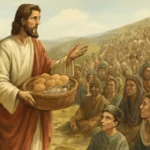
Across centuries, the the feeding narrative has influenced art, music, and literature. Visual depictions often emphasize the moment of distribution—the crowd gathered, the line of baskets, the expressions of astonishment and gratitude. In literature, the event is used to explore themes of insufficiency, faith, and communal transformation. In modern contexts, the miracle continues to be invoked in discussions about hunger, charity, and the responsibilities of communities to care for the vulnerable.
Reading the Feeding of the Five Thousand in a contemporary light yields several actionable takeaways for individuals, families, and communities.
Compassion in action: The narrative centers on Jesus’ response to human need. The primary lesson is that compassion should move from feeling to action, turning concern into tangible support for those who are hungry or marginalized.
Worldly scarcity and spiritual abundance: The story reframes scarcity as a situation in which generosity unlocks abundance. When people share what they have, even small resources can become a source of nourishment for many.
Collaboration and leadership: The disciples’ role highlights how leadership and service function together. Modern communities can apply this model by fostering teamwork, empowering volunteers, and coordinating efforts to meet needs efficiently.
Hospitality as hospitality to all: The inclusion of people from diverse backgrounds—families, travelers, and locals—emphasizes hospitality. In practice, this invites inclusive ministries that welcome the vulnerable and seek to meet their needs with dignity.
Humility and trust: The miracle occurs when human plans are complemented by trust in a larger purpose. Believers are encouraged to bring what they have, entrust it to God, and participate in the work of blessing and feeding others.
The Feeding of the Five Thousand remains a foundational story not because of its numerical miracle alone, but because of what it communicates about God’s care for creation, the role of human agents in service, and the meaning of abundance in a world of need. Across the five thousand fed and counted in the biblical text, there is a universal resonance: when communities gather, share, and coordinate, scarcity can be transformed into sustenance. When readers contemplate the bread and fish narrative, they are invited to reflect on how their own resources—whether measureable or spiritual—can be blessed, multiplied, and made available for others.
In the end, the miracle of the loaves and fishes is not only about an event in a remote landscape but about a kind of invitation—an invitation to trust in a God who cares for both body and soul, an invitation to participate with others in acts of generous provision, and an invitation to see Jesus as the Bread of Life whose nourishment transcends time and circumstance. As a result, the story endures as a lens through which readers today can examine faith, community, and the ongoing work of compassion in the world.








Leave a Reply